Tia News
Is a hybrid of self-paced practice and tutoring cheaper?
Hybrid tutoring vs full-time tutoring cost: compare total spending, parent workload, and learning support before replacing tutor sessions with self-paced practice.
By Tia Education Team · Published

A hybrid of self-paced practice and tutoring is cheaper only when the tutor sessions you remove cost more than the practice resource and any extra support you add. If you are paying for help but still sitting beside your student through every assignment, include that parent workload in the decision, not just the tutoring bill.
- Hybrid tutoring vs full-time tutoring cost depends on total spending, not the number of tutor sessions alone.
- Keep tutoring for explanations your student needs; use self-paced practice for skills your student can already attempt independently.
- Tia fits families seeking personalized tutoring, curriculum-aligned explanations, and parent learning records.
- A 10-minute daily session is an option when it fits the student, not a promise of results.
Is a hybrid of self-paced practice and tutoring cheaper?
A hybrid plan saves money when the spending it removes exceeds the spending it adds. Compare both arrangements over the same period, for the same subject and learning goal. A smaller tutoring bill does not establish savings if you also add subscriptions, materials, or replacement sessions.
For this 2026 comparison, “full-time tutoring” means tutor-led support throughout the learning work you are comparing. It does not mean a fixed number of hours or a replacement for school. Ask each provider what the arrangement actually includes.
Separate practice from teaching before reducing support. A student who understands an explanation but needs repetition has a different need from a student who cannot start the task. The distinction is central to how adaptive tutoring changes a lesson.
| Arrangement | Best for | Main advantage | Main limitation | What to compare |
|---|---|---|---|---|
| Self-paced practice | Students who can attempt the skill independently | You can reserve tutor-led time for other needs | Practice alone does not establish that a student understands the method | Resource spending and help needed when stuck |
| Hybrid practice and tutoring | Students who can practice some skills independently but need explanations for others | You can assign different jobs to practice and tutoring | You must coordinate the work and check that support gaps do not grow | Practice resources plus retained tutor sessions |
| Tutor-led support throughout | Students who need guidance across the work being compared | You can arrange explanations and feedback throughout that work | You are purchasing guided support even for tasks the student can attempt alone | The full arrangement, including what happens between sessions |
These are decision categories, not claims that one arrangement produces better outcomes. Choose based on the work your student can do and the support your student still needs.
Why this matters
You do not need to choose between doing everything yourself and handing over every lesson. You need a clear division of responsibility. The student does the learning, the tutor addresses teaching needs, and you decide whether the arrangement fits your family.
For your 2026 budget, distinguish a lower bill from a better fit. Removing useful explanations while keeping repetitive exercises changes the support your student receives. Keep the explanation available until the student can attempt the next task without you taking over.
How do you compare the total cost without missing anything?
Use your current invoices and the provider's current terms. Do not compare a recurring subscription with a single tutor session and treat them as equivalent. Both totals must cover the same learning period.
- Define the goal. Name the subject and skill, such as explaining a math method or organizing an English paragraph. Avoid a broad goal like “get better at school.”
- Record current support. List tutor sessions, practice resources, and materials you use for that goal. Separate existing purchases from new purchases.
- Identify removed support. Specify which sessions or resources the hybrid arrangement would replace. A resource added alongside everything else is an additional purchase, not a saving.
- Add replacement spending. Include the practice resource, retained tutoring, and any extra help you plan to purchase. Check the current terms for charges that apply to your arrangement.
- Compare learning evidence. Ask the student to attempt a relevant task and explain the method. Review errors as well as completed work.
- Review parent workload. Record whether you are arranging lessons, finding explanations, or correcting misunderstandings. Decide how much of that work you can take on.
The financial test is simple: compare the current total with the proposed total. The practical test is separate: decide whether the proposed arrangement supplies the help your student needs.
Do not call a plan cheaper until you have counted both the support you removed and the support you added.
When does self-paced practice fit the job?
Self-paced practice fits work the student can attempt with a method they understand. Ask the student to explain why an answer works, not just whether it matches an answer key. If the explanation is missing, keep teaching in the plan.
Consider math facts. Brief games can give a student opportunities to practice recall without turning every attempt into a tutor-led lesson. That is a practice choice, not evidence that explanations are unnecessary elsewhere in math.
For a 2026 routine, as little as 10 minutes a day is an option when it fits the student. It is not a minimum, a required schedule, or a promise of a fixed result. Choose the task first and adjust the length to the student's engagement.
Best for: a student who understands the task and can begin independently. Limitation: a completed practice set does not tell you whether the student can explain or apply the method elsewhere.
When should tutor-led support stay in the plan?
Keep tutor-led support for the part of the work your student cannot yet attempt independently. That might be understanding a new concept, interpreting a question, or explaining why a method works. Name the obstacle before purchasing more time.
Ask the tutor to address that obstacle directly. “Help with math” leaves the task vague; “help the student explain why these opposite angles match” gives the lesson a clear purpose. Follow with a fresh task that uses the same concept.
Human tutors can personalize teaching. Ask how the tutor changes explanations, checks understanding, and communicates next steps rather than assuming those features from the label “one-on-one.”
Best for: a student who needs guided explanations across the work being compared. Limitation: more guided time is not, by itself, evidence of more understanding. Keep the decision tied to what the student can explain and attempt.
Why hybrid tutoring costs vary
For a 2026 comparison, use factors you can verify in your own plan. Your spending depends on what you purchase and what you replace, not on the word “hybrid.”
- Subject scope: compare support for the same subjects, rather than one subject against a broader arrangement.
- Retained tutoring: identify the sessions you will still purchase after adding independent practice.
- Resource overlap: check whether existing materials already serve the practice job you need.
- Explanation needs: include the help you plan to retain when a student cannot understand a method independently.
- Recordkeeping: decide who will document the work and what records your family needs.
- Parent involvement: separate the provider's responsibilities from the coordination and teaching you will handle.
Do not turn every factor into a dollar estimate. You can compare actual spending while describing parent workload separately. That keeps the budget factual without pretending your time is unlimited.
How do you build a hybrid routine that keeps teaching available?
Start with a skill rather than a collection of resources. Your student should know what the practice is for and where to turn when an explanation stops making sense. You remain in charge of changing the arrangement.
- Choose a skill. Pick work that connects to the student's current curriculum or assignment.
- Check understanding. Ask for an explanation or an independent attempt before deciding that practice alone fits.
- Practice independently. Give the student work that uses the method they can already attempt.
- Gather questions. Have the student identify the confusing step rather than silently repeating it.
- Review support. Use those questions and subsequent attempts to decide what teaching stays in the plan.
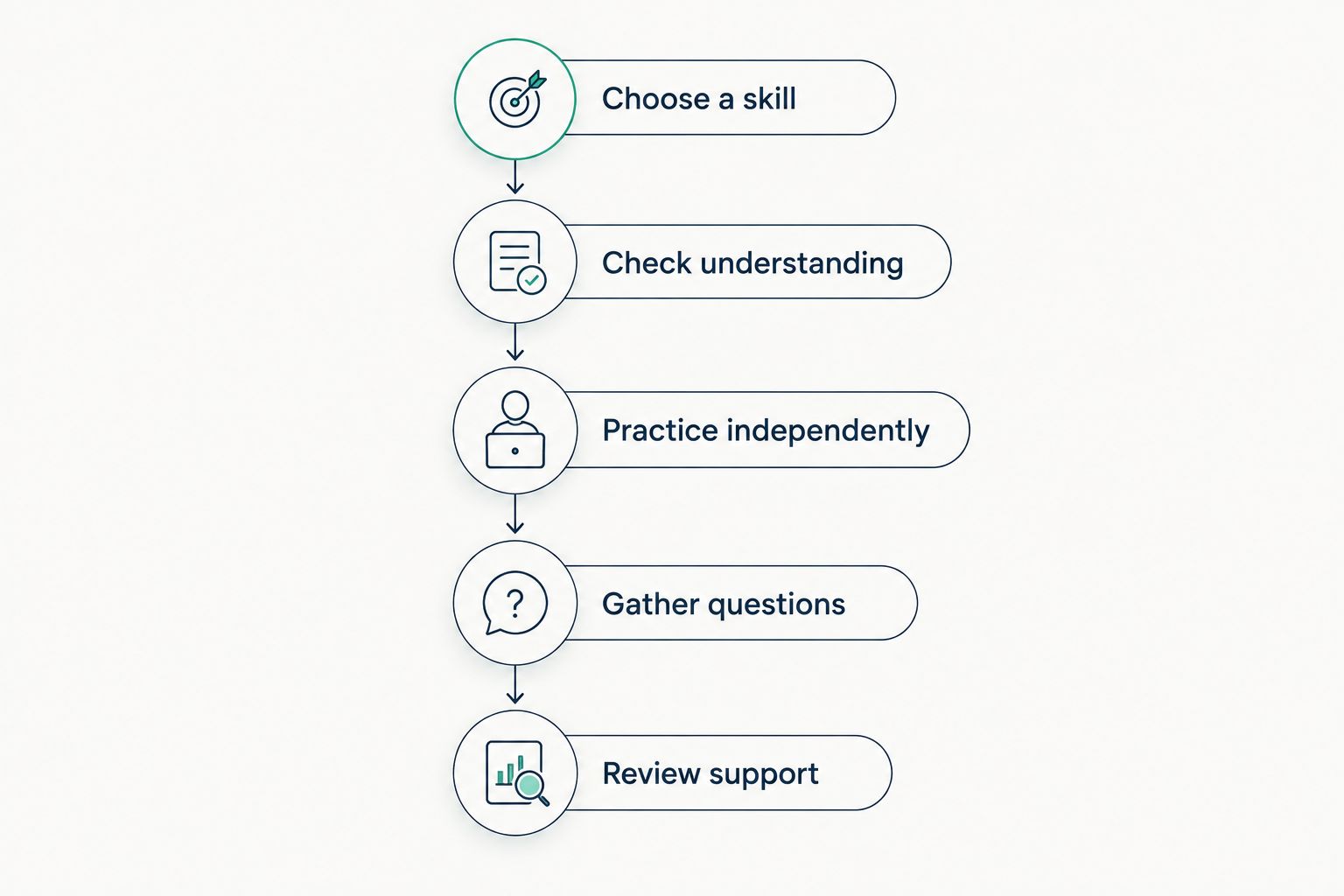
Keep the routine small enough to manage. If you are constantly finding replacement explanations, revisit the division of work. The purpose is to assign support deliberately, not to make you the unpaid tutor for every gap.
How does the comparison change for SAT preparation?
For SAT preparation, define the specific task before comparing arrangements. A student seeking help with a math concept needs a different plan from a student seeking feedback on how they approach reading questions. Keep the comparison tied to that need.
Comparing SAT prep course options requires separating course instruction, independent practice, and individual feedback. Those are different jobs, even when they appear in the same preparation plan. Ask what each arrangement supplies before deciding which part another resource can replace.
For a US student's 2026 plan, ask how the material relates to the SAT work the student is preparing to do. Then identify the work the student can attempt independently and the work that still needs explanation. Do not assume that purchasing a course removes the need for individual help, or that individual help requires replacing every practice resource.
The same budget rule applies: count the support you retain and the purchases you add. There is no automatic saving attached to calling a preparation plan hybrid.
Where does a personalized tutor fit?
Tia is best for families seeking curriculum-aligned personal tutoring with parent learning records. It teaches Math, English, and Science for students in Grades 5 to 12, adapting explanations, pace, level, and examples to the student.
Tia's tutoring also tracks understanding. It uses Bayesian Knowledge Tracing, an established method that updates an estimate of skill mastery from student answers over time. Question-level mastery is mapped to the curriculum and included in the report.
The parent dashboard, engaged-time measurement, and self-writing records give you information to review alongside the student's work. These features help distinguish time spent from the reported estimate of understanding. Neither measure is an independently verified exam-score gain.
Best for: families who want personalized explanations and a parent view of learning. Limitation: a mastery estimate is not an infallible measure of everything a student knows, and homeschool records still need to be checked against local requirements.
Should you replace tutor sessions all at once?
Replace a defined job, not an entire relationship, just because you have found another resource. Decide which work the student can attempt independently. Keep a clear route back to explanations when the work changes.
Before changing the plan, ask the student what currently helps. A familiar tutor's explanations and a practice resource's exercises are not interchangeable simply because both cover the same subject.
Review the next independent attempt. If the student cannot explain the method, restore the teaching needed for that task rather than adding more of the same practice. Your budget decision should follow the learning need, not force it.
FAQ
Is hybrid tutoring always cheaper than tutor-led support throughout?
Hybrid tutoring is cheaper only when the spending it removes exceeds the spending it adds. Compare retained sessions, practice resources, and other purchases over the same period.
Can a 10-minute daily session replace a longer tutoring session?
A 10-minute daily session is an option when it fits the student's task and engagement, not a guaranteed replacement for longer tutoring. Keep explanations available for work the student cannot attempt independently.
How do I know whether my student needs practice or an explanation?
Ask your student to explain the method and attempt a relevant task independently. A correct answer without an explanation is not enough to decide that teaching is no longer needed.
Does Tia track understanding or just tutoring time?
Tia tracks question-level mastery, maps it to the curriculum, and includes it in the report, alongside engaged-time measurement. Its Bayesian Knowledge Tracing method updates an estimate of mastery from student answers over time.
Should I compare subscriptions with individual tutor sessions?
Compare the total arrangement over the same period rather than comparing a subscription with a single session. Include the tutor sessions you retain and the resources you add.
Can I use a hybrid approach for homeschooling?
You can assign independent practice and tutoring different jobs within your homeschool plan. Keep curriculum choices, learning checks, and local reporting requirements under your direction.
Does a lower tutoring bill prove the hybrid plan is working?
A lower tutoring bill proves only that you spent less on tutoring. Check total spending, parent workload, and what the student can explain and attempt before judging the arrangement.
One last thing
Before canceling a tutor session, write down its job. If the job is “repeat work the student understands,” consider assigning that practice elsewhere. If the job is “make the explanation understandable,” keep teaching in the plan.
Replace a job you no longer need, not support your student still uses. That is the clearest starting point for a cost comparison.
Related guides
- What parents should see in a tutoring dashboard
- How to make a 10-minute daily tutoring session count
- How to keep homeschool records without a last-minute scramble
- How to choose a homeschool curriculum without buying everything
Tia Education Team