Tia News
How to make a 10-minute daily tutoring session count
Make 10 minute daily tutoring sessions count with one clear goal, student-led practice, and an independent check. Build a routine that fits your student.
By Tia Education Team · Published

You have a busy day ahead, and your student has one concept that still feels confusing. Make 10 minute daily tutoring sessions count by choosing one small learning goal, letting the student do the thinking, and checking what they can explain without help. Ten minutes is a useful starting point when it fits your student, not a promise of a particular result or a deadline for understanding.
- Make 10 minute daily tutoring sessions about one skill, not finishing an entire assignment.
- Tia personal tutoring fits families seeking adaptive Math, English, and Science teaching with parent visibility.
- Use an independent explanation or attempt to check understanding before choosing the next lesson.
- Keep short tutoring sessions flexible; extend, simplify, or pause when the student needs a different approach.
Why this matters
A student can finish a worksheet with plenty of help and still feel unsure about the method. Your short session needs a clearer target than getting through the page. Look for something the student can do or explain with less support.
For your 2026 learning routine, treat the timer as a planning tool rather than a score. You stay responsible for the schedule, while your student stays responsible for the thinking. If the explanation is not landing, change the teaching approach instead of repeating it louder or faster.
See how adaptive tutoring changes a lesson for more on adjusting teaching to the student rather than simply continuing through material.
How do you make a 10-minute daily tutoring session count?
Choose one skill, practice it with support, then check it without supplying the answer. Prepare the task before the session so your student does not spend the learning window searching for materials or deciding where to begin.
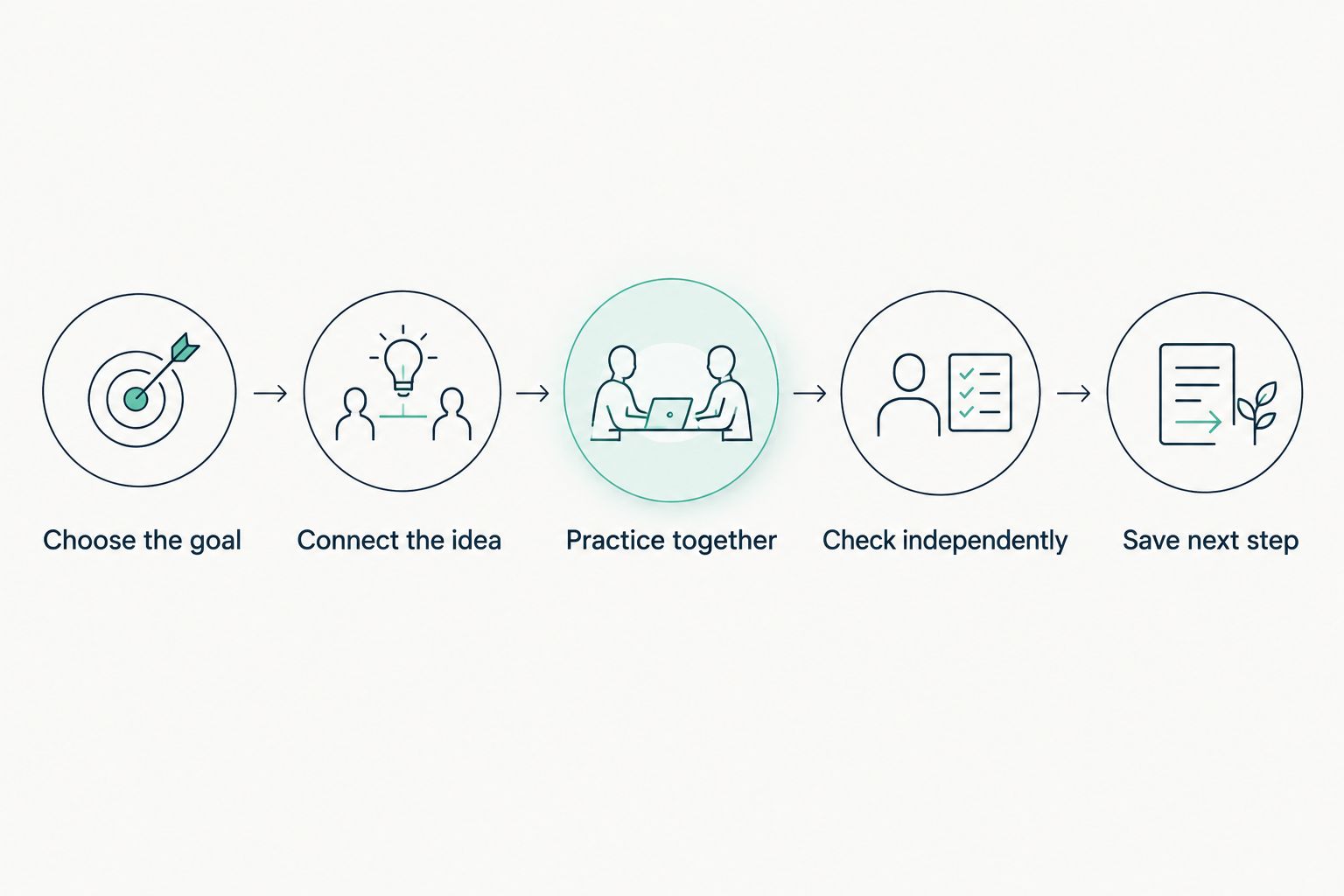
Use the following sequence as a flexible guide. Do not divide the session into rigid timed segments. Some days, finding the confusing step is the useful work.
1. Choose the goal
Make the goal small enough to describe in a short sentence. Replace a broad instruction such as working on fractions with a specific task, such as explaining why equal-sized pieces matter when comparing fractions.
Ask your student what feels unclear. If they cannot name it, start with a recent example and ask them to show where they stopped understanding. You are choosing an entry point, not asking them to diagnose every learning gap.
2. Connect the idea
Use something familiar to introduce the skill. A student interested in sports can discuss a percentage through a game statistic. A student interested in stories can practice punctuation using a sentence they want to write.
Keep the curriculum skill unchanged. The interest supplies the setting, not a replacement for the learning goal. If the example adds unfamiliar vocabulary or extra calculations, simplify it.
3. Practice together
Work through an example while the student explains their choices. Ask what they would try next before showing the next step. Leave room for an answer instead of filling every pause.
When an error appears, identify the specific decision that needs attention. Was the problem choosing a method, understanding a word, or carrying out the calculation? Address that decision before adding more practice.
4. Check independently
Offer a fresh example that uses the same skill, or ask the student to explain the idea in their own words. Keep the task within what you just taught. This is a check, not a surprise test.
Notice how much prompting the student needs. If you supply every step, record the skill as still needing support. A correct answer with a clear explanation gives you better information than a correct answer produced through hints.
5. Save the next step
End with a brief note about what happened and where to begin next time. Write the skill, the support needed, and the next task. Avoid vague entries such as doing well or needs more practice.
For your 2026 records, a useful note might say that the student compared fractions using a drawing but still needed help explaining the symbols. The next session can begin with that connection rather than restarting the whole topic.
What fits into 10 minutes in Math, English, or Science?
Choose a task with a clear stopping point. A complete essay, a full lab report, or a broad exam review is too large for the session described here. Select a part that your student can work on meaningfully without rushing.
These examples are planning options, not claims about what every student will finish. Match the difficulty to the student's current understanding.
| Subject | Best for | A focused task | Useful feature | Limitation |
|---|---|---|---|---|
| Math | Practicing a specific method | Explain a fraction comparison, then try another | Makes the student's reasoning visible | A missing prerequisite needs attention before more examples |
| English | Revising a specific writing choice | Improve a topic sentence and explain the change | Keeps feedback tied to an actual sentence | Does not replace planning and revising a whole essay |
| Science | Clarifying a specific concept | Explain a process using a simple diagram | Connects vocabulary with an explanation | Does not replace experiments or extended investigation |
Math: explain the method, not just the answer
For Math, choose a skill that appears in the student's current work. Ask the student to show the method with a drawing, objects, words, or symbols. Then connect that representation to the notation used in their course.
For example, a chocolate bar divided into eighths gives you something concrete to discuss before writing a fraction. Let the student explain what the denominator represents. Do not turn the activity into a race to finish calculations.
English: improve one writing decision
For English, work on a sentence, a short passage, or a specific revision. Ask the student what they want the reader to understand. Then choose the writing decision that supports that purpose.
If the goal is a clearer topic sentence, stay with that goal. Correcting every spelling and punctuation issue at the same time changes the task. Save unrelated feedback for another session.
Science: check the explanation
For Science, ask the student to explain a relationship or process rather than recite a term alone. A sketch, a spoken explanation, or a comparison gives you a way to discuss what the student understands.
Keep the prompt specific. Explaining how a particular diagram represents a process is more manageable than reviewing an entire chapter. If the explanation reveals a vocabulary gap, make that term the next teaching target.
Why the right tutoring session length varies
Ten minutes is a starting format, not a universal attention limit. For your 2026 plan, use the student's work and responses to decide whether to keep that format or change it.
- Current understanding: A familiar skill allows focused practice. A missing foundation calls for teaching before repetition.
- Task size: A sentence revision has a different scope from an essay. A concept check has a different scope from an experiment.
- Teaching approach: An explanation that does not make sense needs a different example, representation, or pace.
- Student readiness: Notice whether your student is ready to think, needs a movement break, or needs to return later.
- Learning purpose: Maintaining a practiced skill is different from introducing an unfamiliar concept or planning a larger project.
Do not keep adding examples merely to fill the timer. If your student explains the skill clearly, choose an appropriate next step or finish. If they remain confused, reduce the task and identify what needs teaching.
What should you do when the session gets stuck?
Change the task before increasing the pressure. Ask your student to point to the confusing part, then check whether the difficulty is the instruction, the example, or the underlying concept.
If the directions are the problem, restate them plainly and ask the student to explain the task back. If the concept is the problem, use a simpler representation. If the student is tired or frustrated, stop treating completion as the immediate goal.
Do not count copied answers as independent practice. Instead, ask the student to explain a single decision they understand. That gives you a useful place to restart without turning the session into a longer struggle.
A missed day does not require a double session as punishment. Return to the saved next step and check what the student remembers. Keep the routine supportive rather than making the schedule another assignment to recover.
Where Tia fits into a short tutoring routine
Tia personal tutoring is best for families seeking adaptive Math, English, and Science teaching with parent visibility. The personal tutor serves students in Grades 5 to 12 and adapts teaching to their pace, level, and interests while staying aligned with their curriculum.
The practical benefit is a teaching approach that responds to the student, rather than asking the parent to supply every explanation. Parents get a live dashboard, engaged-time measurement, and self-writing records. For a 2026 home-learning routine, those features support oversight without making elapsed screen time the only thing you inspect.
The limit remains important: an adaptive tutor does not make every learning goal fit into 10 minutes. You still choose the family routine and check whether the student needs a different task, more time, or support beyond the current lesson. Do not assume a short session replaces all subject instruction or satisfies local homeschool requirements.
Explore Tia if you want personalized tutoring alongside parent-facing records. Use a focused learning goal to judge the fit, not a promise that a particular duration will produce a particular result.
Is 10 minutes of tutoring a day enough?
Ten minutes of tutoring is a workable starting point for a small, focused task when it fits the student. It is not a guarantee of progress, complete curriculum coverage, or enough support for every learning need.
Use the independent check to decide what follows. If the student cannot explain the concept after supported practice, revisit the teaching rather than assuming the schedule itself is sufficient.
Should I tutor every subject every day?
A 10-minute session should have a clear subject and skill, not become a rushed tour through Math, English, and Science. Choose the priority based on current work and what the student needs help understanding.
For homeschool families, place short tutoring within the wider learning plan. Reading together, projects, subject lessons, and other activities still need their own space. You do not need to squeeze all learning into the tutoring window.
How do I know whether short tutoring sessions are helping?
For 10-minute sessions, compare what the student can do independently with what still requires prompts. Keep the skill and level of difficulty similar enough that the comparison tells you something useful.
Look beyond completed tasks. Ask whether the student can explain the method, recognize an error, or use the idea in a fresh example. Review your 2026 learning notes for changes in support needed, not just a growing total of minutes.
FAQ
What's the best way to start 10 minute daily tutoring sessions?
Start 10 minute daily tutoring sessions with a single skill from the student's current work. Prepare an example, ask where the confusion begins, and leave room for an independent check.
Is 10 minutes of tutoring enough to improve grades?
Ten minutes of tutoring does not guarantee a grade improvement. Use the session for a focused learning goal and assess what the student understands without prompting.
Should I use a timer during a short tutoring session?
Use a timer as a planning aid, not as a deadline for understanding. Stop, simplify, or extend the task according to what the student needs.
What should my student do at the end of the session?
Your student should explain the skill or try a fresh example without being given each step. Record the support still needed and the next learning task.
Can Tia support a short daily tutoring routine?
Tia provides personal tutoring in Math, English, and Science for students in Grades 5 to 12, adapting to their pace, level, and interests. Choose a focused goal for a short routine rather than expecting every lesson to fit a fixed duration.
What if my student needs a movement break?
Let your student take a movement break when it helps them return ready to work. Do not prescribe the same interval for every student or treat needing a break as failure.
What should I record after daily tutoring?
Record the skill practiced, what the student did independently, and what still needed support. Time spent is useful context, but it does not by itself show understanding.
One last thing
Before ending, ask your student what they would try first next time. Their answer gives you a starting point and keeps them involved in the learning plan. If they cannot answer yet, save a clear prompt together.
You do not need to become an expert in every subject to support that routine. Choose the goal, protect a manageable space for learning, and notice what your student can now explain. The useful finish is a clear next step, not an empty countdown.
Related guides
- Practice math facts with short games in Grade 5 and up
- Build a homeschool schedule that fits your student
- Keep homeschool records without a last-minute scramble
Tia Education Team