Tia News
How to build a homeschool schedule that fits your student
Build a homeschool schedule around your student's pace in 2026. Use daily anchors, a subject loop, and simple reviews to make the routine work for your family.
By Tia Education Team · Published

Build your homeschool schedule around a few dependable anchors, then place demanding work when your student is ready to learn. Give each subject a clear place without requiring every day to look the same. In 2026, the right schedule is one your student can follow, you can adjust, and your family can sustain.
- A homeschool schedule works best when it follows your student's learning pace, not a copied classroom timetable.
- Use daily anchors for predictability and a loop schedule when subjects need room to move.
- Tia is best for families who want adaptive Math, English, and Science tutoring within a parent-led routine.
- Check completed work and engaged learning before adding more scheduled time.
How do you build a homeschool schedule that fits your student?
Start with what must happen, find your student's workable learning periods, and build subject blocks around both. If you are new to homeschooling, keep the first version simple. A schedule is a plan you revise, not a test you pass. Families considering personalized tutoring for homeschool students can also decide which subjects need direct parent instruction and which would benefit from separate support.
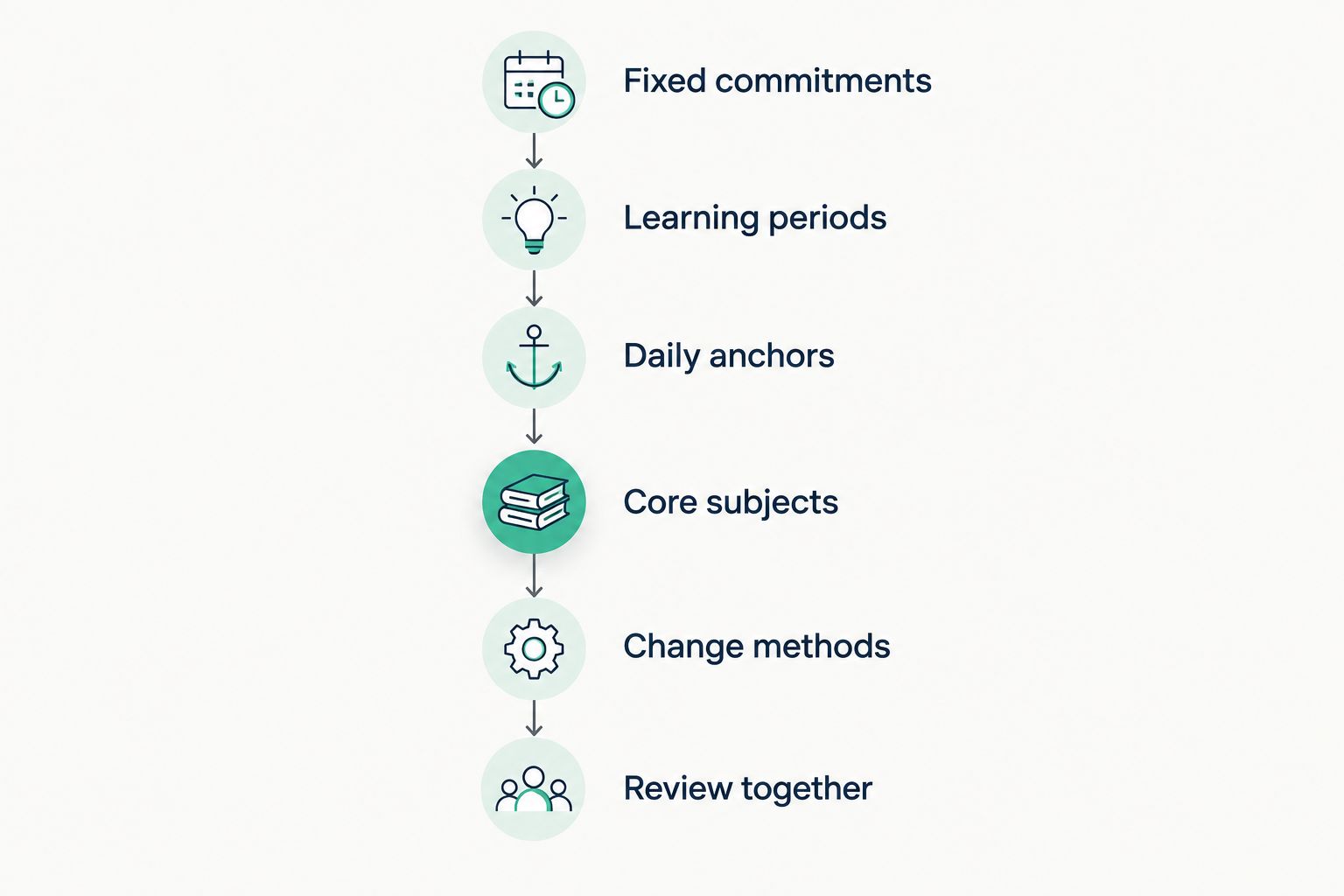
- List your fixed commitments. Write down work hours, appointments, activities, and any requirements that apply where you live. Put these on the calendar before assigning subjects. Keep local recordkeeping rules separate from your preferred daily rhythm; a flexible day does not remove reporting obligations.
- Notice when learning comes more easily. For several ordinary days, observe when your student is willing to begin, able to stay with a task, and ready for a break. Ask your student what feels different about a good learning period. Use those observations instead of assuming that an early start is always better.
- Choose a small set of daily anchors. An anchor is an event you can recognize without watching the clock: breakfast, a shared reading period, lunch, or an afternoon check-in. Put learning between anchors. Your student knows what comes next, while you retain room to respond when a lesson needs longer.
- Give core subjects a place. Decide when Math, English, and Science will be covered across the week. Place a subject that needs sustained attention in a period when your student can engage with it. Not every subject needs an identical block on every day.
- Leave space to change methods. If a lesson is not connecting, try a different explanation, a hands-on model, or a return to the topic later. You can change the teaching method without abandoning the learning goal. Keep the student doing the thinking rather than filling the calendar with more explanation.
- Review the plan with your student. Look at completed work, questions that remain, and how the day felt. Keep what helped. Move or shorten what repeatedly turns into a struggle, then review again after the revised routine has had a fair chance.
For a 2026 homeschool schedule, write these steps on one page before making a detailed timetable. That page gives you something you can use on a difficult day. It also makes a change in plan visible: you can tell whether you moved a subject, changed its method, or dropped it without deciding.
Why this matters
It is hard to tell whether a homeschool day went well when the only measure is how long everyone sat at a table. A student can spend a long period stuck on one concept or finish meaningful work in a shorter one. Plan for the learning that needs to happen, then give it an appropriate place in the day.
A copied school timetable also hides the choices you can make at home. You can read aloud with an older student, pause for movement, or use objects to explain a fraction before returning to symbols. In 2026, your homeschool schedule should make those choices easier, not treat every change as falling behind. Keep any required instruction and records in view while you make them.
What could a flexible homeschool day look like?
Use this as an example of order, not required hours. The sequence matters more than matching someone else's start time. A family might begin with shared reading, move to a demanding Math lesson, take a break, and then work on English or Science. An afternoon can hold a project, independent work, or an activity outside the home.
| Part of the day | Possible focus | What you watch for |
|---|---|---|
| First learning period | Reading together or a familiar task | Can your student settle into the work? |
| Focus period | A subject that needs close attention | Is the explanation making sense? |
| After a break | Practice, writing, or Science | Can your student work with less prompting? |
| Closing check-in | Review work and name a question | What needs attention next time? |
This 2026 example does not assign the same duration to every student. If Math is difficult at the start, move it. If reading aloud helps your student begin, keep it even when they can read independently. You are looking for a repeatable order that leaves room to teach the student in front of you.
Should you use a timetable or a loop schedule?
A fixed timetable assigns subjects to set periods. A loop schedule keeps subjects in an order and moves to the next one when time is available. Neither is the default winner. Choose by the kind of predictability your student needs and the interruptions your family actually has.
| Approach | Best for | Advantage | Limitation |
|---|---|---|---|
| Fixed timetable | Students who benefit from a predictable subject order and start time | Everyone can see when each subject happens | One long lesson can push the rest of the day off plan |
| Daily anchors | Families who want a familiar rhythm without exact start times | The day has recognizable transitions | You still need to decide which work belongs between anchors |
| Loop schedule | Families whose available time changes from day to day | A missed subject stays next in the rotation | You must check that essential work is not repeatedly postponed |
For many families, a combination is easier to maintain: keep an anchor for beginning and ending learning, then rotate some subjects in a loop. Best for a student who needs both structure and flexibility: daily anchors with a subject loop. Its drawback is that you have to look ahead and protect work tied to a deadline or local requirement.
Why does a homeschool schedule need to vary?
A schedule should change for a reason you can name. These factors give you a better basis for adjustments than whether another family's day looks fuller.
- Learning pace: Give a student time to work through a concept. Move on when they can use it, not just when a block ends.
- Subject demands: Reading together, writing a draft, and working through a Math problem ask for different kinds of attention. Place them accordingly.
- Student interests: A current interest can make an unfamiliar idea easier to approach. Use it to introduce the concept, then return to the learning goal.
- Need for breaks: Some students work better with shorter lessons and movement between them. Watch the student rather than prescribing one interval for everyone.
- Family commitments: Appointments, work, co-ops, and activities affect the time available. Put them on the plan instead of treating them as disruptions.
- Reporting requirements: Keep the records your location requires. A flexible timetable still needs a dependable way to document work.
If a student repeatedly resists one block, ask what is happening inside it. The time of day might be wrong. The material might be too difficult, or the explanation might not fit. Changing the method is a more precise response than adding another block of the same work.
How do you adjust a schedule without starting over?
Change one part of the day at a time. If a late Math lesson is consistently difficult, try it in your student's strongest learning period while leaving the rest of the routine in place. You can then judge the change without wondering which of several new rules made the difference.
Ask your student to describe where they got stuck. A request for a break, a different explanation, or more time is information you can use. Keep responsibility clear: you set the learning goal and support the process, while your student does the work.
For some students, a brief daily practice period fits better than an occasional long session. Even 10 minutes a day can be a manageable starting point when it suits the student. That duration is an option, not a promised result or a rule for every subject. Review what your student can explain and do before extending the session.
How should high school subjects fit into the week?
Start with courses, assignments, and deadlines, then decide where focused work belongs. A high school student can help plan the order of tasks and name when they are ready for demanding work. You remain responsible for checking requirements and making sure the schedule leaves time to meet them.
For a student considering advanced courses, planning an AP course load belongs in the same conversation as weekly capacity. Course choices affect how much reading, practice, and assignment time a homeschool schedule must hold. Decide what the student can sustain before filling open periods with more work.
Do not treat a full calendar as proof that a course is going well. In 2026, compare the planned work with what your student completed and can explain. If one course regularly takes over the week, examine its workload and the student's understanding before moving every other subject into less useful time.
Where does tutoring fit without taking over the day?
Tutoring fits best when you can name the subject and the obstacle. Tia is best for homeschool families with students in grades 5 to 12 who want adaptive, one-on-one support in Math, English, or Science while keeping the parent in charge of the schedule. Tia adjusts teaching to the student's pace and gives parents a dashboard to track progress.
Use that support for a learning goal, not as a substitute for deciding what your student needs to study. Tia's limitation is clear: a tutor does not set your family's commitments or determine local homeschool requirements. You still decide where a session belongs and how it connects to the rest of your plan.
When you review a difficult subject, distinguish time assigned from time engaged. Tia's parent dashboard includes engaged-time measurement and self-writing records that can help with homeschool reporting. Pair those records with the work your student can discuss or show you; neither a calendar block nor a dashboard replaces that conversation.
Find a steadier subject routine
Explore adaptive Math, English, and Science support that fits a parent-led schedule.
How often should you review the plan?
Check the day briefly with your student, then make larger changes when you can see a pattern. A single difficult lesson does not require a new routine. Repeatedly unfinished work, a subject that never gets started, or a student who cannot explain a completed task tells you exactly where to look.
Keep the review practical. Ask what was finished, what still needs an explanation, and which part of the day supported the best work. Then choose one adjustment. A 2026 homeschool schedule earns its place by helping you make those decisions, not by staying unchanged.
Is it okay if homeschool starts later than school?
Yes. Set a start time your family can follow and that leaves room for the learning and commitments you must cover. Judge it by the work and your student's engagement, not by whether it matches a classroom bell.
What if my student does not finish every planned subject?
Move unfinished work deliberately instead of quietly dropping it. A loop schedule can keep the next subject visible, while your review helps you decide whether the workload or teaching approach needs to change.
Can we change our homeschool schedule midyear?
Yes. Keep the learning goals and applicable requirements in view, then change a routine that is not helping your student learn. A midyear change can be as small as moving one subject or choosing a different way to teach it.
FAQ
What is the best homeschool schedule for a new family?
The best homeschool schedule for a new family has a few daily anchors and clear places for core subjects. Start simply, then adjust after you see when your student works well.
How many hours should a homeschool student study each day?
There is no single daily number that fits every homeschool student. Check your local requirements, then plan around the work your student needs to complete and the time they spend engaged in it.
Is a loop schedule better than a fixed timetable?
A loop schedule is better when your available time changes and you want missed subjects to remain next in line. A fixed timetable is better when predictable subject periods help your student begin; either approach needs a way to protect deadlines.
How do I schedule breaks for a student who needs to move?
Place breaks where your student needs them and watch whether they return ready to work. Shorter lessons can help some students, but no single break interval fits everyone.
Can tutoring fit into a homeschool schedule?
Yes. Put tutoring in the part of the day that suits the subject and your student's attention. Tia supports Math, English, and Science for students in grades 5 to 12 while you keep control of the wider routine.
How do I tell whether our 2026 homeschool schedule is working?
Look at completed work, your student's explanations, and recurring points of difficulty. Revise a block when the same problem keeps appearing, rather than measuring success by time on the calendar alone.
What should I do when our homeschool day gets interrupted?
Keep the next priority visible and return to it when time allows. Daily anchors or a loop schedule can preserve the order of work without requiring you to recreate the missed day.
One last thing
A good schedule tells you what to change when learning stalls. If your student has time for a subject but cannot get started, adding more time is not your only choice. Move the block, change the explanation, or ask what feels hard. Let that answer shape the next day of your 2026 homeschool schedule.