Tia News
Inside Tia: How Adaptive Tutoring Changes a Lesson When a Student Gets Stuck
See how Tia’s adaptive tutoring changes pace, level, explanations and examples when a student gets stuck, while keeping parents informed.
By Tia Education Team · Published · Last updated
A student says, “I still don’t get it.” That moment is where adaptive tutoring either becomes useful or turns into another fixed lesson on a screen. Tia is designed to change the route into the idea: slow down, step back, reframe the explanation, add a visual, or connect the concept to something the student already understands.
- Tia adapts the pace, level, explanation, examples and lesson sequence as a student works.
- A wrong answer is treated as information about the next teaching step, not simply a score.
- Tia can connect curriculum concepts to a student's interests without changing what must be learned.
- Hints and guided questions keep the student doing the thinking instead of receiving finished answers.
- Parents can see sessions, honest engaged time, skills and progress through a separate dashboard.
Innovation starts when the first explanation fails
Most learning products can present information. The harder problem is deciding what to do when the information does not land.
A fixed lesson usually has one route. The student watches the explanation, answers a question, and moves forward or repeats a similar task. That works when the student understands the original explanation. It is much less useful when the difficulty sits underneath the current topic, or when the teaching method does not suit how the student is processing it.
Tia’s adaptive tutoring starts from a different assumption: confusion is information. A wrong answer can reveal a missing foundation, a misunderstood word, a rushed step, or an explanation that needs to be presented differently.
The innovation is not simply putting lessons online. It is using each response to decide how the lesson should change next.
What does adaptive tutoring change?
Adaptive tutoring should change more than the difficulty of the next question. Tia can adjust five parts of the learning experience.
| Part of the lesson | What can change | Why it matters |
|---|---|---|
| Pace | Slow down, pause or move ahead | Students are not forced through a fixed timetable |
| Level | Return to a missing foundation | The real gap can be addressed before it causes more confusion |
| Explanation | Use another method, example or visual | The student gets a new route into the same idea |
| Context | Connect the idea to a student interest | An unfamiliar concept begins from something familiar |
| Sequence | Choose what to teach or revisit next | The lesson follows demonstrated understanding |
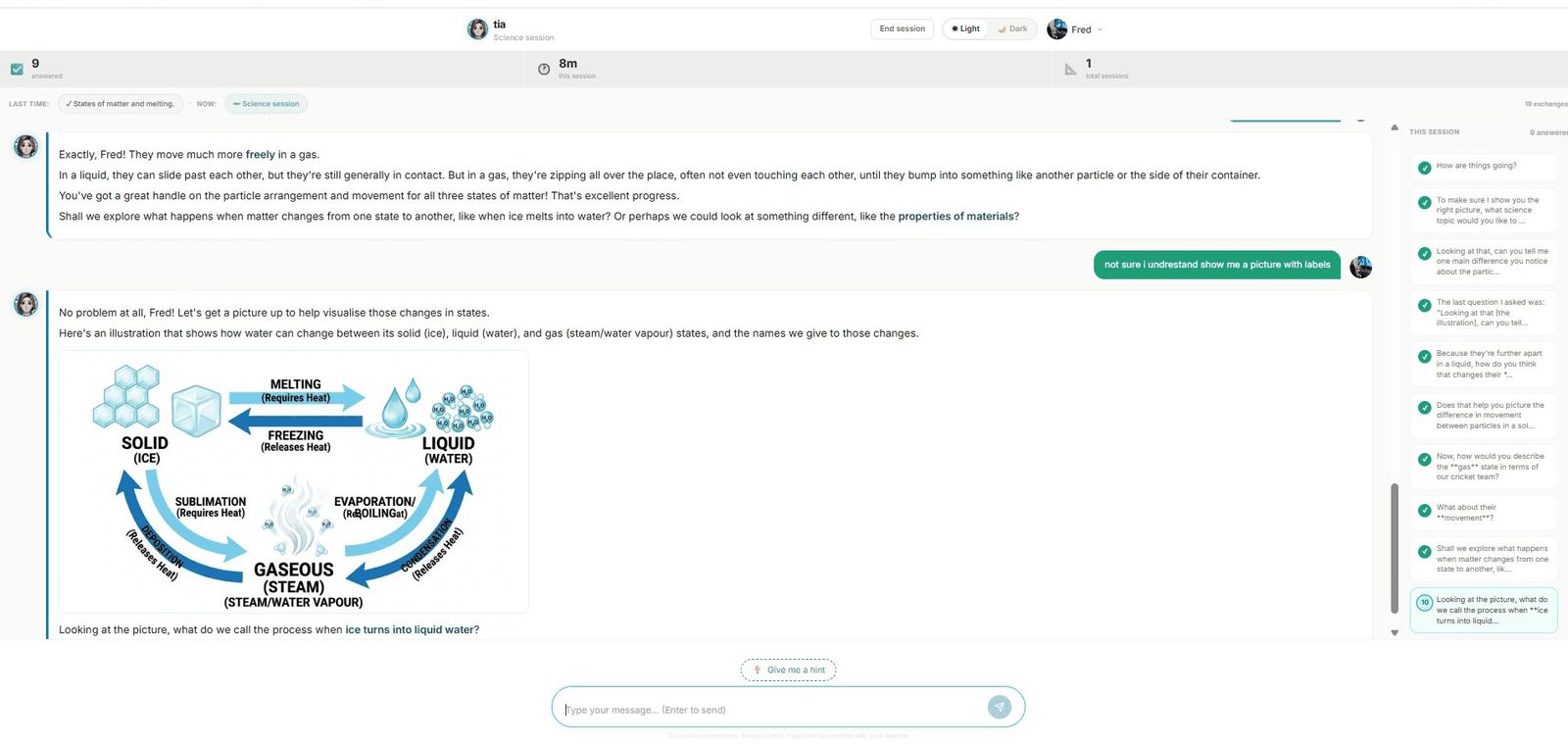
These changes work together. If a Grade 7 student is learning states of matter and asks for a picture, the useful response is not to repeat the paragraph. Tia can introduce a labeled diagram, ask the student to use it, and then check whether the visual changed their understanding.
That is a small moment, but it shows the larger difference between content delivery and tutoring. The lesson responds to the student.
A real example: changing the explanation during a science session
In a real Tia science session, a student was working through solids, liquids and gases. The written explanation had covered how particles move and how changes of state occur. The student then said they were not sure they understood and asked for a labeled picture.
Tia changed the form of the explanation. A visual diagram showed melting, freezing, evaporation, condensation, sublimation and deposition. The next question asked the student to use the picture to reason through what happens when water vapor becomes liquid water.
Three important things happened:
- The student identified what was missing from the first explanation.
- The tutor changed the teaching method rather than only repeating the content.
- The student still had to interpret the visual and answer the question.
The diagram did not replace the learning. It made the learning reachable.
A wrong answer should shape the next teaching step
Traditional online practice often records whether an answer was right or wrong, then serves another question. Adaptive tutoring can use more of the response.
Consider a student solving a ratio problem. An incorrect answer might come from several places:
- The student does not understand what the two numbers represent.
- The student understands the relationship but cannot simplify it.
- The student knows the method but made an arithmetic error.
- The student rushed because the example felt abstract.
Those are different problems. Giving each student the same correction wastes the information inside the mistake.
Tia looks for patterns across responses. When the same error appears again, the lesson can return to the underlying skill. When the student shows confidence, the level can rise. When confidence falls, the next step can become smaller without making the student feel they have failed.
This is one reason personal tutoring can make a positive difference. Bloom’s two-sigma finding placed the average tutored student at the 98th percentile. The Education Endowment Foundation reports that one-to-one tuition adds roughly five months of progress. The value comes from responding to the learner, not simply assigning more work.
Same curriculum goal, two different explanations
Tia adapts the tutoring to the student, not the student to a fixed explanation. Two demonstration sessions with test students show what that means for one math concept: vertical angles. Fred likes cricket. Charlotte likes horses. Both need to understand the equal angles opposite each other where two straight lines cross.
These are product demonstrations supplied by Tia, not student testimonials or a study of learning outcomes. The screenshots show the explanation and the next question. They do not show a completed assessment or prove that either student mastered the concept.
Fred meets vertical angles through cricket bats
Fred asks for help with vertical angles. Tia acknowledges that the idea feels tricky, recalls the cricket-bat example and shows two bats crossing in an X. Opposite angles are labeled 55 degrees and 125 degrees.
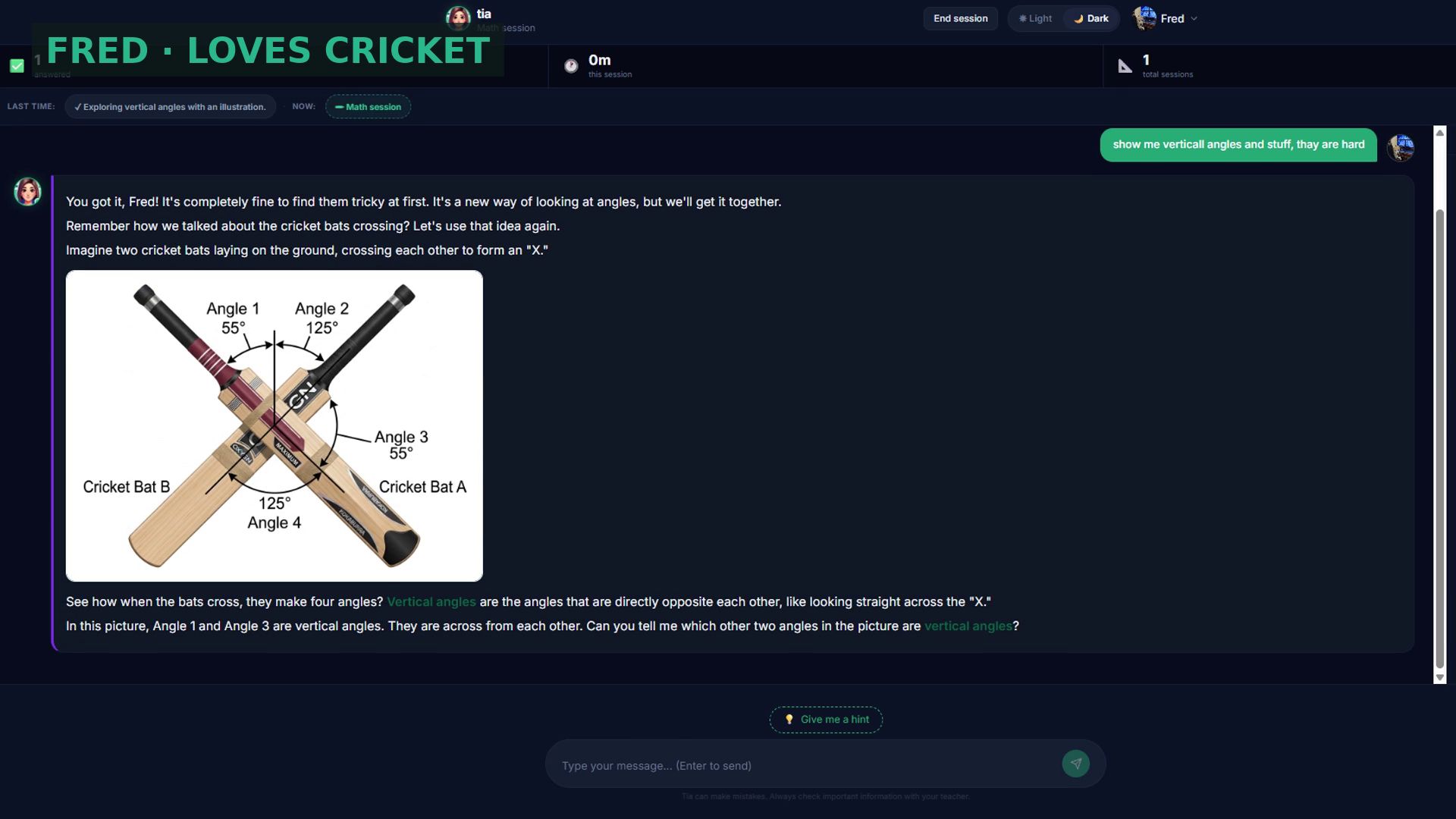
Product demonstration: the cricket context changes the explanation, while the math goal stays fixed.
The important part comes after the illustration. Tia asks Fred to identify the vertical-angle pair rather than ending with a finished answer. Fred still has to apply the idea.
Charlotte meets the same idea through horse trails
Charlotte's session opens by returning to vertical angles and recalling the horse-trail analogy. When Charlotte says the angles are hard and asks to see them, Tia draws two trails crossing in an X. The top and bottom angles carry the same A label; the left and right angles carry the same B label.
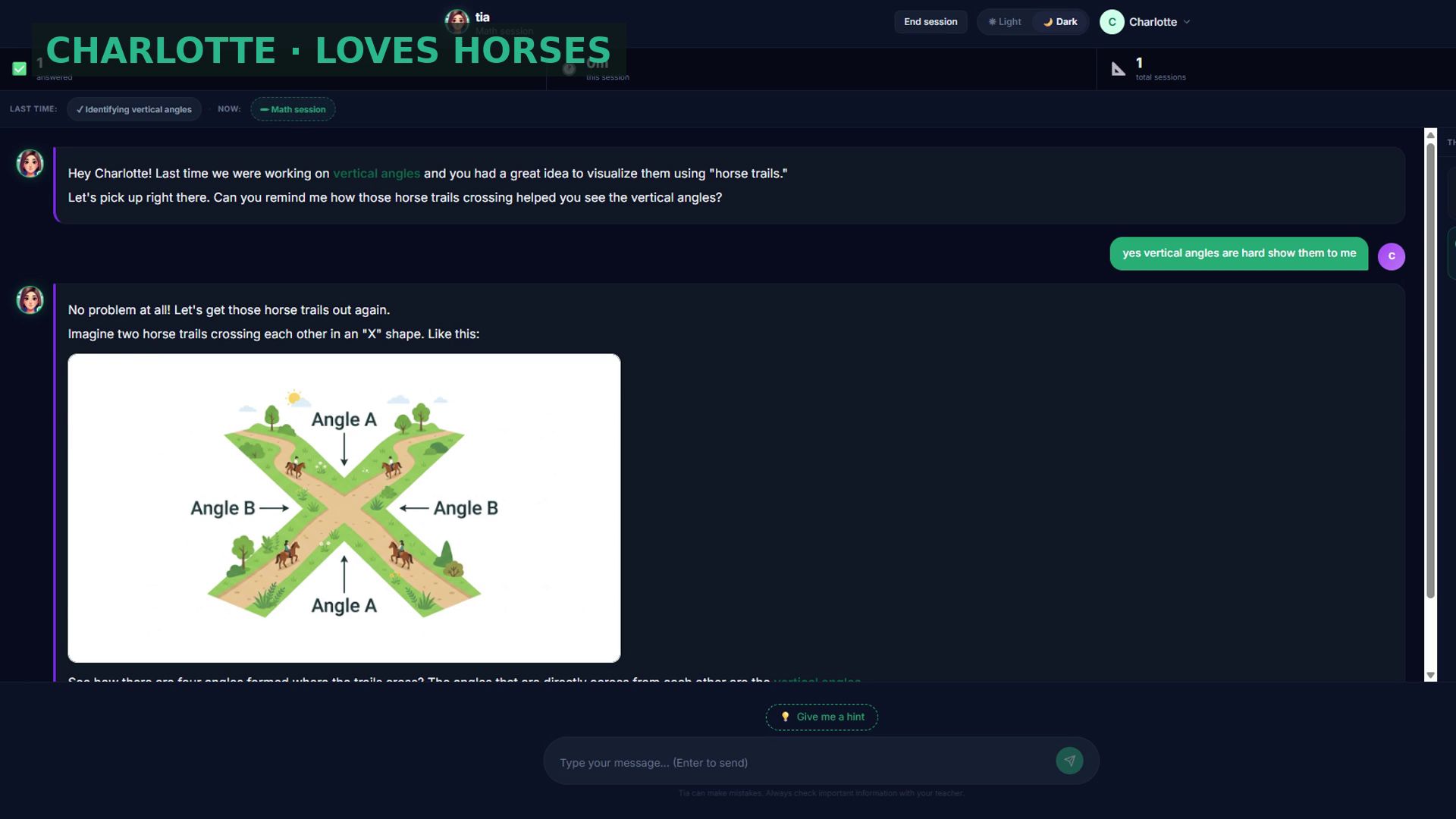
Product demonstration: Tia resumes a prior analogy and responds to Charlotte's request for a visual.
Both sessions connect an interest to a formal concept. The interest is the starting point, not a substitute for the concept. A useful next check is a plain diagram without horses or bats: can the student identify the opposite angles and explain why they are equal?
| What stays the same | What changes for Fred | What changes for Charlotte |
|---|---|---|
| Vertical angles are opposite at an intersection | Two cricket bats form the intersection | Two horse trails form the intersection |
| Opposite angles are equal | Numbered pairs show 55 degrees and 125 degrees | Matching A and B labels show the pairs |
| The student needs to reason | Identify the requested angle pair | Revisit the visual and identify the opposite pairs |
The screenshots support a specific claim: the teaching example changes with the student's interests, and the conversation carries earlier context forward. They do not establish that another tutor cannot do the same. A skilled human tutor can also use interests effectively.
Teaching through interests without losing the curriculum
Personalization can become superficial when it only changes colors, rewards or profile settings. Tia uses student interests inside the teaching itself.
During setup, students choose interests. Tia can also learn from what they mention during sessions. Those interests become possible ways to frame examples, explanations and warm-up questions.
A student who follows football might explore averages through player statistics. A student who enjoys cooking might meet fractions through recipes. A student interested in gaming might reason about coordinates through a game map.
The curriculum skill remains the same. The route into it changes.
This distinction matters. Interest-based teaching should not distract from the required topic or lower the standard. It should give the student a familiar starting point, then lead back to the formal concept and language they need for their grade.
Tia is aligned to each student’s country and curriculum. The curriculum defines what must be learned. The student’s pace, level and interests help determine how it is taught.
Productive struggle stays with the student
The fastest answer is not always the best teaching response.
Students build understanding by attempting, noticing errors, revising and explaining. If technology completes that process for them, the page may look finished while the underlying skill remains weak.
Tia is a tutor, not a solver. When a student asks for an answer, the next response should usually be a question, hint or smaller step that helps them reach it.
A useful adaptive sequence might look like this:
- Ask the student to explain what they already know.
- Identify the exact step where the reasoning changed direction.
- Offer a hint rather than the finished answer.
- Reframe the idea if the hint does not help.
- Ask the student to complete or explain the next step.
- Revisit the skill later to check whether it was retained.
This protects productive struggle: work that is challenging enough to build understanding but supported enough to remain achievable.
The technology does the adapting. The student still does the learning.
Continuous understanding instead of one nervous test
A single test captures one point in time. It can be affected by memory, stress, sleep, guessing or the exact questions selected.
Tia builds a picture of understanding across normal sessions. Each question adds context: which skills are secure, which errors repeat, how much support was needed, and whether the student can explain the idea independently.
That does not mean tests have no place. It means a parent can see more than one test score.
Continuous evidence can help answer practical questions:
- Is the student making progress in the exact skill that was causing difficulty?
- Did a new explanation improve understanding?
- Is the student ready to move ahead?
- Is the same gap appearing in different topics?
- Was the student actively engaged or merely logged in?
A score reports an outcome. A learning record helps explain how the outcome was produced.
Parents should see the result of adaptation
Personalization should not be a claim that only the provider can see. Parents need evidence that the tutoring is changing with their student.
Tia gives parents a separate login. The dashboard shows recent sessions, subjects covered, honest engaged time, skills mastered and what the student worked on. Weekly email summaries provide a shorter view when parents do not open the dashboard.
For homeschool families, time, attendance and curriculum coverage build into self-writing progress records. That reduces the need to reconstruct the term from memory when reporting time arrives.
The dashboard does not ask parents to supervise every answer. It keeps them informed while allowing the student to work independently.
What parents should see in a tutoring dashboard explains the full buyer checklist.
Where technology makes the biggest difference
Technology is most useful when it can do something consistently that has previously been difficult to provide at scale.
For Tia, that includes:
- Being available when the student is ready to work
- Remembering prior sessions and recurring gaps
- Changing explanations without embarrassment or impatience
- Connecting examples to individual interests
- Tracking active learning as it happens
- Building parent summaries and records from normal sessions
- Supporting Math, English and Science within one account
The Institute of Education Sciences notes that technology can enrich and extend tutoring. The strongest use is not technology for its own sake. It is technology applied to a real constraint: personal tutoring is valuable, but access, scheduling and cost can limit who receives it consistently.
Tia uses technology to make adaptive personal tutoring available for one flat monthly price, while keeping the parent in control of whether it suits their student.
What Tia does not replace
Innovation also requires clear limits.
Some students need a scheduled person waiting for them at a fixed time. Some need specialist support, an accommodation plan, or help that sits outside tutoring. Some families prefer face-to-face teaching even when online support is available.
Tia does not make those needs disappear. It offers a different fit: flexible, curriculum-aligned tutoring that adapts during the lesson and gives parents a clear record afterward.
The best choice depends on the student. The important question is not whether one format is universally better. It is whether the support matches the reason the student is stuck.
How can a parent test whether tutoring is truly adaptive?
Do not judge adaptive tutoring from a feature list alone. Use a trial with one topic the student genuinely finds difficult.
Watch for five signs:
- The tutor identifies the exact sticking point. It should not treat every wrong answer as the same problem.
- The explanation changes. Repeating the same words more slowly is not adaptation.
- The student remains responsible for the reasoning. Hints and questions should come before solutions.
- The next task reflects what just happened. The lesson should not continue along a fixed path regardless of the response.
- The parent can see meaningful evidence afterward. Look for engaged time, the skill covered, progress and remaining gaps.
A genuinely adaptive session should feel different by the end because of what the student said and did during it.
FAQ
What is adaptive tutoring?
Adaptive tutoring changes the pace, level, explanation, examples or lesson sequence based on how a student responds. It should do more than simply make the next question easier or harder.
How does Tia respond when a student gets stuck?
Tia can slow down, return to a missing foundation, offer a hint, use a visual, reframe the explanation or connect the idea to one of the student's interests. The goal is another route into the concept, not simply the answer.
Does Tia give students the answers?
No. Tia is designed as a tutor, not a solver. It uses questions, hints and guided steps so the student remains responsible for the reasoning and learning.
How does Tia use a student's interests?
Students choose interests during setup, and Tia can learn from interests they mention during sessions. It uses those interests to frame examples and explanations while keeping the lesson connected to the required curriculum skill.
Can parents see how Tia is helping?
Yes. Parents have a separate dashboard showing recent sessions, honest engaged time, subjects covered, skills mastered and what the student worked on. Weekly summaries and progress records add a longer view.
Does adaptive tutoring replace a human tutor?
Not for every student or need. Students who require a fixed appointment, a person physically present or specialist support may need another format. Tia is best suited to families seeking flexible adaptive tutoring with clear parent visibility.
What subjects and grades does Tia cover?
Tia covers Math, English and Science for students in Grades 5 to 12, aligned to each country's curriculum.
A different lesson for the same learning goal
True personalization does not mean lowering the standard or abandoning the curriculum. It means recognizing that students can reach the same learning goal by different routes.
When the first route fails, Tia can change the pace, step back to a missing skill, introduce a visual, ask a smaller question or use an example that feels familiar. That is the innovation: the lesson is not fixed before the student begins.
See how Tia works, read how Tia uses AI for good in education, or explore Tia at tia.coach. 14-day free trial, no card needed.