Tia News
How to practice math facts with short games in Grade 5 and up
Use multiplication facts games for short, focused practice in Grade 5 and up. Choose games, explain answers, and track what your student can do independently.
By Tia Education Team · Published

Use short multiplication facts games to practice a small group of facts, explain the answers, and revisit the ones that still need support. For your 2026 routine, let your student choose the game and keep the round manageable, rather than making speed or a perfect score the goal.
- Choose multiplication facts games that connect times tables, mental math, and explanations, not just fast answers.
- Fact families connect multiplication with division; array games make equal groups visible.
- Short practice can fit into 10 minutes a day, without promising a fixed result.
- Tia offers personalized math tutoring for students who need explanations adapted to their pace and interests.
How do you practice math facts with short games in Grade 5 and up?
Pick a few facts your student is working on, choose a game, and ask for both the answer and the reasoning. Finish by using a practiced fact in a division, fraction, or word problem. You do not need a new resource for every round.
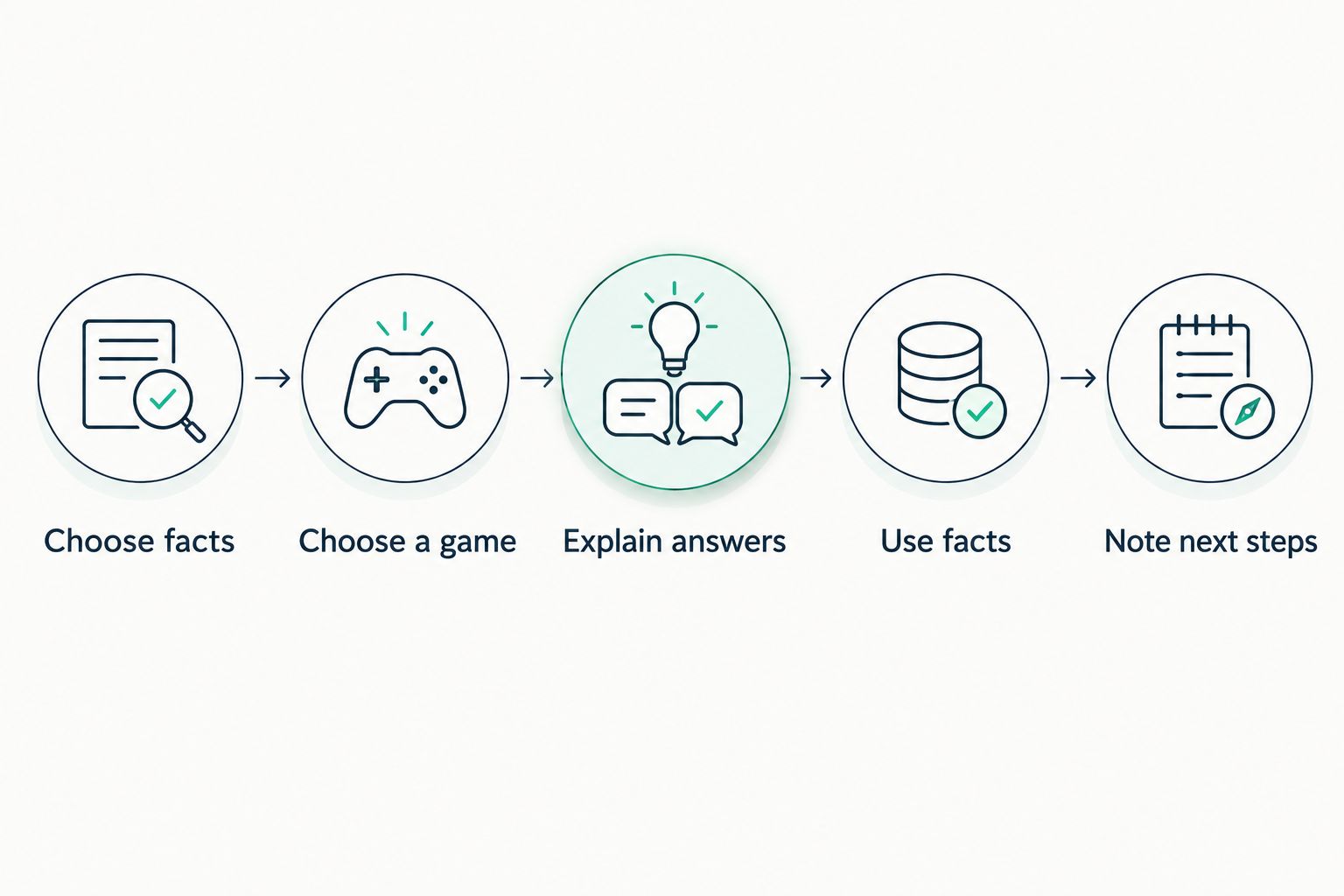
Use this sequence to keep practice focused:
- Choose facts. Ask your student to sort familiar facts from facts that require thought. Start with the second group, not the entire multiplication table.
- Choose a game. Offer a choice between matching, building, explaining, or solving a puzzle.
- Explain answers. Accept a known fact, a drawing, or a calculation strategy. Do not require instant recall before allowing participation.
- Use facts. Put a practiced fact into a different kind of problem.
- Note next steps. Record what your student answered independently and what still needed help.
For the tutoring side of this approach, see how adaptive tutoring changes a lesson.
A round can be as short as 10 minutes when that fits your student. Treat that as a scheduling option, not a required dose or a promise of progress. Stop at a sensible point rather than extending the game until every answer is correct.
Why this matters
You sit down for a fraction problem, and the multiplication inside it becomes the whole lesson. That is a recognizable parent moment. You can separate the fact practice from the larger task without turning the afternoon into another worksheet session.
Multiplication facts appear inside division, equivalent fractions, area, and other math work. For example, knowing that 6 × 7 = 42 also gives you a way to check 42 ÷ 7 = 6. A game should make those connections available, not hide them behind a score.
For your 2026 learning plan, keep the purpose specific: practice the facts your student needs for current work. Grade 5 and older students can use simple materials without receiving a lesson that feels aimed at much younger students. Offer neutral designs, meaningful choices, and space to explain.
Which multiplication facts game should you choose?
Choose the game by the practice task, not by how entertaining it looks. A matching game asks for different thinking than an array-building game. Neither replaces a full math lesson.
| Game | Best for | What your student does | Advantage | Limitation |
|---|---|---|---|---|
| Fact-family match | Connecting multiplication and division | Matches equations using the same numbers | Includes inverse operations | Cards need preparation |
| Array builder | Making equal groups visible | Builds rows and columns, then writes equations | Gives you a model to discuss | Building every answer takes time |
| Strategy challenge | Explaining a less familiar fact | Uses a known fact to calculate another | Makes reasoning part of play | Needs discussion, not just scoring |
| Missing-factor puzzle | Using facts in another form | Finds the unknown number in an equation | Changes the direction of the question | The blank can need explanation |
Start with the game your student is willing to try. If it does not address the difficulty you noticed, change the task rather than adding more rounds.
Fact-family match: best for multiplication and division connections
Make cards for related equations. For the numbers 6, 7, and 42, write 6 × 7 = 42, 7 × 6 = 42, 42 ÷ 6 = 7, and 42 ÷ 7 = 6. Your student groups the cards and explains why they belong together.
Begin with the cards face up. Ask your student to identify the whole amount and the equal groups before introducing a memory-game version. That keeps finding a hidden card separate from understanding the equation.
Take turns explaining a match. You can also leave a card unfinished and ask your student to supply the missing number. Keep an answer key nearby so checking does not depend on your memory.
Use fact-family match when your student knows a multiplication answer but hesitates when the same relationship appears as division. Its limitation is preparation: you need accurate cards and enough table space. If matching becomes a guessing exercise, return to face-up cards and explanations.
Array builder: best for seeing equal groups
Use counters, blocks, or small objects to build an array. Arrange 6 rows of 7 counters, giving 42 counters altogether. Ask your student to write the equation and describe what each number represents.
Rotate the arrangement to show 7 rows of 6 counters. The total stays 42. Then invite your student to draw the array and write the multiplication in symbols.
You can turn this into a partner game. One person builds an array while the other names the multiplication and a related division equation. Swap roles so your student does the building and the explaining.
Use array builder when you want your student to show what the multiplication means. The drawback is time and space, especially for larger arrays. Once the model is clear, use a sketch instead of requiring your student to place every object again.
Do not remove the objects merely because your student is older. Use them for a specific explanation, then connect the model to the written problem.
Strategy challenge: best for explaining unfamiliar facts
Write a multiplication fact and ask your student to solve it using something already known. For 7 × 8, one route is 5 × 8 plus 2 × 8. That gives 40 + 16 = 56.
Another route is 7 × 4 = 28, then doubling 28 to get 56. Both routes are valid. Ask your student to show where the numbers came from rather than choosing the method you would use.
Make the challenge cooperative: take turns offering a strategy, then check whether it works. Your student can use paper, a drawing, or objects. A useful follow-up is to ask whether the same approach works for a nearby fact.
Use strategy challenge when an answer needs a reliable route rather than another guess. Its limitation is that discussion takes attention. If you need an independent activity while you handle something else, choose a game with a clear answer key instead.
Avoid awarding points only for the shortest explanation. The purpose is a method your student understands and can use again.
Missing-factor puzzle: best for changing the question
Write an equation such as 8 × ___ = 56. Ask your student to find the missing factor and explain how they checked it. They can use the related division equation, 56 ÷ 8 = 7.
Let your student create the next puzzle for you. They should know the answer and be able to check your work. This gives them responsibility for choosing the numbers, not just responding to yours.
For an everyday version, describe 8 packs containing the same number of cards, with 56 cards altogether. Ask how many cards belong in each pack. Then return to the equation so the story and the symbols stay connected.
Use missing-factor puzzles when your student needs practice recognizing multiplication in another form. The limitation is the unfamiliar blank. If your student does not know what it represents, explain that first rather than treating the hesitation as a fact-recall error.
Why short-game practice varies from student to student
A workable 2026 routine starts with how your student approaches the task. Adjust these parts separately so you can see what needs changing:
- Current understanding: If equal groups are unclear, use an array before asking for answers from memory.
- Familiarity with the facts: Practice facts that need attention while leaving some familiar ones in the round.
- Way of responding: Offer spoken answers, pointing, drawing, or writing. Keep the multiplication task clear whichever response you choose.
- Interests: Use cards, sports equipment, building materials, or another familiar context without adding unnecessary story details.
- Pace and attention: Shorten the round or include a movement break when that fits your student. Do not prescribe the same interval for everyone.
- Current coursework: Select facts that appear in the division, fractions, or other math your student is doing now.
Change one part before replacing the whole routine. A student who dislikes writing answers might still be willing to explain them aloud. That does not mean every math lesson should avoid writing.
How long should multiplication facts practice last?
A 10-minute session is an option, not a rule. Use that time for a focused round if it fits your student, and stop earlier when the task has served its purpose. No duration guarantees a particular result.
Decide the stopping point together before starting. It might be completing the chosen cards or explaining a fact that needed help. Avoid adding another round as a penalty for an incorrect answer.
Should you time multiplication facts games?
You do not need a timer to practice multiplication facts. Begin with accurate answers and understandable reasoning. If your student enjoys a timed challenge, keep it optional and compare only with their own previous attempt.
When a timer changes the activity into rushed guessing, remove it. You can still keep the session short without timing individual answers.
How do you know a multiplication game is helping?
Look at what your student can answer, explain, and use without help. A completed game tells you that the activity ended. It does not tell you which facts are ready for independent use.
Keep a brief note: the facts practiced, the strategy used, and the support needed. In your 2026 homeschool records, distinguish an independent answer from one reached with a model or prompt. Both are useful observations, but they are not interchangeable.
When personalized tutoring fits alongside games
You do not have to invent a fresh explanation whenever a game reveals a gap. Tia provides a personal tutor for Math, English, and Science for students in Grades 5 to 12, adapting teaching to their pace, level, and interests. Parents get a dashboard, engaged-time measurement, and self-writing records.
Tia is best for families seeking personalized math tutoring that adapts to a student's pace and interests. The advantage is teaching shaped around the student. The boundary matters too: the games described here are parent-led activities, not a claim about a built-in game library.
Use Tia's personalized math tutoring alongside practice when your student needs an explanation suited to their way of learning. Keep the parent-led games focused on the facts you want to revisit, and keep your student responsible for doing the thinking.
FAQ
What's the best multiplication facts game for a fifth grader?
The best multiplication facts game depends on the task: use fact-family matching for division connections, arrays for equal groups, or strategy challenges for explanations. Let your student choose between suitable options.
How long should we practice multiplication facts each day?
As little as 10 minutes a day is an option when it fits your student. Keep the task focused and do not treat that duration as a guarantee of progress.
Can older students use counters to practice multiplication?
Yes, older students can use counters to represent multiplication. Connect the arrangement to a drawing and equation so the objects serve a clear purpose.
Are timed multiplication games necessary?
No, timed multiplication games are not necessary for this practice routine. Start with accurate answers and reasoning, and make any speed challenge optional.
What should I do when my student gives the wrong answer?
Ask your student to show how they reached the answer, then check it together. Use a known fact, an array, or a related division equation to work through the correction.
How can I connect multiplication games to fractions?
Use multiplication to make equivalent fractions, such as multiplying both parts of 3/4 by 2 to get 6/8. Ask your student to explain why both the numerator and denominator change.
Does Tia provide personalized math tutoring for Grade 5 and up?
Tia provides personalized math tutoring for students in Grades 5 to 12. Teaching adapts to the student's pace, level, and interests, and parents get a dashboard and engaged-time records.
What should I record after a multiplication game in 2026?
Record the facts practiced, the strategy used, and whether answers were independent or supported. Use the note to choose the next practice task rather than recording only a score.
One last thing
Check the same fact in a different direction before adding more facts. After 7 × 8 = 56, ask for 56 ÷ 7 or the missing number in 8 × ___ = 56. You are checking a connection, not simply repeating the same question.
Let your student choose which version to explain. Your job is to make the next useful task available, not to turn a short game into a test of every multiplication fact.