Tia News
How to choose a homeschool curriculum in your first year without buying everything
How to choose homeschool curriculum in 2026: start with one core resource per subject, check your state’s rules, and change methods when they do not fit your student.
By Tia Education Team · Published

Choose a homeschool curriculum by checking your state’s requirements, picking one core resource for each subject you plan to teach, and trying it with your student before adding more. In your first year, the best plan is one you can adjust when a lesson, schedule, or teaching method does not fit. A large stack of materials will not tell you how your student learns.
- How to choose homeschool curriculum in 2026: check requirements, start with one core resource per subject, then adjust.
- Best for a first-year family: a small set of materials you can teach and your student can use.
- Tia is best as a personalized tutoring supplement for grades 5 to 12, not a replacement for your curriculum plan.
- Keep samples of student work and check your state’s recordkeeping rules before you settle on a system.
Why this matters
It is easy to buy a full shelf when you are still figuring out what a Tuesday at home looks like. You are choosing materials, teaching lessons, watching your student’s response, and keeping records. Give yourself room to learn what works.
A curriculum decision also affects the records you keep. Before you order materials, read your state’s current homeschool requirements and decide where you will put completed work and learning notes. This guide to keeping homeschool records covers the recordkeeping side. Your state’s rules, not a curriculum seller’s checklist, determine what you need to document.
In 2026, separate two questions: What must you teach and record where you live? What helps this student learn it? The first sets your boundaries. The second determines whether the materials will earn a place in your routine.
How do you choose a homeschool curriculum in your first year without buying everything?
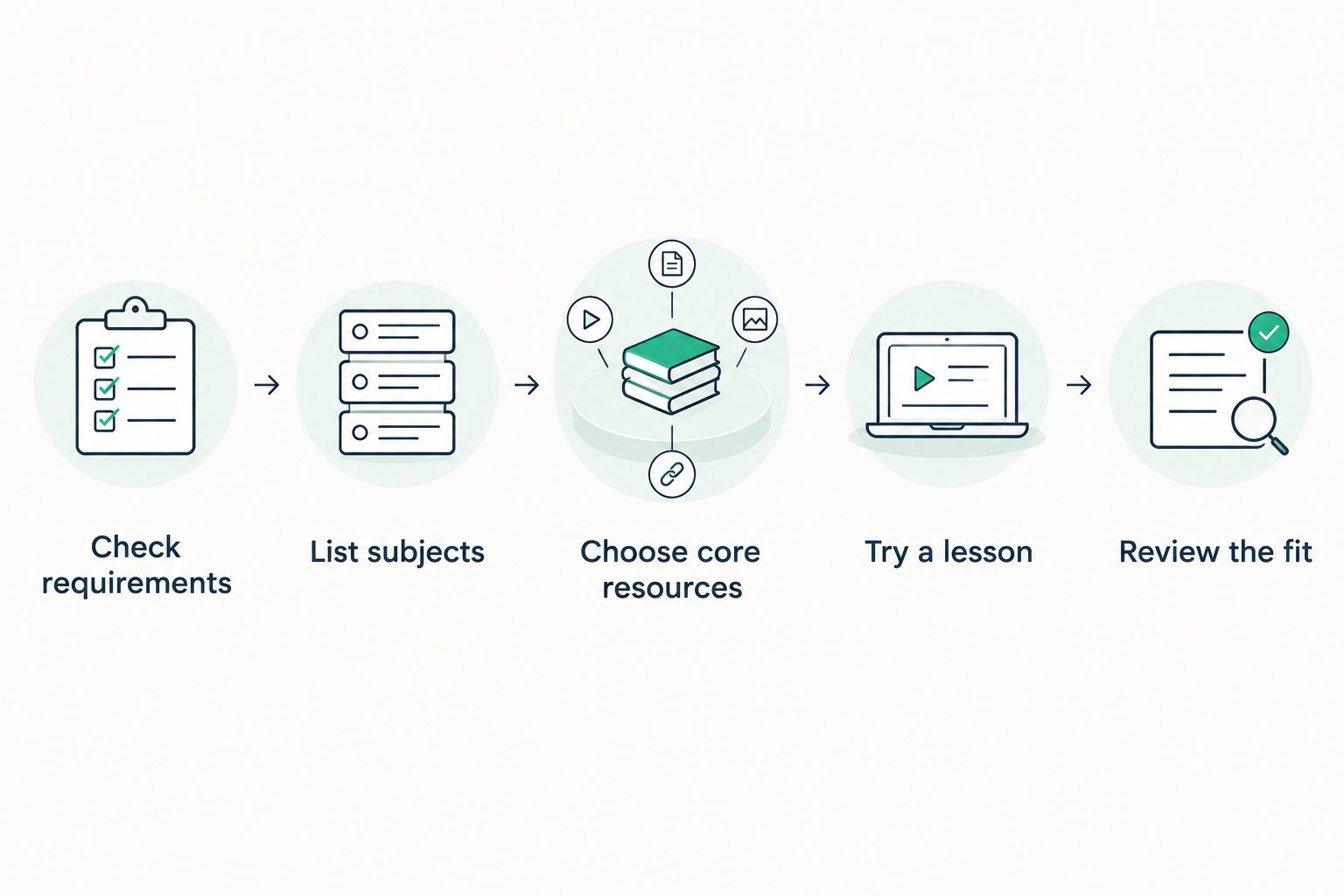
Start with requirements, choose one core resource per subject, and test the fit before you add anything else. Use these steps in order. Each one gives you a reason to keep, change, or skip a material instead of buying it because it looks complete.
- Check your state’s requirements. Look at the current rules for subjects, instruction, assessments, and records. Write down what applies to your student. Do not assume another family’s plan meets your obligations.
- List the subjects you will teach. Put your required subjects on the page first. Add a separate note for interests and projects so they do not get mistaken for missing core materials.
- Choose one core resource per subject. Look for a clear sequence of lessons and a way to see what your student has learned. A core resource gives you a starting path; it does not have to supply every explanation or activity.
- Try a real lesson. Ask your student to work through an ordinary lesson, not just a favorite sample. Watch where they need an explanation, how much you need to prepare, and what they can do afterward.
- Review before adding. Keep the parts that help. Change a method that does not fit. Add a supplement only for a need you can name, such as extra practice with fractions or support with essay structure.
A single difficult afternoon is not enough to judge an entire subject. Look for a pattern in the work and in your student’s response. If the explanation repeatedly misses them, changing how you teach the idea is more useful than buying another complete package.
Write down what a good fit means for your family
Before you compare catalogs, make a short decision sheet. Note your student’s current level, where they need support, what holds their interest, and how much instruction you can provide. Include the work you need to keep as evidence of learning.
Then ask the same questions of every resource: Can I see what comes next? Can my student understand the explanation? Can I tell what they learned? Can we change pace without losing our place? In 2026, those answers are more useful to your first-year plan than a long list of included extras.
Which materials should you buy first?
Buy a core resource only after you know the subject it must cover and have inspected how it teaches. Treat supplements and tutoring as responses to specific gaps, not as items every homeschool needs from day one.
| Option | Best for | Advantage | Limitation | First-year verdict |
|---|---|---|---|---|
| Core curriculum resource | Giving a subject a lesson sequence | Shows what to teach next | Its explanation may not fit your student | Choose one per subject you need to cover. |
| Targeted practice material | Reworking a skill your student finds difficult | Focuses on a named need | Does not organize a whole subject | Wait until you can identify the gap. |
| Project or interest-led activity | Giving a topic a familiar context | Makes room for the student’s interests | Needs to connect to your learning goals | Add when it supports the core work. |
| Personalized tutoring | Getting another explanation or guided practice | Can adapt the pace of an explanation | Does not set your legal requirements or replace your oversight | Use where your student needs support. |
You do not have to choose between structure and your student’s interests. A math sequence can tell you which concept comes next, while blocks or fraction tiles make an abstract idea easier to discuss. A reading assignment can lead into reading aloud together, even with an older student. The resource provides direction; you decide how to teach the lesson in front of you.
The best first-year curriculum is the one you can use, check, and change. A resource that looks complete but sits unopened does not help you teach. Start with the material that answers your next teaching question, not every question you expect to have this year.
How do you tell whether a curriculum fits your student?
Watch what happens during a lesson and afterward. A student who finishes a page has completed a task; ask them to explain the idea, apply it in a different example, or show you where they got stuck. Their answer tells you whether to continue, revisit the concept, or change the explanation.
Use a few lessons to answer these questions:
- Can your student begin? If every lesson requires you to translate the directions, the format is adding work.
- Does the explanation connect? Try familiar interests or physical objects when an abstract explanation is not landing.
- Is the pace adjustable? Your student needs room to revisit a concept or move on after showing understanding.
- Can you see the learning? Keep work that shows what your student attempted and what they can explain now.
- Can you sustain the preparation? A good-looking plan still has to fit the time and energy available in your home.
Ask your student which part helped them understand. Their answer is not the only factor, but it belongs in the decision. A student who can name what is confusing gives you a better starting point than another unopened workbook.
Why homeschool curriculum choices vary
There is no single shopping list that answers how to choose homeschool curriculum for every family. These factors change what belongs in your plan:
- State requirements. Check the rules where you homeschool before deciding whether a resource covers your obligations.
- Student level. A grade label is a starting point; the student’s work tells you where instruction should begin.
- Teaching method. Some concepts become clearer through conversation, reading aloud, pictures, or hands-on models rather than another written explanation.
- Pace and attention. Shorter lessons or movement breaks suit some students. Build the rhythm around the student instead of prescribing the same interval for everyone.
- Parent capacity. Preparation, teaching, and recordkeeping take time. Choose materials you can actually manage.
- Existing materials. Use what already works before buying a second version of the same job.
A boxed curriculum can be a useful starting structure. It is not a promise that every lesson will suit your student. If one method repeatedly fails to connect, keep your learning goal and change the method mid-year. You are still in charge of the plan.
Can you change curriculum partway through your first year?
Yes. Keep the learning goal, review the work your student has done, and change the part that is not working. You do not have to replace every subject because one resource is a poor fit. In 2026, make that decision from completed work and your state’s requirements rather than from a need to finish a purchased book.
First identify the problem. Is the subject sequence unclear, the explanation hard to follow, or the workload difficult to sustain? If the sequence works but the explanation does not, try a different way to teach the same concept before replacing the core resource.
Do you need a strict daily schedule before choosing materials?
No. You need enough structure to cover your responsibilities and return to unfinished work. A rigid timetable is not the only way to do that. Some families rotate subjects through a loop so the next subject resumes when time is available; others prefer a daily order.
Test your rhythm alongside your materials. If a lesson needs more discussion than you expected, notice what happens to the rest of the day. A schedule is useful when it helps you teach and notice progress, not when it forces you to move on before your student understands.
When does a personal tutor belong in a homeschool plan?
Add tutoring when you can name the support your student needs, such as another explanation of a math concept or guided English practice. Tia is best for families who want a personalized tutor for a student in grades 5 to 12 while the parent keeps control of the homeschool plan. Tia teaches Math, English, and Science at the student’s pace, and parents can use its dashboard to follow progress.
Tia is a supplement, not your state requirements checklist or your complete plan for every subject. Its strength is adapting instruction when a student needs a different explanation. Its limit is equally important: you still decide what to teach, which materials to keep, and what records your state requires. In 2026, choose a tutor for a defined need rather than adding one because your first-year plan feels unfinished.
See how Tia teaches
Explore personalized tutoring for Math, English, and Science.
FAQ
What is the first step in choosing a homeschool curriculum?
Check the current homeschool requirements in your state. Then list the subjects you need to teach before comparing materials.
Should I buy every subject from the same curriculum provider?
No. Choose each subject’s core resource for how well it fits your requirements, your student, and your ability to teach it. A matched set is not necessary for a workable plan.
How many core resources should I start with per subject?
Start with one core resource per subject you plan to teach. Add another material only when you can name the need it will meet.
What if my student dislikes the curriculum I bought?
Find out whether the problem is the topic, the explanation, the pace, or the workload. Try a different way to teach the same learning goal before replacing everything.
Can I use projects alongside a homeschool curriculum?
Yes. Use projects to give a subject context and keep track of what your student learns through them. Check that your overall plan still meets your state’s requirements.
Does Tia replace a homeschool curriculum?
No. Tia is a personalized tutor for Math, English, and Science in grades 5 to 12. Parents remain responsible for their homeschool plan and applicable requirements.
Do I need a fixed homeschool schedule in my first year?
No. Choose a repeatable rhythm that lets you cover your responsibilities and see your student’s work. Adjust it when lessons need more time or a different approach.
One last thing
The most useful item in your first-year plan is not another curriculum box. It is a brief note after a lesson: what your student understood, what confused them, and what you will try next. That note gives you a reason to keep a resource, change your approach, or ask for help.
For 2026, leave space in the plan to make those decisions. You can start with one core resource per subject, teach the next lesson, and let your student’s work tell you what the plan needs next.