Tia News
How to plan movement breaks for homeschool students with ADHD
Plan movement breaks for ADHD around your student, not a rigid timer. Choose activities, agree on a return step, and adjust your homeschool routine together.
By Tia Education Team · Published

Plan movement breaks for ADHD around a manageable learning task, an activity your student chooses, and a clear place to restart. If your student is getting out of their chair again, you do not need to turn sitting still into another assignment. Agree on the break before the lesson, adjust it to what you observe, and treat it as learning support, not an ADHD treatment or a reward for finishing work.
- Plan movement breaks for ADHD around your student's needs, not a universal timer.
- Choose a simple activity and identify the next learning step before the break.
- Judge the routine by learning and the return to work, not stillness.
- Tia suits homeschool families seeking personalized tutoring in Math, English, and Science, not ADHD treatment.
Why this matters
You are managing the lesson, the household, and the decision about whether to keep going. A break plan gives you and your student something concrete to agree on before that decision becomes frustrating. It does not require a perfect timetable.
For your 2026 homeschool plan, start with a routine you can change. A homeschool schedule that fits your student should leave room for movement without making every lesson follow the same pattern.
The aim is a workable return to learning, not a longer stretch of sitting still. Keep that distinction visible when you decide whether a break belongs before, during, or after a task.
How do you plan movement breaks for homeschool students with ADHD?
Build the plan together while the lesson is not underway. Your student should know what the learning task is, how to request a break, and what happens afterward. Keep the agreement short enough to use without another explanation.
1. Choose the task
Name a small, visible piece of learning rather than an entire subject. That might be explaining a math method, reading a passage, or planning an English paragraph. Choose a stopping point that preserves the student's place.
For example, pause after discussing a worked example rather than midway through unfamiliar instructions. If the student needs to stop sooner, mark the current step instead of insisting on completion. The stopping point is a plan, not a test of endurance.
2. Agree on the cue
Decide how your student will ask for movement. A spoken request, a gesture, or a written reminder is enough. You can also agree to check in at a natural task boundary.
Do not require your student to become visibly distressed before using the cue. Make a request something you can discuss plainly. If requests arrive repeatedly at the same kind of task, look at that task as well as the break routine.
3. Pick the movement
Offer a small choice of familiar, safe activities that fit your space and your student's abilities. Walking through the hallway, stretching comfortably, or moving outdoors with appropriate supervision are possible starting points. Let your student decline an activity they dislike.
Avoid turning movement into another lesson to perform correctly. You do not need equipment, a fitness target, or a complicated game. The practical question is whether the activity fits the break and leaves a manageable transition back.
4. Mark the return
Before the student leaves, identify the exact next action. Leave the book open, mark the problem, or write a short reminder. Agree on an ending cue that your student understands.
A timer is an option, not a requirement. If a sound is unwelcome, choose a spoken cue or a visible reminder instead. Keep the first action after the break small and clear, such as rereading the question or explaining the last completed step.
5. Review the fit
After the lesson, ask what worked and what needs changing. Look at the return to learning, the task completed, and your student's account of the break. Do not judge the routine only by whether the room was quieter.
For a 2026 planning note, record the task, movement choice, and what happened afterward. Change the part that caused difficulty rather than replacing the whole day. Your student's needs can differ across subjects and days.
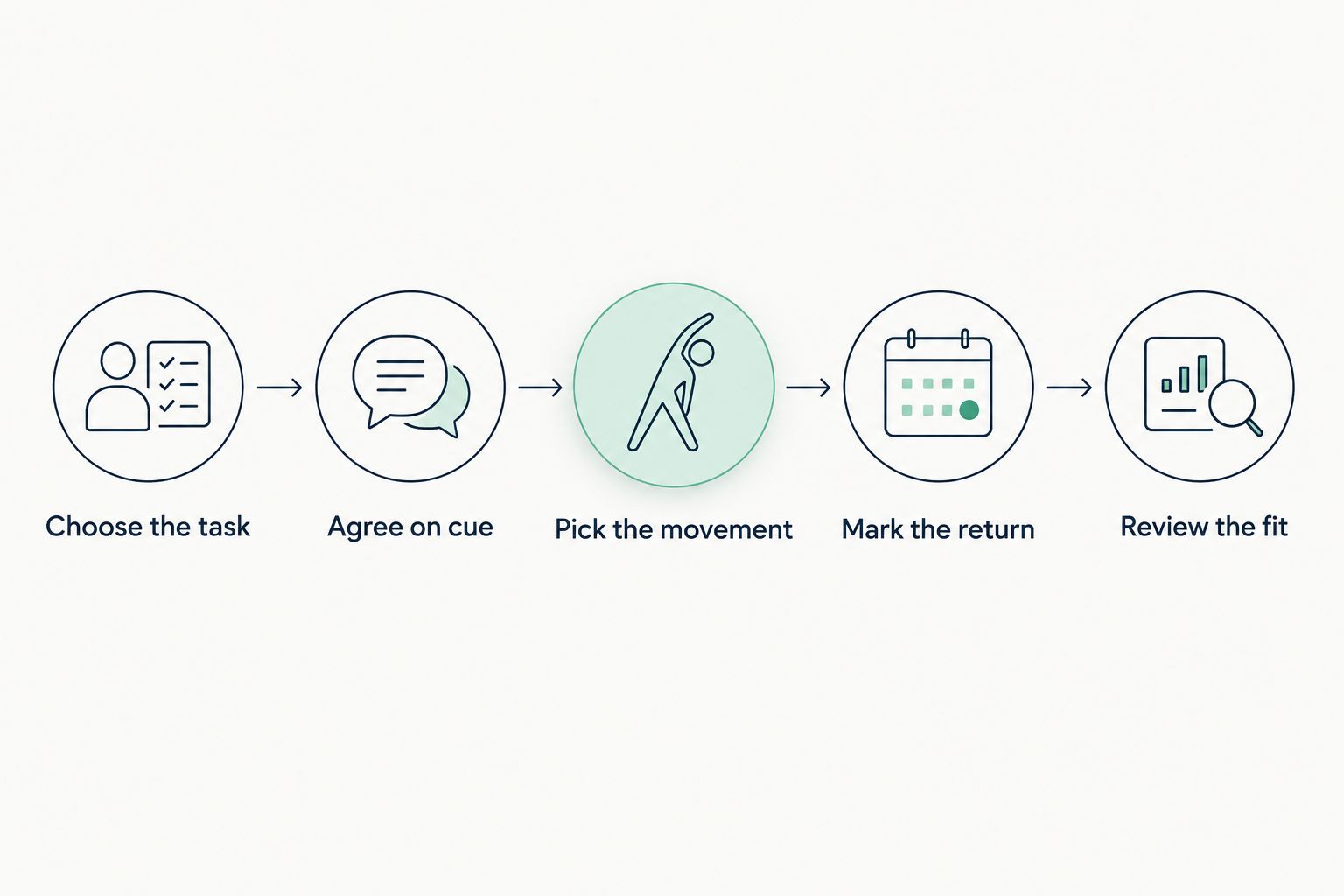
Keep this sequence somewhere you can refer to without interrupting the lesson. It is a shared agreement, not a behavior chart. Revise it with your student when an activity, cue, or return step is not working.
Which movement break fits your homeschool space?
Choose by practical fit rather than by a claim that an activity is best for every student with ADHD. The table compares starting options, including their limits. Use only movements that are comfortable and appropriate for your student.
| Movement option | Best for | Practical advantage | Limitation to plan for |
|---|---|---|---|
| Indoor walk | Students who prefer a simple change of place | Needs little setup | A shared hallway needs a clear route |
| Comfortable stretching | Students who prefer to stay near the learning area | Avoids moving to another room | Not every student enjoys stretching |
| Outdoor movement | Students who want time outside | Creates a clear change of setting | Weather, access, and supervision affect the plan |
| Familiar movement game | Students who enjoy a playful break | Gives the activity a recognizable beginning | Rules and restarting need advance agreement |
Choose the activity your student accepts and your household can support. A modest indoor option is a valid choice. You do not need to recreate another family's space, equipment, or outdoor access.
For your 2026 routine, keep an alternative available when the usual activity is impractical. Discuss that alternative in advance. A rainy day should not require inventing the entire plan during a difficult lesson.
Avoid competitions, scoring systems, or exercise challenges unless your student genuinely wants them. A movement break does not need a winner. Keep physical safety and comfort ahead of completing the activity.
Why movement break plans vary
A useful plan responds to the student and the situation. These factors belong in the decision:
- Student preference: Ask which movements feel comfortable and which ones the student wants to avoid.
- Learning task: Reading, written work, and problem-solving have different natural stopping points.
- Return demands: Decide whether the next instruction is clear or needs a smaller first step.
- Home setup: Choose an activity that fits your space, supervision, weather, and access.
- Daily circumstances: Revisit the plan when your student reports tiredness, discomfort, or a different need.
- Individual guidance: Follow any relevant advice from your student's healthcare professional about activity or safety.
Do not assume that ADHD supplies the same schedule for every student. Observe the individual in front of you. A routine that suits a sibling or a parent group is a suggestion to consider, not a standard your student must meet.
How often should a homeschool student with ADHD take movement breaks?
There is no single break interval to prescribe to every homeschool student with ADHD. Plan check-ins at manageable task boundaries, allow a clear way to request movement sooner, and review how the student returns to learning. Do not interrupt productive work solely to satisfy a borrowed schedule.
If requests become frequent, ask whether the student understands the task and knows how to begin. Consider the length of the assignment and the amount of written work. A break and a change in teaching are different responses; your student might need either or both.
Small learning sessions are another option. For some students, as little as 10 minutes of learning fits a particular day's task. That is an example of a shorter session, not a prescribed break interval or a promise of a fixed result.
How long should a movement break last?
A movement break should have an agreed ending that fits the student and the activity, not a universal duration. Choose a recognizable endpoint or an acceptable timer together. Review whether that agreement makes returning manageable.
Explain the endpoint before the student starts moving. Walking a familiar route or finishing an agreed activity gives the break a boundary without requiring a numerical target. If the ending repeatedly creates conflict, change the agreement together outside lesson time.
Do not shorten a break as punishment for struggling with the task. Revisit the task, the movement choice, and the return instructions separately. This keeps the conversation about what the student needs to continue learning.
What if your student does not want to return after the break?
Start by checking the return step. Ask the student to identify what comes next, then clarify it if needed. Keep your tone plain and give the student room to explain what is difficult.
For a 2026 lesson plan, write the restart action beside the assignment rather than relying on memory. Distinguish an unclear instruction from a disagreement about ending the activity. They need different conversations.
Use these adjustments as practical choices, not guaranteed solutions:
- Unclear restart: Point to the marked question and explain the first action.
- Overwhelming task: Reduce the next piece of work without abandoning the learning goal.
- Unfinished activity: Agree on a clearer endpoint before the next break.
- Unwanted movement: Offer a different comfortable activity rather than insisting on the original choice.
- Repeated difficulty: Review the wider routine and seek individualized guidance when needed.
Avoid assuming that every delayed return is refusal. Ask first. If discomfort, distress, or persistent difficulty is affecting daily life, discuss it with a qualified healthcare professional rather than trying to solve it through scheduling alone.
Where personalized tutoring fits
Movement planning and teaching adaptation are separate parts of the homeschool routine. Tia provides personalized tutoring in Math, English, and Science for students in Grades 5 to 12, adapting to their pace, level, and interests. Parents get a dashboard, engaged-time measurement, and self-writing records.
Tia suits homeschool families seeking personalized tutoring in Math, English, and Science, not ADHD treatment. Its relevant role here is adapting the teaching. The parent and student remain responsible for choosing and reviewing the movement routine.
For a student who understands an idea through a familiar interest, examine how adaptive tutoring changes a lesson. Keep the subject goal in view while changing the explanation or pace. Do not assume a tutoring service supplies automatic break scheduling or clinical support.
When reviewing a lesson, separate time engaged in tutoring from time spent away from it. Both matter to your understanding of the day, but they describe different activities. Look at the student's work and explanation alongside the time record.
Keep a useful record without adding another job
A brief note is enough to review the movement routine. Record the learning task, chosen activity, return step, and any adjustment you want to try. Include your student's view, not only your own observation.
Your 2026 homeschool record can distinguish learning activity from the movement break without turning every pause into paperwork. Follow the reporting requirements that apply where you live. Do not assume that movement time qualifies as academic instruction or satisfies a particular legal requirement.
Look for a practical question to answer at the next lesson. Did the student know where to restart? Was the activity comfortable? Did the assignment need a different explanation? Those questions give the note a purpose.
FAQ
What's the best way to plan movement breaks for ADHD at home?
Plan a manageable task, a student-chosen movement activity, and a clear return step before the lesson. Adjust the routine to the individual student rather than applying a universal timer.
Should I make my student finish the worksheet before taking a movement break?
Do not make worksheet completion a condition for every movement break. Agree on manageable stopping points and allow your student to request a break earlier when needed.
Does my student need a movement break every time they get out of their chair?
Getting out of a chair does not automatically mean the lesson needs to stop. Ask what your student needs and assess the learning task rather than treating stillness as the goal.
Are 10 minutes enough for a homeschool learning session?
10 minutes of learning is an option when that duration fits the student and task. It is not a universal schedule or a promise of a particular result.
What movement breaks can we use without special equipment?
An indoor walk or comfortable stretching can be starting options without special equipment. Choose movements that fit your student's abilities, preferences, and available space.
Can movement breaks replace ADHD treatment?
Movement breaks are learning supports, not a replacement for ADHD treatment. Follow individualized healthcare guidance and discuss persistent concerns with a qualified professional.
Can Tia manage my student's ADHD movement breaks?
Tia provides personalized tutoring, not ADHD treatment or an automatic movement-break plan. Parents and students choose the break routine around learning and review whether it fits.
What should I do if a timer makes returning harder?
Choose a different ending cue with your student instead of insisting on the timer. A spoken cue or the endpoint of an agreed activity gives you another way to mark the return.
One last thing
Write the return instruction before the break, not afterward. That small planning choice means you do not have to invent the next step while asking your student to stop an enjoyable activity. It also lets your student see exactly what they are returning to.
Start with a routine you can revise together. Keep the student in charge of doing the learning, and keep yourself free to change the method. A workable homeschool day does not have to look motionless.