Tia News
How to use a loop schedule for homeschool subjects
A homeschool loop schedule keeps subjects in order when plans change. Learn what to rotate, what to keep regular, and how to track completed work in 2026.
By Tia Education Team · Published

If a homeschool day gets interrupted, you do not have to squeeze every subject into what remains. A homeschool loop schedule keeps subjects in a set order, so your student picks up with the next subject when learning resumes. Use it alongside any work that needs to happen regularly, and keep your own record of what your student completed in 2026.
- A homeschool loop schedule carries unfinished subjects into the next learning day instead of treating them as missed.
- Keep essential daily work separate, then rotate subjects that fit your student's pace.
- Tia is a useful personal tutor for Math, English, and Science practice within a loop, but parents still set the schedule.
- Record completed work and check your local homeschool requirements; a loop does not replace either.
Why this matters
A rigid Monday plan can fall apart by Tuesday. An appointment runs long, a writing assignment needs more attention, or your student is ready to keep working on a difficult concept. A loop gives you a clear next step without pretending every day has the same amount of time.
The point is not to fit more subjects into the day. It is to protect a workable learning rhythm. If you are still deciding which activities belong in that rhythm, start with a homeschool schedule that fits your student. Then use a loop for the subjects you want to rotate rather than assign to fixed weekdays.
How do you use a loop schedule for homeschool subjects?
Write the rotating subjects in order. On each learning day, start where you left off, complete the work that fits, and mark the next subject. When you reach the bottom, return to the top. That is the whole mechanism.
For example, a family might keep its regular Math lesson outside the loop and rotate Science, writing, and a reading project. If the student completes Science but writing takes the rest of the available time, the next loop session starts with the reading project. Nothing needs to be moved from a missed Tuesday to an already full Thursday.
| Approach | How subjects move | Best for | Advantage | Drawback |
|---|---|---|---|---|
| Fixed weekday plan | Each subject has an assigned day | Families who need predictable subject days | Easy to see what is planned for a given day | An interrupted day can leave its subject behind |
| Homeschool loop schedule | Subjects stay in order across learning days | Families whose available time changes | The next subject remains clear after an interruption | Frequency needs checking so important work gets enough attention |
| Daily core plus loop | Regular work stays daily; other subjects rotate | Families balancing core practice with varied projects | Keeps regular work visible without fixing every subject to a weekday | Requires you to decide what belongs in each part |
Start with a daily core plus a short loop if your student needs regular practice but your days vary. Treat the plan as a way to make decisions, not a rule that overrides the student's progress.
Set up the loop
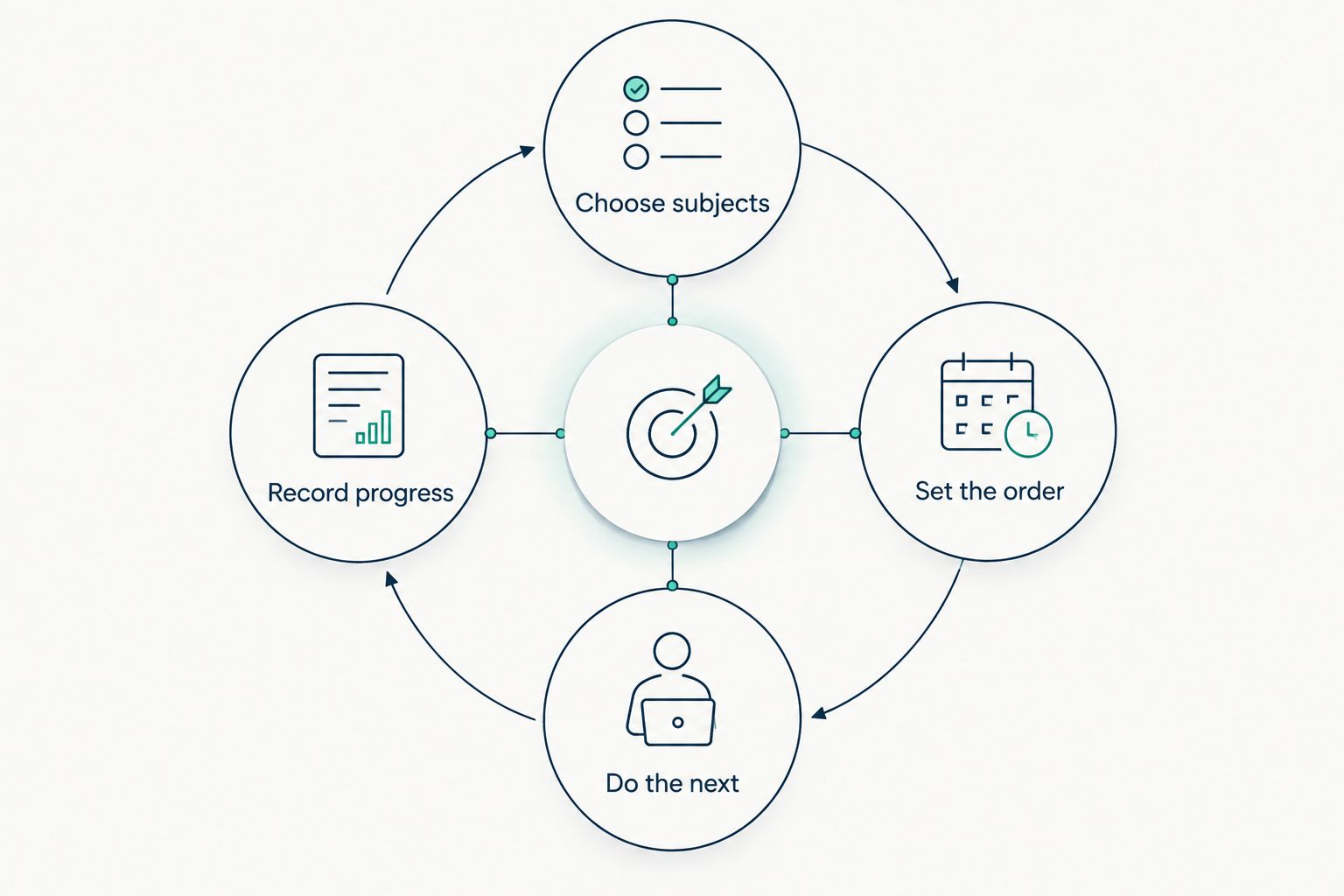
- Choose subjects. List work that can rotate. Leave work requiring more regular attention in a separate daily core.
- Set the order. Put the rotating subjects in a sequence your family can follow. Keep the list visible to both you and your student.
- Do the next. At the start of a loop session, work on the first unfinished subject. Move on when that session's planned work is complete or when it makes sense to stop.
- Record progress. Note the subject, the work attempted, and what the student actually completed. Mark the next starting point before you put the plan away.
The schedule tells you what comes next, not whether the student understood it. If a concept needs another session, stay with it. You can return to the sequence once the student is ready.
What belongs outside the loop?
Keep a subject outside the loop when rotating it would make your student's practice too irregular for your plan. That does not mean every family needs the same daily subjects. Decide from the work your student is doing, the curriculum you use, and the requirements that apply where you homeschool.
You can also split a subject. Regular reading can sit in the daily core while a longer literature project goes in the loop. Math practice can stay regular while a hands-on investigation rotates with Science and writing. The distinction is about the kind of work, not a permanent label on the subject.
For a first homeschool year, begin with one core resource per subject rather than filling the calendar with extras. Add a rotating activity only when you can explain what it contributes. A shorter list makes it easier to see whether your student is learning or merely moving through tasks.
How do you know when to move to the next subject?
Set a clear stopping point for each session, such as completing a lesson, discussing a reading, or reaching a sensible pause in a project. You do not need to finish every large project in one turn. Write down the next step so your student can resume without starting over.
If the student is stuck, do not advance just to keep the loop moving. Change the explanation, use a physical model, or return to the prerequisite idea. For a fraction lesson, you might show parts of a whole with fraction tiles or a chocolate bar divided into eighths, then connect those parts to a picture and a written fraction. The learning goal stays the same even when the method changes.
A student can also ask to continue when a topic has their attention. The loop remains available afterward. It is a memory aid for the plan, not a timer that cuts off useful work.
Why a homeschool loop schedule varies
There is no single subject order that fits every student in 2026. Build the loop around these practical differences:
- Curriculum sequence. Some lessons depend on earlier work. Keep those lessons in order even if other subjects rotate around them.
- The student's current understanding. A subject that needs another explanation deserves time before the next task.
- Available learning time. Appointments, outings, and family commitments change how much fits in a day. The loop preserves your place.
- Subject frequency. Review your records to see whether a long loop leaves an important subject unattended for your plan.
- Learning method. A boxed resource might not fit your student. You can change the teaching method mid-year without abandoning the subject.
- Reporting requirements. Your local rules determine what you must document. A rotation list alone is not a record of completed learning.
In 2026, review the loop against actual completed work rather than judging it by how full the calendar looks. If one subject repeatedly gets skipped, move it earlier, shorten the list, or take it out of the loop. Change one part at a time so you can tell what helped.
Can you use a loop without a rigid daily timetable?
Yes. A loop sets subject order, not a required start time or a fixed length for every lesson. You can begin after reading together, an outing, or the first part of your daily core. Then continue with the next rotating subject when your student is ready.
That flexibility does not mean leaving the day undefined. Tell your student what regular work comes first, show them the next loop subject, and agree on a sensible stopping point. The student still does the learning; you provide a plan they can follow.
For some students, a shorter lesson followed by a movement break is easier to manage than one long block. For others, stopping during a focused project is disruptive. Let the student's response shape the session rather than applying the same interval to every subject.
A workable home-learning day
You might open with reading aloud together, including with an older student. Next, your student completes the regular work you have chosen for that day. After a break, look at the loop and begin its next subject. Before stopping, record what happened and mark where to resume.
This is an example, not a required sequence. If a Science project fills the available time, leave the next subject for another learning day. If the student finishes early, you can continue around the loop or stop. The measure is the work and understanding you can describe, not whether every box received a check.
Planned rest weeks can fit a homeschool rhythm too. A rest week pauses the loop; it does not erase your place. Decide when rest fits your family and your applicable requirements rather than forcing it into a fixed cycle.
How can tutoring fit into the loop?
A tutor fits best when a subject needs an explanation that meets the student where they are. It should support the learning plan you set, not decide the order of your whole homeschool day.
Tia is a personal tutor best for students in Grades 5 to 12 who need adaptive Math, English, or Science instruction within a parent-led homeschool plan. Its advantage is teaching at the student's pace and giving parents a dashboard, engaged-time measurement, and records. Its limit in a loop schedule is just as clear: the parent still decides which subjects rotate, what work counts, and what local reporting requires.
You can place a Tia Math, English, or Science session in the daily core or use it when that subject comes up in the loop. Choose based on the student's need for practice, not on whether a calendar square is empty. If you want to see how the tutoring works, visit Tia.
How do you keep homeschool records with a loop schedule?
Record what the student did, not just where the subject sat on the rotation. For each learning session, note the date, subject, material or activity, and work completed. Add a brief note when the student needs to revisit a concept. Keep whatever additional documentation your local rules require.
A dated record also helps you spot a schedule problem. If writing appears on the loop but rarely appears in completed work, the issue is visible. You can adjust the order or move writing into a more regular slot instead of assuming the plan is working because it looks balanced on paper.
Tia gives parents a live dashboard, engaged-time measurement, and self-writing records for tutoring activity. Those can help you review Tia sessions, but they do not automatically document reading, projects, or other learning outside Tia. Keep the rest of your homeschool record in a form that meets your needs and local requirements.
What if the loop stops working mid-year?
Change the method before you abandon the goal. If a subject keeps taking longer than expected, give it a smaller next step or move it outside the loop. If your student understands the material but resists the format, try a different way to teach it. A loop should make the next decision easier, not make a poor fit harder to change.
Ask your student which part feels difficult: beginning, understanding the concept, or finishing the assigned work. Those are different problems. A clearer starting task helps with beginning; another explanation helps with understanding; a more sensible stopping point helps with finishing. Your student can tell you more about the obstacle than an untouched schedule can.
Revisit the plan during 2026 whenever the work changes. A new unit, a shift in interests, or a different family routine can change which subjects need regular attention. You are allowed to rewrite the loop and keep the progress already made.
FAQ
What is a homeschool loop schedule?
A homeschool loop schedule is a subject list that continues in order across learning days. When a day ends, the next session begins with the next subject rather than a fixed weekday assignment.
How do I start a homeschool loop schedule in 2026?
In 2026, choose the subjects you want to rotate, put them in order, and mark your place after each session. Keep any work that needs more regular attention outside the loop.
Is a homeschool loop schedule better than a fixed schedule?
A homeschool loop schedule is better when your available learning time changes and you want unfinished subjects to carry forward. A fixed schedule is easier when specific subject days matter to your family.
Should Math go in the homeschool loop?
Math can go in the loop if the rotation gives your student the practice needed for your plan. If Math needs more regular attention, keep it in the daily core and rotate other work.
What happens if we miss a homeschool day?
Resume with the next subject on your loop when learning resumes. Check any deadlines or local requirements separately; the loop does not cancel them.
Can I use a loop schedule for a student who needs breaks?
Yes. A loop controls subject order, so you can pause a lesson and return to it after a break. Set the break and lesson length around your student rather than using one rule for every day.
Does a homeschool loop schedule count as a learning record?
No. A loop shows planned subject order, not what your student completed. Keep dated records of actual work and follow the reporting rules that apply where you homeschool.
One last thing
The most useful mark on a 2026 homeschool loop is not a check beside every subject. It is a clear note about where your student will begin next, especially when a lesson needs another approach. That small handoff lets you close the day without making tomorrow's first decision all over again.