Tia News
What to do when a boxed homeschool curriculum does not fit
Boxed curriculum homeschool not working? Keep what fits, change the teaching method, check state requirements, and track what your student learns in 2026.
By Tia Education Team · Published

If a boxed homeschool curriculum does not fit, keep the lessons that help your student learn and change the method, pace, or resource that gets in the way. Check your state's homeschool requirements before dropping content, then record what you taught and what your student can do. In 2026, the box can support your plan without controlling it.
- If a boxed curriculum homeschool plan is not working, keep useful content and change the teaching method first.
- Check state homeschool requirements before replacing lessons, and keep records of the work your student completes.
- Tia is best for Grades 5 to 12 students who need a personal tutor alongside a parent-led plan.
- A curriculum switch is not the only option; a different pace or explanation may solve the problem.
Why this matters
You open the next lesson, and your student is already stuck on the instructions. You bought the box to make planning easier. Now you are wondering whether to push through it or start over.
A difficult lesson does not mean you chose badly. The content might be right while the explanation is wrong for your student. A different example, a slower pace, or a chance to handle physical objects before working with symbols can change how a lesson goes. This guide to how adaptive tutoring changes a lesson shows what it means to change the teaching rather than simply repeat an explanation.
Your decision in 2026 is not limited to keeping or abandoning the whole program. Look at what your student is meant to learn, what is making that difficult, and which parts of the box still help. That gives you a smaller, clearer change to make.
What should you do when a boxed homeschool curriculum does not fit?
Start with the lesson that is failing, not the whole school year. Identify the learning goal, try a different way to teach it, and check whether your student can use the idea without being led through every step. Then decide whether to keep, modify, or replace that part of the curriculum.
| Your situation | Best next move | What it preserves | What to watch |
|---|---|---|---|
| The topic fits, but the explanation does not | Keep the topic and teach it another way | Your planned learning goal | Changing the format without checking understanding |
| The lessons move too quickly | Slow down and revisit the prerequisite | Useful materials already in the box | Mistaking a schedule for evidence of learning |
| The work is too repetitive | Select work that shows understanding | Practice where it serves a purpose | Skipping a skill your student has not mastered |
| The sequence does not suit your student | Reorder lessons after checking dependencies | Content you still want to cover | Teaching a later skill before its foundations |
| Large parts do not fit | Compare another resource with your requirements | Your ability to choose a better match | Discarding records or required content |
No option wins for every student. Keeping the box reduces planning, but it can keep you tied to lessons that are not working. Modifying it gives you control, but you must track what you changed. Replacing it offers a fresh approach, but another complete program can bring the same problem in a different package.
Start with the lesson goal
Write down what the lesson asks your student to do. Separate that goal from the activity printed on the page. If the goal is to compare fractions, finishing a particular worksheet is not the goal. Showing which fraction is greater, and explaining why, is closer to the learning you need to see.
Ask your student to show you where the work stops making sense. Listen before you demonstrate. A confusing direction, an unfamiliar word, and a missing earlier skill call for different responses. In 2026, treat that conversation as information about the lesson, not a verdict on your student.
Change the method before changing the topic
Try an explanation that connects to something your student already knows. For fractions, physical pieces or a chocolate bar divided into eighths can make the parts visible before you move to pictures and symbols. For writing, talk through the idea before asking for a paragraph. The student still does the thinking; you change how the idea is introduced.
You do not need to create an elaborate lesson to test a new method. Work through a small example together, then give your student a similar problem to attempt independently. If they can explain their choice, you have something more useful than a completed page.
Decide what to keep
Keep the box's reading, examples, practice, or sequence when they serve your student. Set aside the parts that repeatedly block the learning goal. If the material depends on a skill your student has not learned, pause and teach that skill before returning.
Keep the useful structure; change the part that prevents learning. That is often a more manageable 2026 homeschool decision than buying a replacement for every subject at once.
How to change course without losing your place
A change works best when you can name what stayed the same. You remain in charge of the learning goal and the records. The resource supplies material, not permission to respond to your student.
- Keep the spine. List the topics you still intend to cover and check them against your state's current homeschool requirements. Note any content you cannot simply omit.
- Change the method. Choose an explanation, example, activity, or pace that suits the difficulty you observed. Change one part before deciding the entire resource has failed.
- Check the work. Ask your student to solve, explain, write, or demonstrate something without copying the example. Use that work to choose the next lesson.
- Record the change. Save the work and note the topic, resource, and adjustment you made. Follow the recordkeeping rules that apply where you homeschool.
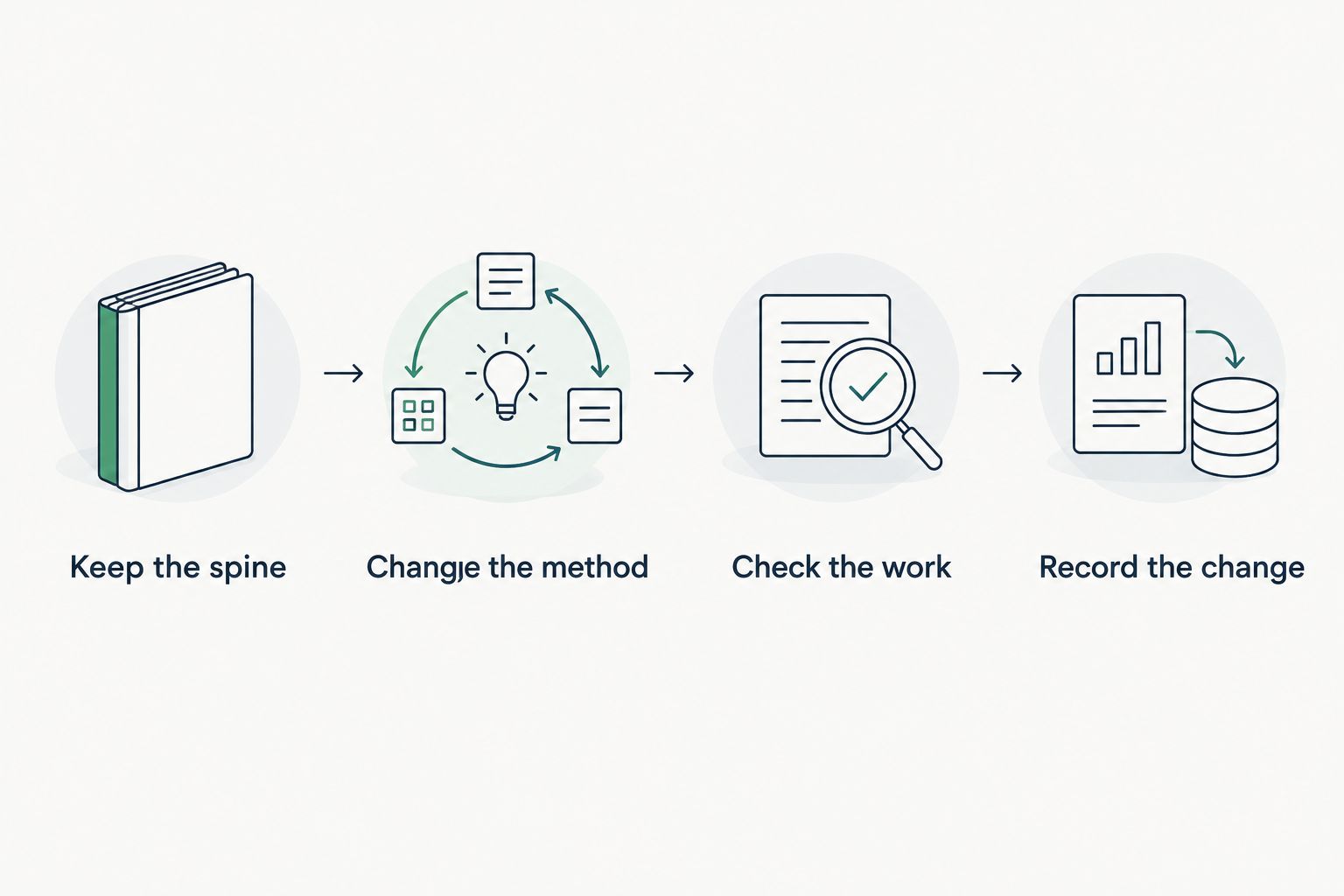
These steps also give you a way to talk with your student. You can say what the lesson is trying to teach and ask which part feels unclear. You do not have to promise that the next method will work. You only need a way to notice whether it does.
In 2026, resist the urge to count a finished page as proof by itself. Look at what your student did independently. A short explanation in their own words can reveal a gap that a copied answer hides. Keep the work even when it shows a misunderstanding; it helps you see what to teach next.
Why a boxed curriculum fit varies
- The starting point differs. A lesson can assume earlier knowledge your student does not yet have. Teach that foundation rather than repeating the same instruction louder or faster.
- The examples differ. An unfamiliar setting can obscure a familiar concept. Change the context while keeping the learning goal.
- The pace differs. A printed schedule cannot tell you when your student is ready for the next topic. Use their work to make that call.
- The amount of practice differs. Some students need another example; others can demonstrate understanding without completing every similar question.
- The way a student responds differs. Speaking an idea aloud, using physical objects, and writing a response reveal different parts of understanding. Choose the response that helps you see the skill, then work toward any required written work.
- The reporting rules differ. Your state's requirements affect what you must teach and document. Check them before making a major change to a 2026 plan.
These factors do not require a new box for every difficulty. They tell you where to look. If the problem is the example, change the example. If the problem is missing prior knowledge, teach it. If the content itself does not meet your needs, then compare alternatives against the same goal.
Should you keep, adapt, or replace the boxed curriculum?
Keep it when your student is learning and the structure saves you planning time. You can still adjust individual lessons. The downside is that a convenient schedule can tempt you to move on before your student understands.
Adapt it when the topics are useful but the teaching approach does not fit. Keep a note of what you replaced and a sample of your student's work. The downside is the extra planning and recordkeeping you take on.
Replace it when the content or approach repeatedly fails to serve your student. Compare any new resource with the skills you need to cover and the way your student learns. The downside is that switching materials alone will not resolve an unidentified learning gap.
| Choice | Best for | Advantage | Limitation |
|---|---|---|---|
| Keep the box | A student learning well with occasional adjustments | Less day-to-day planning | The printed pace can become the default |
| Adapt the box | A student who needs another explanation or pace | Retains useful content | Changes need to be tracked |
| Replace the box | A student whose needs are poorly served across the material | Lets you choose a different approach | Requires a new content and requirements check |
Do not make this a vote on whether you are doing homeschool correctly. Make it a decision about the next useful lesson. A first-year parent can begin with one core resource per subject and change a method when needed, rather than collecting replacements for every difficult day.
Where does a personal tutor fit?
A personal tutor can help when the topic belongs in your plan but your student needs another way into it. Tia is best for Grades 5 to 12 students who need personalized Math, English, or Science teaching alongside a parent-led homeschool plan. Tia adapts to a student's pace and interests, while the parent dashboard shows progress and engaged time.
Tia does not decide your homeschool requirements or replace your responsibility for the overall plan. It is a teaching resource for the subjects it covers, not a reason to discard a boxed curriculum that is helping. If you need support with a difficult topic, look at Tia alongside the lesson goal and the work your student can already do.
The useful question is not whether Tia or the box should own the school day. It is whether a different explanation helps your student understand the next concept. You stay the parent making that decision.
How do you keep records when you change materials?
Keep records that show both what you planned and what your student did. Save examples of work, note the topics covered, and identify any resource you used in place of a boxed lesson. Check your state's current rules for the records and subjects it requires; a dashboard or worksheet does not change those obligations.
A simple record can say which lesson goal you kept, how you taught it differently, and what the student produced. That is more informative than marking a lesson complete when your student still cannot use the skill. In 2026, make this note when you change the lesson so you are not reconstructing the decision later.
If you use Tia for a subject it covers, its parent dashboard and engaged-time measurement can help you see activity and progress. Pair that information with the work you retain and your own notes. Your records should reflect the learning you are responsible for documenting, not just time spent with a resource.
Can you change a curriculum mid-year?
Yes, you can change a curriculum mid-year, subject to the homeschool requirements where you live. Keep your earlier records, identify what your student has already learned, and map any replacement material to what remains. You do not need to restart a subject simply because you changed its teaching resource.
Begin with the next skill your student is ready to learn. If the new resource approaches topics in a different order, check what it assumes your student already knows. This keeps a mid-year switch from creating another gap.
What if your student dislikes every lesson in the box?
First find out whether the difficulty is the content, the presentation, the pace, or the amount of work. Ask your student to show you a specific stopping point. Then change one part of the next lesson and watch what happens when they work independently.
If the mismatch spans the material, compare other resources rather than forcing the entire box. Keep your requirements and the student's learning goals in view. A resource that feels easier to open is useful only if it helps you teach what your student needs to learn.
FAQ
What do I do if my boxed homeschool curriculum is not working?
Keep the learning goal, identify where your student gets stuck, and change the method or pace before replacing the entire curriculum. Check your state's homeschool requirements before dropping content.
Can I skip lessons in a boxed homeschool curriculum?
You can choose how to use a boxed resource, but first check your state's requirements and whether a later lesson depends on the skill. Keep work that shows your student understands what you decide to move past.
Should I finish a boxed curriculum I already bought?
Finish the parts that help your student learn, not pages solely for the sake of finishing them. If the approach repeatedly blocks progress, adapt or replace those lessons while tracking the required content.
Can I switch homeschool curriculum in the middle of the year?
Yes, you can change resources mid-year while continuing to meet the rules where you homeschool. Keep earlier records and identify the skills your student still needs to cover.
How can I tell whether the curriculum or the pace is the problem?
Ask your student to explain a lesson goal and show where the work becomes unclear. If a different explanation helps but the next printed lesson arrives too soon, adjust the pace before replacing the content.
Is a personal tutor a replacement for a boxed curriculum?
A personal tutor can support a student on specific subjects, but it does not automatically replace a parent's homeschool plan. Tia teaches Math, English, and Science to students in Grades 5 to 12; you remain responsible for choosing resources and meeting local requirements.
What records should I keep when I adapt a homeschool lesson?
Keep the topic, the resource or method you used, and work that shows what your student did. Check your state's current recordkeeping rules for anything else you must retain.
One last thing
The most useful part of a box may be its list of topics, not its exact lesson script. When a lesson stalls in 2026, name the skill before you judge the whole curriculum. You can keep the destination and change the route.