Tia News
Could voice-based tutoring suit your student with ADHD?
Voice tutoring for ADHD suits some students, not all. Compare voice and text, plan a short trial, and check understanding without promising treatment.
By Tia Education Team · Published

Voice tutoring for ADHD can suit a student who finds speaking a question easier than typing it, provided the student also feels comfortable hearing explanations. If homework stalls before your student can ask for help, an optional spoken conversation is one format to try, not a treatment for ADHD or a promise of better attention. Keep text, diagrams, and written work available, and judge the fit by what your student can explain and do.
- Voice tutoring for ADHD is an individual-fit choice, not an ADHD treatment.
- Tia personal tutoring suits families seeking curriculum-aligned teaching with optional voice, text, and parent learning records.
- Keep written math and independent reading practice alongside spoken explanations.
- Compare participation and understanding, not just session length or willingness to talk.
Why this matters
You know the moment: the assignment is open, your student has a question, and writing that question becomes another task. You do not need to decide that all future learning should happen aloud. You need to find out whether speaking makes this particular lesson easier to enter.
Voice is an option, not a label. A student can prefer talking through an unfamiliar concept and still want text when checking a detail. The practical starting point is switching between voice and text within a lesson, rather than committing to one format for every subject.
Choose the format around the learning task, not around the diagnosis. Your student remains the person doing the thinking.
Could voice-based tutoring suit your student with ADHD?
Yes, when your student wants to speak and the conversation helps them work on the actual subject. It is a poor fit when listening feels uncomfortable, speaking adds pressure, or conversation replaces the work they need to practice. An ADHD diagnosis alone does not answer that question.
Use this comparison when choosing a starting format in 2026. These are options to test with your student, not predictions about how every student with ADHD learns.
| Format | Best for | Useful feature | Limitation to check |
|---|---|---|---|
| Voice | Students who prefer asking questions aloud | Lets the student speak a question and hear an explanation | Spoken conversation does not replace written working or independent reading |
| Text | Students who prefer composing questions in writing | Keeps participation centered on typed exchanges | Typing the question can become an extra task |
| Voice and text | Students whose preference changes with the task | Allows different formats during the same lesson | Switching formats still needs to serve a clear learning goal |
There is no requirement to start with voice. Ask your student which format feels comfortable, then observe an ordinary learning task. If text works better, that is a useful answer, not a failed trial.
Signs that make voice worth trying
Consider a spoken explanation when your student willingly describes a question aloud but hesitates to type it. Another reason to try is a direct request from your student to hear an explanation rather than read one. Neither observation establishes a fixed learning style.
Look for the specific obstacle. Is your student unsure about the concept, unsure how to phrase the question, or simply uncomfortable with the chosen format? Voice addresses the participation format; teaching still needs to address the concept.
Signs to pause or change format
Stop the voice experiment if your student asks to type, finds the conversation tiring, or cannot comfortably follow the explanation. You do not need to persuade them to prefer it. Change the format and keep the subject goal small.
Also pause when the exchange sounds productive but your student cannot attempt the next step. A fluent conversation is not enough evidence of understanding. Return to a worked example, a diagram, or a simpler question.
Why the fit varies from student to student
The useful question is not whether voice is generally better for ADHD. It is whether this format suits your student, this task, and this moment. Check these factors before choosing:
- Student choice: Ask whether your student wants to speak, type, or switch. Do not turn an optional format into another requirement.
- The immediate obstacle: Separate difficulty asking for help from difficulty understanding the subject. They need different responses.
- The learning goal: Hearing an explanation is different from practicing reading, writing an essay, or showing mathematical working.
- Pace and explanation: Check whether your student needs a smaller step, another example, or time to attempt the problem.
- Lesson length: Use a shorter session or a movement break when that fits your student, without imposing a universal interval.
- Evidence of understanding: Look at answers, explanations, and subsequent attempts, not only time spent participating.
You can change more than the input format. Keep the student involved in deciding what to change, and avoid making several changes at once when you want to understand what helped.
How to try voice without turning it into another assignment
Use a familiar subject and a manageable task. The purpose is to compare ways of participating, not to test your student's tolerance for a new routine. Keep your observations brief enough that you will actually use them.
Choose the task
Pick something specific, such as explaining a step in a math problem or asking about a science concept. Avoid starting with an entire backlog of unfinished assignments. You want a clear question and a recognizable stopping point.
Tell your student what you are trying: a different way to ask for help. Make clear that they can return to text. That keeps the decision about learning rather than about pleasing you.
Let them choose
Offer voice and text without presenting either as the correct answer. If your student wants to begin by typing and later speak, follow that choice. Do not require them to explain or defend the preference.
Stay nearby if they want support, but leave the question to them. Your role is to help the session begin, not to conduct the conversation on their behalf.
Keep visible work
Leave paper, the assignment, or a relevant diagram available. A spoken explanation of a math step should sit alongside the student's written working. For English, keep the distinction between discussing a passage and reading it independently.
Do not remove a useful visual just because voice is available. Different parts of the same task can call for different ways of working.
Check understanding
After the explanation, ask your student to attempt the next step or explain the idea in their own words. Keep this low pressure. You are checking whether the teaching reached the subject goal, not scoring how well your student talks.
Notice where another explanation is needed. A correct answer with substantial help tells you something different from an independent attempt, so record that distinction.
Review together
Ask what felt easier and what felt harder. Combine that answer with the work you saw. Your student's preference matters, and so does whether the lesson addressed the intended skill.
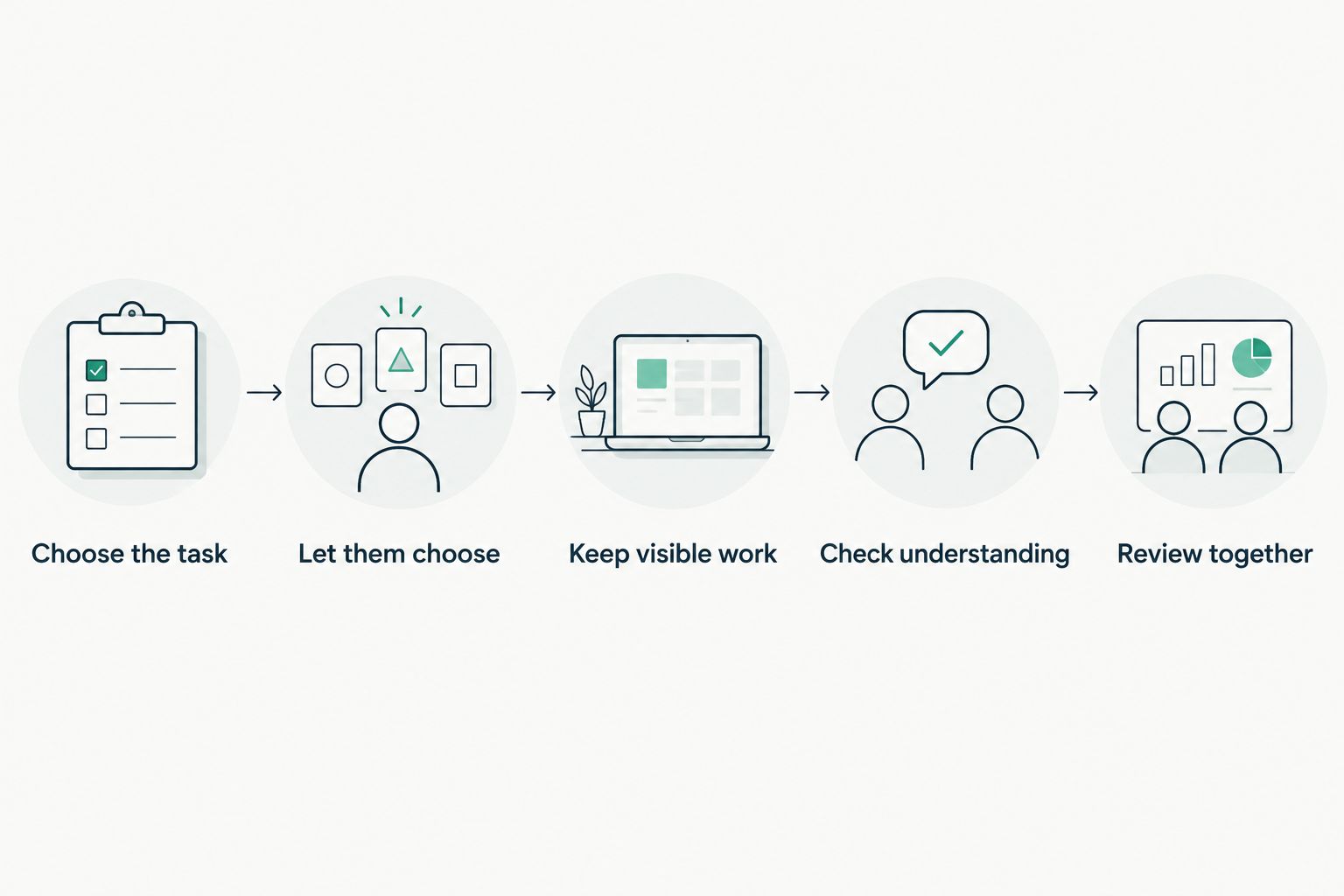
If a short session fits, you can begin with as little as 10 minutes. That is a practical starting option, not a required duration or a promise of results. End at a sensible point and use what you noticed to plan the next session.
What Tia offers for this kind of trial
Tia adapts to the student, not the other way around. Its personal tutoring covers Math, English, and Science for Grades 5 to 12, with curriculum-aligned teaching that adapts explanations, pace, level, and examples to the student's interests.
The two-way voice launch confirmed on October 17, 2026 lets students speak and hear verbal explanations. Students can also type and switch between voice and text within the same lesson. Two-way voice is included in all bundle plans; that inclusion is not confirmed here for standalone subject plans.
Tia personal tutoring is best for families seeking curriculum-aligned explanations, optional voice and text, and parent learning records. The limitation is equally important: these features do not establish that voice improves ADHD symptoms or produces higher achievement.
The learning records include more than time. The tutor measures mastery per question, maps it to the curriculum, and includes that information in reports. Its Bayesian Knowledge Tracing method updates an estimate of skill mastery from student answers over time.
Treat that estimate as information to review alongside your student's work. It is not an exact measure of everything the student knows, and curriculum mastery tracking is not the same as independently verified exam-score gains. Parents also receive a live dashboard, engaged-time measurement, and self-writing homeschool records.
What should you look for after a session?
Use a small set of observations rather than a verdict based on enthusiasm alone. A student can enjoy talking without understanding the concept. Equally, a quiet session can include worthwhile learning.
For your 2026 tutoring review, separate participation, understanding, and preference:
| Check | What to observe | What it does not establish |
|---|---|---|
| Participation | Whether your student asks their own question | Improved attention or a clinical benefit |
| Understanding | Whether your student attempts or explains the next step | Mastery of the whole topic |
| Independence | How much help the attempt requires | Guaranteed future performance |
| Preference | Whether your student wants voice, text, or a mixture next time | A permanent learning style |
Write a short note about the task, the format, and the help required. You do not need a second reporting system. The useful record is one that helps you choose the next teaching step.
If the format feels easier but understanding is still unclear, adjust the explanation or task. If the format itself is uncomfortable, change it. Those are different decisions.
Does voice tutoring replace ADHD support?
Voice tutoring does not replace ADHD care, school accommodations, or individualized educational support. It changes how a student participates in a lesson. Keep existing support decisions separate from whether a spoken explanation feels useful.
If your student has an IEP or 504 plan, continue working with the relevant school team on those supports. Do not assume that choosing voice tutoring automatically delivers a listed accommodation or fulfills a school's responsibilities.
Should every tutoring session use voice?
Voice does not need to be the default for every session. Start with the student's preference and the task, then allow a change. A format that suits a science discussion does not automatically suit essay drafting or a written math solution.
Keep the decision reversible. You are choosing a way to work today, not assigning your student a permanent category.
Can listening to tutoring replace reading practice?
Listening to tutoring does not replace independent reading practice. A spoken explanation can support access to subject learning while reading remains a separate skill to practice.
If the goal is understanding a science idea, hearing an explanation is one participation option. If the goal is reading a passage independently, make sure the student still does that work. Name the goal before choosing the format.
FAQ
Is voice tutoring for ADHD better than text tutoring?
Voice tutoring for ADHD is not automatically better than text tutoring. Compare the student's comfort, participation, and understanding on a specific task, and keep both formats available.
Can voice tutoring improve my student's attention?
Do not expect voice tutoring to improve attention as a clinical outcome. It is an optional way to participate in subject learning, not an ADHD treatment.
Can my student switch between speaking and typing with Tia?
Tia lets students switch between voice and text within the same lesson. Students can speak and hear verbal explanations while retaining the option to type.
How long should we try a voice tutoring session?
A session can be as short as 10 minutes when that fits your student. Choose a manageable task and a sensible stopping point rather than treating that duration as a rule or a guarantee.
What if my student prefers typing instead of talking?
Use text if your student prefers typing. An ADHD diagnosis does not mean a student should learn through voice, and preferences can change with the task.
What should parents compare when choosing voice tutoring in 2026?
Compare format choice, curriculum alignment, explanation flexibility, and learning records in 2026. Check understanding through student work rather than treating time spent or willingness to talk as proof of mastery.
Does hearing a lesson count as independent reading practice?
Hearing a lesson is not independent reading practice. Keep reading practice separate when reading is the skill your student needs to develop.
One last thing
The most useful result of a voice trial can be a clear preference for text. That tells you something actionable about your student without requiring a new label or a longer session.
For your next tutoring decision in 2026, choose a manageable task and let your student choose how to ask for help. Keep the format flexible and the learning goal clear.
Related guides
- When typing gets in the way of showing what a student knows
- Talking through math instead of typing every question
- Planning movement breaks for homeschool students with ADHD
- What parents should see in a tutoring dashboard
Tia Education Team