Tia News
One lesson, different ways to learn: switching between voice and text
Voice or text tutoring works best when students choose by task. Learn when to speak, listen, type, or switch while keeping the learning goal clear.
By Tia Education Team · Published

Voice or text tutoring lets your student speak, listen, or type within the same lesson, switching formats as the task changes. Tia adapts to the student, not the other way around.
- Tia makes voice or text tutoring a student choice within the same lesson.
- Choose voice for talking through a question; choose text when exact wording or notation matters.
- Keep written math, independent reading, and writing practice when those are the learning goals.
- Two-way voice is included in all bundle plans; standalone subject-plan inclusion is not confirmed.
Why this matters
Your student understands the question but stops at the thought of typing an explanation. Or the opposite happens: speaking feels uncomfortable, while putting a question into words on screen feels manageable. You do not need to turn either moment into a decision about how your student must always learn.
For families choosing tutoring in 2026, the useful question is not whether voice beats text. It is whether the student can choose a format that supports the work in front of them. You keep the learning goal steady while allowing the way of participating to change.
Choose the format for the task, not a permanent label for the student. Talking, listening, reading, and writing have different roles within a lesson.
Should my student use voice or text tutoring?
Use voice when your student wants to ask a question aloud or hear an explanation. Use text when your student wants to compose a question, examine exact wording, or work carefully with symbols. Use both when different parts of the same lesson call for different approaches.
The two-way voice capability confirmed on October 17, 2026 lets students speak and hear verbal explanations while retaining typed participation. Switching between voice and text happens within the same lesson. The choice does not require committing the entire session to one format.
| Format | Best for | Practical advantage | Limitation to keep in mind |
|---|---|---|---|
| Voice | Asking aloud and explaining reasoning verbally | The student can participate without typing every question | Spoken explanations do not replace written notation or independent reading |
| Text | Exact wording, written questions, and careful revision | The student can compose what they want to ask | Typing can become an extra task when expressing the question is uncomfortable |
| Voice and text | Lessons with changing demands | The student can change how they participate within the lesson | Switching formats does not remove the need to practice the target skill |
These are choices, not a ranking. Start with the student's preference, then check whether the format still serves the learning goal.
Voice: best for talking through a question
Choose voice when the student wants to explain where they became confused. That might mean describing why a math step seems wrong or asking for a science explanation in different words. Hearing an explanation is another available way to take part.
Do not require a polished speech. A useful starting point is simply naming the confusing step and asking for help understanding it. The student still needs to consider the explanation and do the learning.
Voice also has limits. Saying how to solve an equation is not the same as writing each step correctly, and hearing a passage is not independent reading practice. Use spoken participation to support the subject goal, not replace it.
If your student prefers typing, respect that preference. Voice is optional, not the next level they must reach.
Text: best for exact wording and written work
Choose text when the wording itself matters. A student revising an English sentence needs to examine the sentence, not just discuss its general meaning. A student working with mathematical notation also needs to attend to the symbols.
Text gives the student a way to compose a question before asking it. That is a useful choice when speaking feels uncomfortable or when they want to be precise. It does not need to be the default for every exchange.
The limitation is the extra act of typing. When the goal is understanding a science concept, composing a long question can become separate work. Let the student ask aloud if that is the more comfortable route, then return to writing when writing becomes the actual goal.
Voice and text: best for changing tasks within one lesson
A student can begin with a spoken question, hear an explanation, and then type a follow-up. They can also start with text and switch to voice when they want to describe their reasoning. Neither sequence is the correct sequence for everyone.
Tia is a personal tutor best suited to families seeking curriculum-aligned teaching with voice and text choices in the same lesson. Its personalized tutoring also adapts explanations, pace, level, and examples to the student.
That flexibility has a boundary: format choice is not evidence that learning has happened. The student still needs opportunities to answer, apply the idea, and work independently. For more on the teaching mechanism, see how adaptive tutoring changes a lesson.
How do I help my student choose a format?
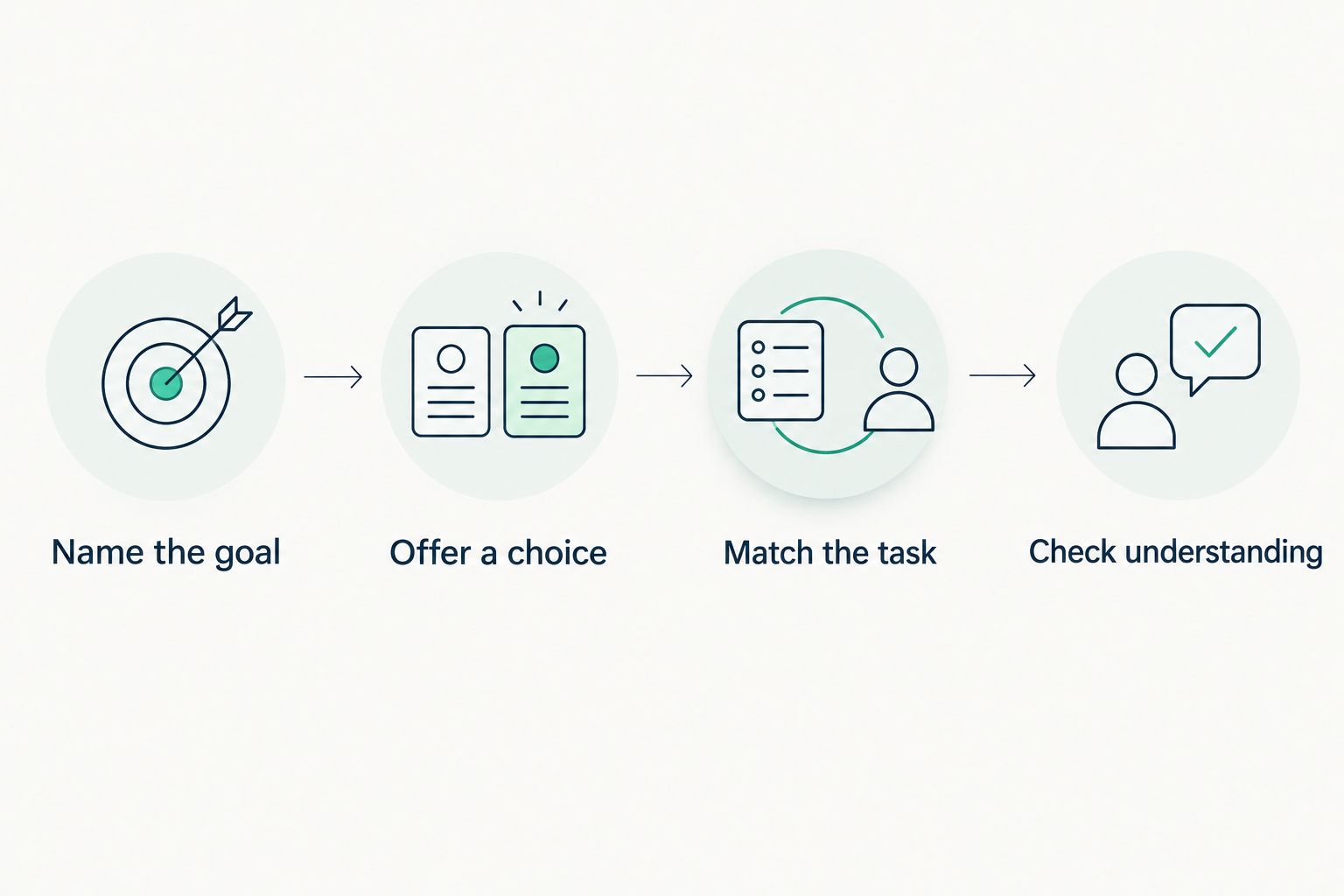
Use this short decision process for a lesson in 2026. It is a parent-guided approach, not a set of interface instructions.
- Name the goal. Decide what the student is learning, such as explaining a concept, solving a problem, or revising a paragraph. Keep that goal separate from how they ask for help.
- Offer a choice. Ask whether they want to speak or type the first question. Accept the answer without turning it into a test.
- Match the task. Keep written work when notation, spelling, sentence construction, or independent reading is part of the goal. Spoken support can sit alongside that work.
- Check understanding. Ask the student to apply the explanation rather than simply confirm that it sounded clear. Let them change formats again if needed.
The goal is not frequent switching. A student who works comfortably in text can stay there, while another student can move between formats when it helps them participate.
What would switching look like in a real subject?
The following examples are illustrative lesson plans, not testimonials or records of live sessions. They show how you can separate asking for support from practicing the subject skill.
Math: discuss the reasoning, keep the written steps
A student asks aloud why a particular operation comes next. They listen to an explanation, then work through the calculation on paper. They can type a precise follow-up if a symbol or expression needs attention.
The parent checks the mathematical working, not how fluent the conversation sounded. A confident spoken explanation does not remove the need to write an equation accurately.
English: talk about the idea, then write the sentence
A student describes the point they want a paragraph to make. They ask for an explanation of how evidence supports that point, then return to their own writing. The next question can be typed if it concerns a particular sentence.
Keep independent reading in the lesson when reading is the goal. Listening to an explanation can support a discussion, but it does not show how the student reads the passage alone.
Science: explain a concept, then apply it
A student asks aloud for help understanding a process. After hearing an explanation, they write their own account or work on a related question. They can use text when a scientific term needs careful attention.
Check whether the student can use the idea in the next task. Repeating the explanation is different from applying it.
Why the right format varies
The same student does not need the same format for every subject or every part of a lesson. These factors give you practical reasons to offer a choice:
- The learning goal. Discussing an idea and practicing written expression call for different kinds of work.
- Comfort with typing. Writing a question can be uncomfortable even when the student has something useful to ask.
- Comfort with speaking. Some students prefer composing their thoughts in text rather than saying them aloud.
- The need for precision. Mathematical notation, scientific vocabulary, and sentence revision require close attention to written detail.
- The current task. Asking for an explanation and demonstrating understanding are different activities within the same lesson.
Avoid assigning a fixed auditory or visual identity. A preference for hearing one explanation does not establish a permanent learning style or prove that voice produces better results.
How do I know whether switching is helping?
Watch the work, not just the conversation. Is the student asking the question they wanted to ask? Can they explain the next step and attempt it themselves? Those checks keep format choice connected to learning.
When comparing tutoring in 2026, separate participation, engaged time, and mastery information. They answer different questions. A student being present is not the same as a student understanding a skill.
Tia measures mastery per question, maps it to the curriculum, and includes it in the report. Its Bayesian Knowledge Tracing method updates an estimate of skill mastery from student answers over time. That estimate is useful learning information, not an infallible measurement or independently verified exam-score gain.
Parents also receive a live dashboard, engaged-time measurement, and self-writing homeschool records. Use those records alongside the student's actual work. Do not treat a longer conversation as proof of greater understanding.
Can students in Grades 5 and 6 choose either format?
Students in Grades 5 and 6 fall within the stated Grades 5 to 12 product range. Offer the same choice without assuming younger supported students should always speak rather than type.
A parent can help identify the lesson goal and then step back from composing every question. Keep the student responsible for attempting the work. Choosing voice should not turn the parent into the person answering on their behalf.
Does voice tutoring suit every student with ADHD?
Voice tutoring is an individual-fit choice, not an ADHD treatment. Some students find spoken participation more comfortable; others prefer text or a mixture of both.
Ask the student which format they want for the current task. Do not promise better attention, clinical benefits, or higher achievement from using voice. If the format is not helping participation, change the approach rather than insisting on it.
FAQ
Can my student switch between voice and text in the same lesson?
Yes. Tia lets students speak, hear verbal explanations, and type within the same lesson. They can switch formats rather than choosing one for the entire session.
Is voice or text tutoring better for learning?
Neither format is universally better. Choose voice for spoken questions and explanations, text for precise written work, or both as the task changes.
Does my student have to use voice?
No. Voice is optional, and students retain typed participation. A student who prefers text does not need to switch to speaking.
Is two-way voice included in every plan?
Two-way voice is included in all bundle plans. Inclusion in standalone subject plans has not been confirmed, so check the current plan details before choosing.
Can talking through math replace writing the steps?
No. Talking through math can support a discussion of reasoning, but students still need written notation and mathematical working when those are part of the task.
Does hearing an explanation count as independent reading?
No. Hearing an explanation is listening, not independent reading practice. Keep opportunities for the student to read the actual text when reading is the learning goal.
Should I choose voice for a student who finds writing uncomfortable?
Offer voice as an option for asking questions and discussing subject content. Keep writing practice separate when writing is the skill being taught, and let the student choose how to ask for support.
One last thing
For your next lesson in 2026, ask a smaller question than which format your student prefers overall: how would they like to ask this particular question? Then check what they can do with the explanation.
A comfortable conversation is a starting point, not the finish line. Keep the student in charge of participating and responsible for the learning.
Related guides
- When typing gets in the way of showing what a student knows
- Talking through math instead of typing every question
- What parents should see in a tutoring dashboard
Tia Education Team