Tia News
Talking through math instead of typing every question
Talk through math problems without losing written working. Learn when to use voice, text, and diagrams so your student can explain and check each step.
By Tia Education Team · Published

Your student knows what they want to ask, but typing the math question has become a task of its own. Let them talk through math problems by describing the sticking point, explaining a possible next step, and asking for help, while keeping equations, diagrams, and written working visible. Speaking is another way into the lesson, not a replacement for doing the math.
- Talk through math problems to explain reasoning, then use written working to check each step.
- Tia suits families seeking personalized math tutoring with optional voice, curriculum-aligned teaching, and parent records.
- Choose voice for discussion, text for precise notation, and a mixture when the problem needs both.
- A clear spoken explanation is useful evidence, but students still need to solve problems independently.
Why this matters
You do not need to turn every homework question into a typing exercise. If your student wants to explain something aloud, that is a reasonable starting point. Keep the learning goal separate from the communication format.
For families choosing online math tutoring in 2026, the useful question is not whether speaking beats typing. It is whether your student can ask for an explanation, work through the mathematics, and show what they understand.
The guide to when typing gets in the way of showing what a student knows covers the broader participation question. Here, the focus is math: discussing reasoning without losing the symbols, diagrams, and working that make an answer checkable.
How can students talk through math problems instead of typing?
Start with the problem in view. Your student can speak about what it asks, identify the confusing step, and suggest what to try. Then they should write the mathematical step and check whether it matches what they said.
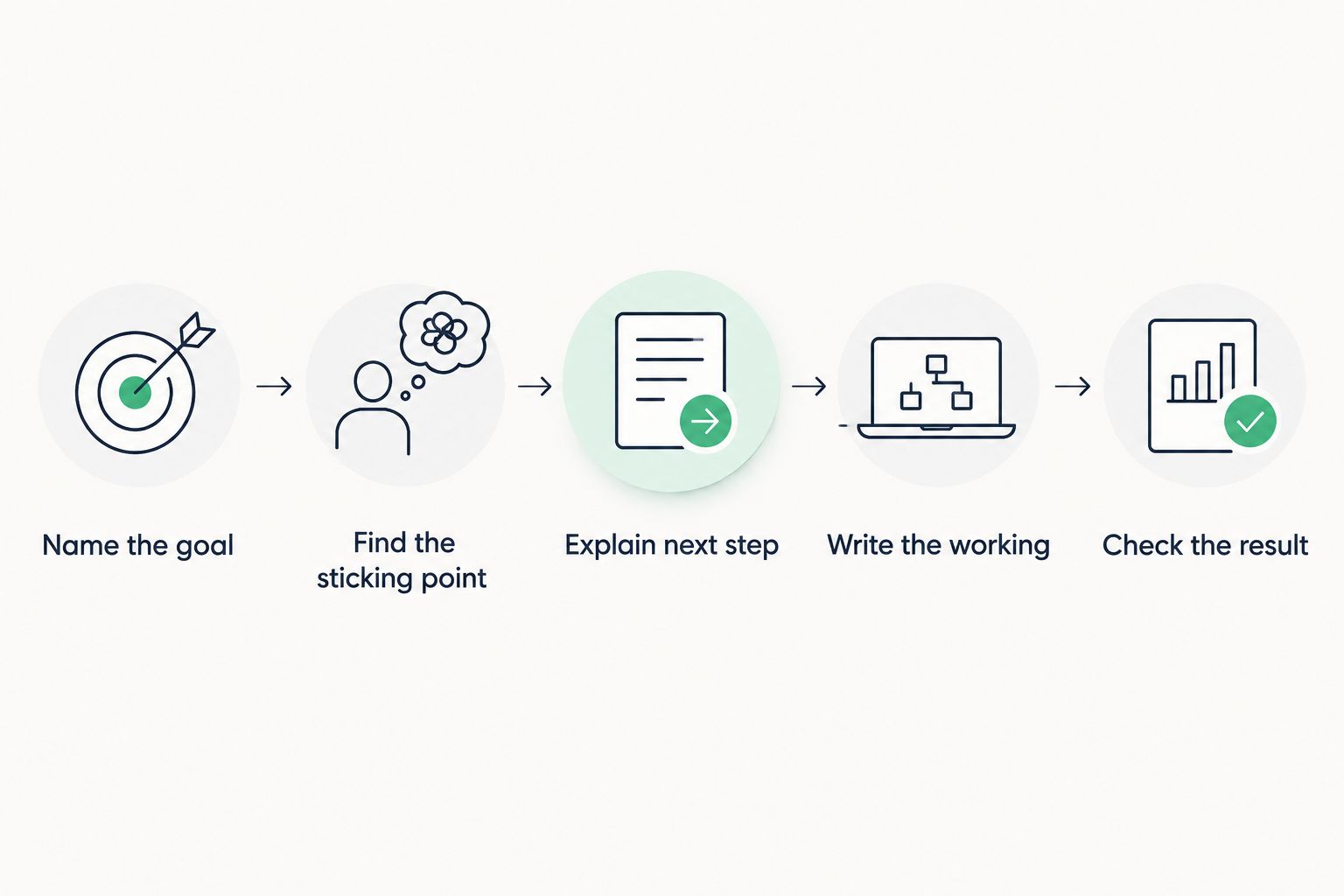
Use this sequence without turning it into a script:
- Name the goal. Ask your student to say what the problem wants them to find, rather than reading every symbol aloud.
- Find the sticking point. Separate an unfamiliar word from an unclear operation or a calculation mistake.
- Explain a next step. Let your student propose a move before asking the tutor to solve it.
- Write the working. Keep the equation, calculation, or labeled diagram on paper or in the student's usual workspace.
- Check the result. Ask whether the answer fits the question and whether the student can explain why.
These are teaching prompts, not instructions for a particular interface. Your student can pause, switch to text, or return to the diagram whenever that makes the mathematics clearer.
The goal is not a polished speech. A hesitant explanation can still give you something specific to discuss: why the student chose an operation, what a symbol means, or where a calculation stopped making sense.
Voice, text, or both: which fits the math task?
Choose the format for the task, not a permanent learning-style label. The same student can prefer speaking about a word problem and typing an equation later in the lesson.
In 2026, format choice should be part of your tutoring decision, not a reason to abandon written mathematics. Use this comparison as a starting point and let the student change their mind.
| Format | Best for | What it helps you do | What to watch for |
|---|---|---|---|
| Voice | Explaining a sticking point | Ask questions and describe reasoning without composing a typed paragraph | Spoken notation can leave signs, grouping, or labels unclear |
| Text | Precise mathematical expressions | Keep symbols and the exact question visible for checking | Entering notation can interrupt the discussion |
| Voice with written working | Problems involving several steps or diagrams | Discuss the method while preserving a checkable solution | The student still needs to connect each spoken idea to the written step |
None of these formats removes the need to think. A student who prefers text does not need to speak to prove engagement, and a student who prefers voice should not have to type every explanation before receiving help.
Talking through a word problem
Begin by asking what the quantities represent. Do not rush straight to choosing an operation. A student can read a problem accurately without yet knowing how its information fits together.
Illustrative example, not a recorded tutoring exchange: a rectangular garden measures 3 meters by 4 meters. The question asks for its perimeter. Have your student sketch the rectangle and label the sides before calculating.
Useful spoken prompts include:
- What does perimeter ask us to measure?
- Which sides have the same length?
- How will your calculation include every side?
- What unit belongs with the answer?
The written calculation is 3 + 4 + 3 + 4 = 14 meters. Keep that line visible while your student explains why all four sides belong in the total.
If the student multiplies the two dimensions instead, return to the question. Ask them to trace the boundary they are measuring. Correct the meaning before repeating the calculation. You do not need to supply a longer explanation when the missing piece is the difference between going around a shape and covering its surface.
Talking through fractions and algebra
Fractions need visible notation. Saying the numerator and denominator can support a discussion, but your student should still see which number sits above the fraction bar.
For an illustrative fraction problem, divide a bar into 8 equal parts. Shade 3 parts, then another 2 parts. Ask your student to describe what changed and what stayed the same before writing 3/8 + 2/8 = 5/8.
The whole is still divided into eighths. The number of selected parts changed. Keep the picture beside the symbols so your student can connect the explanation to the calculation.
For algebra, ask your student to describe the purpose of a step. With 2x + 3 = 11, they can explain that subtracting 3 from both sides preserves equality, then write 2x = 8. Dividing both sides by 2 gives x = 4.
Do not accept fluent wording as the final check. Have the student substitute 4 into the original equation. Written substitution connects the spoken explanation to an answer they can verify.
Talking through geometry without losing the diagram
Geometry discussion needs clear references. Words such as that angle or the other line are not enough when several features appear in the same drawing. Keep labels visible and ask your student to name the part they mean.
For example, when two straight lines cross, opposite angles are equal. Your student can identify an opposite pair, mark the diagram, and explain which relationship supports the answer. The drawing should show the same relationship the student describes.
Tia's client-supplied product demonstrations use crossing cricket bats for Fred and crossing horse trails for Charlotte to explain vertical angles. These are labeled demonstrations of interest-based explanations, not testimonials or evidence of mastery. They show an explanation connected to a student's interests, not the new voice interface.
An analogy is a starting point. Bring the student back to the angle labels and the mathematical relationship so the example does not become a substitute for the geometry.
Why the right balance varies
There is no requirement to finish a lesson in the format you started with. Use these factors to decide when talking helps and when something needs to stay written:
- Notation: Fractions, exponents, negative signs, and grouped expressions need a precise written reference.
- Diagrams: Geometry and graphs need visible labels that match the discussion.
- Writing comfort: Some students find it easier to ask a subject question aloud than compose it in text.
- Student preference: Offer speaking and typing without treating either choice as a test of effort.
- The learning goal: Discussing a method and producing a complete written solution are different tasks. Make room for both when both are required.
You remain in charge of the lesson's purpose. Your student can help choose how to participate without having to decide what counts as a mathematically complete answer.
How Tia supports talking through math
Tia adapts to the student, not the other way around. Students can speak and hear verbal explanations, type, and switch between voice and text within the same lesson. Two-way voice is included in all bundle plans.
As confirmed for the 2026 voice launch, the choice sits alongside personalized math tutoring that adapts explanations, pace, level, and examples to the student. Curriculum alignment keeps that discussion connected to the learning goal. Voice is an optional way to participate, not a claim that listening is always better.
Tia is best for families seeking personalized math tutoring with optional voice, curriculum-aligned explanations, and parent learning records. The practical limit remains: spoken discussion does not replace diagrams, exact notation, or the student's own written solution.
Ask for an explanation of the confusing step rather than a finished answer to copy. Then let your student decide whether to discuss the next step aloud or work quietly before returning with a question.
What should parents look for after the conversation?
Look for mathematics your student can explain and use, not simply a longer conversation. Ask them to point to a written step and say why it is valid. Then offer another problem that requires the same idea without supplying the method.
For a 2026 tutoring review, separate these three kinds of information:
- Participation: Did the student ask questions and attempt the work?
- Understanding: Can the student explain and apply the mathematical idea?
- Records: What learning information can you review afterward?
Tia measures mastery per question, maps it to the curriculum, and includes it in reports. Its Bayesian Knowledge Tracing method updates an estimate of skill mastery from student answers over time. That estimate is useful learning information, not an infallible measurement or independently verified exam-score gain.
The parent dashboard, engaged-time measurement, and self-writing homeschool records provide additional context. Review them alongside the student's work rather than treating time spent as proof of understanding.
How do you start without making another complicated routine?
Pick a current problem and let your student choose whether to begin aloud or in text. Keep paper and a pencil nearby. Your first job is to find the unclear step, not to supervise every sentence.
A session can be as short as 10 minutes when that fits the student. Choose a narrow goal, such as explaining why equal fractions need equal-sized parts. Do not promise a particular result from that duration or stretch the session just to meet a time target.
For your 2026 home-learning routine, keep the exit question simple: can your student show the idea without having the next step supplied? If not, note the exact sticking point and return to it. You do not need to rebuild the whole schedule because one explanation needs another attempt.
FAQ
Can my student talk through math problems instead of typing every question?
Yes. Your student can discuss the confusing step and explain their reasoning aloud while keeping equations, diagrams, and written working visible. Speaking changes how they participate, not the need to do the mathematics.
Is talking through math better than writing it down?
Neither format is universally better. Voice fits discussion, while writing keeps notation and calculations precise; many problems need both.
Can students switch between voice and text with Tia?
Students can switch between voice and text within the same lesson. They can speak and hear verbal explanations while retaining the option to type.
Does voice tutoring replace showing math work?
Voice tutoring does not replace showing math work. Students still need written calculations, labeled diagrams, or other required working to make a solution checkable.
What should I ask when my student says they do not understand the problem?
Ask your student to identify what the question wants them to find and where they became unsure. Separate confusing wording from an unclear operation before asking them to calculate.
Does a confident spoken answer prove math mastery?
A confident spoken answer does not prove math mastery. Ask the student to solve another problem and connect their explanation to valid written steps.
One last thing
Ask your student to explain a mistake, not just repeat a correct solution. For example, they can describe why adding the denominators would change the size of the fraction parts. That gives you a specific idea to discuss without demanding a perfect performance.
Keep the conversation open and the mathematics visible. Your student can talk, pause, write, and try again. You stay the parent, not the person responsible for supplying every next step.
Related guides
- How adaptive tutoring changes a lesson
- How to help your student with word problems
- What parents should see in a tutoring dashboard
Tia Education Team