Tia News
When typing gets in the way of showing what a student knows
Voice tutoring for students who struggle with writing offers another way to ask. Compare spoken and typed help without dropping writing practice.
By Tia Education Team · Published

Your student can explain the idea aloud, but typing a question brings the lesson to a stop. Voice tutoring for students who struggle with writing gives them another way to ask for subject help, without removing the need to practice writing itself.
- Tia voice tutoring fits students who need spoken subject help alongside text, curriculum-aligned teaching, and parent learning records.
- Separate understanding the subject from writing the response; both deserve attention, but they are different tasks.
- Use voice for questions and explanations, while keeping written calculations, diagrams, and independent reading where needed.
- Choose the format with your student, rather than assigning a fixed learning style.
Why voice tutoring matters for students who struggle with writing
A student faces different tasks when learning science and when composing a typed science question. They need to understand the concept, choose words, and enter the question. When your immediate goal is understanding the concept, you can separate those demands.
That distinction matters when choosing tutoring in 2026. A short typed answer is not enough evidence to decide what a student understands. Ask the student to explain the reasoning, then check it with another question or a written example.
Spoken participation is an option, not a better method for every student. Some students prefer time to compose a written question. Others want to speak first and write afterward. The two-way voice launch announcement explains how speaking and typing can sit within the same tutoring lesson.
When a student understands more than they can comfortably write
You might hear a detailed explanation at the kitchen table, then see only a few words on the page. Start by noticing the difference rather than deciding its cause. That observation does not diagnose a writing difficulty or prove full understanding.
Ask what feels difficult: finding the first sentence, spelling an unfamiliar term, typing, or understanding the question. Your student does not need to solve every difficulty before asking for help with the subject.
The goal is access to learning. If writing difficulties persist, discuss them with the student's teacher or an appropriate professional, alongside any tutoring you choose.
How to use voice tutoring without losing writing practice
Identify the task that is getting stuck
Start without a new tool. Ask your student to explain the same idea aloud while you listen, using the assignment already in front of you. Keep the wording neutral: you are finding a workable starting point, not testing whether they are trying hard enough.
Then distinguish the subject goal from the response format. Explaining why a character made a decision is different from writing a well-organized paragraph about it. Both matter, but they need different feedback.
Avoid turning this check into another long assignment. Stop once you know what to work on next.
- Ask whether the difficulty is understanding, wording, spelling, handwriting, or typing.
- Invite an oral explanation without supplying the answer.
- Note what the student explains independently and where prompting is needed.
- Choose whether the next task targets subject knowledge or written expression.
Choose one curriculum goal before choosing a format
Use the current assignment or curriculum materials to name the learning goal. A spoken conversation about an interesting topic is not automatically practice for the skill your student needs next.
For a 2026 home-learning plan, write the goal in plain language. Examples include explaining equivalent fractions, supporting an interpretation with evidence, or distinguishing an observation from an explanation. These are illustrative goals, not claims about a particular curriculum's sequence.
Once the goal is clear, decide which parts need speech, text, diagrams, or written working. Choose the format around the task, not the whole subject.
- Identify the exact concept or skill in the current lesson.
- Keep the assignment instructions nearby.
- Separate talking through an idea from producing the required response.
- Decide what independent work will demonstrate understanding.
Offer spoken help alongside typed help
Try the manual approach first: let your student ask you a question aloud, then return to their own work. If they need ongoing subject explanations beyond what you can provide, consider a tutor that supports spoken participation.
Tia adapts to the student, not the other way around. Students can speak and hear verbal explanations, type, and switch between voice and text within the same lesson. Two-way voice is included in all bundle plans; that inclusion should not be assumed for standalone subject plans.
Tia voice tutoring combines this format choice with teaching adapted to the student's pace, level, interests, and curriculum. It covers Math, English, and Science for students in Grades 5 to 12. Spoken participation does not establish that a student can independently read or write the same material.
- Let the student choose whether to start by speaking or typing.
- Ask for an explanation of the difficult part, not a completed answer.
- Keep the student's own notes and working beside the lesson.
- Reconsider the format whenever it stops serving the task.
Connect spoken reasoning to visible work
Use an ordinary notebook or the original worksheet to connect the conversation to something your student produces. They can explain the reasoning aloud, then write the equation, label the diagram, or draft the sentence themselves.
The following is an illustrative activity, not a product demonstration or testimonial. A student explains aloud why two fractions are equivalent, draws matching fraction models, and writes a mathematical statement. Each response gives you something different to examine.
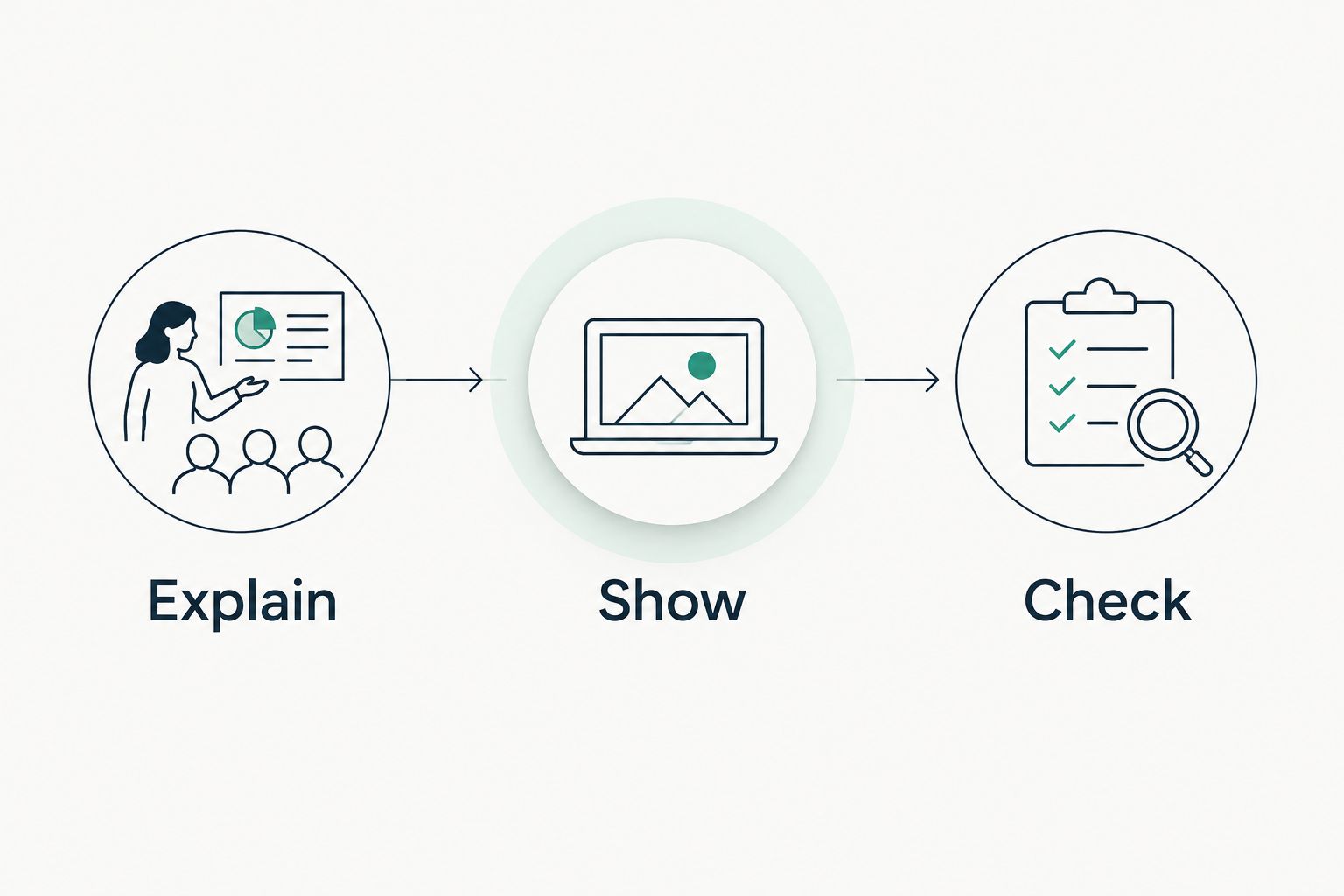
For your 2026 tutoring routine, use this flexible sequence: Explain, Show, Check. Return to an earlier part whenever the student's work reveals a question.
- Explain: Invite the student to describe the idea in their own words.
- Show: Ask for a written step, diagram, or sentence that represents it.
- Check: Offer a related task to attempt without supplying the method.
Preserve the skill the assignment is meant to teach
Before replacing a written response with a spoken one, ask what the assignment assesses. Speaking can help a student explore an argument, but an essay still requires decisions about sentences, structure, and revision. Hearing a passage explained is not independent reading practice.
For school assignments, follow the agreed instructions and accommodations. A tutoring format does not change classroom requirements, and an easier way to ask a question is not automatically an approved assessment format.
Use voice to reach the learning task, not quietly remove it. If writing is the goal, make room for supported writing rather than treating a fluent conversation as the finished work.
- Keep written calculations when the task requires mathematical working.
- Keep reading practice separate from listening to explanations.
- Use spoken brainstorming before the student drafts their own sentences.
- Confirm permitted response formats with the teacher when needed.
Review understanding separately from participation
Start with a simple parent record: the skill attempted, the help given, and what the student completed independently. You do not need an elaborate reporting system to notice whether the next lesson should revisit the same idea.
When evaluating tutoring in 2026, distinguish time spent participating from evidence of understanding. A long conversation does not by itself demonstrate mastery. Equally, a brief answer needs context before you judge it.
The personal tutor described here measures mastery per question, maps it to the curriculum, and includes it in reports. Its Bayesian Knowledge Tracing method updates an estimate of skill mastery from student answers over time. That estimate is useful learning information, not an infallible account of everything a student knows or proof of exam-score gains.
- Record the concept rather than only the session length.
- Distinguish an independent answer from one completed with help.
- Review curriculum mastery information alongside actual work samples.
- Ask your student which format helped them participate.
- Choose the next task from the evidence, not from how fluent the conversation sounded.
Compare ways to support a student who finds writing difficult
The best option depends on whether you need help accessing a subject, practicing writing, or both. Start with the smallest change that meets the need. A spoken check-in with a parent is different from ongoing tutoring, and neither replaces targeted writing instruction when that is required.
Use this comparison for a 2026 decision. The limitations matter as much as the convenient features.
| Option | Best for | What it offers | Key limitation |
|---|---|---|---|
| Parent-led spoken check-in | Best for identifying where a familiar assignment gets stuck | A chance to hear the student's explanation before choosing the next task | Depends on the parent's time and subject knowledge |
| Written or typed practice | Best for practicing written responses and examining visible working | A record of sentences, notation, organization, and revision | Requiring a written question first does not suit every student's immediate need |
| Tia personal tutoring | Best for students needing spoken and typed subject help with curriculum and parent records | Adaptive explanations, same-lesson voice and text, mastery information, and a parent dashboard | Voice does not replace independent reading, writing instruction, or required written work |
| Human tutoring arranged around the assignment | Best for families seeking live interpersonal support and individualized discussion | An opportunity to discuss goals and response formats directly with a tutor | Families need to confirm the individual tutor's subject expertise and approach |
You do not have to choose one format permanently. A student can discuss a science explanation aloud and still write the conclusion. They can type a literature question and then talk through the reasoning.
Common mistakes parents make when writing gets in the way
Treating a fluent explanation as complete mastery
A confident explanation is useful evidence, not the final check. Ask the student to apply the idea to a related task and examine the work they produce. Keep the tone curious rather than trying to catch them out.
Replacing every written task with speech
Changing how a student asks for help is different from changing what they need to learn. Keep writing practice when writing is the goal. Adjust the support around that work instead of removing it without discussion.
Assigning a fixed learning style
Enjoying spoken explanations does not mean a student should always learn through listening. Offer choices within the lesson. Let the student's response and the task guide what happens next.
Turning the parent into the answer writer
It is tempting to turn a student's spoken idea into a polished response for them. Instead, ask the student to choose the wording and produce the work. If an agreed accommodation involves adult assistance, follow its boundaries and record the support honestly.
Keeping only a time total
Participation records and work samples serve different purposes. Keep both when they help you understand progress. For homeschool reporting, check local requirements rather than assuming a tutoring report satisfies every obligation.
FAQ
What's voice tutoring for students who struggle with writing?
Voice tutoring lets students ask subject questions aloud and hear spoken explanations instead of relying only on typed exchanges. It provides another route into learning, not a replacement for writing instruction or independent reading practice.
Can my student use voice if they understand more than they can write?
Yes, a spoken exchange is an option for exploring what your student understands before asking for a written response. Check understanding with a related task, because an oral explanation alone does not prove mastery.
Does Tia let students switch between talking and typing?
Yes, Tia lets students switch between voice and text within the same lesson. Students can speak and hear verbal explanations while retaining the option to type. Two-way voice is included in all bundle plans.
Will voice tutoring improve my student's writing?
Voice tutoring does not by itself establish an improvement in writing. Spoken brainstorming can be part of a writing activity, but the student still needs to practice drafting, organizing, and revising their own work.
Is listening to a tutor the same as reading practice?
No, hearing an explanation is not independent reading practice. Keep opportunities for the student to read when reading is the learning goal, even if spoken explanations support subject access elsewhere.
Do writing difficulties mean my student has dysgraphia?
Writing difficulties alone do not establish a diagnosis of dysgraphia. Discuss persistent concerns with the student's teacher or an appropriate professional rather than drawing a conclusion from a tutoring session.
Should I choose voice or text for every lesson?
Choose the format around the student and the current task, not a permanent rule. Speech can suit asking a question, while text or paper remains useful for notation, diagrams, and written responses.
One last thing
Before the next lesson, ask: Would you rather say the question or type it? Then keep the learning goal unchanged. You are offering a different way to participate, not lowering what your student is working toward.
Related guides
- How adaptive tutoring changes a lesson
- Personalized English tutoring for essay writing
- What parents should see in a tutoring dashboard
Tia Education Team