Tia News
You can now talk to Tia, and she talks back
Tia voice tutoring lets students talk, listen or type in one lesson. See how voice fits math, English and science while keeping learning in focus.
By Tia Education Team · Published

Tia adapts to the student, not the other way around. Tia voice tutoring now lets students speak and hear verbal explanations, type their questions, and switch between voice and text within the same lesson.
- Tia voice tutoring adds spoken conversation alongside text, with switching inside the same lesson.
- Two-way voice is included in all bundle plans at no extra charge.
- Voice is optional, not a replacement for reading, written work or checking understanding.
- Parents still get curriculum-linked mastery information, engaged-time measurement and self-writing homeschool records.
Your student has a question. You can hear them trying to explain it, but getting that question typed feels like another assignment. You do not need to turn every moment of subject learning into a writing task.
The October 17, 2026 launch adds another way to participate in a personal tutoring lesson. Students can talk when speaking feels comfortable, use text when they want to see their question, and change formats without starting a separate lesson. You stay in charge of the learning routine.
You can explore Tia as a personal tutor for math, English and science. The important change is choice, not a requirement to replace typing with talking.
Why voice tutoring matters for families
For families with students in Grades 5 to 12, voice tutoring is a way to ask questions and hear explanations while working toward a subject-learning goal. It gives students another route into a lesson when composing a typed question gets in the way.
That distinction matters. Understanding a science concept, spelling its terminology and writing a polished explanation are different tasks. Sometimes you want to work on all of them. Sometimes you want to find out whether your student understands the concept first.
For your 2026 learning routine, choose the format around the task, not a fixed label for the student. A student who wants a spoken explanation today can still prefer text tomorrow. Voice does not establish an “auditory learning style,” and it is not automatically the better option.
The new format sits alongside personalized teaching that adapts pace, level and examples to the student. Curriculum goals still give the lesson its direction. Conversation is a way to participate, not the learning outcome itself.
What changes, and what stays the same
Students can now speak to their tutor and hear verbal explanations. Text remains an option, including within the same lesson. Two-way voice is included in all bundle plans at no extra charge.
The lesson still needs a clear purpose. A spoken explanation about fractions should help your student reason about fractions. An English conversation should support the reading or writing task, not quietly replace it.
Parents still have a live dashboard, engaged-time measurement and self-writing records. The tutor also measures mastery per question, maps it to the curriculum and includes it in the report. Adding voice does not mean progress is measured only by how long a student talks.
Start with the learning goal, then choose the format
You can try the basic approach without a tutoring service: ask your student to explain a problem aloud, discuss the confusing part and keep any necessary working on paper. The personal tutor brings spoken and typed participation into the same adaptive lesson.
Use this sequence to keep the first session manageable. The goal is not to test every feature. It is to find a comfortable way for your student to do the learning.
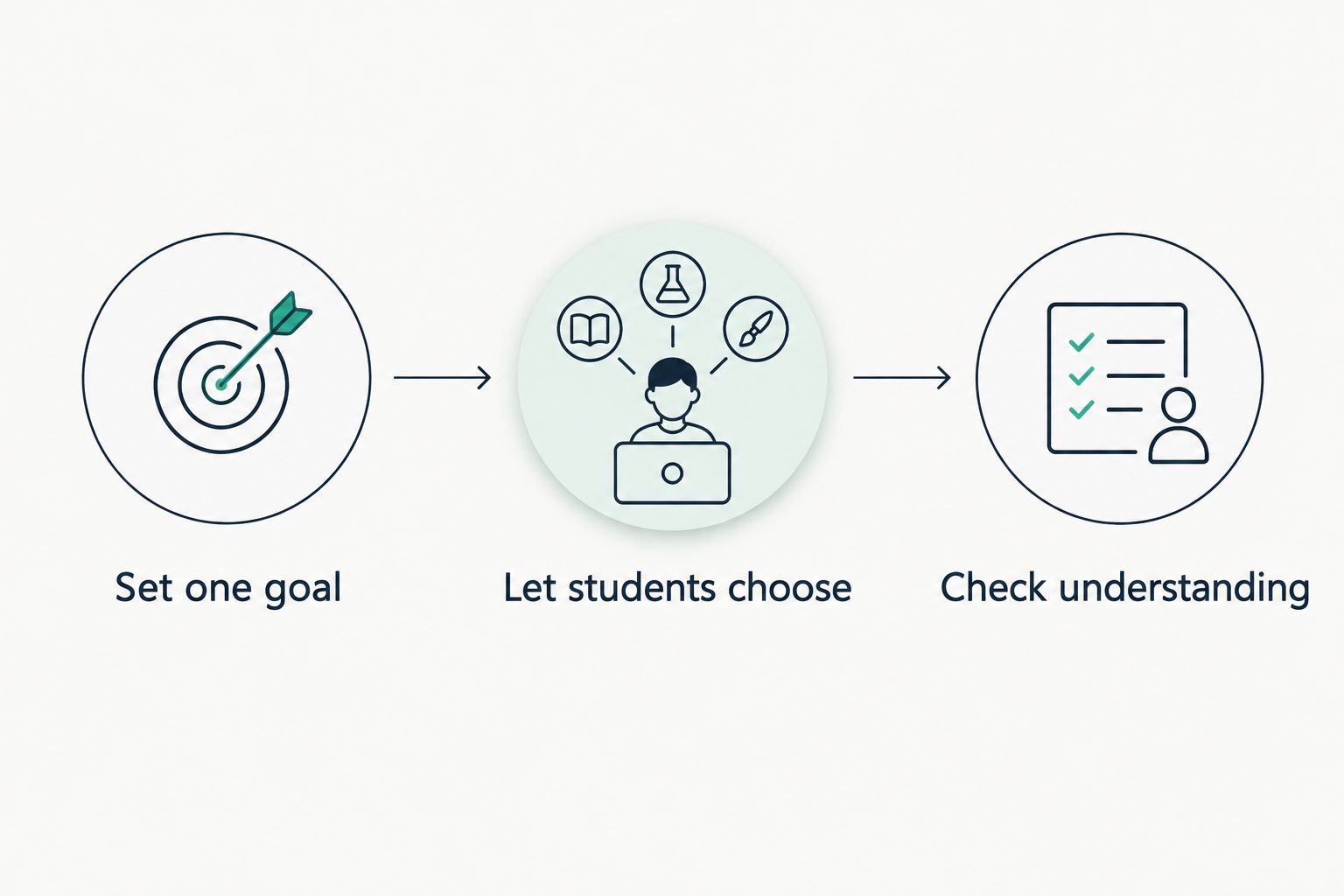
Set one goal
Before opening a lesson, ask your student what they want help understanding. You can write that goal on a piece of paper. Keep it specific enough that you can recognize whether the session addressed it.
For example, “understand why these fractions are equivalent” gives you a clearer target than “get better at math.” A 10-minute session is an option when a small task fits your student, not a duration that guarantees a result. Stop or continue according to the task and the student's needs.
Start your 2026 routine with a manageable question rather than a long feature tour. A short, purposeful first session gives you something concrete to discuss afterward.
- Choose one question from the current subject work.
- Ask your student to name the confusing part.
- Keep the assignment or relevant passage nearby.
- Agree on what you want the student to explain afterward.
Let students choose
Ask whether your student wants to begin by speaking or typing. Neither answer needs defending. Some students want time to compose a question; others would rather say what is confusing before they lose the thought.
You can offer the same choice in a parent-led discussion. Within the tutoring lesson, students can switch between voice and text instead of committing to one format throughout. That flexibility is the practical change.
For some students uncomfortable with reading or writing, speaking is a more comfortable starting point. Some students with ADHD also prefer it. Treat those as individual preferences, not promises about attention, treatment or achievement.
- Offer voice and text without ranking them.
- Let your student change formats during the lesson.
- Avoid assigning a permanent learning-style label.
- Keep typing available when speaking feels uncomfortable.
Ask for explanations
Begin manually by asking your student to tell you where an explanation stopped making sense. Then ask what would make the idea more familiar. An interest, an everyday example or a simpler explanation can give the conversation a useful starting point.
The personal tutor adapts explanations, pace, level and examples to the individual student. That is more specific than simply reading the same answer aloud. The purpose is to teach the curriculum concept in a way the student can work with.
The guide to how adaptive tutoring changes a lesson explains that teaching approach. Voice adds another way to take part; personalization remains about what is taught and how it is explained.
- Ask for a different explanation when the first does not connect.
- Suggest a familiar interest or everyday situation.
- Ask why a step works, not only what comes next.
- Give the student time to respond before helping.
Keep written work
Put paper beside the lesson when the subject calls for it. Speaking about a calculation does not remove the need to write the calculation. Hearing an explanation does not count as independent reading practice.
In math, keep diagrams, symbols and intermediate steps visible. In English, return to the passage or the student's draft. In science, keep the relevant diagram, vocabulary or evidence in view.
Voice can support access to the subject while you preserve the skill being practiced. If the assignment is essay writing, the student still needs to write. If the goal is interpreting a graph, the graph still matters.
- Write mathematical steps rather than relying on memory.
- Keep diagrams available during spoken explanations.
- Return to the original text for reading tasks.
- Separate understanding a concept from producing finished writing.
Check understanding
After an explanation, ask your student to try the next relevant task with less help. You can do this yourself with a fresh example from the material. Look for reasoning, not just agreement with the explanation.
A comfortable conversation and demonstrated understanding are different things. Speaking can make a question easier to ask, but the student still needs to work through the subject.
The same distinction separates tutoring from role-play practice for sales calls: rehearsing a conversation focuses on how someone responds, while a subject lesson must also check the knowledge behind the response. Keep that subject check in place, whether the student speaks or types.
- Ask the student to explain why an answer makes sense.
- Try another relevant question without repeating every hint.
- Compare spoken reasoning with any written working.
- Note the part that still needs teaching.
Review learning records
You can keep a simple manual note after a lesson: the topic, what your student attempted and what needs another look. That is more informative than recording only that tutoring happened.
The tutor's parent dashboard and self-writing records bring learning information together. Mastery tracking uses Bayesian Knowledge Tracing, an established method that updates an estimate of skill mastery from student answers over time. It is an estimate, not an infallible measurement of everything a student knows.
For your 2026 records, distinguish engaged time, curriculum mastery information and independently verified exam results. They answer different questions. A useful report helps you decide what comes next without treating any one measure as the whole picture.
- Review the curriculum topic alongside the time spent.
- Look at mastery information rather than duration alone.
- Keep your own observations when they add context.
- Use homeschool records alongside local reporting requirements.
Compare voice, text and a mixed lesson in 2026
Tia voice tutoring is best for families who want optional spoken participation within personalized, curriculum-aligned lessons. Its limits matter too: voice does not replace reading, writing, diagrams or evidence of understanding.
These are participation options within a lesson, not a ranking of students. Choose according to what your student needs to do at that moment.
| Option | Best for | Main benefit | Key limitation |
|---|---|---|---|
| Voice | Students who prefer asking a question aloud | Spoken questions and verbal explanations | Does not replace written working or independent reading |
| Text | Students who prefer composing and seeing their questions | Typed participation remains an option | Typing can become an extra task when the goal is subject understanding |
| Voice and text together | Students whose preferences change during a lesson | Switching formats within the same lesson | Changing formats is not evidence that the concept is understood |
| Parent-led discussion | Families beginning with a familiar conversation | You can ask questions and observe reasoning directly | You provide the explanations and keep the records yourself |
Text is not the old option to abandon. It remains useful when the student wants to compose a precise question or work directly with written language. Voice is an addition, not a replacement rule.
Common mistakes families make with voice tutoring
Treating voice as the new default
A feature launch does not create an obligation to use it. If your student wants to type, keep that choice open. The benefit is having another format available when it fits.
Ask again when the task changes. A student might talk through a science question and then prefer text for an English task. Neither choice defines how that student must learn.
Mistaking listening for reading practice
Hearing a passage explained is different from reading it independently. Both can have a place, but they do not measure the same skill.
If your 2026 learning plan includes reading practice, keep that practice explicit. Use spoken support around the task without reporting listening as independent reading.
Letting the conversation replace the assignment
A student can discuss an essay without producing a paragraph. They can explain a math idea while leaving out essential working. Return to what the assignment actually asks them to do.
Keep the relevant output visible: a written solution, a revised sentence or an explanation supported by evidence. Let conversation support that work rather than stand in for it.
Assuming a longer session means more learning
A long conversation is not automatically a productive lesson. Engaged time tells you about participation; mastery information addresses understanding of curriculum skills.
Review both alongside the student's work. You do not need to stretch a focused session simply to make the clock look better.
FAQ
Can students really talk to Tia and hear a reply?
Yes. Students can speak to Tia and hear verbal explanations, while retaining the option to type. Two-way voice was confirmed for launch on October 17, 2026.
Can my student switch between voice and text during one lesson?
Yes. Students can switch between voice and text within the same lesson. They do not need to choose one format for the entire session.
Is two-way voice included in every plan?
Two-way voice is included in all bundle plans at no extra charge. That inclusion claim does not extend to standalone subject plans without confirmation.
Is voice tutoring better than typing?
Neither format is better for every student or every task. Voice suits students who prefer speaking a question, while text suits students who prefer composing it in writing.
Does hearing an explanation count as reading practice?
No. Hearing an explanation is not independent reading practice. Keep reading tasks explicit when reading is the skill your student needs to practice.
Could voice tutoring suit a student with ADHD?
Voice is an option for some students with ADHD who prefer spoken participation. Individual fit matters, and voice does not promise improved attention, clinical benefit or higher achievement.
Will parents still see learning progress rather than just session time?
Yes. Parents get a dashboard, engaged-time measurement and reports that include curriculum-linked mastery information. Mastery estimates are not independently verified exam-score gains.
One last thing
At the end of the first lesson, ask which part your student would rather say aloud and which part they would rather write. Their answer gives you a practical starting point for the next session.
You do not need a permanent verdict on voice. The useful change is permission to choose again. Keep the learning goal steady while the way your student participates stays flexible.
Related guides
- What parents should see in a tutoring dashboard
- How to keep homeschool records without a last-minute scramble
- How to teach abstract math with everyday objects
Tia Education Team