Tia News
How to teach abstract math with everyday objects in Grades 5 to 12
Use hands on math activities to connect objects, drawings, and symbols. Teach fractions, ratios, algebra, and geometry with everyday materials in Grades 5 to 12.
By Tia Education Team · Published

Your student can follow a worked example, then freeze when the numbers change. To teach abstract math with everyday objects in Grades 5 to 12, model one idea with familiar materials, draw what the objects represent, and connect the drawing to mathematical symbols.
- Hands on math activities should connect objects, drawings, and symbols, not stop at arranging materials.
- Use equal-sized pieces for fractions and identical counters for equal units.
- Choose the activity by the missing concept, not the student's grade alone.
- Tia offers personalized math tutoring for students who need teaching adapted to their pace and interests.
Why this matters
You do not need to turn your kitchen into a classroom. You need a way to make the meaning of a calculation visible while your student does the thinking.
For your 2026 learning plan, choose the concept before choosing the materials. A student who struggles with fractions needs to see equal parts of a defined whole, not simply handle a pile of colorful pieces. The guide to helping students with fractions at home gives you a related starting point.
The object is a model of the mathematics, not a replacement for it. Every activity should end with your student explaining how the model matches a drawing or equation.
How do you teach abstract math with everyday objects in Grades 5 to 12?
Start with a problem your student is already studying. Keep the mathematical goal intact, but change how you present it.
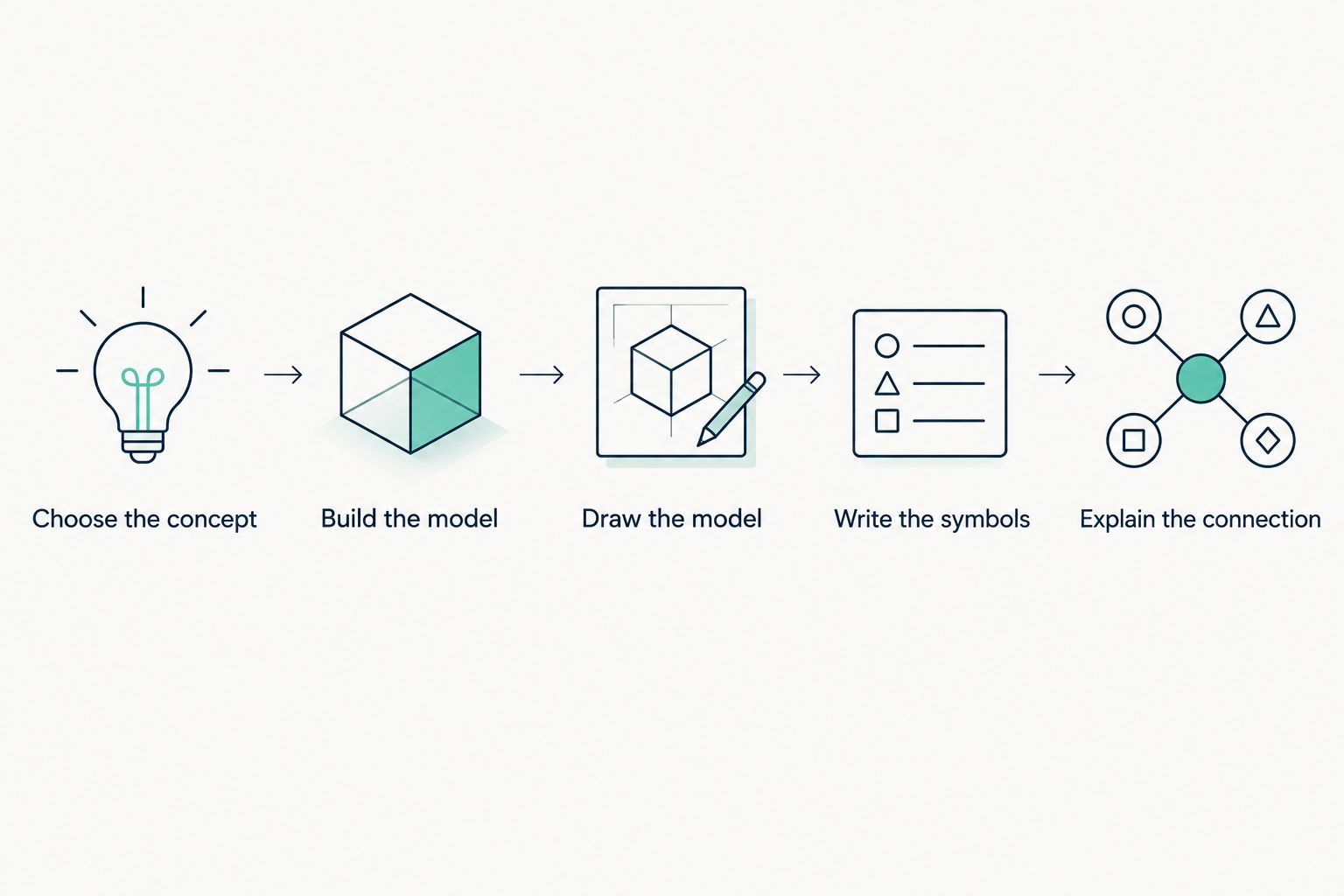
Use this sequence for fractions, ratios, equations, geometry, or another topic where the relationship can be represented physically:
- Choose the concept. Name the specific idea, such as equivalent fractions or keeping both sides of an equation equal.
- Build the model. Let your student arrange objects. Agree on what each object represents before calculating.
- Draw the model. Sketch the arrangement and label the quantities. Leave out decorative details.
- Write the symbols. Match each part of the drawing to the numbers, variables, or operations in the problem.
- Explain the connection. Ask your student to explain why the written mathematics describes the model, then try a changed example.
Keep the sequence flexible. If the equation stops making sense, return to the drawing or objects rather than repeating the same explanation louder.
For example, arrange 12 counters into 3 equal groups. Each group contains 4 counters. Draw the groups, then write 12 ÷ 3 = 4 and ask what each number means.
Do not accept a correct answer as the whole explanation. Ask whether the student divided the counters into three groups or made groups of three. Both arrangements involve division, but they answer different questions.
Which everyday objects work best for hands on math activities?
Choose materials that make the relationship clear with the least setup. A familiar object is useful only when its size, shape, or assigned meaning fits the concept.
| Material | Best for | What it makes visible | Limitation to address |
|---|---|---|---|
| Paper strips | Fractions and equivalence | Equal parts of the same whole | Unequal folds distort comparisons |
| Identical counters | Grouping and ratios | Countable units and repeated groups | Counting alone does not explain the relationship |
| Cups and counters | Simple equations | An unknown quantity beside known units | Cups represent unknowns by agreement, not measurement |
| Square paper pieces | Area and algebraic structure | Rows, columns, and partitions | Length and area must stay distinct |
| String and a ruler | Geometry | Lengths and changing shapes | Measurement is approximate, not a proof |
| Colored counters | Probability models | Categories and possible outcomes | A short experiment need not match the theoretical probability |
You can reuse the same materials across your 2026 math plan. Avoid collecting a separate kit for every topic before you know which representation your student needs.
Fractions: show the same whole before comparing parts
Use identical paper strips or a chocolate bar divided into equal sections. Best for students who calculate fractions without understanding what the denominator names. The advantage is a visible whole; the limitation is that every comparison must use the same-sized whole.
Divide a strip into 8 equal parts. Shade 3 parts and label the amount 3/8. Ask your student to identify the whole, the size of each part, and the number of selected parts.
Now use two matching strips. Fold one into halves and the other into fourths. Align 1/2 with 2/4, then draw both before writing 1/2 = 2/4.
For addition, show 1/4 + 1/8 using matching wholes. Rename the quarter as 2/8, then combine it with 1/8 to make 3/8. Ask why the pieces need a common size before adding their counts.
If the strips have different lengths, stop and reset. That mismatch changes the model, even when the written fractions look correct.
Ratios: build repeated groups, then name the relationship
Use two colors of counters. Best for students who confuse a part-to-part ratio with a fraction of the total. The benefit is visible grouping; the limitation is that the counters need clear labels.
Build a group with 2 blue counters and 3 white counters. The blue-to-white ratio is 2:3. Blue counters make up 2/5 of the whole group, not 2/3.
Build another identical group. You now have 4 blue counters and 6 white counters, so 2:3 and 4:6 describe the same relationship.
Draw the groups and write a ratio table. Ask what stays the same when the total grows. Then ask whether adding one counter of each color preserves the ratio; it does not in this example.
Algebra: give the unknown a consistent meaning
Use matching cups to represent the same unknown quantity and counters to represent single units. Best for students beginning simple equations. This model makes equal operations visible, but it becomes cumbersome for negative or fractional quantities.
Represent x + 3 = 7 with one cup and 3 counters on one side of the table, and 7 counters on the other. Explain that the two sides represent equal quantities. Remove 3 counters from each side, leaving the cup equal to 4 counters.
Write each change underneath the arrangement:
- x + 3 = 7
- x + 3 − 3 = 7 − 3
- x = 4
Next, represent 2x = 8 with two matching cups and 8 counters. Split the counters equally between the cups. Each cup represents 4 units.
Ask why the cups must represent equal quantities. If your student cannot explain that agreement, return to the meaning of the variable before introducing a harder equation.
Geometry and algebra: separate length from area
Use square paper pieces, a ruler, and rectangular outlines. Best for students connecting multiplication to area. The model shows rows and partitions, but a measured drawing cannot establish every geometric claim.
Make a rectangle 3 cm long and 4 cm wide. Its perimeter is 14 cm, while its area is 12 square centimeters. Trace the boundary to discuss perimeter, then cover the inside with unit squares to discuss area.
For an algebra connection, draw a rectangle with height x and width x + 2. Split the width into x and 2. Label the two areas x² and 2x, then write x(x + 2) = x² + 2x.
Keep the units explicit. A side length and an area are different quantities, even when both involve the same variable. This positive-length rectangle illustrates the algebraic structure; it does not physically represent every possible value of x.
High school math: use a model without treating it as proof
Older students can use everyday objects without making the lesson feel elementary. Choose a model that matches the current question, then state its limits.
Best for probability: colored counters in an opaque container. Use 3 blue counters and 2 white counters, with identical size and shape. If each counter is equally likely to be selected, the probability of drawing blue is 3/5.
Replace the counter after each draw and mix again. Record the outcomes, then compare the experimental proportion with the theoretical probability. Do not promise that a small set of draws will produce exactly 3 blue results for every 5 selections.
Best for right-triangle relationships: measured string lengths. A triangle with side lengths 3 cm, 4 cm, and 5 cm illustrates 3² + 4² = 5². Discuss the relationship, but distinguish the calculated equality from an imperfect physical construction.
For advanced topics, sometimes a graph or labeled diagram is the clearer representation. Do not force an object into a lesson when it obscures the mathematics.
Why the right activity varies
The same materials will not suit every student or every problem. Choose your starting point using these factors:
- Current level: Model the missing idea, even when it appears earlier than the student's current course.
- Curriculum goal: Keep the activity tied to the concept and notation your student is studying.
- Learning pace: Move to symbols when your student can explain the model, not because the activity looks finished.
- Student interests: Use a familiar context while keeping the mathematical relationship accurate.
- Model limits: Change the representation when physical objects no longer express the quantities clearly.
You remain in charge of the lesson choice. Your student remains responsible for arranging, explaining, and checking the mathematics.
Where personalized tutoring fits
Sometimes your student understands the objects but gets stuck when the equation appears. That is a specific connection to work on, not a reason to abandon the topic.
Tia is best for students in Grades 5 to 12 who need personalized math tutoring at their own pace. Tia adapts teaching to the student's level and interests within the curriculum. Parents get a live dashboard and engaged-time records.
In your 2026 learning plan, use Tia math tutoring alongside the representations that make sense to your student. Keep physical materials and hands-on lesson choices with you. A tutoring dashboard gives you information about tutoring; it does not replace listening to your student explain a paper model.
Explore personalized math support
Teaching adapted to your student's pace, level, and interests.
How do I know when my student is ready to put the objects away?
Your student is ready to try without objects when they can explain what the quantities and operations represent. Ask them to draw the model from memory, write the matching equation, and explain a changed example.
Keep the materials nearby. Returning to them is a way to check meaning, not a penalty.
What if my student enjoys the activity but cannot solve the written problem?
Bring the written problem beside the model and match each part explicitly. Ask your student to point to the quantity represented by each number, then explain the operation.
If that connection is unclear, simplify the example while preserving the concept. More arranging is not the goal; a clearer explanation is.
FAQ
What are the best hands on math activities for a fifth-grade student?
The best starting activity targets the concept the student cannot yet explain. Use equal paper strips for fractions or identical counters for grouping, then connect the model to a drawing and equation.
Can hands on math activities work for high school students?
Yes, physical models can illustrate high school ideas such as algebraic area, probability, and right-triangle relationships. State the model's limits and follow it with the notation or reasoning the course requires.
Do I need special materials for hands on math activities in 2026?
No, paper strips, identical counters, cups, string, and a ruler can represent the examples in this guide. Choose materials by the concept rather than collecting a kit before identifying the need.
How long should a hands-on math lesson last?
Let the concept and your student's response guide the lesson length. Finish with an explanation or a clear next step, rather than treating time spent handling objects as evidence of understanding.
Should my student always use objects before solving an equation?
No, use objects when they clarify a relationship your student does not yet understand. If the student can explain the equation accurately, move to drawings, symbols, or a more suitable representation.
Can Tia provide the physical objects for these activities?
Treat the physical activities in this guide as parent-led work using materials you choose. Tia provides personalized tutoring in Math, English, and Science; the objects described here are not a stated product offering.
One last thing
Before putting materials away, ask your student to identify something the model cannot show. A cup hides an unknown quantity, a ruler gives an approximate measurement, and a rectangle cannot have a negative physical length.
For your 2026 homeschool records, note the concept, the representation, and the student's explanation. Record what your student understood, not just what you set out on the table.