Tia News
TutorOcean alternatives in 2026
Compare TutorOcean alternatives: Tia for adaptive tutoring and parent records, Wyzant for human tutors, and Khan Academy for structured skill practice.
By Tia Education Team · Published

TutorOcean connects you with human tutors, a useful starting point when your student needs someone to work through a difficult subject. If you are also piecing together daily lessons, progress checks, and homeschool records, choosing a tutor is only part of the job. The best TutorOcean alternative in 2026 is Tia for adaptive, curriculum-aligned tutoring with parent records; Wyzant for choosing a human tutor; and Khan Academy for structured independent practice.
- Among TutorOcean alternatives, Tia fits families seeking personalized tutoring, curriculum mastery information, and homeschool records.
- Wyzant fits parents who want to choose a human tutor rather than change the tutoring model.
- Khan Academy fits students who need structured courses, mastery learning, and independent practice.
- Stay with TutorOcean when your current human tutor understands your student and the arrangement works.
Why this matters
You do not need another learning resource simply because homework was difficult tonight. You need to identify what was missing: an explanation, useful practice, a personal connection, or a clearer picture of progress.
Those needs point to different services. A tutor marketplace helps you choose a person. An adaptive personal tutor adjusts teaching within a student-focused workflow. A course platform gives you organized material to work through.
For your 2026 shortlist, compare those models before comparing individual features. Changing platforms without changing the part that is not working leaves you with the same problem.
TutorOcean alternatives at a glance
| Option | Best for | Standout feature | How it differs from TutorOcean |
|---|---|---|---|
| TutorOcean | Families seeking a human tutor | Tutor marketplace connecting students with tutors | The human-tutor benchmark for this comparison |
| Tia | Adaptive Math, English, and Science tutoring with parent records | Curriculum-aligned explanations, mastery tracking, and self-writing records | An adaptive personal tutor rather than a marketplace for choosing a human tutor |
| Wyzant | Parents who want to choose a human tutor | Tutor profiles and individual tutor selection | Another human-tutor marketplace, so the individual match remains central |
| Khan Academy | Structured independent study and practice | Courses, mastery learning, and tailored practice | A learning platform rather than a human-tutor marketplace |
This is a comparison of fit, not a ranking of proven learning outcomes. Neither a feature list nor a familiar platform name tells you whether your student can explain the next problem independently.
1. Tia: best for adaptive tutoring with parent records
Tia is a personal tutor for students in Grades 5 to 12 studying Math, English, and Science. It adapts explanations, pace, level, and examples to the student while teaching toward curriculum goals.
That combination suits a parent who wants help with the learning itself and a clearer record afterward. You stay responsible for the overall plan; the student still does the thinking.
Where Tia shines
- Explanations adapt to the student. Interests help make an unfamiliar concept more recognizable, rather than only changing which practice question appears next.
- Voice and text work within the same lesson. Students can speak and hear explanations, type, or switch between formats. Two-way voice is included in all bundle plans.
- Mastery information goes beyond elapsed time. Answers update an estimate of skill understanding, mapped to the curriculum and included in reports.
- Parent records are part of the workflow. The live dashboard, engaged-time measurement, and self-writing homeschool records give you information to review.
The mastery method is Bayesian Knowledge Tracing. In plain language, it updates an estimate of what a student understands from answers over time. It is an established method, not an exact measurement of everything a student knows or proof of future exam results.
Where it falls short
- It is not a human-tutor marketplace. If choosing a particular person is essential, this is a different model.
- Its stated subject scope is Math, English, and Science. Do not choose it on the assumption that every other subject is included.
- Hearing an explanation is not independent reading practice. Keep the student's actual learning goal in view when choosing voice.
- Self-writing records do not remove your responsibility to check local homeschool requirements.
Head-to-head: adaptive tutor or human-tutor marketplace?
| Dimension | Tia | TutorOcean |
|---|---|---|
| Teaching model | Adaptive personal tutor | Human-tutor marketplace |
| Main selection decision | Whether the teaching workflow fits your student | Which human tutor fits your student |
| Personalization | Curriculum-aligned explanations using student context | Teaching decisions made by the selected tutor |
A client-supplied 2026 product demonstration shows the distinction in explanation design. Two test students, Fred and Charlotte, receive vertical-angle explanations using cricket bats and horse trails respectively. These are teaching demonstrations, not testimonials or proof that either student mastered geometry.
For a closer look at the mechanism, read how adaptive tutoring changes a lesson.
Best for: Families seeking adaptive tutoring with curriculum mastery information and parent learning records.
Verdict: Buy for this workflow, not as a replacement for a preferred human relationship.
2. Wyzant: best for choosing a human tutor
Wyzant makes sense when you want to keep human tutoring but reconsider the person you work with. Like TutorOcean, it is a tutor marketplace, so your central task remains finding a suitable individual.
That is a narrower change than moving to an adaptive tutor. Start with what you want the tutor to do differently, not simply with another search results page.
Where Wyzant shines
- Tutor profiles give you a starting point for selecting a person with relevant subject experience.
- A human tutor can adapt explanations through conversation and respond to the student's reasoning.
- You can make the individual teaching relationship the main decision criterion.
Where Wyzant falls short
- A marketplace does not make every tutor an equally suitable match. You still need to assess the individual.
- A profile alone cannot show how a tutor will respond when your student misunderstands something.
- Choosing another marketplace does not, by itself, solve your need for a consistent learning plan or useful parent records.
Ask a prospective tutor to explain how they would approach one real difficulty. For essay writing, that might mean distinguishing an unclear argument from a punctuation problem. For math, ask how they decide whether to revisit a prerequisite.
In your 2026 comparison, use the same questions for prospective tutors on both marketplaces. Otherwise, a more appealing profile can distract from the teaching criteria you actually care about.
Best for: Parents who want a human tutor and are ready to assess a new individual match.
Verdict: Buy when a specific tutor fits better, not merely because the marketplace is different.
3. Khan Academy: best for structured independent practice
Khan Academy offers structured courses, mastery learning, tailored practice, and progress tools. It is a useful alternative when your student needs organized material to work through rather than a different human tutor.
Do not confuse the core Khan Academy platform with Khanmigo, its separate guided tutoring offering. This recommendation concerns the core learning platform, not a claim that all Khanmigo features are included.
Where Khan Academy shines
- Structured courses help you identify a sequence of topics instead of assembling unrelated exercises.
- Mastery learning and tailored practice support work on specific skills.
- Progress tools help you review activity and learning progress.
Where Khan Academy falls short
- Independent course work is not the same experience as a personal tutoring conversation.
- If your student needs an explanation reframed around their interests, check how that need will be met rather than assuming practice selection covers it.
- A progress view and a homeschool reporting workflow serve different purposes. Decide which records your family needs.
Khan Academy belongs on a 2026 shortlist for a student who can use structured resources productively. It is a less direct replacement when the missing piece is a sustained personal teaching relationship.
Best for: Students who need a clear course sequence and independent skill practice.
Verdict: Buy into the course model when practice is the gap; skip it as a like-for-like human-tutor replacement.
Why people switch from TutorOcean
A switch makes sense when the tutoring model no longer matches the job you need done. There is no need to assume TutorOcean lacks personalization or that a human tutor cannot keep useful records.
Use these specific reasons to decide whether to explore an alternative:
- Teaching fit: Your student needs a different explanation, pace, or way to participate. First decide whether changing the tutor would solve that.
- Practice fit: Your student understands explanations but needs a clearer sequence of independent work. A structured course platform addresses a different need from another tutoring appointment.
- Parent visibility: You want to review skill understanding and engaged time, not rely only on a general account of the lesson.
- Recordkeeping: You want learning records built into the tutoring workflow rather than reconstructing them at reporting time.
These are decision criteria, not reasons to abandon a tutor who is helping. Name the unmet need before moving anything.
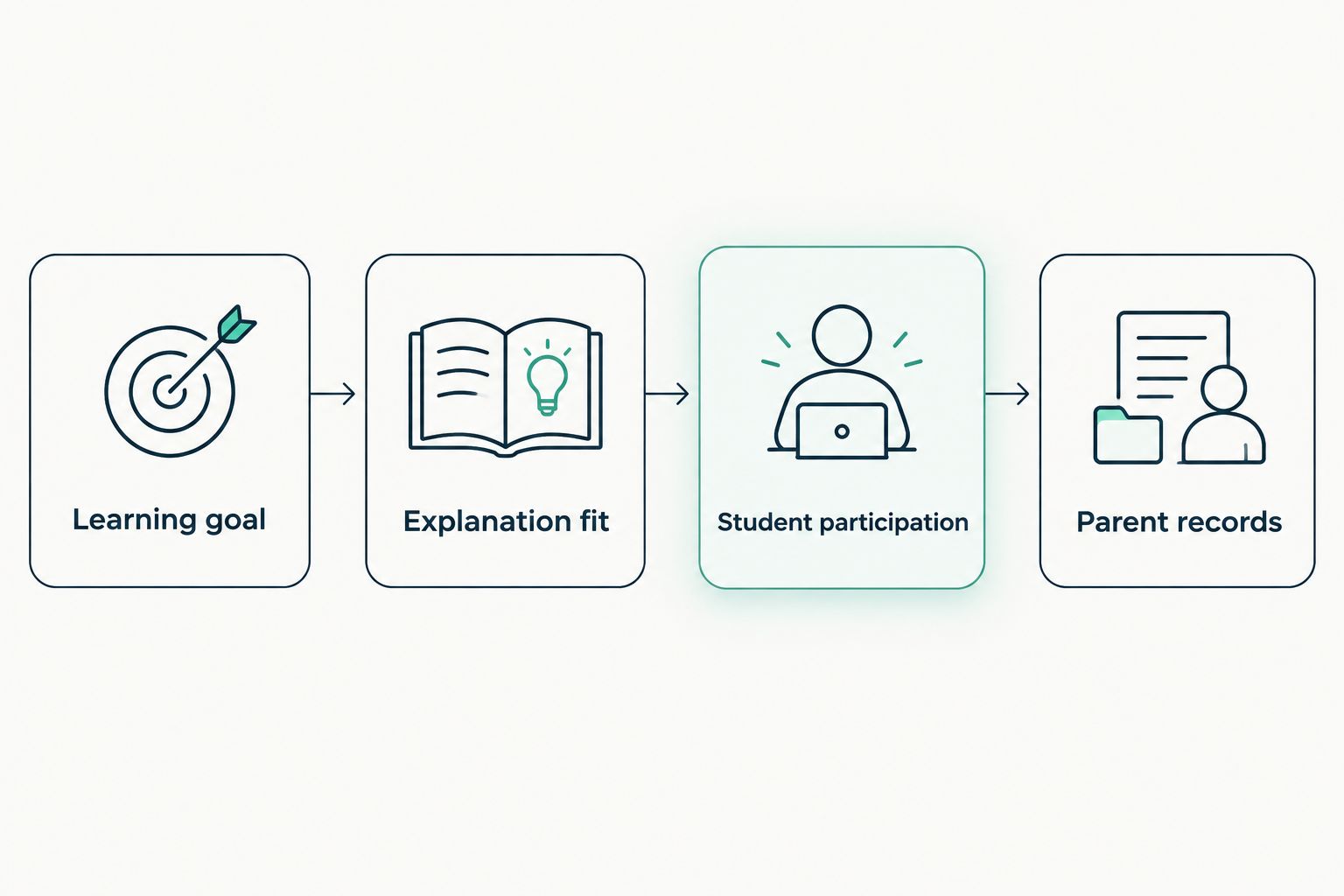
Compare one learning goal before you commit
For a useful 2026 comparison, bring the same learning goal to every option. Avoid comparing a polished course overview with an ordinary tutoring session on an unrelated topic.
Learning goal
Choose something concrete: explaining equivalent fractions, supporting a paragraph with evidence, or distinguishing a scientific observation from an inference. Write down what the student should do independently afterward.
Explanation fit
Notice what happens after confusion. Does the tutor or resource repeat the same wording, offer another representation, or help uncover the missing prerequisite? Ask your student which explanation made sense.
Student participation
Keep the student in charge of showing their reasoning. Voice can be an optional way to ask or explain, while written math, diagrams, and reading still have their place.
Parent records
Review what you can actually learn afterward. Separate time spent, questions answered, estimated mastery, and the student's independent explanation. Those are related observations, not interchangeable measures.
A 10-minute session is one practical starting point when a short session fits your student. It is not a promised dose for a particular result. Choose enough time to see the teaching interaction without turning the comparison into another exhausting assignment.
When staying with TutorOcean is the right call
Stay with TutorOcean when your current tutor understands your student, adapts explanations usefully, and helps your student work more independently. A good teaching relationship is a reason to stay, not an obstacle to trying something new.
Before switching, ask for a clearer goal and an agreed way to review progress. If that resolves the problem, you do not need another platform. If the unmet need is built-in parent reporting or a different teaching model, compare that specific difference.
FAQ
What's the best TutorOcean alternative for homeschool families?
Tia is the best fit in this comparison for homeschool families seeking adaptive tutoring with parent learning records. It combines curriculum-aligned explanations, mastery information, engaged-time measurement, and self-writing records. Parents still need to check local reporting requirements.
Is Wyzant better than TutorOcean?
Wyzant is a better choice only when a particular tutor or arrangement fits your student better. Both are human-tutor marketplaces, so compare individual teaching approaches rather than assuming the platform determines the quality of every lesson.
Can Khan Academy replace a TutorOcean tutor?
Khan Academy can replace the structured practice portion of a learning plan, but it is not a like-for-like replacement for a human tutor. Its core platform offers courses, mastery learning, tailored practice, and progress tools.
Does personalized tutoring mean personalized practice?
Personalized tutoring and personalized practice are different. Practice personalization changes what a student works on; explanation personalization changes how a concept is taught. Ask how each service handles both.
Can my student talk instead of typing during tutoring?
Tia supports speaking, hearing explanations, typing, and switching between voice and text within the same lesson. Two-way voice is included in all bundle plans. Voice is an option, not a universally better way to learn.
Does a mastery score prove my student understands everything?
No mastery estimate proves complete understanding. Bayesian Knowledge Tracing updates an estimate from answers over time. Pair that information with your student's independent reasoning rather than treating it as an infallible score.
Should I switch if my current TutorOcean tutor is helping?
Stay if the teaching relationship works and your needs are being met. Before switching, identify an unmet need that another option directly addresses, such as a different teaching model or an integrated parent-record workflow.
One last thing
Ask your student to explain one idea without the tutor or resource supplying the next step. That small check gives you something more useful to discuss than whether the lesson felt busy.
Keep the question kind and specific. You are choosing support that helps your student learn, not asking them to audition for a platform.
Related guides
- What parents should see in a tutoring dashboard
- How to keep homeschool records without a last-minute scramble
- How to choose tutoring that adapts to your student
Tia Education Team