Tia News
How to choose tutoring that adapts to your student
Choose adaptive tutoring by checking teaching fit, curriculum goals, voice and text choice, and parent records. Know what to look for in a real lesson.
By Tia Education Team · Published

Tia adapts to the student, not the other way around. To choose adaptive tutoring, look for teaching that changes explanations, pace, examples, and participation format while keeping your student's curriculum goal clear. If another promising resource has left you explaining every instruction, use a real lesson to check what changes when your student gets stuck, not just what the feature list promises.
- Choose adaptive tutoring by testing explanations, pace, curriculum alignment, student choice, and useful parent records.
- Tia adaptive tutoring fits families seeking personalized teaching alongside curriculum mastery information and homeschool records.
- Voice and text are participation choices, not fixed learning styles or proof of understanding.
- Ask students to explain their reasoning, then compare their work with the progress report.
How do you choose tutoring that adapts to your student?
Choose the tutor that responds to your student's thinking, not just the last answer. A useful evaluation follows a specific learning goal through an explanation, a student response, an adjustment, and a progress record.
For your 2026 shortlist, use these steps before committing to a routine:
- Name the goal. Bring a current topic, assignment, or skill your student needs to understand.
- Watch the explanation. Ask for a different example when the first explanation does not connect.
- Check the pace. See whether the lesson revisits a missing step instead of simply supplying the answer.
- Let students choose. Check whether speaking, listening, or typing fits the task.
- Review the evidence. Compare the student's reasoning with the information available to you afterward.
Tia offers personalized Math, English, and Science tutoring for students in Grades 5 to 12. It combines curriculum-aligned teaching with a student profile, mastery information, and parent records. Those features belong in your evaluation together, rather than as separate selling points.
For a closer look at the teaching itself, read how adaptive tutoring changes a lesson. Your central question stays simple: what happens differently because this particular student needs help?
Why this matters
You can find a resource that matches the subject and still spend the evening translating its instructions. That does not mean you chose badly. It means subject coverage and teaching fit are different questions.
A student might need a slower explanation of one concept and a quicker route through another. The same student might prefer speaking through a question today and typing tomorrow.
Your job is not to identify a permanent learning type. It is to notice what helps your student participate, reason, and work toward the current goal. Keep the goal steady, but allow the route to change.
Compare what actually adapts
For a 2026 tutoring comparison, separate changes to the teaching from changes to the practice. Neither tells the whole story alone.
A program can select a useful next question without explaining the previous mistake differently. A tutor can offer an engaging analogy without checking whether the student can apply the idea independently.
| Capability | Best for | What to look for | Limit to remember |
|---|---|---|---|
| Adaptive explanations | Students who need another way into a concept | A changed example, smaller step, or clearer explanation | An appealing explanation is not proof of mastery |
| Personalized practice | Students ready to work on selected skills | Questions connected to demonstrated needs | Question selection alone does not show how teaching adapts |
| Voice participation | Students who want to ask or reason aloud | A spoken exchange that stays on the learning goal | Speaking does not replace every written task |
| Text participation | Students who prefer composing a written response | Space to type questions and inspect wording | Typing comfort can differ from subject understanding |
| Parent learning records | Parents coordinating learning and reporting | Skill information alongside meaningful activity records | A report still needs interpretation and local requirements checks |
Use this table as a set of questions, not a ranking of formats. You are looking for the combination that fits your student, with honest limits attached to each feature.
Check whether explanations change, not just question difficulty
Start with a concept your student genuinely finds difficult. Ask the tutor to explain it, then ask for another approach without changing the learning goal.
Look for a meaningful change. A shorter version of the same wording is different from an explanation that uses a familiar interest, exposes a missing step, or connects an example to the formal rule.
In client-supplied product demonstrations from October 2026, Fred's cricket interest and Charlotte's interest in horses provide different ways into vertical angles. Crossing cricket bats or horse trails form an X, with matching opposite angles. These are labeled teaching demonstrations, not testimonials or evidence of mastery.
The important next step is the student's reasoning. Can your student identify the opposite angles in a different diagram and explain the relationship without relying on the original story?
An interest-based example should help the student reach the mathematics. It should not become a detour that leaves the underlying idea unexplained.
Talk, listen or type: Tia adapts to how your student wants to learn
Let the student choose how to participate, then check whether that choice serves the task. Voice is an option alongside text, not a universally better method.
Students can speak and hear verbal explanations, type, and switch between voice and text within the same lesson. Two-way voice is included in all bundle plans. That inclusion does not establish what is included in standalone subject plans.
During your evaluation, distinguish these tasks:
- Ask aloud. Let your student explain where the confusion starts without composing a long typed question.
- Inspect text. Keep a written explanation available when wording or notation needs close attention.
- Show working. Preserve written mathematical steps, diagrams, and other work the subject requires.
- Choose again. Let the student change format when the task changes.
Hearing an explanation is not independent reading practice. Talking through mathematics also does not remove the need to write mathematical working.
For your 2026 decision, do not treat format flexibility as a promise of better attention or higher achievement. Judge whether it gives your student a workable way to take part in this lesson.
Keep curriculum goals visible
Ask the provider to connect the lesson to the curriculum your student follows. Then narrow the question to the actual topic and level you need.
“Covers math” is not enough information for choosing help with a particular skill. Ask what the student is working toward, what prerequisite knowledge matters, and how the lesson connects to that goal.
You can change the explanation without changing the destination. A familiar example should still lead back to the vocabulary, notation, or reasoning the student needs for their coursework.
Do not assume curriculum alignment means the service manages your entire curriculum, assigns credit, or replaces your other resources. Confirm each responsibility separately. You remain in charge of deciding how tutoring fits the wider learning plan.
Read mastery information alongside engaged time
A useful parent view answers different questions: what did the student work on, how did they participate, and what does their work suggest about understanding?
Tia adaptive tutoring measures mastery per question, maps it to the curriculum, and includes it in reports. Its Bayesian Knowledge Tracing method updates an estimate of skill mastery from student answers over time.
That is an estimate, not an exact account of everything a student knows. It is also different from independently verified improvements in exam scores.
Engaged-time measurement answers another question: how much recorded time reflects participation in learning? Do not use duration alone as evidence that a concept is secure.
Self-writing homeschool records can support your recordkeeping, but they do not remove your responsibility to check local reporting requirements. For your 2026 records, compare the report with a sample of the student's work and any documentation you are required to keep.
Why the right tutoring fit varies
The same feature can matter greatly to one family and little to another. Base your choice on these supported differences rather than the longest feature list:
- Current understanding. A missing prerequisite needs a different response from a student who understands the method but makes an isolated error.
- Participation preference. Speaking, listening, and typing offer different ways to join a lesson, without defining a fixed learning style.
- Student interests. Familiar examples provide another route into a topic when the connection serves the concept.
- Curriculum goals. The relevant topic, level, and expectations determine what the lesson needs to teach.
- Pace and routine. A student may need smaller steps in one topic and less repetition in another.
- Parent records. Homeschool reporting and everyday progress checks place different demands on the information you need afterward.
Write down your priorities before trying a service. That keeps an impressive feature from outweighing a basic mismatch with your student's needs.
Try a lesson with a clear decision process
Choose a manageable goal rather than testing every subject at once. For example, ask your student to explain one unfamiliar step in a current assignment and then attempt a related task.
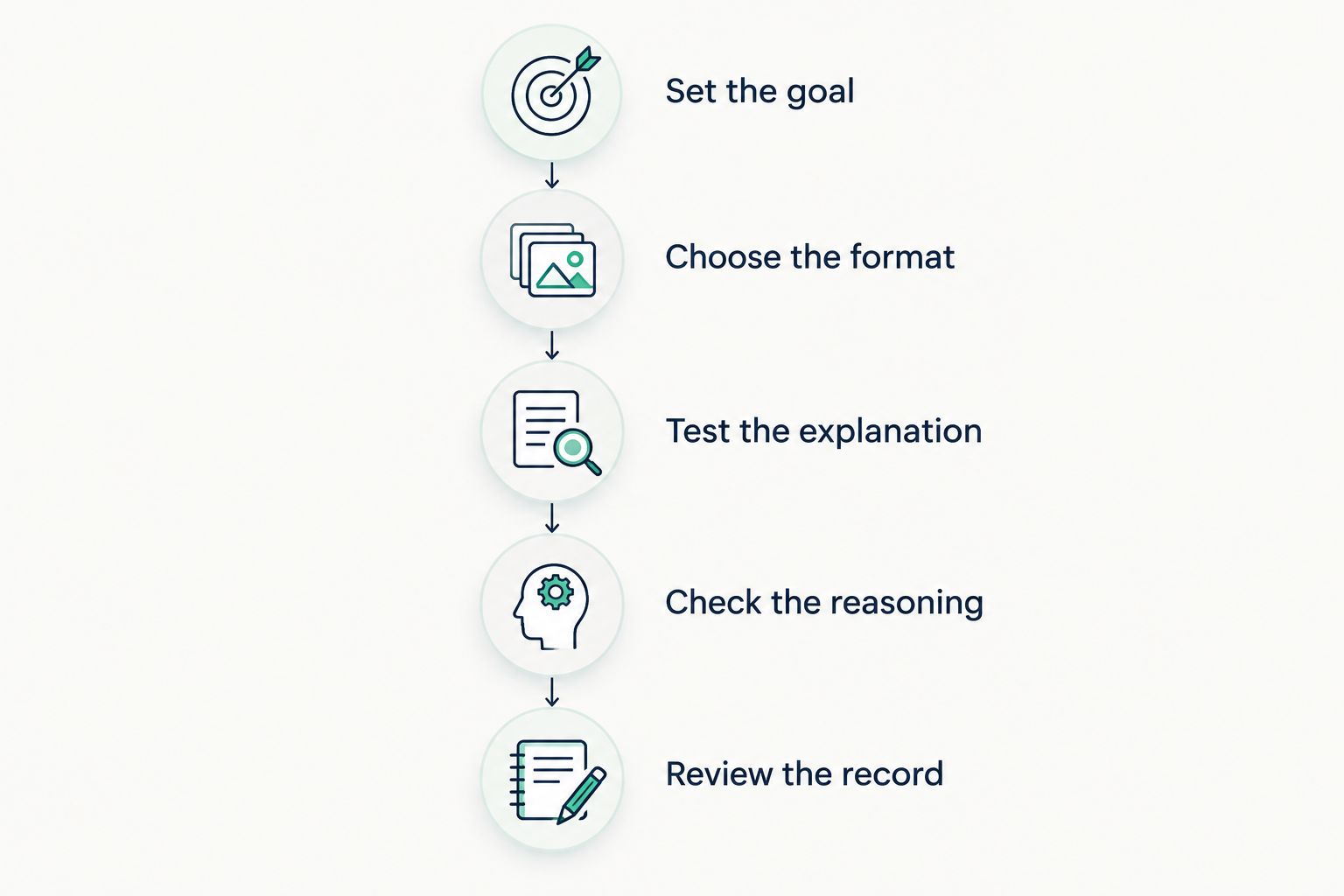
Use this sequence to keep the evaluation focused:
- Set the goal. Name the concept you want to investigate.
- Choose the format. Let your student start by speaking or typing where those options are available.
- Test the explanation. Ask for a different approach if the first one does not connect.
- Check the reasoning. Ask your student to explain a fresh example without supplying the answer.
- Review the record. Compare what you observed with the learning information available afterward.
Keep your first session manageable. As little as 10 minutes a day can be a starting point when that fits your student, but that duration does not promise a particular result.
Afterward, ask what helped, what remained confusing, and what your student would change next time. Their answers belong beside your observations, not beneath them.
What is the difference between adaptive teaching and adaptive practice?
Adaptive teaching changes how a concept is explained in response to the student's needs. Adaptive practice changes the work selected for the student.
Look for both where your goal requires them. A student who needs another explanation should not have to rely only on receiving another question.
Should I choose voice tutoring or text tutoring?
Choose the format that helps your student participate in the current task. There is no need to assign one permanent format to every lesson.
Check whether switching is possible, then preserve any reading, writing, or diagram work that the learning goal itself requires.
How can I tell whether personalization is helping?
Look for your student explaining and applying the idea, not just enjoying the example. Review that work alongside the provider's mastery information.
A single successful answer is useful evidence to examine, not a reason to assume the whole topic is secure.
FAQ
What's the best way to choose adaptive tutoring in 2026?
Choose adaptive tutoring by observing a real lesson tied to your student's current curriculum goal. Check what changes after confusion, whether the student can explain the idea, and what the parent record shows.
Is Tia a good fit for homeschooling families?
Tia is a good fit for homeschooling families seeking personalized subject teaching with curriculum mastery information and parent records. Parents still need to check local requirements and decide how tutoring fits their wider curriculum.
Does personalized tutoring mean my student needs a fixed learning style?
No, personalized tutoring does not require assigning your student a fixed learning style. Evaluate explanations, pace, examples, and participation choices against the task your student is doing.
Can my student speak instead of typing every question?
Students can speak, hear verbal explanations, type, and switch between voice and text within the same lesson. Two-way voice is included in all bundle plans; do not assume the same inclusion for standalone subject plans.
Is engaged time the same as understanding?
No, engaged time and understanding answer different questions. Review activity information alongside mastery estimates, student explanations, and actual work.
Does a 10-minute tutoring session guarantee progress?
No, a 10-minute tutoring session does not guarantee a particular result. A short session can fit a student's routine, but its usefulness depends on the task and the learning that takes place.
Can I try the tutor before choosing a routine?
The offer is a 14-day free trial, no card needed. It applies per account, not per student, so use it to examine teaching fit and parent records before deciding.
One last thing
An explanation that feels familiar is a starting point, not the finish line. After the cricket, horses, or other interest-based example, ask your student to tackle the same concept in an unfamiliar setting.
Choose the tutor that helps your student move from a familiar example to independent reasoning. You stay responsible for the learning plan. Your student stays responsible for doing the learning.
Related guides
- What parents should see in a tutoring dashboard
- Switching between voice and text within one lesson
- Keeping homeschool records without a last-minute scramble
Tia Education Team