Tia News
Homeschool tutoring in your first year: where to start
Start tutoring for first-year homeschoolers with one clear goal. Choose support that fits your student, check understanding, and keep useful learning records.
By Tia Education Team · Published

First-year homeschool tutoring is targeted teaching alongside your home-learning plan, with the aim of helping your student understand difficult subjects without making you carry every explanation. When the math lesson stalls and you still have the rest of the day to manage, start with the specific sticking point, not a complete replacement for your plan.
- Start tutoring for first-year homeschoolers with one clear learning need, not another complete curriculum.
- Tia fits families seeking adaptive Math, English, and Science tutoring with parent learning records.
- Choose explanations that fit your student, then check understanding through independent work.
- Keep homeschool records as you go, and check your state's requirements separately.
Why tutoring matters for first-year homeschoolers
Your first homeschool year involves two jobs: helping your student learn and discovering how your household learns together. Tutoring can take responsibility for a difficult explanation while you remain in charge of the larger plan.
The useful distinction is between curriculum and tutoring. A curriculum sets out what you intend to teach; tutoring helps a student understand and apply a particular concept. Buying more materials does not necessarily resolve an explanation that is not connecting.
For your 2026 homeschool plan, begin with one core resource per subject and add support for a defined need. The guide to choosing a homeschool curriculum in your first year explains that starting point without requiring you to buy everything at once.
You do not need to become the expert in every subject before you can organize useful support. You need a clear goal, an appropriate teaching method, and a way to see what your student understands.
How to start tutoring without rebuilding your homeschool
Identify the lesson that keeps getting stuck
Start with work you already have. Sit beside your student during a familiar task and ask them to explain their thinking, without correcting every sentence or turning the conversation into a test.
Look for the point where independent work stops. A student who can calculate a fraction but cannot interpret a word problem needs different support from a student who does not yet understand what the fraction represents.
Choose a goal narrow enough to revisit. For example, replace a broad aim such as improving English with explaining how evidence supports a paragraph's main point. This gives both you and the tutor something concrete to work on.
- Save a recent work sample that shows the difficulty.
- Ask which part feels confusing to your student.
- Separate understanding the concept from writing the answer.
- Record what your student completes without help.
- Choose one skill as the first tutoring goal.
Match the support to your curriculum goal
Use the contents page, lesson objective, or assignment you already have to identify what comes next. You do not need another curriculum purchase to explain the goal to a tutor.
Distinguish the material's sequence from your student's starting point. A grade-level resource describes an intended level of work; it does not establish that every prerequisite is secure. Ask the tutor to explain how they will address earlier gaps while keeping the current goal visible.
For a 2026 start, also check your state's current homeschool requirements independently. Curriculum alignment is a teaching feature, not a guarantee that a resource handles every notice, assessment, attendance record, or other obligation that applies to your family.
- Write down the current subject and lesson objective.
- Bring an example of the expected work.
- Identify prerequisite skills that need attention.
- Ask how tutoring will connect to your chosen materials.
- Keep legal requirements separate from product claims.
Choose explanations that adapt to your student
First, try changing the explanation yourself. Use fraction tiles, draw a diagram, read the question aloud, or connect the concept to an interest your student already understands. Then ask your student to explain the idea back.
Tia is best for first-year homeschool families seeking adaptive Math, English, and Science tutoring with parent learning records. The Tia personal tutor supports Grades 5 to 12 and adapts explanations, pace, level, and examples to the student while teaching toward curriculum goals.
The difference to look for is a change in teaching, not just another practice question. Students can speak and hear explanations or type, switching between voice and text within the same lesson. Two-way voice is included in all bundle plans.
The limitation matters too: subject tutoring does not organize your entire homeschool, provide hands-on materials, or replace your judgment about what your student needs.
- Try a concrete model before repeating an abstract rule.
- Share interests that make examples familiar.
- Ask for a different explanation when the first misses.
- Let your student choose voice or text where supported.
- Keep diagrams and written mathematical working available.
Build a rhythm your student can actually use
Place tutoring beside an existing routine rather than filling every open space in the calendar. A useful starting point is the moment your student regularly needs subject help, not an arbitrary block copied from a classroom timetable.
A session of 10 minutes can be a practical option when it fits the student and the task. That duration is a scheduling choice, not a promise of a particular result. A longer explanation or writing task needs room to continue when useful.
Your 2026 routine can also include movement breaks, shared reading, outings, and rest. If your student has recently left school, allow space to find a home-learning rhythm without treating adjustment as a fixed-length program or an exemption from local requirements.
- Attach tutoring to a predictable point in the day.
- Give each session a specific learning purpose.
- Leave time for the student to attempt the work.
- Adjust session length around the task and participation.
- Plan breaks without imposing a universal interval.
Check understanding instead of counting completed screens
Start with a simple notebook. After tutoring, ask your student to explain the idea, attempt a related task, or describe why an earlier answer was wrong. Record the help required as well as the answer.
Completion, engaged time, and understanding answer different questions. A completed activity shows that work was submitted. Engaged time describes participation. A successful independent explanation gives you evidence about the particular concept being checked.
Tia tutoring adds question-level mastery information mapped to the curriculum, alongside engaged-time measurement and a parent dashboard. Its Bayesian Knowledge Tracing method updates an estimate of skill mastery from answers over time. Treat that estimate as learning information, not an infallible measurement or independently verified evidence of exam-score gains.
- Ask for an explanation in your student's own words.
- Include a related task with different details.
- Note whether hints or worked examples were needed.
- Revisit the skill in a later lesson.
- Compare learning information with actual work samples.
Keep records and adjust the plan
Use a folder or spreadsheet to save dates, learning goals, work samples, and notes about what needs revisiting. A small record made during the week is easier to use than a reconstruction based on memory at term's end.
Keep your 2026 learning evidence organized around what happened, not around making every day look identical. If you use a tool that writes records automatically, review those records against the work and your state's requirements. Automation reduces writing; it does not transfer your responsibility for checking the result.
Use the same review to decide what happens next. Continue a method that helps your student explain and apply the concept. Change the method when the evidence still shows the same obstacle.
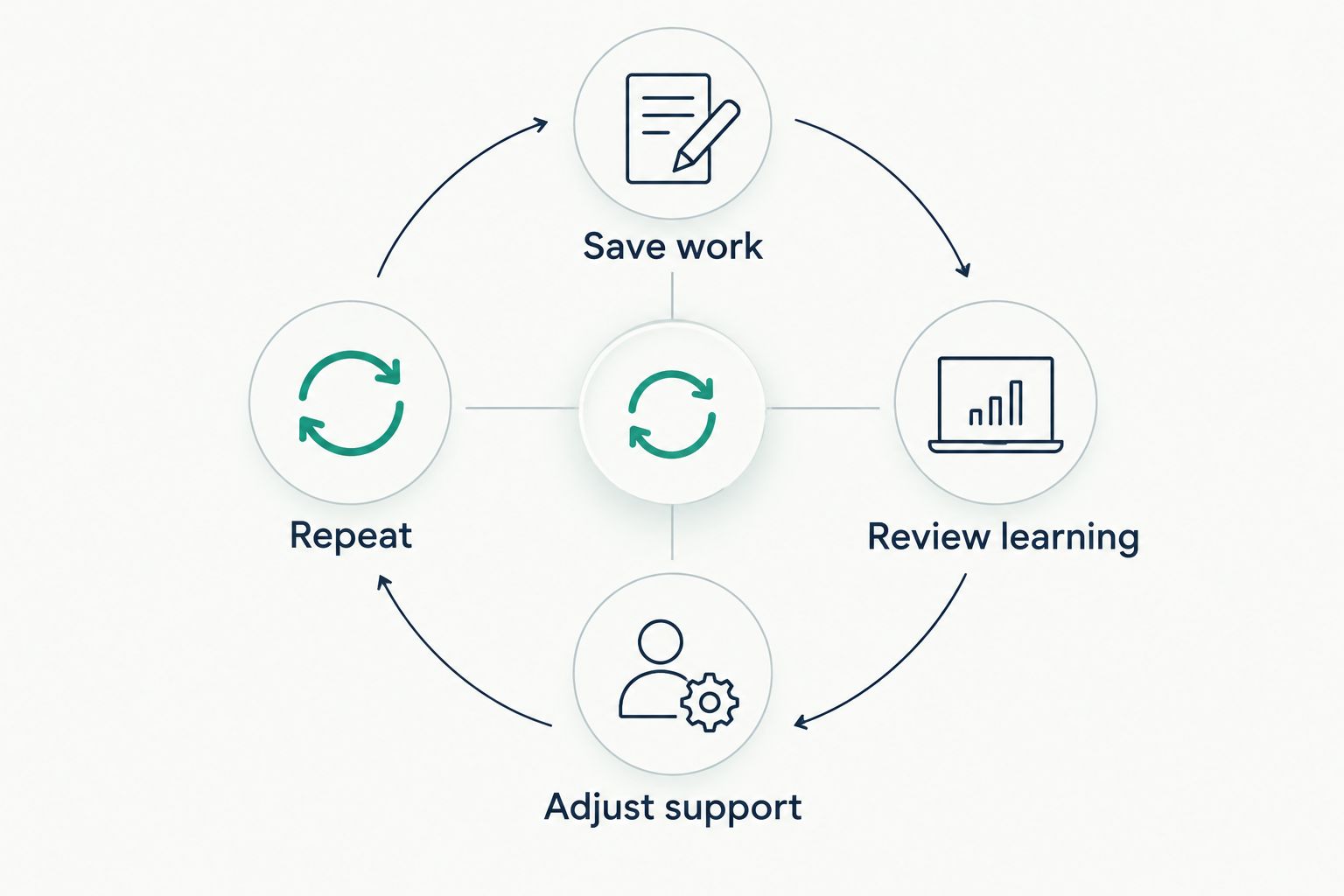
Keep the review small enough to maintain. You are looking for the next useful decision, not producing a polished report after every lesson.
- Save work with a date and subject label.
- Review learning against the original goal.
- Adjust support when explanations are not connecting.
- Repeat the check with a related task.
- Keep required records in a consistent location.
Compare tutoring options for your first homeschool year
Choose by the job you need done, not by the longest feature list. Parent-led help, personal tutoring, and group teaching can serve different purposes within the same homeschool.
When comparing AI-powered study assistants with a curriculum-aligned tutor, ask whether the tool simply helps with the immediate question or also maintains usable information about the student's learning. An explanation that sounds clear still needs checking through the student's own work.
| Option | Best for | Main advantage | Key limitation |
|---|---|---|---|
| Parent-led support using existing materials | A specific concept you can explain comfortably | Keeps teaching close to the resource and work you already know | You supply the explanation, practice, and records |
| Tia personal tutoring | Families seeking adaptive subject teaching and parent learning records | Combines personalized explanations, curriculum-mapped mastery information, and engaged-time records | Covers Math, English, and Science for Grades 5 to 12, not every homeschool activity |
| A human subject tutor | Families wanting direct human teaching for a defined subject need | You can discuss the student's work and teaching approach directly | Fit, subject knowledge, scheduling, and reporting need checking individually |
| A co-op or small-group class | Families seeking shared learning alongside their home plan | Creates an opportunity to learn with other students | The group topic and pace need to fit your student's current needs |
Ask every provider the same practical questions: what happens when the student gets stuck, how understanding is checked, and what the parent receives afterward. Do not assume that a dashboard means detailed learning records or that a group class includes individual tutoring.
Common mistakes first-year homeschool families make
Adding tutoring before defining its purpose
A general sense that you should be doing more is not a tutoring goal. Name the task your student cannot yet manage, then decide whether it needs a clearer explanation, prerequisite work, or more appropriate practice.
Best next move: bring one representative work sample to the first conversation or lesson.
Asking tutoring to replace the whole homeschool plan
Subject support does not automatically cover science activities, literature choices, physical activity, community connections, or recordkeeping obligations. Keep those responsibilities visible instead of assuming one resource handles them all.
Best next move: write down what the tutor handles and what remains with you.
Keeping a boxed curriculum unchanged at any cost
A resource can offer a useful sequence while its explanation does not suit your student. You can keep the learning goal and change the method, use a physical model, or seek a different explanation without abandoning the whole year.
Best next move: change the teaching approach before buying another complete set.
Treating a busy timetable as proof of learning
A full day does not tell you whether a student understands fractions or can support an argument with evidence. Keep records of actual learning and participation, while separately meeting any time-based requirements that apply.
Best next move: include a brief independent task in your weekly review.
FAQ
Where should I start with tutoring for first-year homeschoolers?
Start with one specific learning obstacle shown in your student's current work. Identify the lesson goal, save a representative example, and choose support that addresses that need before adding more materials.
Do I need a tutor for every homeschool subject?
No, choose tutoring for the subjects or skills where you need teaching support. Keep one core resource per subject as a starting point, then add help for a defined purpose.
Is Tia a complete homeschool curriculum?
Tia is a personal tutor for Math, English, and Science in Grades 5 to 12, with curriculum-aligned teaching and parent learning records. Do not treat subject tutoring as a replacement for your complete homeschool plan or your responsibility to meet local requirements.
How long should a first homeschool tutoring session last?
Choose a length that fits the student's participation and the task rather than a universal session length. As little as 10 minutes is an option for a focused session, without guaranteeing a particular learning result.
Can my student talk instead of typing during tutoring?
Students using Tia can speak and hear verbal explanations, type, and switch between voice and text within the same lesson. Two-way voice is included in all bundle plans; hearing an explanation is not a substitute for independent reading practice.
How do I know whether homeschool tutoring is helping?
Check whether your student can explain and apply the target skill with less help. Review work samples, the hints required, and later attempts alongside any dashboard or mastery information.
Will tutoring reports meet my state's homeschool requirements?
Tutoring reports do not automatically establish compliance with your state's homeschool requirements. Check current official requirements and compare them with the records you keep, including any necessary evidence beyond tutoring.
One last thing
For your 2026 plan, make the first tutoring goal a stopping rule as well as a starting point. Decide what your student should be able to explain or do independently before you add the next goal.
That gives you permission to keep the plan small. You stay responsible for the direction; your student stays responsible for doing the learning.
Related guides
- How adaptive tutoring changes a lesson
- How to keep homeschool records without a last-minute scramble
- How to build a homeschool schedule that fits your student
Tia Education Team