Tia News
TutorBright alternatives in 2026
Compare TutorBright alternatives: Tia for adaptive tutoring, Wyzant for human support. Match teaching, curriculum, and parent records to your student.
By Tia Education Team · Published

TutorBright offers individualized tutoring with a human tutor, a strength when your student benefits from a personal relationship. If homework still leaves you translating explanations or piecing together learning records, compare the teaching approach and parent workflow rather than switching for a longer feature list. The best TutorBright alternative in 2026 is Tia if you need adaptive, curriculum-aligned tutoring with parent records; Wyzant if you want to choose a human tutor yourself.
- Among TutorBright alternatives, Tia fits families seeking adaptive personal tutoring with curriculum mastery information and parent records.
- Wyzant fits families who want to select a human tutor and discuss an individual teaching approach.
- Khan Academy fits structured independent study; IXL fits personalized skill practice and diagnostic recommendations.
- Stay with TutorBright when the tutor relationship works and your student can explain learning independently.
Why this matters
You do not need another platform to supervise. You need help that addresses the part of learning that keeps getting stuck, whether that is understanding an explanation, practicing a skill, or starting work without a parent beside the desk.
Those are different jobs. A student who needs a concept explained differently does not necessarily need more practice questions, and a student who understands the lesson might simply need a clearer practice routine.
Choose the teaching relationship first, then compare the reporting and routine. Your student still does the learning. The right support gives you a clearer role without asking you to become the subject expert.
TutorBright alternatives at a glance in 2026
These options represent different approaches, not interchangeable tutoring packages. Use the table to decide which category deserves a closer look.
| Option | Best for | Standout feature | Difference from TutorBright |
|---|---|---|---|
| TutorBright | Families seeking individualized human tutoring | A human tutor relationship | The benchmark when personal connection is central |
| Tia | Adaptive personal tutoring with parent visibility | Curriculum-aligned explanations, mastery tracking, and self-writing records | A digital personal tutor rather than a human tutor relationship |
| Wyzant | Families who want to select a human tutor | Tutor profiles and direct discussion of teaching needs | A marketplace where choosing the individual tutor is central |
| Khan Academy | Structured independent learning | Courses, mastery learning, and tailored practice | A learning platform rather than an assigned human tutor |
| IXL | Targeted skill practice | Personalized diagnostic recommendations | A practice-focused option rather than a human tutoring relationship |
No option wins every category. Human rapport, adaptive explanations, structured courses, and diagnostic practice solve different problems, even when they cover the same school subject.
1. Tia: best for adaptive tutoring with parent records
Tia adapts to the student, not the other way around. Its personal tutoring covers Math, English, and Science for Grades 5 to 12, adjusting explanations, pace, level, and examples to the student's interests while teaching against curriculum goals.
This is the strongest fit when you want the teaching and the parent records in one workflow. Students can speak and hear explanations, type, or switch between voice and text within the same lesson; two-way voice is included in all bundle plans.
Where it shines
- Explanation personalization: The teaching can connect a concept to an interest instead of only changing the next practice question.
- Mastery information: Answers update an estimate of curriculum skill mastery through Bayesian Knowledge Tracing.
- Parent visibility: A live dashboard, engaged-time measurement, and self-writing homeschool records bring learning information together.
- Participation choice: Voice and text offer different ways to ask questions and explain reasoning.
Where it falls short
- It does not provide the relationship of a human tutor.
- Its stated subject scope is Math, English, and Science, not every subject a student might study.
- A mastery estimate is not an independently verified exam-score improvement or a complete measure of understanding.
- Hearing an explanation does not replace independent reading practice.
The distinction matters: engaged time shows participation, while mastery information estimates understanding from answers over time. Neither should be treated as a guarantee that a student can apply every skill independently.
| Decision point | Adaptive personal tutor | TutorBright |
|---|---|---|
| Teaching relationship | Digital tutoring that adapts explanations and pace | Individualized tutoring with a human tutor |
| Main fit | Families seeking integrated teaching and parent records | Families prioritizing human connection |
| What to evaluate | Explanation changes, student reasoning, and learning records | Tutor rapport, explanation quality, and communication |
Best for: Homeschooling parents and families seeking support across the stated subjects with a clearer view of learning.
Verdict: Buy for the integrated teaching-and-records workflow, not as a substitute for human rapport.
2. Wyzant: best for choosing a human tutor yourself
Wyzant is a tutor marketplace, so your decision centers on the individual tutor rather than one uniform teaching experience. That fits a parent who wants to discuss a specific course, review tutor profiles, and choose the person who will work with the student.
Human tutors can personalize explanations, examples, and pacing. The useful comparison with TutorBright is therefore how you select the tutor and agree on the work, not whether human tutoring can adapt.
Where Wyzant shines
- You can make the tutor's subject experience and teaching approach central to your selection.
- You can discuss the student's current work and the kind of help needed.
- A human tutor can respond to questions and adjust an explanation during a conversation.
Where Wyzant falls short
- Selecting and evaluating the tutor becomes part of your job.
- Do not assume every tutor uses the same lesson structure or reporting approach.
- A strong subject match still needs to become a workable student-tutor relationship.
Before choosing, ask the tutor to describe how they handle an incorrect answer. Listen for a plan to investigate the student's reasoning, not simply repeat the solution more slowly.
Best for: Families who want an active role in selecting a human tutor for a particular learning need.
Verdict: Buy when choosing the individual tutor is your priority; hold if you want less selection work.
3. Khan Academy: best for structured independent learning
Khan Academy combines structured courses, instructional resources, mastery learning, tailored practice, and progress tools. It belongs on this shortlist when your student can work through material independently but needs a clearer path through a topic.
Do not confuse the Khan Academy platform with Khanmigo, its separate guided tutoring offering. Evaluate the specific product you intend to use rather than assigning every capability to the whole platform.
Where Khan Academy shines
- Structured courses give independent study a sequence.
- Mastery learning and tailored practice support work on particular skills.
- Progress tools give you more to discuss than whether a video was watched.
Where Khan Academy falls short
- The core platform does not supply an assigned human tutor relationship.
- A course sequence is not the same as a personal conversation about why an explanation is confusing.
- You still need to decide how the material connects to the student's current curriculum goals.
Best for: Students ready to use structured resources and practice with parent oversight.
Verdict: Buy into this approach for independent study; skip it as a like-for-like replacement for human tutoring.
4. IXL: best for targeted skill practice
IXL offers skill practice with personalized diagnostic recommendations. It fits a family whose main question is what the student should practice next, rather than who should teach the next lesson.
Where IXL shines
- Diagnostic recommendations help direct practice toward identified skills.
- Skill-focused work gives you a specific topic to revisit.
- Personalized practice can sit alongside instruction from another source.
Where IXL falls short
- Personalized recommendations are not the same as personalized explanations.
- A practice platform does not provide a human tutor relationship.
- Selecting a relevant skill does not establish that the student understands the underlying concept.
Best for: Students who need focused practice alongside their existing instruction.
Verdict: Buy for practice; hold if your student first needs the concept taught differently.
Why people switch from TutorBright
A useful reason to switch in 2026 is a mismatch between the support you have and the work you need done. These are decision criteria, not claims about TutorBright customer complaints or service failures.
You want a different teaching relationship
Some students want a human conversation. Others are comfortable asking questions through a digital lesson and prefer choosing between speaking and typing. Start with your student's response, not an assumption that one format is universally better.
You need clearer learning records
For homeschooling families, records are part of the decision, not an administrative extra. Ask whether you can distinguish active participation, topics studied, and evidence of understanding.
The guide to what parents should see in a tutoring dashboard sets out the information to examine. Records can support your reporting work, but you remain responsible for checking local requirements.
You need practice rather than more tutoring
If your student can explain the concept but needs repetition, a practice-focused option deserves consideration. If the explanation itself is not landing, adding questions leaves the teaching problem unresolved.
Test the fit with one real learning problem
For your 2026 comparison, use the same learning goal with each shortlisted option. Choose something the student is currently studying, not an impressive demonstration unrelated to their work.
Keep the comparison manageable. A 10-minute session can be a practical starting point when it suits your student, but that duration does not promise a particular result.
- Learning goal: Name the concept or task you want the student to understand.
- Explanation: Notice whether the support changes when the student says something is unclear.
- Student reasoning: Ask the student to explain the next step without copying the example.
- Parent record: Check what you can review afterward and what it actually establishes.
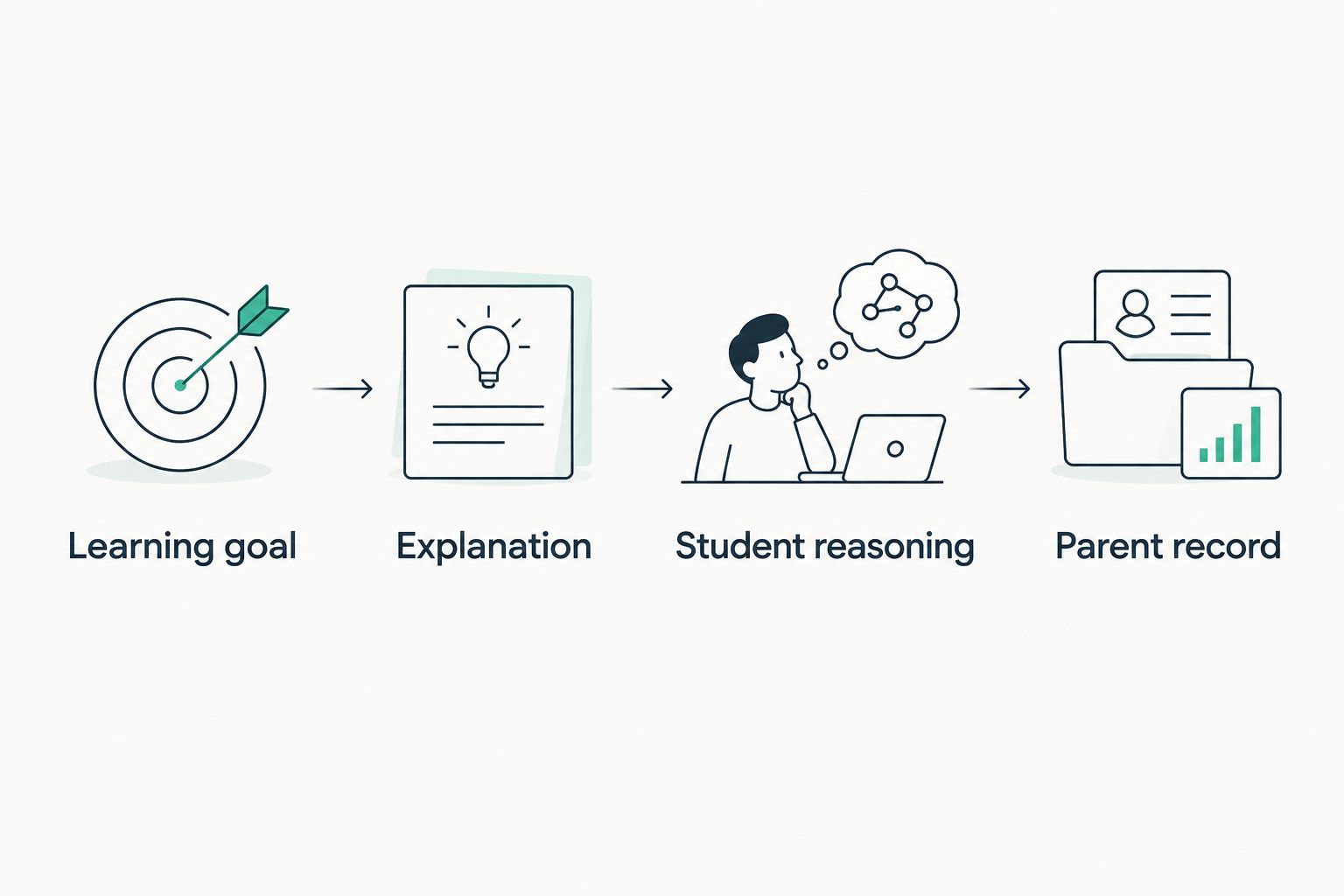
For example, a student studying fractions might complete a familiar question correctly but struggle to explain why the method works. That difference gives you a more specific next question than a general request for more math help.
Do not turn the comparison into another test the student has to pass. Ask which explanation made sense and where they still needed help, then use the answer to choose support.
For exam revision, protect the student's thinking
Exam preparation needs a separate check: who is doing the reasoning? A polished worked answer is not evidence that the student can reproduce the method on a new question.
With AI-powered exam preparation, the important distinction is whether support prompts the student's thinking or simply supplies an answer. Apply the same standard to a human tutor, a course, or a practice platform.
Ask the student to attempt the problem first. Then use help to identify the sticking point, explain the missing idea, and return the work to the student.
Keep diagrams and written working when the subject requires them, even if the student prefers discussing questions aloud. Speaking is a participation option, not a reason to remove mathematical notation or independent writing from the task.
When staying with TutorBright is the right call
Stay with TutorBright if the tutor relationship works, explanations make sense to your student, and you have the learning information you need. A different platform is not automatically an improvement.
Before replacing a working relationship, discuss the specific gap. Ask for clearer learning goals, a different explanation approach, or a more useful update if those are the issues you are trying to solve.
Keep the decision proportionate. If the student needs extra practice between useful tutoring sessions, consider whether a practice resource addresses that need without replacing the tutor.
FAQ
What's the best TutorBright alternative in 2026?
Tia is the best fit on this shortlist for families seeking adaptive, curriculum-aligned personal tutoring with parent records. Choose Wyzant if selecting a human tutor is the priority, Khan Academy for structured independent study, or IXL for targeted practice.
Which TutorBright alternative offers a human tutor?
Wyzant offers a marketplace for selecting a human tutor. Compare the individual tutor's teaching approach, subject experience, and communication with your family's needs.
Is Khan Academy the same as one-on-one tutoring?
No. Khan Academy's core platform provides structured learning resources, mastery learning, tailored practice, and progress tools rather than an assigned human tutor. Khanmigo is a separate guided tutoring offering.
Is IXL better for explanations or practice?
IXL fits targeted skill practice and personalized diagnostic recommendations. If your student needs a concept explained differently, evaluate the teaching support separately from the practice recommendations.
Can an adaptive personal tutor track understanding rather than just time?
Yes. The featured adaptive tutor uses Bayesian Knowledge Tracing to update an estimate of skill mastery from student answers and map it to the curriculum. That estimate is distinct from engaged time and is not an independently verified exam-score gain.
Should I switch if my student likes their TutorBright tutor?
Keep a productive tutor relationship unless another need remains unresolved. Discuss the specific gap first, and distinguish a need for extra practice from a need for different teaching.
Can speaking replace typing during tutoring?
Speaking can replace typing for some questions and explanations when the service supports it. It does not replace independent reading, written mathematical work, or writing practice when those are the learning goals.
One last thing
For your 2026 decision, ask one question after the session: can the student explain the idea without the help still open? Treat the answer as a prompt for the next lesson, not a verdict on the student.
Choose the support that makes the next independent step clearer. More completed questions, longer sessions, and tidier reports are not substitutes for that goal.
Related guides
- How to choose tutoring that adapts to your student
- How adaptive tutoring changes a lesson
- How to keep homeschool records without a last-minute scramble
Tia Education Team