Tia News
Sylvan Learning alternatives for personalized tutoring in 2026
Compare sylvan learning alternatives for 2026. Choose adaptive tutoring for home learning, guided practice, or a human tutor based on your student's needs.
By Tia Education Team · Published

Sylvan Learning offers personalized instruction and the structure of a tutoring center, a reassuring option when homework has become another job for you. That model stops being the right fit when your family needs learning at home rather than a center-based routine. The best Sylvan Learning alternative in 2026 is Tia if you need adaptive personal tutoring with parent records; Khan Academy if you need structured, self-directed practice.
- Among sylvan learning alternatives, Tia fits families seeking personalized tutoring, curriculum alignment, and homeschool records.
- Khan Academy fits students who can work through structured courses and practice with parent guidance.
- An independent human tutor fits families who want a direct teaching relationship.
- Stay with Sylvan Learning when its instruction and center routine already work for your student.
Why this matters
You are not just choosing where your student gets help. You are deciding who explains the difficult parts, who notices a misunderstanding, and who keeps track of the work.
A tutoring center, an adaptive personal tutor, and a course platform solve different problems. Treating them as interchangeable makes the decision harder than it needs to be.
For your 2026 shortlist, start with the moment that keeps repeating. Is your student stuck because the explanation does not make sense? Do they understand the lesson but need practice? Or do they need another person beside them to keep the work moving?
Choose the teaching format before you choose the provider. A recognizable name does not tell you whether its format fits your family.
Sylvan Learning alternatives at a glance
| Option | Best for | Standout feature | How it differs from Sylvan Learning | Main limitation |
|---|---|---|---|---|
| Sylvan Learning | Families seeking center-based instruction | Assessment-led, personalized tutoring | The benchmark for a structured tutoring-center approach | A center-based routine is not the same as learning at home |
| Tia | Families seeking adaptive personal tutoring at home | Teaching that adapts to pace, level, and interests, with parent records | Combines online personal tutoring with engaged-time measurement and self-writing records | Covers grades 5 through 12 and Math, English, and Science, not every age or subject |
| Khan Academy | Students seeking structured courses and practice | Mastery learning, explanations, tailored practice, and progress tools | A resource-and-practice platform rather than the same center-based teaching model | Using the main platform independently leaves lesson selection and support with the family |
| Independent human tutor | Students seeking a direct relationship with a particular tutor | Individual instruction from a person you select | You choose the individual rather than a tutoring-center program | Teaching approach, reporting, and subject scope depend on the tutor |
This comparison concerns the main Khan Academy platform. Khanmigo is a separate offering, so do not assume its features are included in the experience described here.
1. Tia: best for adaptive personal tutoring at home
A student can follow one explanation and get lost in the next. This personal tutor adapts its teaching to the student's pace, level, and interests while staying aligned to the relevant curriculum. It covers 3 subjects: Math, English, and Science, for students in grades 5 through 12.
The distinction is not simply that lessons happen online. The teaching changes for the individual student, while parents get a live dashboard, honest engaged-time measurement, and self-writing records for homeschool reporting.
Where it shines
- Adaptation during learning: Explanations and examples respond to the student's level, pace, and interests.
- Curriculum alignment: Teaching connects to the student's curriculum rather than treating every topic as an isolated exercise.
- Parent visibility: The dashboard gives you a way to follow progress without sitting through every lesson.
- Homeschool records: Self-writing records reduce the separate task of reconstructing what your student studied.
- Home-based learning: The online format fits families looking beyond a tutoring-center setting.
Where it falls short
- Defined age range: It is not an option for students outside grades 5 through 12.
- Defined subject range: It does not replace tutoring in subjects beyond Math, English, and Science.
- Different format: It is not an in-person tutoring center. If the physical setting is what helps your student participate, that difference matters.
- Parent responsibility remains: Reporting support does not replace your responsibility to check local homeschool requirements.
Head-to-head with Sylvan Learning
| Dimension | Tia | Sylvan Learning |
|---|---|---|
| Core format | Online personal tutor | Tutoring-center instruction |
| Personalization | Adapts teaching to pace, level, and interests | Personalized instruction informed by assessment |
| Parent decision | Assess the teaching fit and usefulness of dashboard records | Assess the instruction and routine at the center you would use |
| Home learning | Teaching and records support learning at home | Consider whether the center-based approach fits your home-learning plan |
Best for: Homeschooling parents and parents of school students who want personalized tutoring at home, with visibility into the learning.
Verdict: Buy if adaptive teaching and parent records are your priorities. Skip if your student needs an in-person setting.
2. Khan Academy: best for structured practice with guidance
Khan Academy provides structured courses, instructional resources, mastery learning, tailored practice, and progress tools. It is a strong alternative when your student needs a clear place to review a concept and work through exercises.
Do not mistake a different format for a lack of personalization. Khan Academy includes practice and progress features; the decision is whether those features meet your student's need or whether you want a more direct tutoring relationship.
Where Khan Academy shines
- Structured courses: Your student can follow an organized sequence instead of collecting unrelated worksheets.
- Concept review: Explanations and practice give the student another way to approach familiar material.
- Mastery learning: The platform supports working toward understanding rather than merely opening the next lesson.
- Progress tools: You can use the available progress information when deciding what to review.
Where Khan Academy falls short
- Self-directed use needs support: If your student cannot choose an appropriate lesson or start independently, you still need a plan for guidance.
- A course is not a human relationship: Main-platform resources do not provide the same experience as working with a particular human tutor.
- Course fit needs checking: Match the available material to your student's actual assignments and curriculum objectives.
Head-to-head with Sylvan Learning
| Dimension | Khan Academy | Sylvan Learning |
|---|---|---|
| Main experience | Courses, explanations, and practice | Personalized tutoring instruction |
| Learning structure | Organized course sequences and mastery learning | A tutoring program informed by assessment |
| Parent's choice | Decide how platform practice fits the learning plan | Decide how center instruction fits the learning plan |
For a 2026 decision, try a topic your student already finds difficult. Watch whether the resources help the student begin explaining the idea, not just finish an exercise.
Best for: Students who can use structured practice independently or with consistent parent guidance.
Verdict: Buy into this approach for review and practice. Skip it as your only support if your student needs a direct teaching relationship.
3. An independent human tutor: best for a direct teaching relationship
An independent human tutor gives you a different choice: select the person, then agree on the learning goals together. This fits families who want someone to discuss a student's specific work and build an ongoing relationship.
The provider name matters less here than the individual. Ask the tutor to explain how they would approach the actual difficulty your student is having.
Where an independent tutor shines
- Direct conversation: You can discuss goals and concerns with the person delivering instruction.
- Individual selection: You can look for experience relevant to your student's subject and school level.
- Specific work: You can ask how the tutor handles the assignments or concepts your student needs help understanding.
Where an independent tutor falls short
- No uniform teaching model: The approach depends on the individual tutor.
- Reporting needs agreement: Specify what feedback you want rather than assuming a dashboard or automatic records.
- Subject fit needs checking: Experience in one subject does not establish experience in another.
Compared with Sylvan Learning, the key change is who you select. You are choosing an individual teaching relationship rather than a center's program.
Best for: Students who want an ongoing relationship with a particular human tutor.
Verdict: Buy after confirming subject fit and communication. Wait if the tutor cannot explain the proposed approach.
Why families choose a different format from Sylvan Learning
Changing providers makes sense when the alternative addresses a specific need. It does not require deciding that Sylvan Learning is bad.
Use these reasons as decision criteria, not assumptions about every center or every family:
- Home routine: You want learning to happen at home rather than organize your week around center visits.
- Teaching fit: You want to see explanations change with the student's pace, level, and interests.
- Practice needs: Your student mainly needs structured review rather than another tutoring program.
- Parent records: You need engaged-time information and homeschool records alongside teaching.
- Human relationship: You want to choose and communicate directly with an individual tutor.
Ask your current center how it addresses your priority before switching. A feature you need might already be part of the service you use.
Switch for a clear fit difference, not a promise of better results that nobody has demonstrated for your student.
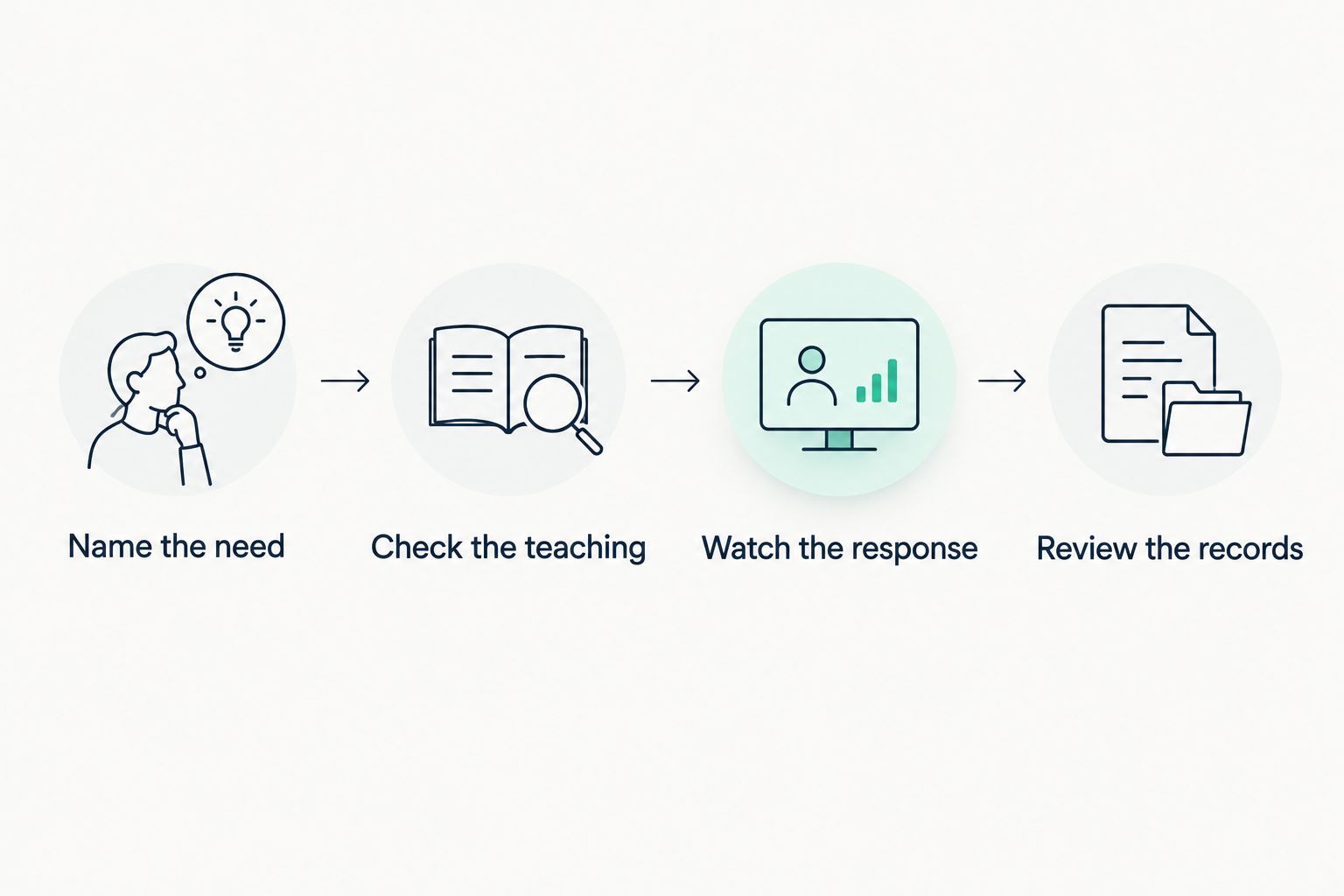
How to choose without turning it into another project
You do not need to test every alternative. You need to check the part of learning that is currently getting stuck.
Name the need
Write one sentence: “My student needs help understanding fractions,” or “My student understands the lesson but avoids starting practice.” Keep it specific enough that you can recognize useful support.
Check the teaching
Choose one real concept from the student's current work. Look for an explanation that helps the student understand the reasoning, rather than simply supplying an answer.
Watch the response
Ask your student to explain the idea in their own words. Notice where they still need help and whether the teaching approach responds to that difficulty.
Review the records
Decide what you need to see as a parent. That might be the topic studied, the work attempted, progress information, or engaged learning time. For homeschooling, also check how those records fit your local requirements.
Keep the first comparison manageable. A 10-minute session can be a practical starting point when that fits your student, not a promised route to a particular result.
For your 2026 shortlist, compare the same concept across your preferred options. Otherwise, you risk comparing an easy review exercise with a genuinely difficult lesson.
When staying with Sylvan Learning is the right call
Stay with Sylvan Learning if your student participates willingly, understands the instruction, and benefits from the center routine. You do not need to replace a working arrangement because another option has a different feature list.
Look at the student's work and listen to their explanation of what they learned. Discuss remaining difficulties with the center before assuming a new provider is the answer.
For 2026, the right choice is the format that supports your student's learning and fits your family's routine. Keep a working teaching relationship. Change the parts that are not working.
FAQ
What's the best Sylvan Learning alternative for homeschooling?
Tia is the best fit here for homeschooling parents seeking adaptive personal tutoring with a live dashboard, engaged-time measurement, and self-writing records. It teaches Math, English, and Science for grades 5 through 12. Parents still need to check local reporting requirements.
Is Khan Academy better than Sylvan Learning?
Khan Academy is a better fit when your priority is structured courses and practice rather than center-based tutoring. Sylvan Learning is a better fit when your student benefits from its instruction and center routine. Neither format is automatically better for every student.
Can online tutoring replace a tutoring center?
Online tutoring can replace a tutoring center when its teaching format meets your student's needs. Check how the student responds to explanations and whether the home routine works. Do not switch solely because lessons happen online.
What should I look for in personalized tutoring?
Look for teaching that responds to the student's pace, understanding, and interests. Ask how the tutor handles a misunderstanding and how you will review progress. A personalized label alone does not answer those questions.
Does Khan Academy have personalization and progress tracking?
Yes, Khan Academy includes mastery learning, tailored practice, and progress tools. It should not be described as only a static resource library. This comparison concerns the main platform, not the separate Khanmigo offering.
How do I compare tutoring for a student who learns differently?
Compare how each option responds when the student needs a different explanation or pace. Let the student describe what helps them understand. Tutoring fit does not replace specialist assessment or support when those are needed.
Should I stop Sylvan Learning before trying an alternative?
You do not need to stop a working arrangement simply to assess another teaching format. Compare the alternative against a specific unmet need first. Discuss any changes with your student so the decision reflects their experience.
One last thing
An answer can be correct without showing understanding. Before choosing your 2026 tutoring option, ask your student: “How did you know what to do?”
Listen to the explanation. Then choose the support that helps your student do more of that thinking independently, while you stay the parent.
Related guides
- How adaptive tutoring changes a lesson
- What parents should see in a tutoring dashboard
- How to keep homeschool records without a last-minute scramble
- Online alternatives to in-person tutoring centers
Tia Education Team