Tia News
Student interests to engaging lessons: complete 2026 workflow
Tutoring that adapts to student interests needs a clear learning goal. Connect familiar examples to curriculum, check understanding, and plan the next lesson.
By Tia Education Team · Published

You have a student who can explain every detail of a favorite game but stalls at a math problem. Instead of rewriting lessons around that interest every day, use a repeatable workflow with Tia: identify the curriculum goal, connect it to something familiar, then check whether the student can use the skill without the familiar example.
- Tia suits families seeking personalized tutoring that adapts to student interests while staying aligned to curriculum.
- Choose the learning goal first; use the student's interest to shape the explanation, not replace the lesson.
- Check understanding with a fresh example before deciding what to teach next.
- Use engaged-time records alongside student work, not as a substitute for evidence of understanding.
Why this matters
A familiar topic gives you a starting point for an explanation. It does not tell you whether the student understands fractions, paragraph structure, or scientific evidence. Your workflow needs both a welcoming entry point and a clear learning check.
Tia is best for families seeking a personal tutor that adapts curriculum-aligned explanations to a student's pace, level, and interests. It covers Math, English, and Science for students in Grades 5 to 12. The parent remains in charge of the learning plan.
For your 2026 learning plan, separate the subject goal from the teaching method. You can keep the required skill while changing the example, the pace, or the amount of explanation. The guide to how adaptive tutoring changes a lesson explains that distinction in more detail.
The benefit is a repeatable way to prepare and review lessons. The limit is equally important: an interesting conversation is not proof of learning. Look for what the student can explain or do afterward.
Before you start
- Access and materials: Have access to Tia, the current assignment or curriculum objective, and somewhere to keep a short lesson note. Keep scratch paper nearby for work the student needs to show.
- Student input: Ask what the student actually enjoys now. Use their answer rather than assuming last year's favorite topic still fits.
- The easy-to-miss gotcha: A student can understand the familiar story without understanding the academic idea. Prepare an unthemed follow-up task before the session so you can check the skill separately.
Use the assignment's exact wording when it matters. “Work on math” leaves too much open; “compare fractions with different denominators” gives the session a defined purpose.
You do not need to create a full interest profile. A brief note about the student's current interest, the target skill, and the point of difficulty is enough to begin this workflow.
Learning goal
- Choose the target skill. Read the current assignment or curriculum objective. Write down what the student should be able to do, not merely the chapter they should finish.
- Locate the sticking point. Ask the student to attempt a representative task. Notice where they stop: understanding the question, choosing a method, carrying out a step, or explaining the answer.
- Define the learning check. Prepare a fresh task that uses the same skill in a different context. Keep its difficulty comparable so you are not testing a new concept by accident.
- Write a short session brief. Include the subject, the skill, the difficulty you noticed, and the student's interest. Leave out unrelated background.
For example, your brief might be: “The goal is to compare fractions. The student enjoys baking and currently compares denominators without considering the size of each piece. Start with equal-sized wholes, then connect the model to fraction notation.”
That brief keeps the explanation tied to the actual difficulty. It also gives you a way to judge whether the lesson addressed the problem you brought to it.
For a 2026 homeschool plan, use the objective from the curriculum you have chosen. For a school assignment, use the assigned skill and method where required. Interest-based teaching changes how you approach the goal; it does not automatically change the goal itself.
Expected result: You have a specific skill, an observed sticking point, and a follow-up task ready before the lesson begins.
Interest connection
- Ask for a current interest. Try: “What would make a useful example today?” Accept an ordinary answer such as cooking, basketball, drawing, or caring for an animal.
- Find a genuine connection. Match the interest to the concept's structure. Equal portions fit fractions; comparing claims and evidence fits argument writing.
- Check the background knowledge. Ask whether the student understands the situation in your example. A sports example is not helpful if it requires unfamiliar scoring rules.
- Offer a plain alternative. Let the student choose a familiar example or a straightforward explanation. Personalization includes respecting a preference for no theme.
Use the student's interest as a bridge, not a costume. Adding a favorite character's name to an unchanged worksheet does not address a confusing explanation. The connection should make the underlying idea easier to discuss.
Choose the approach that fits the moment:
| Approach | Best for | Advantage | Limitation |
|---|---|---|---|
| Student-selected example | Students with a clear current interest | Gives the student a say in the lesson context | The interest still needs a meaningful connection to the skill |
| Parent-suggested example | Students who want help choosing a starting point | Provides a concrete place to begin | The parent can mistake their own interest for the student's |
| Plain example | Students who prefer direct explanations | Keeps attention on the academic idea | Offers less familiar context when the concept feels abstract |
None of these approaches requires the student to become enthusiastic on demand. Ask which explanation makes sense, then listen to the answer.
Expected result: You have a context the student understands, or a deliberate choice to use a plain explanation instead.
Lesson sequence
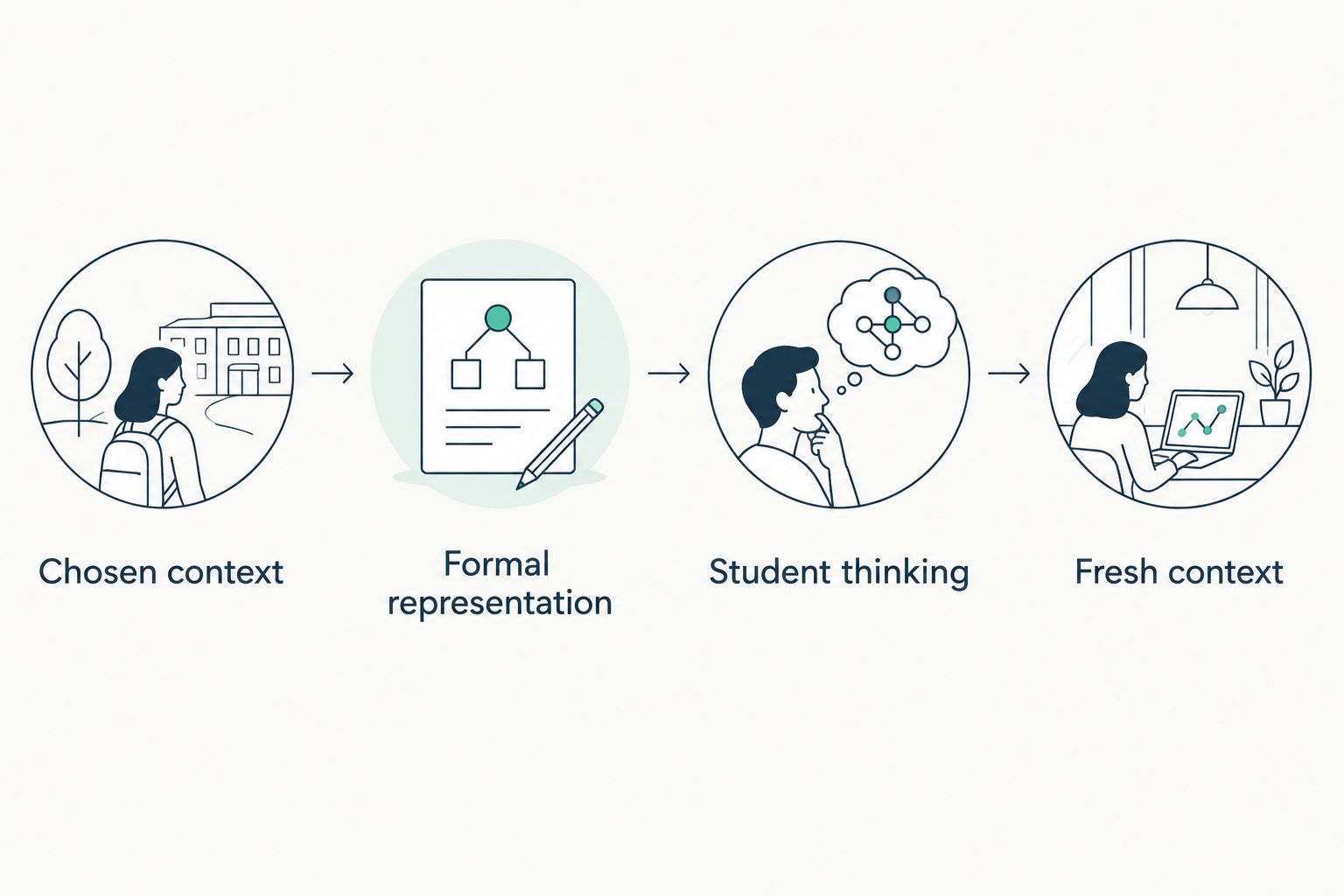
- Introduce the concept through the chosen context. Keep the setup short. State the academic goal so the student knows what they are learning.
- Connect the context to the formal representation. Move from the example to the relevant symbols, vocabulary, diagram, or paragraph structure.
- Ask the student to do the thinking. Have them explain a step, choose a method, or produce an answer. Do not complete the task while they watch.
- Check the skill in a fresh context. Use the follow-up task you prepared. Remove the theme and ask the student to explain why their method works.
Consider a fraction lesson built around a chocolate bar. Describe one whole bar divided into 8 equal pieces. Taking 3 pieces leaves 5 pieces; connect that situation to three-eighths taken and five-eighths remaining.
The important detail is equal-sized pieces from the same whole. Then ask the student to interpret a fraction in a plain diagram. If the explanation works only with chocolate, return to the meaning of the numerator and denominator.
Use the same sequence in English: start with an opinion about a favorite activity, identify the claim and supporting reasons, then apply that structure to the assigned writing topic. In Science, keep the explanation consistent with the actual concept rather than stretching an analogy beyond what it shows.
Expected result: The student has attempted the target skill and a separate learning check. You can distinguish familiarity with the example from understanding of the concept.
Parent review
- Review the student's work. Identify the step completed independently and any step that still needed help. Keep the description specific.
- Check the session records. Use Tia's live parent dashboard, engaged-time measurement, and self-writing records alongside the work you observed.
- Choose the next action. Continue to a related task, repeat the skill with a clearer explanation, or return to a prerequisite concept. Base that choice on the attempt, not the theme's popularity.
- Keep a brief note. Record the target skill, the useful example, the remaining difficulty, and the next task. Keep personal details about the student's interests limited to what helps the lesson.
A useful note says, “Compared fractions correctly with a diagram; needs another attempt without a diagram.” A less useful note says, “Enjoyed the lesson.” Enjoyment matters, but it answers a different question.
For your 2026 records, distinguish engaged time from elapsed time. Neither measure alone proves mastery. Combine the record with a sample answer or a short explanation from the student.
The guide to what parents should see in a tutoring dashboard helps you decide what to review. Self-writing records support homeschool reporting; parents still need to check their local requirements.
Expected result: You know what happened, what the student demonstrated, and what to try next without rebuilding the entire plan.
Refresh the lesson when an interest changes
You do not need to restart the learning plan when a student loses interest in a topic. Keep the academic objective and replace the context.
- Ask what the student wants to use for today's example, including the option of no theme.
- Check that the new context represents the same concept accurately.
- Keep the learning check tied to the original skill.
- Update your short note with the explanation that helped, not a permanent label about the student.
A fraction goal can move from baking to equal sections of a drawing. An argument-writing goal can move from sports to music. The goal stays stable while the entry point changes.
Use this variant during your 2026 lessons when the student says an example feels stale or distracting. Do not change the topic and the difficulty at the same time unless the work shows that both need attention.
Expected result: The lesson reflects the student's current interests without losing curriculum direction or making progress harder to compare.
Troubleshooting
The example takes over the session
The student talks about the interest but does not attempt the target skill. Acknowledge the connection, then ask for a specific academic action: compare the quantities, explain the evidence, or write the claim. If the theme keeps drawing attention away, switch to a plain example.
The student succeeds only with the familiar story
The student answers themed questions but stalls on the unthemed check. Return to the link between the example and the formal idea. Ask what each symbol or sentence represents, then try a comparable task rather than increasing the difficulty.
The interest connection feels forced
The example needs more explanation than the original problem. Remove it. A direct diagram or short explanation is a better choice than a theme that introduces extra rules, vocabulary, or exceptions.
The parent supplies every answer
The student waits for hints before attempting each step. Ask them to say what they understand and where they are stuck before you help. Give support at that point, then leave the next manageable action to the student.
The records look busy, but the next step is unclear
You have time records and completed activities without a clear learning decision. Add a fresh task or ask the student to explain the method. Use that evidence to choose between another explanation, prerequisite practice, or a related skill.
Customize your workflow
Start with the subject where the student needs support. Do not turn every assignment into a themed project. Keep the workflow small enough to repeat: a defined goal, a fitting explanation, an independent attempt, and a brief review.
For your 2026 routine, a session of 10 minutes is an option when it fits the student and the task. That duration is not a promised route to a particular result. Choose a manageable goal rather than rushing a larger lesson to fit the clock.
Across subjects, preserve the same review question: “What can the student do or explain now?” Change the teaching method when needed, while keeping the student responsible for the learning.
FAQ
How does tutoring adapt to a student's interests?
Interest-adaptive tutoring connects a curriculum skill to a familiar topic while adjusting the explanation and pace. A useful lesson then checks whether the student can apply the skill in a different context.
Is Tia a fit for interest-based tutoring?
Tia fits families seeking a personal tutor that adapts to the student's pace, level, and interests. It teaches Math, English, and Science for students in Grades 5 to 12, with a parent dashboard and engaged-time records.
Does every lesson need a theme?
No, a plain explanation is the right choice when the student prefers it or the theme adds confusion. Let the student choose a useful context rather than requiring an interest-based example.
How do I know whether the student learned the skill?
Ask the student to attempt a comparable task in a fresh context and explain their method. Use that work alongside session records rather than treating enjoyment or time spent as proof of understanding.
What if my student does not want to share an interest?
Use a straightforward example and respect that preference. You can still personalize the pace, level, and explanation without asking the student to discuss a hobby.
Can I use this workflow with a school assignment?
Yes, start with the assignment's required skill and preserve any required method. Use the interest connection to explain the concept, then return to the assigned task.
How long should an interest-based tutoring session last?
Choose a length that fits the student and the learning task. A 10-minute session is an option for a small goal, but no fixed duration guarantees a learning result.
One last thing
Ask for an example the student does not already know. A student who can explain the same idea outside a favorite topic gives you stronger evidence than another successful answer inside it.
You stay the parent. Your job is to choose the direction, notice what helps, and leave the thinking to the student.
Related guides
- Use a personalized tutor effectively
- Make a 10-minute daily tutoring session count
- Keep homeschool records without a last-minute scramble
Tia Education Team