Tia News
PowerMinds alternatives in 2026
Compare PowerMinds alternatives. Choose Tia for personalized tutoring and parent records, or match courses, practice and human tutors to your student's needs.
By Tia Education Team · Published

Your student needs another explanation, and you are already carrying the rest of the school day. Tia is the best fit among these PowerMinds alternatives in 2026 if you want curriculum-aligned personal tutoring with parent records; Khan Academy fits families seeking structured courses and practice. The right choice starts with what your student needs next, not a longer feature list.
- Comparing powerminds alternatives? Tia combines personalized tutoring, curriculum mastery information and parent learning records.
- Khan Academy suits structured courses, mastery learning and tailored practice.
- IXL suits personalized diagnostic recommendations and targeted practice.
- Wyzant suits families who want to choose a human tutor.
- Keep PowerMinds if your current arrangement meets your student's needs and gives you useful progress information.
Why this matters
You do not need to become a tutoring expert to make this decision. You need to separate three jobs: explaining a concept, providing practice and showing you what the student understands.
Those jobs overlap, but they are not interchangeable. A practice recommendation tells you what to work on; a personalized explanation changes how the idea is taught.
Tia combines curriculum-aligned teaching in Math, English and Science with a live parent dashboard, engaged-time measurement and self-writing homeschool records. Its personal tutor adapts explanations, pace, level and examples to the student, rather than asking every student to follow the same explanation.
Use this 2026 comparison to identify the job you need help with first. Then check the actual learning experience before changing your routine.
PowerMinds alternatives at a glance
The options below serve different purposes. PowerMinds stays in the table as your current benchmark: judge a replacement against what your family already uses, not against an imagined version of it.
| Option | Best for | Main decision point | How to compare with PowerMinds |
|---|---|---|---|
| PowerMinds | Families whose current arrangement is working | Your student's existing learning experience | Keep it as the baseline for explanations, participation and useful progress information |
| Tia | Personalized tutoring with parent learning records | Adaptive explanations, curriculum-linked mastery information and reporting | Compare the teaching response and the records you receive |
| Khan Academy | Structured courses and independent practice | Courses, mastery learning, tailored practice and progress tools | Compare whether a course-and-practice approach meets the student's need |
| IXL | Targeted practice guided by diagnostic recommendations | Personalized diagnostic recommendations | Compare whether selecting the next skill solves the problem |
| Wyzant | Choosing a human tutor | Individual teaching from a tutor you select | Compare the particular tutor's approach with your current experience |
Choose the teaching model before choosing the name. A student who needs a different explanation has a different problem from a student who understands the lesson but needs practice.
1. Tia: best for personalized tutoring with parent records
Tia adapts to the student, not the other way around. Its personal tutoring combines curriculum-aligned explanations with the student's pace, level and interests across 3 subjects: Math, English and Science.
Students in Grades 5 to 12 can type or speak, hear verbal explanations and switch between voice and text within the same lesson. Voice is an optional way to participate, not a claim that everyone learns better by listening.
Where the personal tutor shines
- Explanation personalization: teaching can use a student's interests to make the concept familiar.
- Curriculum mastery information: answers inform an estimate of skill mastery, mapped to the curriculum and included in reports.
- Parent visibility: the live dashboard, engaged-time measurement and self-writing records connect lessons with your oversight.
- Format choice: students can move between speaking and typing within a lesson.
The mastery tracking uses Bayesian Knowledge Tracing, an established method that updates an estimate of understanding from student answers over time. This is more informative than time alone, but it is not an infallible measurement of everything a student knows.
Where this option falls short
- It is not the same service as choosing a particular human tutor and building that relationship.
- Curriculum mastery estimates are not independently verified exam-score gains.
- Hearing an explanation does not replace independent reading practice or written mathematical work.
- Homeschool records still need your review against local requirements.
Client-supplied product demonstrations show this explanation approach using two test students. Fred's lesson uses crossing cricket bats; Charlotte's uses crossing horse trails. Both teach vertical angles, where opposite angles formed by intersecting lines match.
These are teaching demonstrations, not testimonials or proof of mastery. The useful question is whether a familiar example helps your student explain the mathematics afterward.
For a closer look at the mechanism, read how adaptive tutoring changes a lesson.
Best for: parents seeking personalized explanations, curriculum-linked mastery information and learning records in one student-focused workflow.
Verdict: Buy only after using the trial to check student fit and parent reporting. The offer is: 14-day free trial, no card needed.
2. Khan Academy: best for structured courses and practice
Khan Academy combines structured courses with mastery learning, tailored practice and progress tools. It deserves consideration when your student needs an organized route through material and you want to see progress through that work.
Do not confuse the main Khan Academy platform with Khanmigo. Khanmigo provides guided tutoring; the two should not be treated as identical experiences when you compare alternatives in 2026.
Where Khan Academy shines
- Structured courses give you an organized body of material to work through.
- Mastery learning and tailored practice support more than passive lesson viewing.
- Progress tools help you follow the student's work.
Where Khan Academy falls short
- A structured course is not automatically the right explanation for a particular student's point of confusion.
- The main platform and Khanmigo need separate evaluation if guided tutoring is your priority.
- Course progress alone should not decide whether your homeschool reporting needs are met.
Khan Academy is not simply a resource library without personalization. That would overlook its mastery learning, practice and tracking. The decision is whether that approach fits your student, or whether you want personal teaching integrated with the parent-record workflow described above.
Best for: students who benefit from structured courses and families prioritizing an organized practice resource.
Verdict: Buy into this approach when course structure and practice are your main needs; evaluate guided tutoring separately.
3. IXL: best for targeted practice recommendations
IXL offers personalized diagnostic recommendations. That makes it relevant when your main question is which skill your student should practice next.
Keep practice personalization separate from explanation personalization. Recommending a skill and changing the example used to teach that skill solve different parts of learning.
Where IXL shines
- Personalized diagnostic recommendations give targeted practice a clear role.
- A skill-focused approach fits a decision about what to work on next.
- It provides a useful comparison point when you are assessing practice rather than choosing a human tutor.
Where IXL falls short
- A diagnostic recommendation does not, by itself, establish how an explanation will adapt to a student's interests.
- Completing practice does not remove the need to check understanding.
- A practice-focused choice needs separate evaluation if your priority is parent reporting or a particular teaching relationship.
Ask your student to explain the reasoning behind an answer, not just finish the task. Use that explanation to decide whether the next need is more practice or another way of teaching the concept.
Best for: families whose primary need is targeted practice guided by diagnostic recommendations.
Verdict: Buy for a practice-first need, not simply because you want something different from PowerMinds.
4. Wyzant: best for choosing a human tutor
Wyzant is the alternative to consider when choosing a human tutor is central to your decision. Human tutors can personalize teaching, so the comparison should focus on the individual tutor rather than a claim that only software adapts.
Where Wyzant shines
- You can make the particular tutor's teaching approach part of your choice.
- A human tutor can personalize explanations and respond to student reasoning.
- The teaching relationship can be a central selection criterion.
Where Wyzant falls short
- The individual tutor needs evaluation; the platform name alone does not establish fit.
- You need to discuss how progress will be explained to you.
- Do not assume a tutor's lesson notes will meet your homeschool record requirements without checking.
Bring a real assignment to the discussion. Ask how the tutor would teach the confusing step and how they would check whether the student understood it.
Best for: families who specifically want to select and work with a human tutor.
Verdict: Buy only after evaluating the particular tutor's approach and reporting.
Why people switch from PowerMinds
A switch makes sense when your needs have changed or your current arrangement no longer meets them. You do not need to decide that PowerMinds is bad to choose another approach.
Use these specific reasons as decision criteria, not as assumptions about the service:
- Different explanations: your student needs the concept taught another way, not another repetition of the same wording.
- Targeted practice: your student understands the explanation but needs a clearer next skill to work on.
- Format choice: speaking or typing needs to fit the task and the student's preference.
- Parent records: you need a clearer account of engaged time, curriculum skills and understanding.
- Human relationship: working with a particular person is important to your student.
A 2026 alternatives list should help you name the unmet need. If you cannot name it, changing providers risks replacing a familiar routine without solving a specific problem.
How to compare without restarting everything
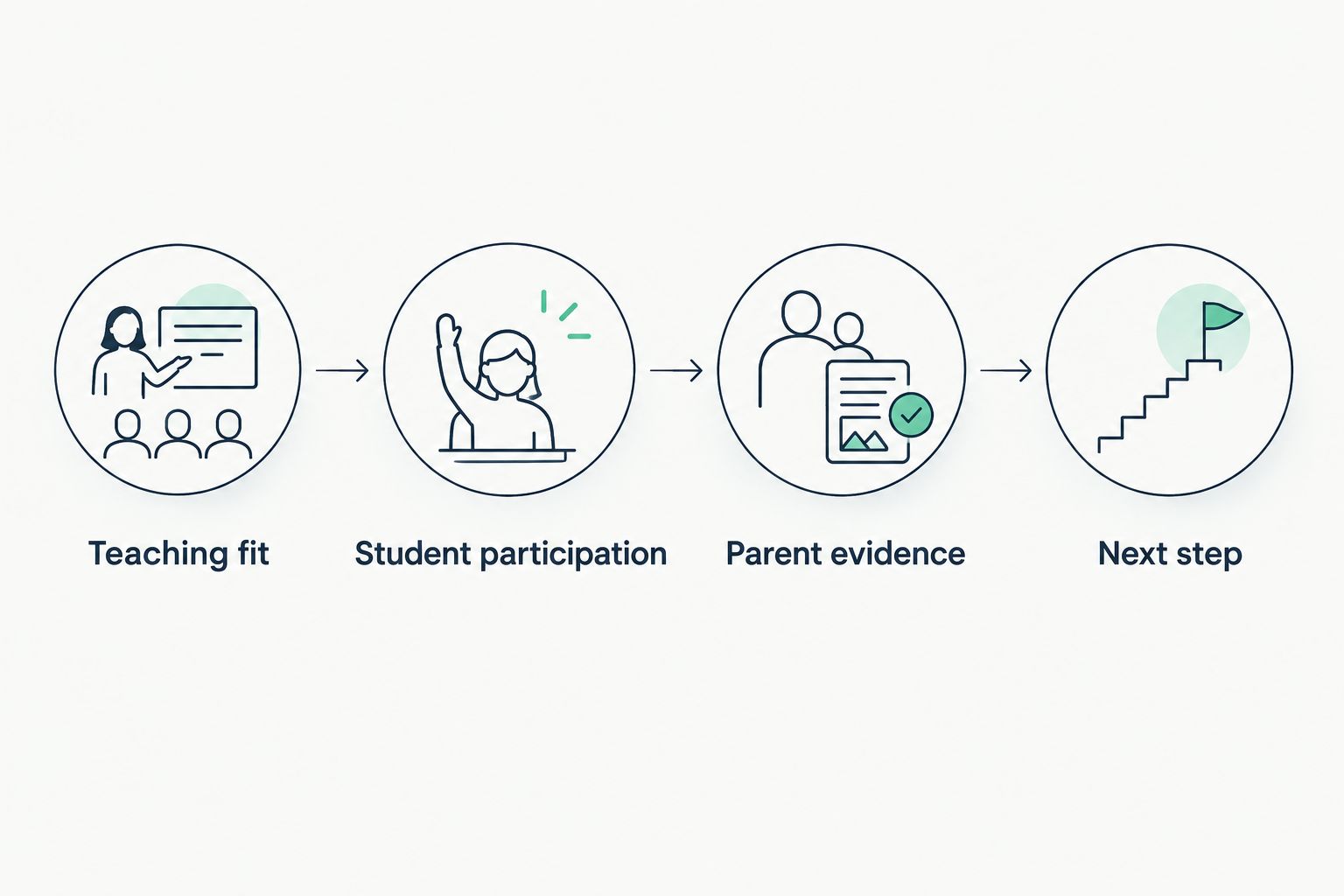
Keep your current curriculum goal and choose one topic your student finds difficult. Use that same topic to assess the alternatives, rather than comparing unrelated demonstrations.
Teaching fit
Ask for an explanation, then ask for a different example. Notice whether the response addresses the actual confusion or simply repeats the original idea.
Student participation
Let your student do the reasoning. Ask them to explain a step, draw a model or describe why an answer makes sense.
Parent evidence
Look for a useful account of the skill, the student's answers and what still needs work. Distinguish engaged time from understanding; both matter, but neither substitutes for the other.
Next step
Finish by identifying what the student should do next. The answer might be another explanation, targeted practice or a conversation with a human tutor.
You can keep this manageable. A 10-minute session is a reasonable starting format when it fits your student, not a promise of a particular result. Choose a narrow goal and leave room for the student to explain their thinking.
When staying with PowerMinds is the right call
Keep PowerMinds if your student understands the teaching, participates in the work and you receive the information you need. A different platform is not automatically a better fit.
Before replacing a working arrangement, identify a concrete benefit you expect from the change. Keep the decision anchored to learning rather than novelty, and include your student in that conversation.
FAQ
What's the best PowerMinds alternative in 2026?
Tia is the best fit in this comparison for families seeking curriculum-aligned personalized tutoring with parent learning records. Khan Academy fits structured courses and practice, IXL fits diagnostic recommendations, and Wyzant fits choosing a human tutor.
Is Khan Academy just a library of videos?
No. Khan Academy includes structured courses, mastery learning, tailored practice and progress tools. Distinguish the main platform from Khanmigo when evaluating guided tutoring.
Is personalized practice the same as personalized tutoring?
No. Personalized practice helps identify or select work, while personalized tutoring changes how a concept is explained. Your student might need either or both.
Can students speak instead of typing during tutoring?
Tia supports speaking, verbal explanations and typing within the same lesson. Two-way voice is included in all bundle plans, and students can switch between voice and text.
Does mastery tracking prove a student will get higher exam scores?
No. Curriculum mastery information is different from independently verified exam-score gains. Bayesian Knowledge Tracing updates an estimate of skill mastery from answers over time; it is not an exact measurement of everything a student knows.
Should I choose Wyzant if I want a human tutor?
Wyzant belongs on your shortlist when choosing a human tutor is your priority. Evaluate the particular tutor's explanations, approach to student reasoning and progress reporting.
Should I switch if PowerMinds is already working?
No, not without a specific unmet need. Staying makes sense when your student understands the teaching, participates and you receive useful progress information.
One last thing
Ask your student to teach the idea back to you using a new example. You are not asking for a polished performance; you are looking for reasoning that goes beyond repeating the tutor's words.
That response gives you something concrete to discuss with any provider. Keep the parent decision with you and the learning with your student.
Related guides
- What parents should see in a tutoring dashboard
- How to keep homeschool records without a last-minute scramble
- How to choose tutoring that adapts to your student
Tia Education Team