Tia News
How to use a homeschool tutor when a lesson gets stuck
Use a homeschool tutor for difficult lessons to pinpoint the sticking point, change the explanation, and check understanding without taking over.
By Tia Education Team · Published

You have explained the same problem again, and your student is still stuck. Instead of repeating the whole lesson, use a homeschool tutor for difficult lessons to isolate the sticking point, change the explanation, and let your student try the next step.
- Tia is best for homeschool families seeking a personal tutor that adapts explanations while keeping parents informed.
- Use a homeschool tutor for difficult lessons to target one sticking point, not repeat an entire chapter.
- Bring the assignment, the student's attempt, and the curriculum goal to the tutoring conversation.
- Check independent understanding after help, then use parent records to plan the next lesson.
Why this matters
A difficult lesson does not automatically mean your curriculum is wrong. Your student might understand the concept but misread the question, miss an earlier skill, or need a different example. Start by finding where the work stops making sense.
Tia is best for homeschool families seeking a personal tutor that adapts explanations while keeping parents informed. Tia teaches Math, English, and Science, adjusts to the student's pace and interests, and gives parents a dashboard and learning records.
For your 2026 homeschool plan, separate the teaching decision from the scheduling decision. First ask what needs explaining. Then decide whether your student should continue, revisit an earlier skill, or pause.
This workflow keeps you in charge of the goal without making you deliver every explanation yourself. It is a conversation-led process, not an automatic connection between a parent note and a lesson.
Before you start
- Gather the lesson materials. Have the exact question, instructions, student's attempt, and relevant curriculum goal beside you. Use your current 2026 curriculum guide where applicable, rather than relying on a remembered topic name.
- Have access ready. You need a student tutoring account and access to the parent dashboard to review records. Keep paper available for mathematical working, diagrams, or a short written response.
- Keep the handoff explicit. Do not assume a concern you notice in a parent dashboard automatically becomes the next lesson's focus. State the concern in the student tutoring conversation, then let your student explain it in their own words.
Avoid rewriting the student's attempt before the tutor sees the reasoning. A wrong answer with visible working gives you a better starting point than a corrected answer that hides the difficulty.
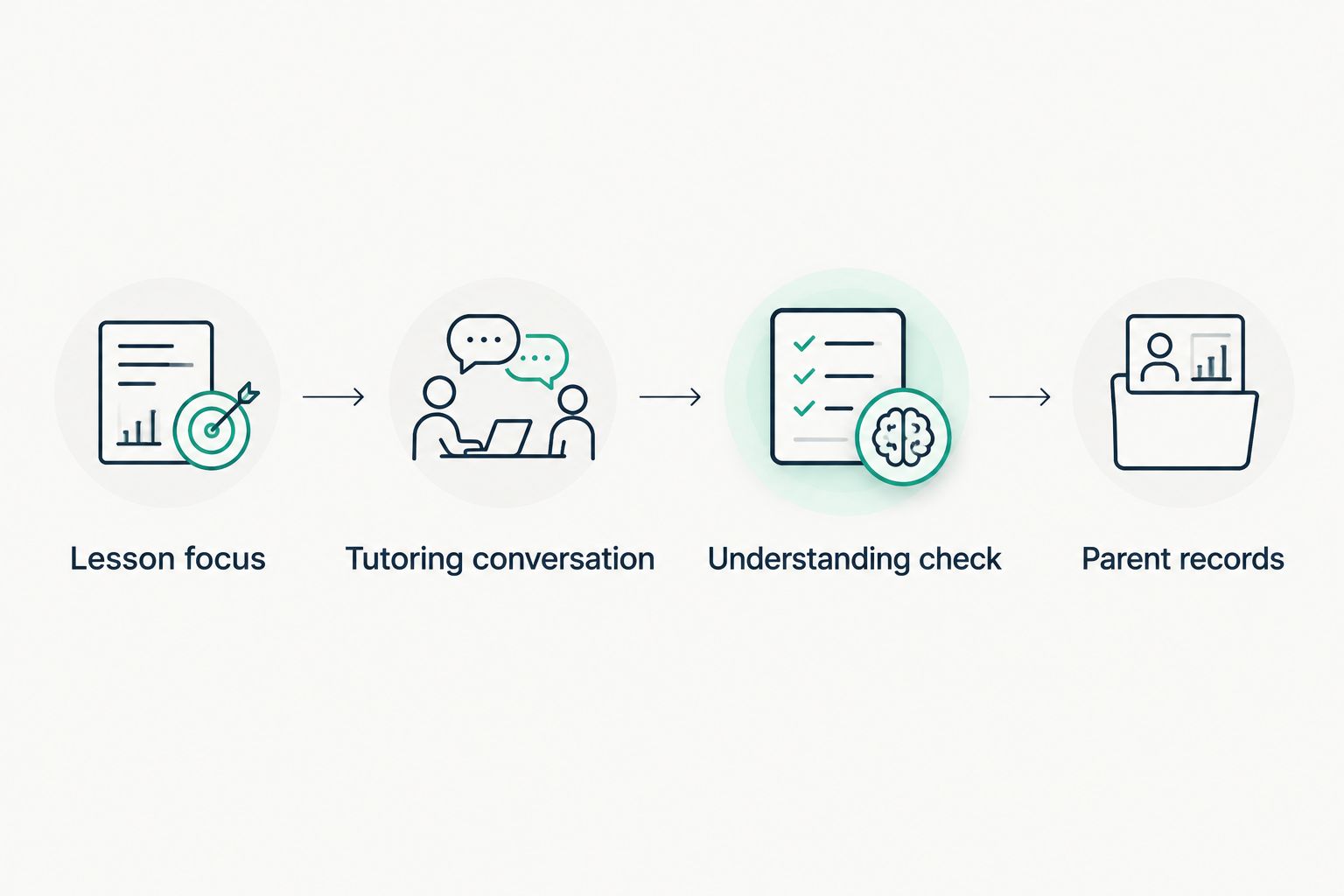
Lesson focus
Turn the concern into a teachable question
- Name the task. Record the subject and what the assignment asks your student to do. Replace a broad label such as fractions with the exact operation or reasoning involved.
- Find the stopping point. Ask your student to show the last step that made sense. Let them point, speak, or write rather than requiring a polished explanation.
- Separate observation from interpretation. Write what happened before deciding why. Not knowing which denominator to use is an observation; being bad at math is not a useful lesson focus.
- Choose a visible outcome. Decide what your student should be able to explain or attempt after help. Keep the target smaller than finishing the worksheet.
For example, the target might be explaining why fractions need equal-sized parts before addition. In English, it might be connecting a quotation to a paragraph's claim. In Science, it might be distinguishing an observation from an explanation.
Expected result: You have one specific teaching question and an example of the student's current thinking. You are not asking the tutor to repair an entire subject in one sitting.
Write a short handoff
Use this illustrative parent note as a model, not as a required form or a product field:
October 2026, Math: The student can identify equivalent fractions but adds denominators when adding unlike fractions. Please explain why equal-sized parts matter, then ask the student to explain the next step before calculating.
Keep the note factual. Include an interest if it offers a familiar starting point, such as sharing food, sports scores, or measuring materials for a project. Do not force an analogy your student dislikes.
Tutoring conversation
Give the student the first turn
- State the task in the lesson conversation. Enter the relevant instructions and the point of confusion. Share only the information needed for the learning task.
- Ask your student to describe the attempt. Have them explain what they tried and why. Resist answering the tutor's questions on their behalf.
- Request an explanation before an answer. Ask for the concept, a worked example, or a smaller prerequisite question. Specify that your student should attempt the next step.
- Change the explanation when needed. Ask for simpler language, a different example, a verbal explanation, or a connection to a familiar interest.
Expected result: Your student participates in a focused explanation and attempts part of the work. A completed answer alone is not the verification step.
Tia adapts to the student, not the other way around. Its personal tutor can adjust explanations, pace, level, and examples while teaching toward curriculum goals. The guide to how adaptive tutoring changes a lesson explains that distinction in more detail.
Choose how the student responds
Voice and text are different ways to participate, not fixed learning-style labels. Let your student choose the format that makes the current task manageable.
| Participation format | Best for | Practical advantage | Limitation |
|---|---|---|---|
| Voice | Explaining reasoning when typing interrupts the thought | The student can ask a question and hear an explanation | Spoken reasoning does not replace diagrams or written mathematical working |
| Text | Examining wording, symbols, or a written response | The student can compose the exact question or sentence | Typing can become an extra task when writing feels uncomfortable |
| Switching within the lesson | Tasks that combine discussion and written work | The student can talk through an idea, then type a precise response | You still need to check what the student understands independently |
Students can speak to Tia, hear verbal explanations, type, and switch between voice and text within the same lesson. Two-way voice is included in all bundle plans. Hearing a passage explained is not independent reading practice, so keep the original reading goal separate when that matters.
Understanding check
Return responsibility to the student
- Remove the worked answer from view. Keep the question visible, but stop pointing to each next step.
- Ask for an explanation. Have your student describe the reason behind the method, not just repeat the sequence.
- Try a fresh example. Use a different question that requires the same skill. Change the surface details without introducing an unrelated concept.
- Return to the assignment. Ask your student to attempt the original task with less help. Note where support is still needed.
Expected result: You can distinguish a copied procedure from an explanation your student can use. If the same confusion returns, the next focus is clearer rather than simply harder.
For a small check, choose 2 questions: one close to the example and one with different wording. This is a suggested routine, not a mastery threshold. A correct response needs context, including whether prompts or hints were necessary.
Ask your student which explanation helped and which part still feels uncertain. Keep that answer separate from your own assessment. A student can feel more comfortable while still needing practice, or understand the method while remaining hesitant.
Parent records
Record the learning decision
- Review the parent information. Look at the topic, engaged time, and mastery information alongside the work your student produced.
- Add the context you observed. Note whether the student worked independently, needed a prompt, or returned to an earlier skill.
- Choose the next action. Continue the assignment, revisit the concept, or plan a later check. Avoid adding a large practice load simply because the lesson was difficult.
- Keep the record with your homeschool materials. Use it to inform your planning and review it against applicable local reporting requirements.
Expected result: Your 2026 learning log explains what was taught, what your student demonstrated, and what happens next. It does not merely show that a session took place.
Tia measures mastery from student answers, maps it to the curriculum, and includes it in reports. Its Bayesian Knowledge Tracing method updates an estimate of skill mastery over time. That estimate supports planning; it is not an infallible measurement of everything your student knows or independent proof of exam-score gains.
Engaged time answers a different question: how much time the student spent engaged in learning. Read time and mastery together rather than treating either as the complete picture. Self-writing records also do not remove your responsibility to check local requirements.
When the same difficulty returns
A recurring problem needs a revised focus, not an accusation that your student was not listening. Compare the new attempt with the earlier one before repeating the same explanation.
- Check what changed. Did the student succeed with numbers but struggle when the task became a word problem? Did unfamiliar vocabulary obscure an otherwise familiar concept?
- Keep the successful part. Name the step your student can now do. Ask the tutor to work on the remaining difficulty instead of restarting everything.
- Reduce support deliberately. Request a guiding question rather than another complete solution, then ask the student to choose the next action.
- Plan a later return. Revisit the skill in another lesson without promising that a particular session length will resolve it.
The same boundary matters when schoolwork becomes exam preparation: study support without giving answers keeps the student's reasoning at the center of the task. Ask for a hint or a question, then leave room for a student response before seeking more help.
If a short session fits, you can plan 10 minutes around one concept. Treat that duration as a scheduling choice, not a promise of progress. End with a clear note about what to revisit rather than rushing toward a finished page.
Troubleshooting
The tutor starts with the wrong topic
Restate the exact task and the point where the student's reasoning stops. Include the relevant curriculum objective or assignment wording. A broad request to help with science gives less direction than a specific question about interpreting a graph.
The explanation is correct but still confusing
Ask for a different representation rather than the same explanation in more words. For fractions, you might use equal-sized paper pieces, draw the pieces, and then connect the drawing to the symbols. These are materials you provide, not physical resources supplied by the tutor.
Your student follows along but cannot start alone
Reduce the task to choosing the first step and explaining why it fits. Then try another example without the worked solution visible. If prompting remains necessary, record that honestly and revisit the prerequisite skill.
Typing becomes the main obstacle
Offer spoken participation where available and appropriate. Keep written working for tasks that require it, and let the student switch formats. Do not turn a Math explanation into an unnecessary test of how comfortably the student can type a paragraph.
The report and your observation seem different
Compare the exact skill, question, and level of assistance. A report can reflect successful answers while your observation captures how much support those answers required. Use both to set the next lesson focus rather than treating either as a verdict on the student.
Customize your workflow
Keep a simple routine rather than building a complicated tracking system. A 3-line parent note can hold the task, the sticking point, and the next action. Add detail only when it helps you make a teaching decision.
Adapt the check to the subject:
- Math: Ask the student to explain why a method fits, then show written working.
- English: Ask the student to revise a sentence or connect evidence to a claim.
- Science: Ask the student to explain a relationship, interpret a result, or distinguish an observation from an inference.
Use the same routine across your 2026 planning documents so recurring concerns are easy to recognize. Keep the curriculum goal steady while changing the explanation, example, pace, or response format.
FAQ
How do I use a homeschool tutor when my student gets stuck?
Identify the exact sticking point, share the student's attempt, and ask for a focused explanation before another answer. Then have your student try a fresh example with less help.
Should I explain the problem to the tutor or let my student do it?
Let your student explain first, then add any missing assignment context. Your observation helps define the goal, but the student needs space to show their own reasoning.
Can Tia turn a parent's concern into a lesson focus?
You can state the concern in Tia's student tutoring conversation and ask for help with that specific concept. Do not assume that a parent dashboard observation automatically changes the next lesson.
What if my student understands more than they can comfortably type?
Offer spoken participation while keeping any necessary diagrams and written working. Students can switch between voice and text within the same lesson, and two-way voice is included in all bundle plans.
How long should tutoring last for a difficult lesson?
Choose a duration that fits the student and the task, rather than a fixed minimum. A 10-minute session can focus on one concept, but that duration does not guarantee understanding or a particular result.
How can I tell whether tutoring helped rather than just finished the work?
Ask your student to explain the method and attempt a fresh example without the worked answer visible. Read that attempt alongside mastery information and the amount of assistance required.
Do tutoring records automatically meet homeschool reporting requirements?
No, tutoring records do not automatically establish compliance with local requirements. Keep the learning records, add relevant context, and check what your jurisdiction requires.
One last thing
Write down the explanation that did not help. Your 2026 records become more useful when they preserve that detail alongside successful work. Next time the concept returns, you can change the teaching approach instead of repeating the same conversation.
Related guides
- What parents should see in a tutoring dashboard
- How to keep homeschool records without a last-minute scramble
- Student interests to engaging lessons: a complete workflow
Tia Education Team