Tia News
Tia Now Teaches to the New Zealand Curriculum
New Zealand Curriculum tutoring for Years 6 to 11, with 2,591 checked English, maths and science statements. 14-day free trial, no card needed.
By Tia Education Team · Published · Last updated
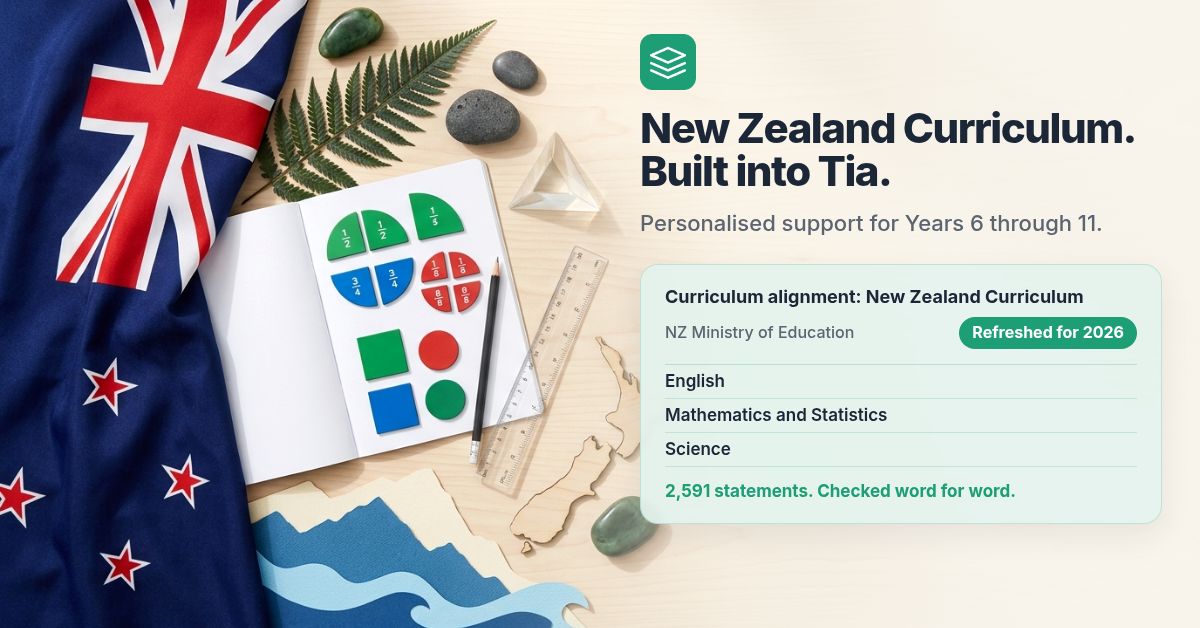
The refreshed New Zealand Curriculum is now built into Tia. Families can use personalised tutoring aligned to Ministry of Education statements in English, Mathematics and Statistics, and Science from Years 6 through 11.
- The New Zealand Curriculum is live now in Tia for Years 6 through 11.
- English, Mathematics and Statistics, and Science are covered.
- English and Mathematics follow the refreshed curriculum in force from 1 January 2026.
- Science follows the Years 0 to 10 curriculum released in August 2026.
- All 2,591 curriculum statements were checked word for word against Tāhūrangi.
The New Zealand Curriculum sets the destination. Tia adapts the pace, level and explanation to the student. Parents can then see the exact statements covered in each progress report.
The New Zealand Curriculum is live now in Tia
Tia now covers English, Mathematics and Statistics, and Science using the New Zealand Curriculum as published by the Ministry of Education.
Coverage runs from Year 6 through Year 11.
| Learning area | Curriculum used in Tia | Coverage |
|---|---|---|
| English | Refreshed New Zealand Curriculum in force from 1 January 2026 | Years 6 through 11 |
| Mathematics and Statistics | Refreshed New Zealand Curriculum in force from 1 January 2026 | Years 6 through 11 |
| Science | Ministry's Years 0 to 10 science curriculum released in August 2026 | Years 6 through 11 |
English and Mathematics and Statistics are taught year by year, as the Ministry now publishes them. Science follows the Ministry's newly released curriculum.
Parents can review the source curriculum on the Ministry of Education's Tāhūrangi curriculum site.
You are invited to start a trial with Tia and choose the New Zealand Curriculum. 14-day free trial, no card needed.
The refreshed 2026 curriculum is built in for its first year
The refreshed English and Mathematics and Statistics curriculum came into force on 1 January 2026. Tia includes it for its first year in New Zealand schools.
The refresh sets out year by year what students should know and be able to do. That makes the progression more precise for parents, teachers and students.
A Year 7 student working on fractions receives support connected to the Ministry's Year 7 expectation. A Year 9 student working on algebra receives help pitched at the Year 9 curriculum, in the Ministry's language.
Mathematics and Statistics coverage carries the full range of strands, including:
- Number
- Algebra
- Measurement
- Geometry
- Statistics
- Probability
Mathematical notation is also preserved as the Ministry publishes it. Fractions, powers and roots remain mathematical notation rather than being flattened into plain text.
This matters because notation is part of meaning. A fraction bar, exponent or root symbol tells the student how quantities relate. Keeping that structure intact makes the curriculum statement clearer and the lesson more faithful to the source.
Science includes the curriculum released in August 2026
Tia includes the Ministry's Years 0 to 10 science curriculum released in August 2026.
The published Science statements are carried into Tia alongside English and Mathematics and Statistics. Students receive support connected to the expectations for their year, and parents can see the statements covered.
The Science curriculum is not treated as an overseas framework or a generic list of topics. It is the New Zealand Curriculum as published by the Ministry of Education.
That distinction matters for a family reviewing classroom learning, planning home education or simply wanting tutoring to use familiar language.
2,591 curriculum statements checked word for word
Tia carries 2,591 New Zealand Curriculum statements in total:
- 1,241 for English
- 772 for Mathematics and Statistics
- 578 for Science
They were taken directly from the Ministry's published curriculum on Tāhūrangi. Each was checked word for word before going live.
Te reo Māori terms are carried exactly as the Ministry writes them, macrons included.
That creates a clear connection between a lesson, a Tia progress report and the terms a New Zealand teacher would use.
“We worked from the Ministry's own published curriculum because families need the language and progression New Zealand schools are using, not a summary. We built in the refreshed 2026 curriculum for its first year so tutoring and parent reports can follow the expectations students are meeting now.”
A parent can connect the wording in a Tia report with the relevant year and learning area on Tāhūrangi.
What a New Zealand Curriculum-aligned lesson looks like
Curriculum alignment should shape the lesson, not simply appear as a label in settings.
A New Zealand-aligned lesson begins with the relevant statement for the student's learning area and year. Tia then adjusts how that student works toward it.
Tia can:
- slow down an explanation
- revisit an earlier idea beneath the current statement
- change the example
- use the student's interests to make the idea more concrete
- offer another practice activity before moving forward
- preserve the mathematical notation used by the Ministry
- record the curriculum statements covered
The student gets a personalised route without losing sight of New Zealand's expectations.
For a Year 7 Mathematics and Statistics student, that may mean using a visual model before returning to the required fraction notation. For a Year 9 student, it may mean breaking an algebraic relationship into smaller steps while keeping the year-level statement in view.
Progress reports name the curriculum statements covered
Every Tia progress report names the New Zealand Curriculum and lists the specific statements the student worked on.
The report uses the Ministry's wording. A parent sees more than “worked on maths” or “completed science.”
A report can show:
- New Zealand Curriculum as the curriculum alignment
- the learning area and year
- the specific Ministry statement
- te reo Māori terms with the Ministry's macrons
- mathematical notation as published
- the learning activity
- progress over time
- honest engaged time in Tia
That detail makes the report useful during a teacher conversation, when reviewing schoolwork or when deciding what the student should revisit next.
It also helps parents see whether extra support is connected to the same language used in the student's New Zealand classroom.
For more on useful learning records, read what parents should see in a tutoring dashboard.
A New Zealand Curriculum tutor alongside school
Students attending state, state-integrated or private schools can use Tia for extra support after school, on weekends or during breaks.
A student may need help because a class moved forward before one idea felt secure. Another may understand the topic but need a different explanation before applying it independently.
Tia keeps support connected to the student's New Zealand year and learning area while adapting the teaching route.
Families searching for a New Zealand tutor can use Tia as:
- a New Zealand maths tutor aligned to Mathematics and Statistics
- a New Zealand English tutor using the refreshed 2026 curriculum
- a New Zealand Science tutor using the Ministry's 2026 release
- personalised support for a specific year-level statement
- a clear record of the curriculum statements covered
The aim is practical. The student gets another way into the material, and the parent can see how that work connects to the New Zealand Curriculum.
Tia teaches to New Zealand's own curriculum, not an Australian or other overseas curriculum.
New Zealand home education support
New Zealand home education operates under a Ministry of Education exemption. Parents and legal guardians apply to the Ministry before beginning home education for a student who would otherwise need to be enrolled at school.
The Ministry explains the application and exemption process in its official home education guidance.
Families are expected to teach at least as regularly and well as a registered school. The Ministry's guidance on teaching at home explains that parents are responsible for the programme and can set their own curriculum.
Tia progress reports can support the records a family keeps by listing:
- the learning area studied
- the New Zealand year used for alignment
- the Ministry's specific curriculum statement
- te reo Māori terms as published
- the learning activity
- progress and engaged time
Families should confirm current exemption, programme and record requirements with the Ministry of Education.
Tia does not claim that its reports satisfy any home education requirement. Parents remain responsible for their exemption, programme and records.
For families comparing New Zealand homeschool curriculum options, statement-level reports make it easier to connect daily learning with the national curriculum they have chosen to follow.
New Zealand's own curriculum, not an overseas substitute
New Zealand's refreshed curriculum is organised by year and written for New Zealand students. Its language, te reo Māori terms, mathematical notation and learning progression matter.
Tia preserves those details rather than placing students into an Australian, British or generic international sequence.
That means a New Zealand parent sees the New Zealand Curriculum named on the progress report and the Ministry's own statements beneath it.
Families interested in how local curriculum alignment works elsewhere can read how British Columbia's curriculum is built into Tia, how Alberta's curriculum is built into Tia and how the Scottish Curriculum for Excellence is built into Tia.
Why year-by-year statements matter
A broad learning area tells a parent the general subject. A year-level curriculum statement identifies what the Ministry expects the student to know or do now.
That precision is useful when a parent wants to compare tutoring with classroom work, review progress before a meeting or keep a year-long record.
It also makes the report traceable. A family can connect a Tia session with the relevant year and learning area on Tāhūrangi.
The curriculum wording does not replace a plain-language explanation. It adds the detail needed to understand exactly what was covered.
FAQ
Is the New Zealand Curriculum live in Tia now?
Yes. New Zealand-aligned English, Mathematics and Statistics, and Science are live now in Tia from Year 6 through Year 11.
Which New Zealand years are covered?
Tia covers Years 6 through 11 in English, Mathematics and Statistics, and Science.
Does Tia include the refreshed 2026 curriculum?
Yes. English and Mathematics and Statistics follow the refreshed New Zealand Curriculum in force from 1 January 2026, taught year by year as the Ministry publishes it.
Which Science curriculum does Tia use?
Science follows the Ministry's Years 0 to 10 science curriculum released in August 2026.
How many New Zealand curriculum statements are built into Tia?
Tia carries 2,591 statements: 1,241 for English, 772 for Mathematics and Statistics, and 578 for Science. Each was checked word for word against Tāhūrangi.
Does Tia preserve te reo Māori macrons and mathematical notation?
Yes. Te reo Māori terms are carried as the Ministry writes them, macrons included. Fractions, powers and roots remain in the mathematical notation the Ministry publishes.
Do progress reports show New Zealand curriculum statements?
Yes. Every report names the New Zealand Curriculum and lists the statements covered in the Ministry's wording.
Can students attending school use Tia?
Yes. Tia works as a New Zealand Curriculum tutor alongside school while lessons remain connected to the student's year-level expectations.
Can home educating families use Tia?
Yes. Families can use New Zealand-aligned tutoring and statement-level progress reports to support the records they keep. They should confirm current requirements with the Ministry of Education.
The New Zealand Curriculum, personalised to the student
New Zealand families should not have to choose between local curriculum alignment and support that adjusts to the student.
Tia brings both together. The New Zealand Curriculum defines what the student is working toward. Personalised tutoring changes the pace and explanation. Progress reports show the exact statements covered.
You are invited to see how adaptive tutoring changes a lesson or start with Tia at tia.coach. 14-day free trial, no card needed.