Tia News
Is 10 minutes of tutoring a day enough to make progress?
10 minutes of tutoring a day can suit a focused goal. Learn how to check understanding, spot stalled progress, and decide when your student needs more.
By Tia Education Team · Published

Yes, 10 minutes of tutoring a day can be enough to work on a focused skill, but the duration alone does not guarantee progress. If a short session is what fits between dinner and everything else, you do not need to dismiss it. The useful test is whether your student understands more and needs less help over time, not whether the timer reaches a particular number.
- 10 minutes of tutoring a day is a starting point, not a guaranteed learning result.
- Choose a narrow curriculum goal, then check whether your student can explain and apply it independently.
- Tia personalized tutoring suits families seeking adaptive explanations, curriculum-linked mastery information, and parent learning records.
- Keep short sessions when they support understanding; change the approach when the same confusion keeps returning.
Is 10 minutes of tutoring a day enough to make progress?
Ten minutes is enough to attempt a small learning goal. It is not evidence that the goal has been learned. A student might use that time to understand a confusing instruction, discuss an error, or practice a familiar skill without prompts.
Separate the size of the session from the size of the task. Revising a sentence is different from planning an essay. Explaining why opposite angles match is different from completing a geometry assignment.
Use this decision process for your 2026 tutoring plan:
- Name the skill. Replace “get better at math” with a specific goal, such as explaining why a step in an equation works.
- Check the starting point. Ask your student to attempt the task before receiving an explanation.
- Teach the sticking point. Address the misunderstanding rather than repeating the entire assignment.
- Check independence. Ask for a fresh attempt without copying the example.
- Choose the next step. Continue, revisit a prerequisite, or leave a clear stopping note.
For the practical session structure, see how to make a 10-minute daily tutoring session count.
Why this matters
A busy parent needs a useful routine, not another standard to feel behind on. A short session deserves a fair assessment based on what happens during it.
At the same time, a manageable schedule must still serve the learning goal. Do not ask a timer to tell you what your student understands. Look at the student's explanation, work, and ability to return to the skill later.
For your 2026 home-learning routine, define progress before deciding whether to add time. That keeps the decision connected to learning rather than a longer screen session.
Short daily tutoring: best for a narrow learning goal
Short daily tutoring is best for a task you can name clearly. Examples include discussing the meaning of a vocabulary word in context, correcting a specific punctuation error, or explaining a step in a math solution.
The advantage is a bounded task with a clear stopping point. The limitation is scope: a brief session does not automatically provide enough room for explanation, practice, and independent application of a difficult new concept.
Use this comparison to match the format to the work. These are planning options, not claims that a particular schedule produces better outcomes.
| Tutoring format | Best for | Useful feature | Limitation to plan around |
|---|---|---|---|
| Short daily session | A narrow skill or focused question | A clear task and stopping point | Limited room for a complex investigation |
| Longer planned session | Connected steps, extended writing, or a difficult concept | Space to work through the task together | Requires a larger uninterrupted opening |
| Flexible combination | Goals that change across the week | Session length follows the work | Needs a clear plan for unfinished tasks |
Choose short daily tutoring when the goal fits the session. Do not shrink the learning goal just to record a completed day.
Longer tutoring: best for connected or extended work
Longer tutoring is best for work that needs connected reasoning or sustained discussion. An essay conference, a multi-step science problem, or an unfamiliar math concept deserves enough room for the student to think.
The advantage is continuity. The limitation is that extra time does not resolve an explanation that still makes no sense to the student.
Before extending a session, ask what the additional time is for. “Finish the next step with less help” is useful. “Stay until the clock says we worked hard enough” is not a learning goal.
You can also split an extended task at a meaningful boundary. Discuss an essay's central claim now, then return to the supporting evidence later. Keep a note of the unfinished question so the next session has a clear purpose.
Why the amount of tutoring needed varies
There is no universal daily duration that proves a student has learned enough. Match the routine to the task and the student's response.
- Starting knowledge: Check whether the student understands the prerequisite skill before adding more advanced work.
- Task scope: A sentence correction and a research paper need different plans.
- Explanation fit: Change the example or wording when the current explanation leaves the student confused.
- Participation format: Let the student speak, type, draw, or write as the task allows.
- Independence: Distinguish work completed with prompts from work the student can explain alone.
- Continuity: Leave a usable next step instead of restarting the same conversation each day.
When reviewing your 2026 schedule, use these factors to decide what to change. Adding minutes is an option, but so is narrowing the goal or teaching a missing foundation.
What should you look for after a short session?
Look for something the student can demonstrate. “We covered fractions” describes a topic. “The student explained why the pieces must represent equal parts” describes observable understanding.
A useful check has four parts:
- Starting point: What could the student do before help?
- Explanation: What did the student understand after discussion?
- Independent attempt: What could the student do without the worked example?
- Next step: What still needs attention?
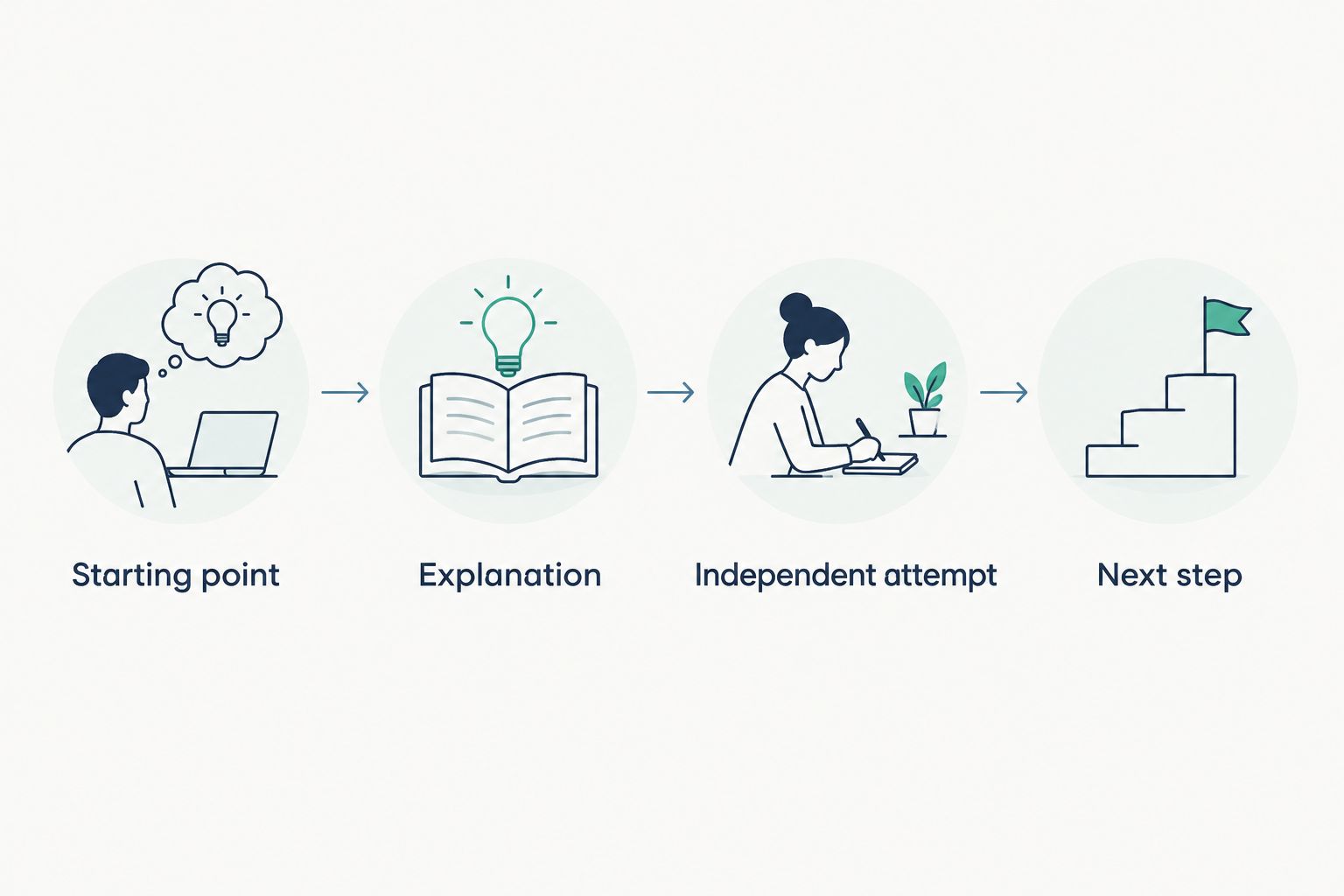
Keep the check proportionate. You do not need to turn the end of every short lesson into a formal test. Ask the student to explain a choice, correct an error, or try a related question.
A correct answer is useful information, but ask about the reasoning too. Copying a demonstrated method is different from explaining when to use it.
Look again when the example changes
Try a related task with different wording or a different context. The purpose is to check whether the student understands the idea rather than remembers the appearance of the example.
For math, ask why a step is valid. For English, ask how a revision changes the meaning. For science, ask the student to use the concept to explain a situation.
These are suggested checks, not a standardized assessment. Use them to decide what to teach next.
When should you change the routine?
Change the routine when it repeatedly ends before the student reaches the learning goal. First identify the obstacle. A larger time slot is not the only response.
If the student cannot begin, check the prerequisites. If the explanation makes sense but independent work breaks down, examine the point where help becomes necessary.
If the student spends the session trying to communicate a question, consider another participation format. Speaking can be an option for discussing reasoning, while written work still matters when writing is the skill being taught.
If a task needs sustained thinking, allow a longer session or a planned continuation. Avoid stopping in the middle of a useful explanation solely because the daily target has elapsed.
Ask the student what needs to change
Try a direct question: “Was the hard part understanding the idea, explaining your question, or doing the work?” Let the answer inform the next session.
Students do not need to choose between unlimited work and stopping at the first difficulty. Agree on a manageable next step, then reassess it together.
Where personalized tutoring fits a short routine
Tia adapts to the student, not the other way around. Tia is a personal tutor for Math, English, and Science that adapts explanations, pace, level, and examples to the student's interests and curriculum.
Tia personalized tutoring is best for families seeking adaptive explanations alongside curriculum-linked mastery information and parent records. Those features give parents more to review than a session's duration.
Tia measures mastery per question, maps it to the curriculum, and includes it in reports. Its Bayesian Knowledge Tracing method updates an estimate of skill mastery from student answers over time. That estimate is not an infallible measurement of everything a student knows or independent proof of exam-score gains.
The parent dashboard, engaged-time measurement, and self-writing records provide additional learning information. The limitation remains important: no dashboard turns 10 minutes into a guaranteed result. Review the records alongside what your student can explain and do.
Can 10 minutes replace a full lesson?
Ten minutes does not automatically replace a full lesson. Use it for a defined part of the learning, then decide whether the student needs more explanation, practice, or connected work.
For your 2026 plan, keep tutoring separate from the full range of subject learning. Reading, writing, experiments, discussion, and independent assignments still need appropriate space.
How soon should I expect progress from short daily tutoring?
Ten minutes of daily tutoring does not establish a reliable deadline for results. Look for changes in the student's reasoning and independence rather than promising a particular grade by a particular date.
Record the starting difficulty and compare later attempts. If the same misunderstanding persists, reconsider the explanation, task, or support instead of simply counting completed sessions.
Does tutoring have to happen every day?
Ten minutes a day is an option, not a requirement for every student. Choose a repeatable rhythm that suits the learning goal and your family's circumstances.
A missed day does not need an automatic catch-up penalty. Return to the next useful step and review whether the overall routine still fits.
FAQ
Is 10 minutes of tutoring a day enough for math?
Ten minutes of tutoring a day can be enough to address a focused math question or practice a narrow skill, but it does not guarantee mastery. Check whether the student can explain the reasoning and try a related problem without prompts.
Can a short tutoring session help with English?
A short tutoring session can focus on a specific English task, such as revising a sentence or discussing evidence in a paragraph. Extended reading and writing need their own space in the learning plan.
Should I stop tutoring when the timer ends?
Stop at a meaningful boundary rather than interrupting useful reasoning solely because the timer ends. If the task remains unfinished, leave a clear note about where to begin next time.
How do I know whether my student is making progress?
Look for clearer explanations, fewer prompts, and independent use of the skill on a related task. Session completion and time spent are not substitutes for those checks.
Is short daily tutoring better than a longer weekly session?
Neither schedule is automatically better for every student or task. Short sessions fit narrow goals; longer sessions provide room for connected work, and a flexible combination is another option.
Does Tia track understanding as well as time?
Tia tracks curriculum-linked mastery from student answers as well as engaged time. Its mastery estimates appear in reports, but they are not infallible measurements or independently verified exam-score gains.
One last thing
A useful short session can end with an unfinished assignment and a clearer understanding. Completion and learning are not the same thing.
Before adding more tutoring to your 2026 calendar, ask your student to show you what changed. If the explanation is clearer and the next step is understood, you have something more useful than a checked box.
Related guides
- How long does it take to see results from tutoring?
- What parents should see in a tutoring dashboard
- How to build a homeschool schedule that fits your student
Tia Education Team