Tia News
How long does it take to see results from tutoring?
How long does it take to see results from tutoring? No fixed timeline fits every student. Learn how to check independent work, track progress, and adjust support.
By Tia Education Team · Published

There is no fixed number of days or tutoring sessions that guarantees results; judge progress by what your student can explain and do independently. Understanding a specific skill and improving a report-card grade are different goals, so they need different checks. Start with a clear learning target, compare similar work over time, and review the teaching approach when the same difficulty keeps returning.
- How long does it take to see results from tutoring? Track independent work, not a promised deadline.
- Tia personal tutoring suits families seeking adaptive lessons and parent visibility, not a guaranteed improvement date.
- Tutoring progress means explaining a skill, using it independently, and applying it to unfamiliar work.
- A 10-minute daily session is an option when it fits the student, not a results guarantee.
How long does it take to see results from tutoring?
Tutoring results do not follow a universal timetable. A student working on a specific punctuation rule has a different target from a student rebuilding the foundations needed for algebra. Neither goal comes with a reliable countdown.
For your 2026 tutoring plan, separate the result you want from the date you want it by. An upcoming test creates a deadline, but it does not establish how quickly the student will learn the material.
Ask what the student can do now, what they need to do next, and how you will recognize the difference. The guide to how adaptive tutoring changes a lesson explains the teaching approach behind that kind of adjustment.
Use this comparison to choose evidence that matches your goal. These are checks you can make, not promised stages every student will reach in the same order.
| Progress check | Best for | What to look for | Strength | Limitation |
|---|---|---|---|---|
| Willingness to participate | Understanding the student's experience | The student attempts work and asks specific questions | Gives the student's perspective a place in the review | Willingness alone does not prove understanding |
| Explanation | Checking a particular concept | The student explains why a step or answer makes sense | Shows more than answer copying | A familiar explanation still needs an independent check |
| Independent work | Checking reduced reliance on help | The student completes a comparable task without prompts | Directly tests the target skill | One successful attempt does not establish consistency |
| Application | Checking use beyond the example | The student uses the skill in a different problem or passage | Tests whether learning extends beyond rehearsal | The new task must still test the intended skill |
| Assessment performance | Reviewing a course or test goal | Work meets the relevant rubric or assessment criteria | Connects tutoring to the academic target | A broad assessment includes more than the skill being tutored |
Why this matters
You have arranged the tutoring. You are making room for it in an already full week. It is reasonable to want evidence that the effort is helping.
The problem is not wanting results. It is asking one number, such as a grade or session total, to describe everything the student is learning.
A completed lesson is evidence of participation, not proof of mastery. Likewise, a difficult assignment does not tell you whether every skill within it is weak. Look at the work closely enough to distinguish a concept gap from an instruction the student misunderstood.
For a 2026 progress review, use both the student's experience and an example of their work. That gives you a concrete conversation: “You understood the explanation, but applying it without a prompt is still hard.” It also gives the tutor a clearer next target.
How to check whether tutoring is working
You do not need to become the subject specialist to follow progress. Your job is to help define the goal, keep a small amount of evidence, and ask useful questions.
Use the following process whenever you review tutoring. Keep it manageable enough to repeat without turning home into a testing center.
1. Set the target
Choose a skill you can observe. “Get better at math” is too broad to tell you what changed. “Explain how to add fractions with different denominators” gives you something specific to check.
For English, the target might be choosing evidence that supports a paragraph's main point. For Science, it might be explaining the relationship between a variable and the outcome of an experiment.
Write the target in language the student understands. Ask whether it matches the part of the work that feels difficult to them.
2. Save a baseline
Keep a sample showing what the student does before focused practice. Record any help they needed, not just whether the final answer was correct.
An answer completed with step-by-step prompting is different from an answer completed independently. Both belong in the record, but they should not be treated as equivalent evidence.
Use an existing assignment when it fits the target. There is no need to add a large assessment just to create a starting point.
3. Practice the skill
Give the student practice that matches the target. If the goal is explaining a scientific relationship, completing unrelated vocabulary exercises does not directly check that goal.
Ask the tutor to change the explanation when the student remains confused. A different example, a connection to the student's interests, or a change in pace gives the lesson another route into the same material.
Keep the student responsible for the thinking. The parent can protect the time and help clarify the goal without supplying every answer.
4. Check independently
Offer a comparable task without repeating the exact worked example. Ask the student to explain their reasoning, then note where help was needed.
Keep the conditions fair. A much harder question, unfamiliar instructions, or a different skill makes the comparison less useful.
If the student cannot complete the task independently, identify the sticking point. That is information for the next lesson, not a verdict on the student's ability.
5. Adjust the plan
Compare the new work with the baseline. Look for a change in the quality of the explanation, the type of mistakes, or the amount of prompting required.
For your next 2026 review, choose the response that fits the evidence: continue practicing the target, revisit a prerequisite, or change the teaching method. Keep the goal visible while allowing the route to change.
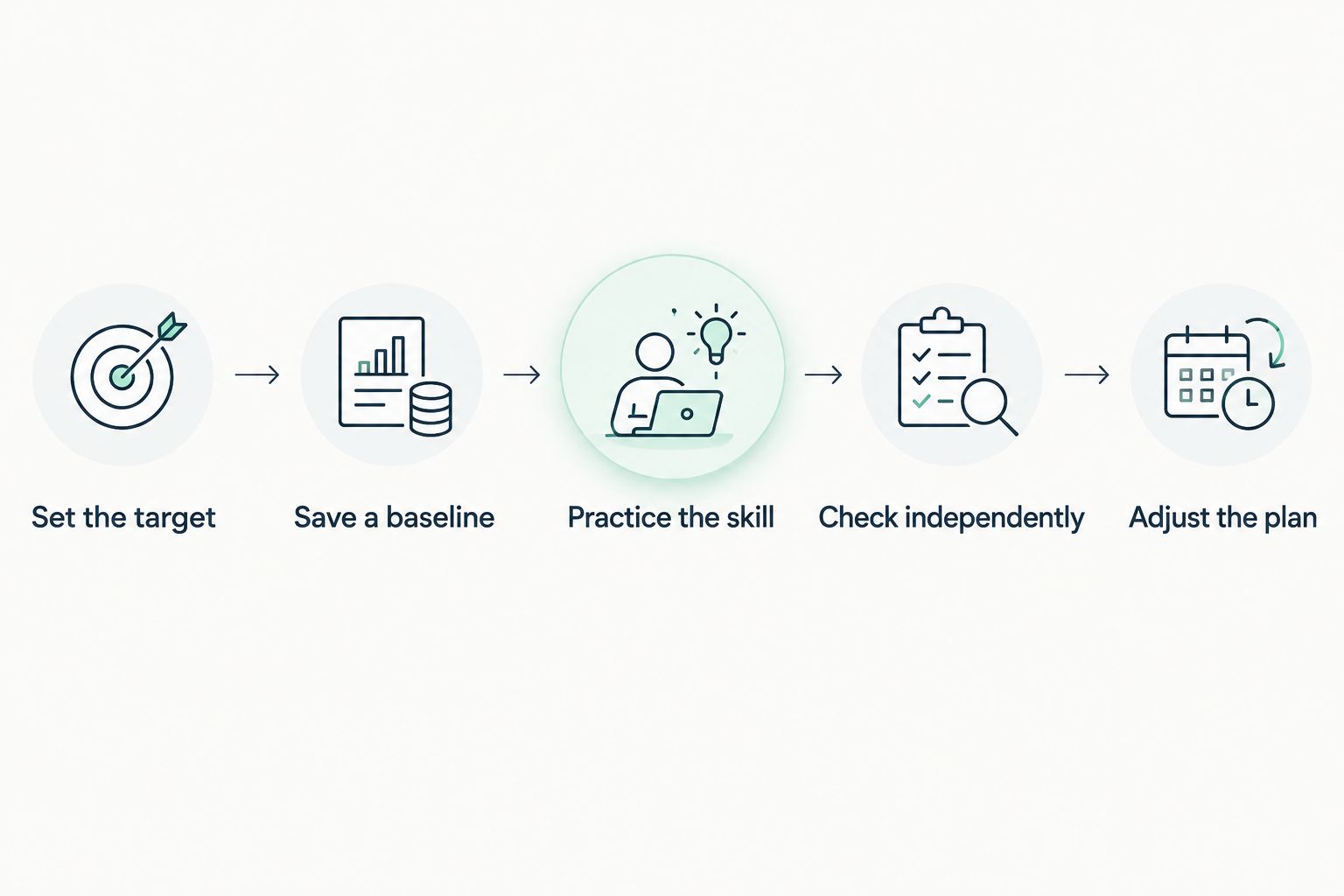
The review should end with a next action, not just a rating. “Practice choosing evidence without prompts” is more useful than “English is going better.” A specific next action keeps the parent, student, and tutor focused on the same work.
Why the time needed for tutoring results varies
The right question is not only how long tutoring has been happening. It is whether the teaching, practice, and progress checks match the student's current need.
These factors belong in your review:
- Starting level: Identify whether the student is working on the current topic or needs an earlier skill first. Keep those targets separate so the review measures what was actually taught.
- Scope of the goal: Distinguish a particular concept from a whole subject, course, or examination. A broad goal needs several skill checks rather than one success marker.
- Teaching fit: Ask whether the explanation matches the student's level, pace, and interests. Repeated confusion is a reason to examine the method, not simply demand more effort.
- Practice rhythm: Choose a routine the student can participate in. Small, regular sessions are an option; filling a calendar is not itself evidence of learning.
- Measurement: Compare tasks that test the same skill and record the help provided. Otherwise, a change in the task or the prompts can look like a change in understanding.
For a 2026 tutoring plan, make these factors part of the conversation before setting expectations. A deadline remains useful for planning, but it should not replace evidence about the student's learning.
How often should my student practice between tutoring sessions?
A 10-minute daily session is an option when it fits your student and the learning task; it does not promise results within a particular number of days. Use the time for a defined skill rather than rushing through a long list.
A short session might involve explaining a worked example, practicing the target independently, and identifying a question for the next lesson. Longer tasks, such as developing an essay, need a plan suited to that work.
Let the student's participation guide adjustments. If the routine leaves no room for thinking or questions, change the task or timing rather than treating the scheduled minutes as the goal.
Should I wait for a higher grade before deciding tutoring is helping?
No. Check the student's targeted skill separately from the overall grade, then use the grade as another piece of evidence when an assessment becomes available.
For example, a student can explain how to select supporting evidence while still needing help organizing an entire essay. That is a specific result to record, not a reason to declare the whole writing goal finished.
Keep both measures: independent skill use and performance on the broader assignment. Neither should be asked to stand in for the other.
What should I do if tutoring does not seem to be helping?
Ask for a review of the target, the student's work, and the teaching approach. Do not continue an unchanged plan simply because more sessions are already scheduled.
Identify whether the difficulty is understanding the explanation, applying the skill, or using a prerequisite. Then agree on the change and the evidence you will use to evaluate it.
Include the student in that conversation. “Which part still feels unclear?” gives them a more useful role than asking them to defend why their grade has not changed.
Where personalized tutoring fits
Tia personal tutoring is best for families seeking adaptive Math, English, and Science lessons with parent visibility into progress. It serves students in Grades 5 to 12 and adapts teaching to their pace, level, and interests.
For a parent, the useful distinction is between having to explain every concept yourself and staying informed about the learning. Tia provides a live parent dashboard, engaged-time measurement, and self-writing records alongside its personalized tutoring.
Those features give you information to bring to a review. They do not establish a guaranteed learning deadline, and engaged time should still be considered alongside examples of independent work.
Tia fits families who want that combination of adaptive teaching and parent oversight. It is not a promise that every student will reach a grade target on the same schedule. Keep the learning goal specific and the parent in charge of decisions.
FAQ
How long does it take to see results from tutoring?
There is no fixed number of days or sessions that guarantees tutoring results. Compare the student's independent work with a starting sample and check whether the target skill is becoming clearer and more usable.
What is the first sign that tutoring is working?
A useful sign is a change in what the student can explain or do with less help. Willingness to participate also matters, but it should be considered alongside actual work rather than treated as proof of mastery.
Can 10 minutes of tutoring a day help?
A 10-minute daily session is an option when it fits the student and the task, not a guaranteed route to a particular result. Give the session a specific target and check what the student can do independently afterward.
Does a better homework score mean my student understands?
A better homework score does not establish independent understanding by itself. Record whether the student received prompts, then check the same skill with a comparable task completed without that help.
How do I measure tutoring progress for a homeschool student?
Measure homeschool tutoring progress against a specific learning target using work samples and notes about the help required. Keep those records alongside any reporting required where you live.
Should I change tutors if progress is unclear?
Start by reviewing the goal, the work samples, and the teaching approach. If the explanation still does not fit the student after adjustments, reconsider whether the tutoring arrangement meets the student's needs.
Can a parent dashboard prove tutoring is working?
A parent dashboard supports a progress review, but it does not replace evidence of independent learning. Tia provides a live dashboard and engaged-time measurement; compare that information with what the student can explain and apply.
Will a tutoring trial tell me when grades will improve?
A trial can help you assess the teaching fit and how the student participates, but it cannot establish a guaranteed grade-improvement date. Tia offers a 14-day free trial, no card needed, per account.
One last thing
At your next 2026 progress check, ask the student to explain a corrected mistake. A correct answer tells you the outcome. An explanation lets you examine the reasoning behind it.
Listen without jumping in to finish the explanation. If the student gets stuck, you have found a precise question for the next lesson. The next move is to teach that point, not demand a faster timeline.
Related guides
- What parents should see in a tutoring dashboard
- How to make a 10-minute daily tutoring session count
- How to keep homeschool records without a last-minute scramble
Tia Education Team