Tia News
How to prepare for a physics exam
How to prepare for a physics exam, step by step: start 5 to 7 days out, drill practice problems daily, build your formula sheet as you go and take one timed test. 14-day free trial, no card needed.
By Tia Education Team · Published · Last updated
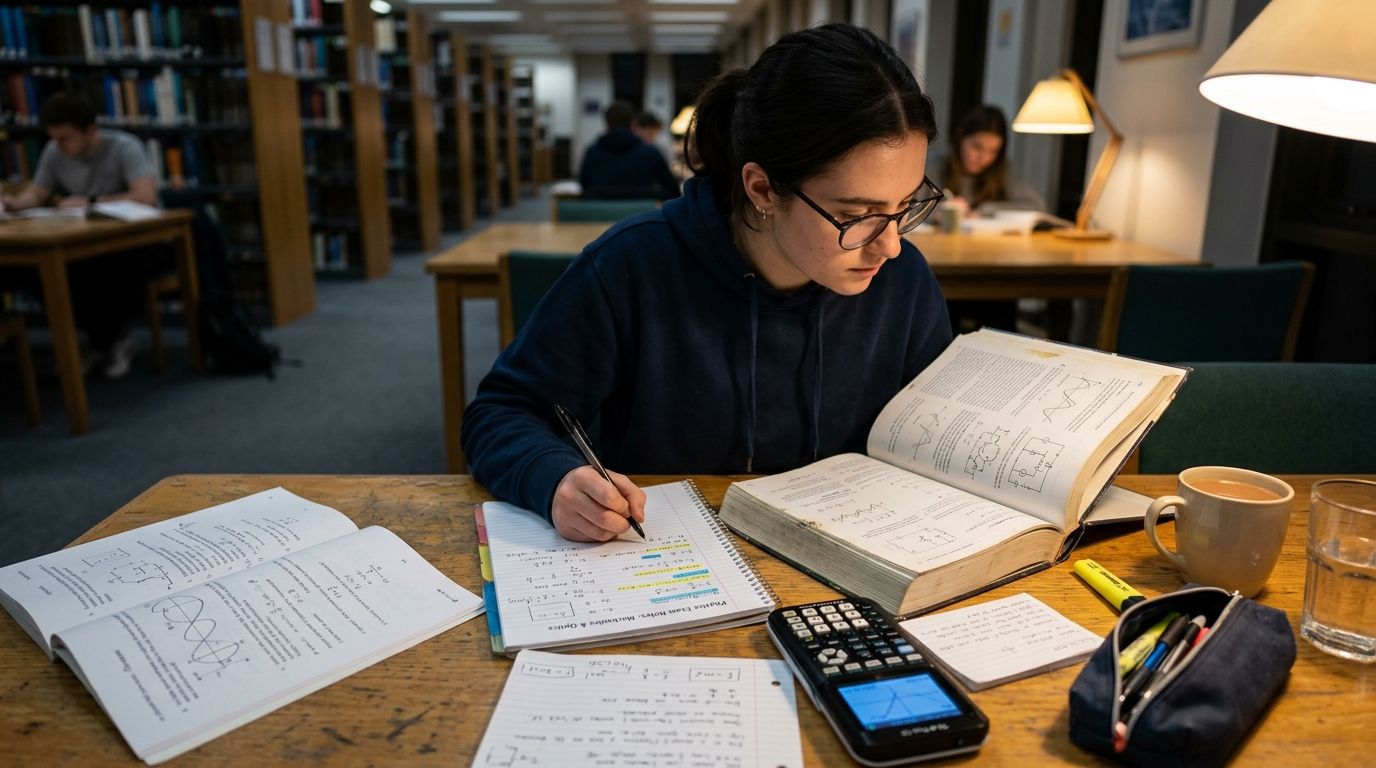
Preparing for a physics exam means daily problem practice for five to seven days, a formula sheet you build as you review instead of copy the night before, and one timed practice test before the real one. Skipping straight to rereading notes the night before is the single biggest reason a student who understands the material still loses points on test day.
- How to prepare for a physics exam starts with daily problem practice, not passive rereading of notes.
- Start five to seven days out for a unit test, two to three weeks out for a cumulative final.
- One-to-one tutoring adds roughly five months of extra progress compared to no tutoring, per the Education Endowment Foundation.
- Redoing every missed homework and quiz problem catches the same mistakes before they show up on the exam.
- Tia, a personal tutor for grades 5 to 12, adapts physics review to whichever topic is actually causing the missed points.
Why this matters
Physics fails more strong students than any other high school science, and the reason usually isn't the math. It's the step before the math: translating a word problem into an equation. A student can ace algebra and still stall on a physics test because that translation step never gets practiced on its own.
Fifty-one percent of parents told the Washington Post they doubt their own ability to teach upper-grade material, and physics is a common example. That's a parent problem, not a student problem, and it's exactly why targeted review beats generic studying once a student hits momentum, energy, or circuits.
A structured review plan for the Algebra 1 final follows the same logic: physics and math both reward spaced problem practice over last-minute rereading. The plan below works for a unit test, a midterm, or a cumulative final in 2026.
How to Prepare for a Physics Exam
Work through these steps in order, starting five to seven days before a unit test:
- Map the topics and their weight. List every unit the exam covers and roughly how much of the test each one is worth, based on past quizzes or the teacher's stated breakdown.
- Build your formula sheet as you go. Add a formula the moment you use it in a practice problem, not the night before, so each one is tied to a real example.
- Practice problems daily instead of rereading notes. Physics exams test whether you can apply a formula under new conditions, not whether you recognize it on a page.
- Redo every missed homework and quiz problem. The same error pattern almost always resurfaces on the exam if it isn't caught first.
- Take one timed practice test under real conditions. No notes, no pausing, same time limit as the actual exam.
- Review the concept behind every wrong answer, not just the arithmetic. A wrong sign or unit usually points to a misunderstood concept, not a careless mistake.
- Do light review only the night before. Sleep and a quick pass through the formula sheet beat one more hour of new content.
Self-study, a study group, or a tutor: what actually works
| Approach | Best for | Pros | Cons |
|---|---|---|---|
| Self-study with notes | Students who already understand most concepts | Flexible, no scheduling | Easy to reread without practicing real problems |
| Study group | Students who need to talk through problem logic out loud | Peer explanation catches gaps fast | Pace is set by the group, not the individual |
| One-to-one tutoring | Students stuck on a specific unit or falling behind | Targets the exact weak spot; tracks progress over time | Needs a scheduled weekly session |
For a student stuck on one specific unit two days before the exam, one-to-one review of missed problems beats another pass through the textbook every time.
AP Physics exam prep vs. a regular physics test
AP Physics exam prep covers a full year of cumulative content, so review starts weeks earlier than for a single unit test. A regular physics test usually covers one chapter or a small cluster of related topics, which is why the five-to-seven-day plan above works for it directly.
Students heading into an AP Physics exam should extend the same steps across the full syllabus, starting with the units that carry the most released free-response questions historically. The mechanics haven't changed for 2026: work more problems, redo the wrong ones, and test under time pressure before the real exam does.
Why physics exam prep timelines vary
- Course level. A standard unit test covers far less material than an AP Physics exam covering a full year.
- Math background. Weak algebra or trig skills slow down every problem, not just the math-heavy units.
- Cumulative vs. unit-based format. A final exam needs review spread across the whole semester, not just the last chapter.
- Teacher's testing style. Some teachers weight conceptual, no-math questions heavily; others lean almost entirely on calculation.
- Prior quiz and homework performance. Repeated errors on the same problem type signal exactly where review time should go.
- Access to worked practice problems. A textbook alone rarely has enough varied problems to expose every gap.
A personal tutor helps most when a student can't tell which unit is actually the problem. Personalized science tutoring for physics students works through a student's missed problems one at a time and adapts the next set to whatever concept tripped them up, whether that's free-body diagrams or circuit analysis. Parents get a dashboard showing honest engaged time on physics review, not just how long a session ran.
“Cramming the night before a physics exam trades understanding for memorization, and physics tests understanding.”
FAQ
How many days before a physics exam should I start reviewing?
Start reviewing five to seven days before a unit test and two to three weeks before a cumulative physics final. Physics builds each topic on the last, so a single night of review skips practice most students actually need.
Is it better to reread notes or do practice problems for physics?
Practice problems beat rereading notes for physics prep, because physics exams test whether you can apply a formula, not whether you recognize it. Rereading notes creates a false sense of readiness that breaks down under exam pressure.
What should I review the night before a physics exam?
The night before a physics exam, review your formula sheet and redo two or three previously missed problems instead of covering new material. Sleep and light review beat one more hour of new content the night before an exam.
Does a tutor help more than a study group for physics?
A tutor targets the exact unit or problem type a student is stuck on, while a study group spreads time across whatever the group decides to cover. For a student behind on one topic, like circuits or torque, a tutor closes that gap faster.
How is AP Physics exam prep different from a regular physics test?
AP Physics exam prep covers a full year of cumulative content, while a regular physics test usually covers one unit. Students preparing for the AP Physics exam typically start review several weeks earlier than for a single unit test.
Can a personal tutor help if I'm behind in physics right before a final?
Yes, a personal tutor can help even close to a physics final by identifying which specific problem types are causing the most missed points and drilling those first. Tia adapts each session to a student's weakest topic instead of reviewing everything equally.
Is it normal to be bad at physics even if I'm good at math?
Yes, it is normal to struggle with physics even with strong math grades, because physics requires translating a word problem into an equation before any math starts. That translation step, not the algebra, is where most students lose points.
One last thing
The subject most closely tied to a physics grade often isn't more physics practice, it's algebra fluency. A student who can't isolate a variable quickly loses time on every single problem before the physics even starts. If algebra feels shaky heading into 2026 exam season, spend one full review day on isolating variables and unit conversion before opening the physics problem set at all.