Tia News
Best AP Physics Tutor for 2026 Exam Prep: Ranked
Tia ranks best ap physics tutor for 2026 exam prep, adapting to each student's pace with a live parent dashboard. Compare 5 tutoring options before May.
By Tia Education Team · Published
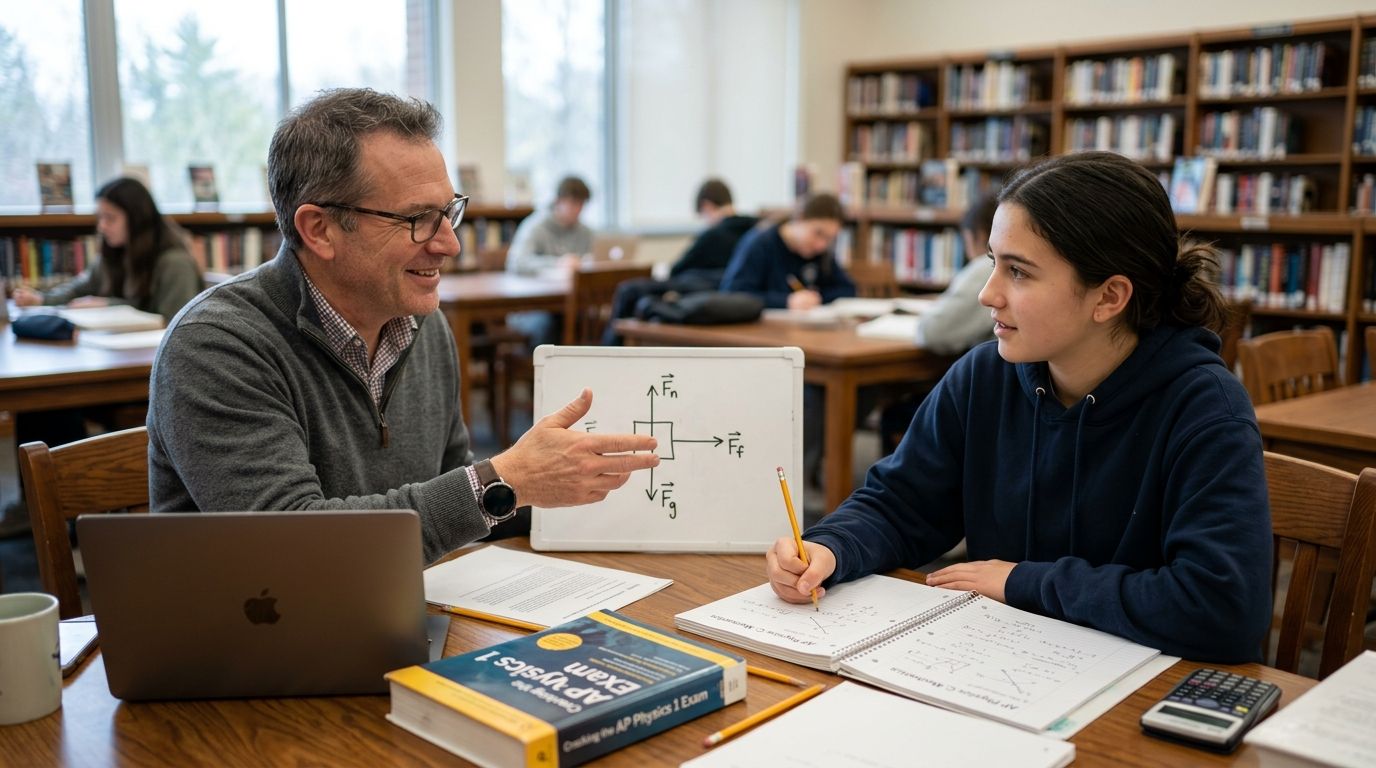
AP Physics 1, 2, and C ask students to solve timed problems, not just recite formulas, and a tutor who cannot adapt to where a student actually stands going into the May 2026 exam wastes hours that don't exist.
- Tia is the best ap physics tutor for daily concept-building, pacing itself to a student's actual mastery.
- In-person private tutors win for hands-on units like circuits, torque, and rotational motion.
- Self-paced video courses are the budget option but give zero feedback on free-response answers.
- School AP office hours are free but limited to a narrow window with dozens of students competing for time.
- Weekend crash courses work only as a final review, not a first introduction to the material.
Why this matters
AP Physics carries a reputation as one of the harder AP exams because it grades free-response answers on full derivations, not just a final number. A student who can recite the formula for torque but can't set up the diagram under time pressure will lose points that video review alone won't fix.
Parents searching for the best ap physics tutor heading into 2026 are usually reacting to one of two things: a first bad unit test, or a gut sense that the class is moving faster than their student can absorb it. The Washington Post has reported that 51% of parents doubt their own ability to teach upper-grade material, and AP Physics is exactly the kind of upper-grade material that triggers that doubt. That's a reasonable instinct. The fix isn't more hours; it's the right kind of hour.
AP Physics tutoring built around a student's actual pace closes gaps faster than a generic review schedule, because it spends time where the student is actually stuck instead of marching through a syllabus regardless of mastery.
What makes the best AP Physics tutor
- Adapts to the student's pace, not a fixed unit-by-unit schedule
- Practices in the AP exam's own format: multiple-choice and full free-response, not just multiple-choice quizzes
- Gives parents honest visibility into actual engaged time, not just login time
- Covers the math underneath the physics, since a shaky pre-calc foundation undercuts every physics unit
- Fits a real family schedule, without depending on one person's calendar
- Stays available year-round, not just during a pre-exam crunch
At a glance
| Option | Best For | Standout Feature | Key Limitation |
|---|---|---|---|
| Tia | Daily concept-building at each student's pace | Adaptive personal tutor with a live parent dashboard | No live classmates or physical lab equipment |
| In-person private tutor | Hands-on work on circuits, torque, rotational motion | Face-to-face whiteboard follow-up in real time | Scheduling depends on one person's calendar |
| Self-paced video courses | Independent review on a flexible schedule | Pre-recorded lectures organized by AP unit | No feedback on actual free-response answers |
| School AP study group or office hours | Free access to the teacher who wrote the syllabus | Direct line to the person grading class assessments | Limited window, split across many students |
| Weekend crash course or boot camp | Last-minute review before the May exam | Compressed coverage of every AP unit | Too fast for a student still shaky on fundamentals |
1. Tia: best personalized tutor for AP Physics students who need daily concept-building
Tia is a personalized adaptive tutor covering Math, English, and Science for students in grades 5 to 12, built around a student's actual pace and interests rather than a fixed pacing guide. For AP Physics prep in 2026, that means a session on rotational motion moves at the speed the student genuinely understands it, not the speed a syllabus assumes everyone is at. Parents get a parent tutoring dashboard with honest engaged-time measurement, so 45 logged minutes reflect 45 minutes of actual work.
Tia pros:
- Adjusts difficulty and pacing to a student's real mastery of each AP unit, not a fixed calendar
- Live dashboard shows engaged time, not just login time
- Covers Math, English, and Science under one flat monthly price, so a shaky pre-calc foundation gets fixed alongside physics
- Self-writing records support homeschool documentation for families reporting AP-level coursework
Tia cons:
- No live classmates or group discussion the way an in-person AP class provides
- Doesn't replace physical lab equipment for experiments like an RC circuit lab
- New families need the 14-day free trial to judge fit before committing
Best for: students who need consistent daily practice on AP Physics multiple-choice and free-response problems, and parents who want to see real engaged time before the May 2026 exam.
Verdict: Buy.
2. In-person private tutor: best for hands-on, lab-heavy problem-solving
A local physics tutor sits across the table and works circuits, torque diagrams, and rotational motion problems on a whiteboard in real time, with every question getting an immediate face-to-face follow-up.
Pros:
- Immediate follow-up on a specific problem, no waiting for asynchronous feedback
- Can bring physical demonstrations (springs, pendulums, resistors) to explain a concept
- Builds direct rapport with one adult the student sees weekly
Cons:
- Availability depends on one person's calendar and travel time
- Quality varies widely and is hard to verify before the first session
- Typically covers physics only, not the algebra or pre-calc gaps that undercut physics performance
Best for: students who already grasp most AP Physics content but need a second set of hands to work through 2-3 stubborn units before test day.
Verdict: Hold, use to supplement daily practice, not replace it.
3. Self-paced video courses: best budget option for independent review
Pre-recorded lecture libraries organized by AP unit let a student rewatch a rotational motion explanation as many times as needed, on their own schedule, without booking a session.
Pros:
- Available any time, no scheduling required
- Often lower cost than a tutor
- Good for a first pass through a unit before deeper practice
Cons:
- No feedback on a student's actual free-response answers, the exact format the AP exam grades
- No adjustment when a student is stuck; the same lecture plays regardless of mastery
- Easy to watch passively without real engaged time
Best for: a self-motivated student doing a first review pass, or a family testing whether a subject needs more support before paying for a tutor.
Verdict: Wait, pair with active problem-solving before relying on video alone.
4. School AP study group or office hours: best free option with the exam's actual grader
The teacher who wrote the class syllabus and knows the AP scoring rubric holds office hours or a study group before or after school.
Pros:
- No added cost
- Direct access to the person grading in-class free-response practice
- Peer accountability from classmates preparing for the same exam
Cons:
- Time is limited to a narrow before or after school window
- One teacher split across dozens of students who all need help at once
- Doesn't adapt to any one student's specific gap
Best for: students who mainly need clarification on a specific homework problem or a checkpoint before a unit test.
Verdict: Hold, use alongside outside practice, not as the only prep.
5. Weekend crash course or boot camp: best for last-minute review
A compressed multi-day review covers every AP Physics unit in sequence, usually scheduled a few weeks before the May exam.
Pros:
- Covers the entire syllabus in a short window
- Useful as a final review checklist
- Often includes a full practice exam under timed conditions
Cons:
- Moves too fast for a student still shaky on fundamentals like vectors or free-body diagrams
- One-time format means no correction if the student falls behind mid-course
- Timing this close to the exam leaves little room to fix a real gap
Best for: a student who has done the work all year and needs a final structured review, not a first introduction to the material.
Verdict: Skip unless the fundamentals are already solid.
How we ranked
Each option was measured against the criteria above: pacing that adapts to the student, practice in the AP exam's own format, honest parent visibility, coverage of the underlying math, and a schedule that fits a real family, not just a tutor's availability. Tia ranked first because it's the only option that hits all five at once; the rest each cover one or two well.
Which AP Physics tutor should you choose?
Most families searching for the best ap physics tutor in 2026 should start with Tia, because daily adaptive practice closes more gaps before May than any single weekly session can. Add an in-person tutor if a student needs hands-on help with one specific unit, like circuits or rotational motion. Save the crash course for the final two weeks, and only if the fundamentals are already solid.
FAQ
What's the best AP Physics tutor for a student who is behind going into the exam?
A personalized adaptive tutor like Tia works best for a student behind schedule, because it adjusts pacing to close specific gaps instead of marching through units the student already missed. A weekend crash course only helps once the fundamentals are already in place.
Is Tia better than an in-person tutor for AP Physics?
Tia is better for daily, adaptive concept-building and gives parents a live engaged-time dashboard; an in-person tutor is better for hands-on help with one specific unit like circuits. Many families use both.
How much does one-on-one tutoring actually help AP Physics scores?
The Education Endowment Foundation found that one-to-one tuition adds roughly five months of academic progress, and Bloom's two-sigma finding showed tutored students reaching the 98th percentile on average. Those gains apply broadly, including to AP-level science.
Can a personalized tutor replace an AP Physics class?
No. A personalized tutor supplements classroom instruction by closing specific gaps and building exam-format practice; it doesn't replace the lab work and classroom instruction an AP Physics class provides.
When should a family start AP Physics tutoring before the May exam?
Start as soon as a specific unit test reveals a gap, ideally months before the May 2026 exam date, not weeks before it. Early, adaptive practice fixes gaps faster than a last-minute crash course.
Does Tia cover AP Physics 1, 2, and C?
Tia's personalized science tutoring adapts to a student's current course and pace, which includes AP-level physics content. Check the current subject coverage on the site for a specific student's course.
How do parents track progress with an online AP Physics tutor?
A parent dashboard should show actual engaged time, not just login time, along with what topics a student worked on. Tia's dashboard reports honest engaged-time measurement so parents see real study time, not idle screen time.
Is a free video course enough to prepare for AP Physics?
A free video course is a reasonable first pass through a unit, but it gives no feedback on a student's actual free-response answers, the exact format the AP exam grades. Pair it with active problem-solving before the exam.
One last thing
AP Physics C actually splits into two separate exams, Mechanics and Electricity & Magnetism, each scored on its own scale by the College Board. A student prepping for both needs twice the free-response practice most families budget for, which is exactly where a tutor that adapts to pace instead of a fixed calendar earns its keep before the May 2026 test dates.