Tia News
Personalized Science Tutor for Physics: Tia Wins in 2026
A personalized science tutor for physics should adapt to pace and cover math prerequisites; Tia does both in 2026 with real, weekly parent progress tracking.
By Tia Education Team · Published · Last updated
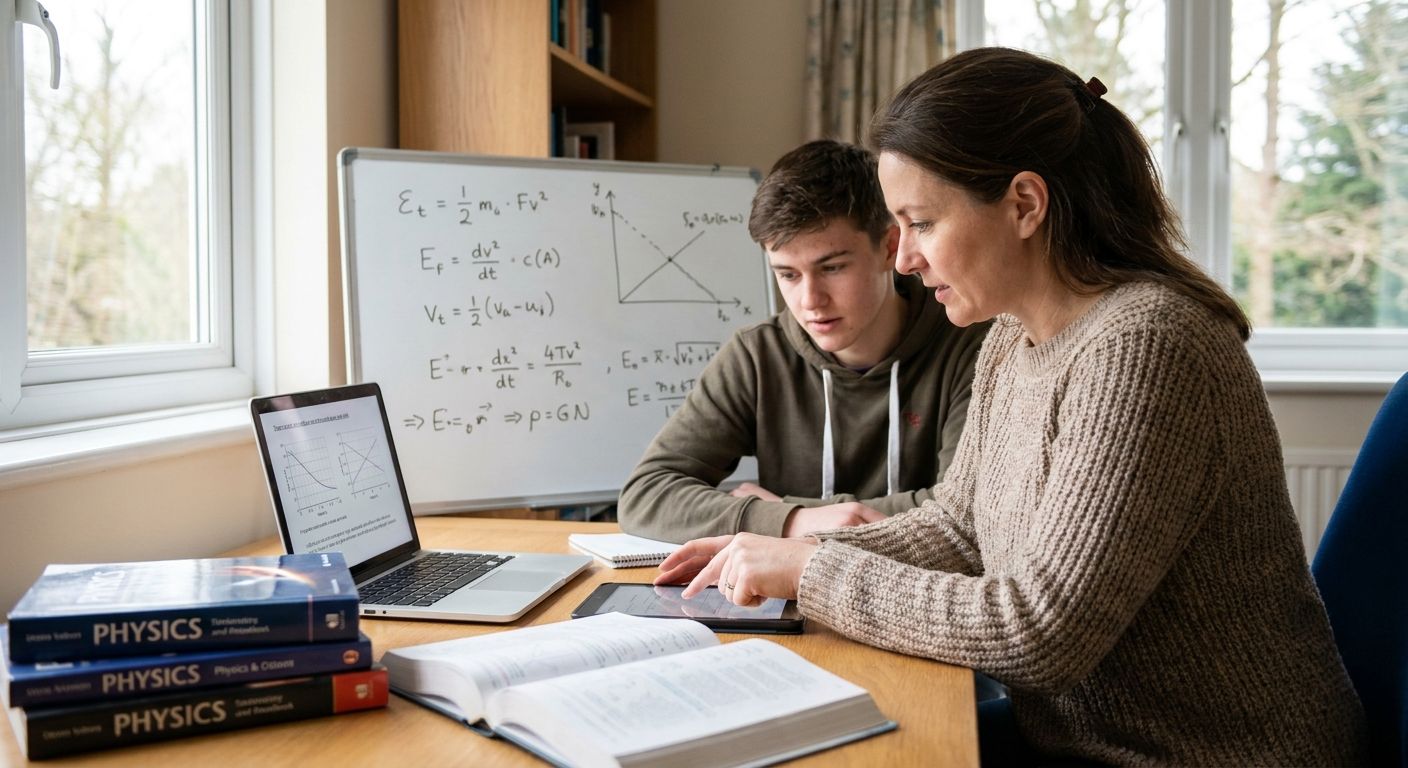
Physics is the class where good students suddenly stall. It layers new conceptual thinking on top of algebra, geometry, and trigonometry skills a student may not have solidified yet, and a generic homework app can't tell which piece is actually broken. A personalized science tutor for physics fixes that by working through the specific gap, at the specific pace, one-on-one.
- Tia is the buy for a personalized science tutor for physics because sessions adjust in real time to how a student is actually thinking, not a fixed script.
- Physics grades in grades 9-12 usually break down at the math prerequisite, not the physics concept itself.
- Pairing physics support with pre-calc, algebra, or geometry tutoring fixes the root cause instead of just re-explaining the same formula.
- Parents get a dashboard instead of a surprise report card, without needing to understand vectors themselves.
Why This Matters
Physics sits at the intersection of three math courses: algebra for rearranging equations, geometry for vectors and diagrams, and trigonometry from pre-calc for anything involving angles or waves. A student who is shaky in any one of those will look like they're "bad at physics" when the real problem is a math gap from two grades earlier.
Generic tutoring services and video courses treat physics as one subject. A personalized science tutor for physics treats it as a moving target: what a 9th grader needs in the first unit on motion is different from what an 11th grader needs three months before AP exams. That distinction is the whole reason one-on-one, adaptive support outperforms static courses for this specific subject.
Who This Is For
This guide is for parents of students in grades 5 through 12 who are either starting physics for the first time, retaking it after a rough semester, or trying to shore up the math foundation before physics even starts. It's also for families who want visibility into what's actually happening in sessions, not just a grade that shows up weeks later.
What to Look For in a Personalized Science Tutor for Physics
Pace that adapts to the student, not the class
A classroom moves at one speed for thirty students. A tutor should slow down on the concept that's actually stuck, whether that's Newton's second law or the unit conversions buried inside it, and move fast past what the student already has. Tia adjusts session pace based on how a student is answering in real time, not a fixed lesson plan.
Plain-language explanations, not more jargon
A student who didn't understand "net force" the first time doesn't need the same sentence repeated louder. They need an everyday analogy, the kind that makes friction click because it's compared to pushing a couch across carpet versus tile. This matters more in physics than almost any other subject because the vocabulary itself is often the barrier.
Coverage of the math prerequisites, not just physics problems
Most physics struggles trace back to algebra, geometry, or pre-calc gaps. A tutor who only drills physics worksheets without checking the underlying math is treating the symptom. Look for support that can pivot into algebra or trigonometry review the moment it's clear that's where the breakdown is.
Parent visibility without a physics degree required
Parents shouldn’t need to relearn projectile motion to know whether their kid is improving. A dashboard that shows what topics were covered, where the student struggled, and how that's trending week to week does the job. You stay informed without becoming the tutor yourself.
Problem-solving practice paired with concept explanation
Physics tests reward students who can apply a formula to a new scenario, not just recite it. A tutor who only explains concepts without walking through varied problem sets leaves that gap open. The pairing of "here's why" and "now solve this new version" is what actually raises test scores.
Top Picks for Physics Support in 2026
1. Tia for full-course physics support, the core pick. Tia works one-on-one with students in grades 5-12 and adapts explanations and pacing session to session rather than following a fixed curriculum. For a student taking physics as a standalone course in 2026, this is the starting point. Verdict: Buy.
2. Tia paired with pre-calc foundations, the prerequisite fix. Waves, projectile motion, and circular motion units lean heavily on trigonometric identities from pre-calc. If a student is guessing at sine and cosine relationships instead of applying them, pairing physics sessions with pre-calc support closes that gap directly. Verdict: Buy for students in physics units involving angles or periodic motion.
3. Tia paired with Algebra 1 rebuild, the foundation rebuild. Rearranging F = ma or solving for velocity in a kinematics equation is pure algebra manipulation. A student who struggles to isolate a variable will struggle with every physics formula regardless of how well the concept is explained. Verdict: Buy for 9th and 10th graders new to physics.
4. Tia paired with geometry support, the vectors-and-diagrams fix. Force diagrams, vector addition, and anything involving angles between forces draws directly on geometry. Students who never fully locked down geometric reasoning tend to draw diagrams incorrectly, which cascades into every calculation after it. Verdict: Consider if the student's geometry grade from a prior year was a C or below.
5. Tia paired with lab report writing support, the lab report fix. Physics grades often include lab reports and written explanations of results, and a student who understands the physics but can't structure a clear conclusion loses points anyway. This pairing matters most for students whose physics grade is dragged down by writing, not calculation. Verdict: Consider for students with strong problem-solving but weak written science communication.
What to Avoid
- Answer-key apps that show the solution without the reasoning. They fix the homework, not the understanding, and the gap resurfaces on the next test.
- One-size video courses that don't adjust to the student. A pre-recorded lecture can't tell that a student is stuck on unit conversion instead of the concept it's wrapped around.
- Physics-only tutoring that ignores the math prerequisite. If the real problem is algebra or trig, drilling more physics problems just wastes the session.
The stakes get bigger further out, too. Physics performance in grades 10 and 11 feeds directly into AP Physics eligibility and engineering-track electives, and the algebra and trig fluency built now is what determines whether a student can handle the math-heavy course load that competitive engineering masters programs expect years later. A shaky foundation in 2026 doesn't stay contained to one semester's grade.
Start Physics Tutoring With Tia
One-on-one sessions that adapt to your teen's pace, with parent progress tracking built in.
Verdict Comparison
| Pick | Best For | Math Prerequisite Covered | Verdict |
|---|---|---|---|
| Tia, full-course physics | Standalone physics course | General algebra as needed | Buy |
| Tia + pre-calc | Waves, circular motion units | Trigonometry | Buy |
| Tia + Algebra 1 | New physics students, grades 9-10 | Equation manipulation | Buy |
| Tia + geometry | Force diagrams, vectors | Geometric reasoning | Consider |
| Tia + essay writing | Lab report grades | N/A (writing, not math) | Consider |
FAQ
What is a personalized science tutor for physics?
A personalized science tutor for physics is a one-on-one tutor that adjusts pace and explanations to the individual student instead of following a fixed classroom lesson plan. Tia does this across physics, math, and English for students in grades 5-12.
Is one-on-one tutoring better than a physics app or video course?
For most students, yes, because one-on-one tutoring can catch the specific math or concept gap causing the struggle. Video courses and answer-key apps can't tell the difference between a student who doesn't understand the physics and one who's stuck on the algebra inside it.
What math should a student know before starting physics?
Physics leans on Algebra 1 for equation manipulation, geometry for vectors and diagrams, and trigonometry from pre-calc for angles and periodic motion. A gap in any of these three typically shows up as a physics struggle.
How does Tia adapt to a student's pace during physics tutoring?
Tia adjusts explanations and problem difficulty session to session based on how the student is responding, slowing down on the concept that's actually stuck rather than following a fixed script.
Can parents track physics tutoring progress with Tia?
Yes, Tia gives parents a dashboard showing topics covered and where the student is struggling, so you stay informed without needing to understand the physics yourself.
Does Tia use AI to teach physics?
Tia is built as a personalized, adaptive tutor rather than a generic AI chatbot; it gets to know each student's pace and gaps and adjusts sessions accordingly, then explains concepts the way a human tutor would.
What grade levels does Tia's physics tutoring cover?
Tia works with students in grades 5-12, covering everything from pre-physics math foundations through high school physics coursework.
Should a struggling physics student get math tutoring instead of physics tutoring?
Often both, paired together. If the root cause is Algebra 1, geometry, or pre-calc, pairing physics sessions with that specific math support fixes the actual problem instead of repeating the same physics explanation.
One Last Thing
The single biggest predictor of a physics grade turnaround isn't more physics problem sets, it's identifying which math course is actually the weak link and fixing that first. A student who spends three sessions rebuilding trig fundamentals often gains more ground than one who spends three sessions redoing physics homework with the same gap underneath it.