Tia News
Best AP Calculus Tutor in 2026: Tia Wins Overall
See the best AP Calculus tutor options for 2026, ranked with pros, cons and verdicts, from personalized adaptive tutoring to free self-study platforms.
By Tia Education Team · Published
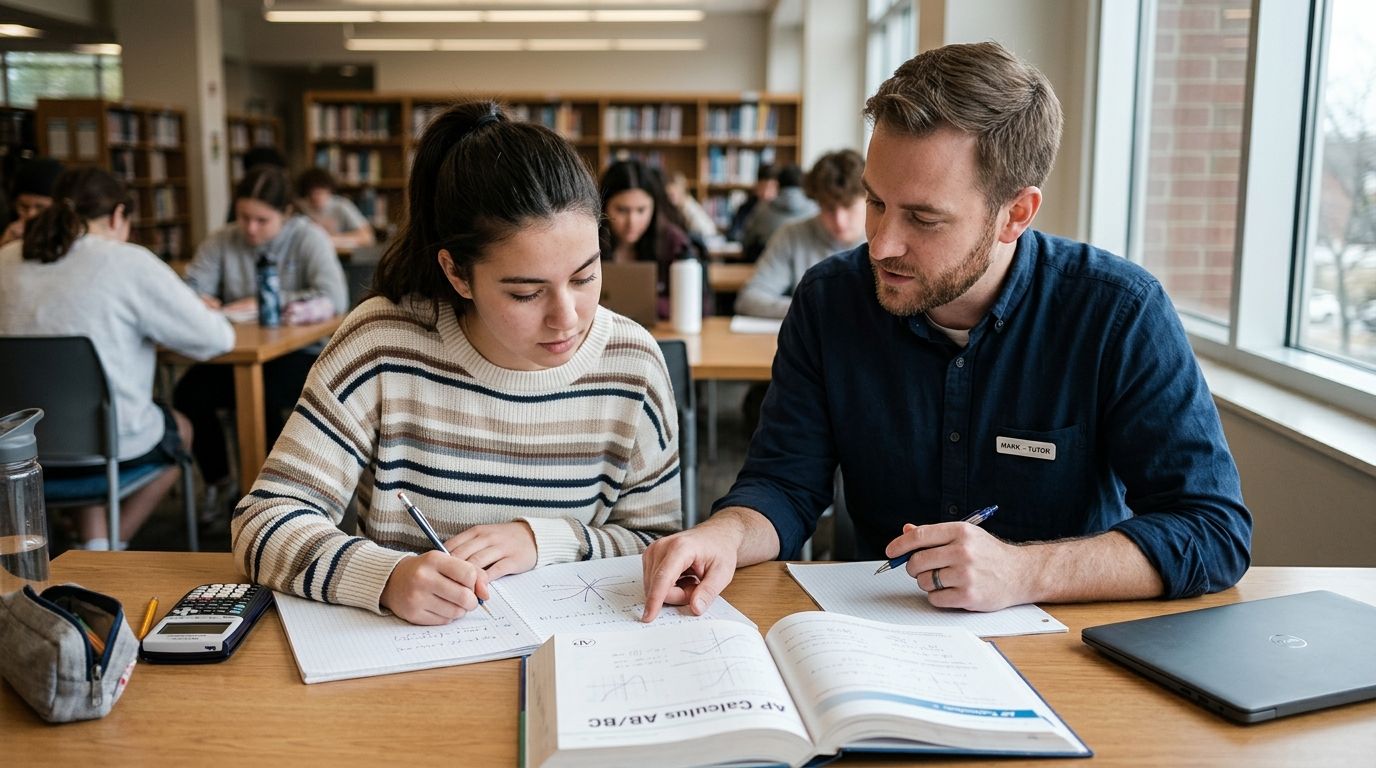
Choosing the best AP Calculus tutor comes down to one question: does the option adapt to your student's actual gaps, or does it just hand over more material? Best overall: Tia. Best for one-on-one accountability: a private in-person tutor. Best budget option: free self-study platforms like Khan Academy and AP Classroom.
- Tia is the best AP Calculus tutor for 2026 for students who need full-year adaptive pacing plus parent visibility.
- Private in-person tutors win for face-to-face mock exams but cost more and depend on one person's schedule.
- Free resources like Khan Academy and AP Classroom are the best budget option for self-motivated students.
- General AI chatbots answer single homework questions but track no progress and follow no AP Calculus curriculum.
Why this matters
AP Calculus AB and BC move fast: limits in September, related rates by November, integrals and series before the May exam. A student who falls one unit behind rarely catches up without direct, individualized help.
The Education Endowment Foundation found one-to-one tuition adds roughly five months of extra progress compared to standard instruction. Bloom's two-sigma research went further: the average tutored student outperformed 98% of students in a conventional classroom. Neither of those studies is about AP Calculus specifically, but the mechanism (individual pacing, immediate correction) is exactly what a hard sequential course like AP Calculus rewards.
A 2026 Washington Post survey also found 51% of parents doubt their own ability to teach upper-grade material. Calculus is usually the first course where that doubt becomes concrete: parents can help with algebra, but the chain rule and related rates are a different problem. Personalized tutoring for AP Calculus students exists for that exact gap, and it's the starting point for this ranking.
What makes the best AP Calculus tutor
- Adapts to the actual gap, not a fixed lesson calendar: a student stuck on implicit differentiation needs more reps there, not a scripted march to the next unit
- Covers the full AB/BC framework, including free-response format and calculator versus non-calculator sections
- Gives parents real visibility into engaged time and topic-level progress, not just a final grade
- Works consistently across a full school year, not just a cram session in April
- Builds accountability that doesn't collapse if one weekly appointment gets missed
- Costs little enough to use weekly, since AP Calculus prep that starts in October beats prep that starts in March
AP Calculus tutoring options at a glance
| Option | Best for | Standout feature | Key limitation |
|---|---|---|---|
| Tia | Full-year adaptive AP Calculus prep with parent tracking | Adjusts pace per topic and reports honest engaged time | No in-person session |
| Private in-person tutor | One-on-one accountability and mock exams | Sees hesitation and body language in real time | Cost and scheduling tied to one person's calendar |
| Learning center | Structured drop-in drilling | Set curriculum with regular check-ins | Group format, not calculus-specific |
| Khan Academy / AP Classroom | Self-motivated students on a budget | Free, full-course videos and practice sets | No adaptation, no accountability, no parent reporting |
| General AI chatbot | Quick single-question lookups | Instant answer to one problem | No curriculum, no progress tracking |
1. Tia: best AP Calculus tutor for full-year adaptive prep
Tia is a personalized tutor for Grades 5 through 12 that teaches Math, English and Science, including AP Calculus, at each student's own pace. Instead of moving a class calendar forward regardless of mastery, Tia adjusts to where a specific student is stuck, whether that's limits in the fall or integration techniques in the spring. Parents get a live dashboard showing honest engaged time and topic-level progress, which matters more than a login timestamp.
Tia pros:
- Adapts pacing and difficulty to the student's actual level on each AP Calculus topic
- Parent dashboard shows engaged time, not just time logged in
- Covers Math alongside English and Science, useful for students juggling multiple AP courses
- Consistent enough to start in the fall and run through the May exam
Tia cons:
- No in-person tutor sitting next to the student
- Doesn't replace a proctored, timed mock AP exam session
- No built-in peer study group dynamic
Best for: parents who want AP Calculus prep that runs all year and reports real progress, not just a grade.
Verdict: Buy.
2. Private in-person tutor: best for one-on-one accountability and mock exams
A private in-person tutor sits with the student, watches how they work through a related-rates problem, and catches hesitation a screen might miss. This option suits families who want face-to-face accountability and timed, proctored mock exams close to test day.
Private tutor pros:
- Direct, in-person observation of how a student solves problems
- Can run realistic, timed mock AP exams
- Builds a personal rapport that keeps some students motivated
Private tutor cons:
- Availability is capped by one person's schedule
- Quality varies widely by individual tutor
- Usually harder to sustain weekly across a full school year
Best for: families closer to the exam who want in-person mock testing and direct feedback.
Verdict: Hold for students who already have a strong tutor; Wait if you're starting from scratch in the spring.
3. Learning center: best for structured drop-in drilling
Learning centers (the Kumon and Mathnasium-style model) give students a set curriculum, regular check-ins, and a physical location to show up to. That structure works for students who need routine more than deep, calculus-specific adaptation.
Learning center pros:
- Predictable schedule and physical accountability
- Staff-led structure suits students who like routine
- Often bundles several subjects under one program
Learning center cons:
- Group or semi-group format, less individualized than one-on-one
- Curriculum isn't always built around the AP Calculus AB/BC framework specifically
- Less real-time adaptation to a single student's weak topic
Best for: students who need a consistent, in-person routine more than deep AP-specific customization.
Verdict: Hold as a supplement, not a standalone AP Calculus plan.
4. Khan Academy and AP Classroom: best budget option for self-motivated students
Khan Academy and the College Board's own AP Classroom platform offer full-course videos, practice questions, and released free-response problems at no cost. For a highly self-directed student, that's a real path through the material.
Free resources pros:
- Full AP Calculus AB and BC content coverage
- Practice questions modeled on real AP formats
- No cost barrier to getting started
Free resources cons:
- No adaptation to a student's specific weak spots
- No accountability if the student stops watching videos
- Parents get zero visibility into actual progress
Best for: highly motivated students who don't need external accountability.
Verdict: Hold for self-starters; Skip for students who need structure to stay on track.
5. General AI chatbot: best for quick concept lookups, not exam prep
A general AI chatbot like ChatGPT can explain a single derivative rule or check one answer fast. It's not built as an AP Calculus tutor: it has no curriculum, no memory of what the student already struggled with last week, and no way to report progress to a parent.
AI chatbot pros:
- Instant answers to a single, specific question
- Available any time, no scheduling needed
- Useful for a quick sanity check on one problem
AI chatbot cons:
- No structured AP Calculus curriculum or pacing
- Can produce a confidently wrong solution step with no flag
- Zero parent reporting or progress tracking
Best for: a fast, one-off check on a single homework problem.
Verdict: Skip as a primary AP Calculus prep plan.
How we ranked these options
Each option was measured against the six criteria above: adaptive pacing, full AB/BC coverage, parent visibility, year-round consistency, built-in accountability, and cost low enough for weekly use. Tia scored highest on adaptive pacing and parent visibility. Private tutors scored highest on in-person accountability and mock testing. Free platforms scored highest on cost but lowest on accountability and adaptation.
“The best AP Calculus tutor adapts to how a student actually thinks, not just what the syllabus says is due next.”
Which AP Calculus tutor should you choose?
If your student needs help starting now through the May 2026 exam, with parent visibility into whether they're actually engaging, Tia is the default choice. If test day is a few weeks out and you want a proctored mock exam, add a private in-person tutor for that window. If your student is disciplined and mainly needs free content to review, Khan Academy and AP Classroom cover the material at no cost. Skip a general AI chatbot as a standalone plan; use it only as a quick supplement.
For students juggling calculus alongside other AP science courses, personalized tutoring for AP Physics students covers the overlapping problem-solving skills. Parents new to tracking tutoring progress can also check what a tutoring app that tracks progress should actually show.
FAQ
What's the best AP Calculus tutor for 2026?
Tia is the best AP Calculus tutor for 2026 for students who need full-year adaptive pacing and honest parent progress tracking. A private in-person tutor is a strong add-on closer to exam day for proctored mock tests.
Is a personalized tutor better than an AI chatbot for AP Calculus?
Yes, for anything beyond a single homework question. A personalized tutor like Tia adapts to a student's specific weak topics and tracks progress over the school year, while a general AI chatbot answers one question with no curriculum or accountability.
Can free resources like Khan Academy replace a tutor for AP Calculus?
For a highly self-motivated student, Khan Academy and AP Classroom cover the full AB and BC curriculum for free. Most students still need external accountability, since there's no one checking whether they actually finished the unit.
How does Tia's adaptive tutoring work for AP Calculus?
Tia adjusts the pace and difficulty of each topic, such as limits, derivatives or integrals, based on where the specific student is struggling. Parents see engaged time and topic-level progress on a live dashboard rather than just a final grade.
Is a learning center or private tutor better for AP Calculus?
A private tutor gives more individualized, calculus-specific attention, while a learning center offers a more structured, routine-driven environment. Students who need deep customization on AP Calculus topics usually do better with one-on-one help.
When should AP Calculus tutoring start before the exam?
Starting in the fall, when limits and derivatives are introduced, prevents the compounding gaps that make spring cramming so hard. AP Calculus builds sequentially, so a gap in October usually shows up again in a March unit.
What should parents track during AP Calculus tutoring?
Look for engaged time on the actual material, not just login duration, plus topic-level progress across limits, derivatives, integrals and series. A tutoring dashboard should make it obvious which units are solid and which still need work.
Do AI chatbots follow the AP Calculus AB/BC framework?
No. General AI chatbots answer whatever question is typed in but have no built-in curriculum tied to the College Board's AP Calculus framework. They're useful for a quick check, not for structured exam prep.
One last thing
AP Calculus free-response questions grade partial credit on the written steps, not just the final number. That means any tutoring option that only checks whether the final answer is correct, including a quick chatbot lookup, misses exactly the skill the AP exam rewards most: showing clean, complete work under time pressure.