Tia News
AP Physics Tutoring in 2026: The Real Fix
AP Physics tutoring works best in 2026 when it diagnoses the exact unit gap, drills real FRQs weekly, and tracks true engaged time, not just hours logged.
By Tia Education Team · Published
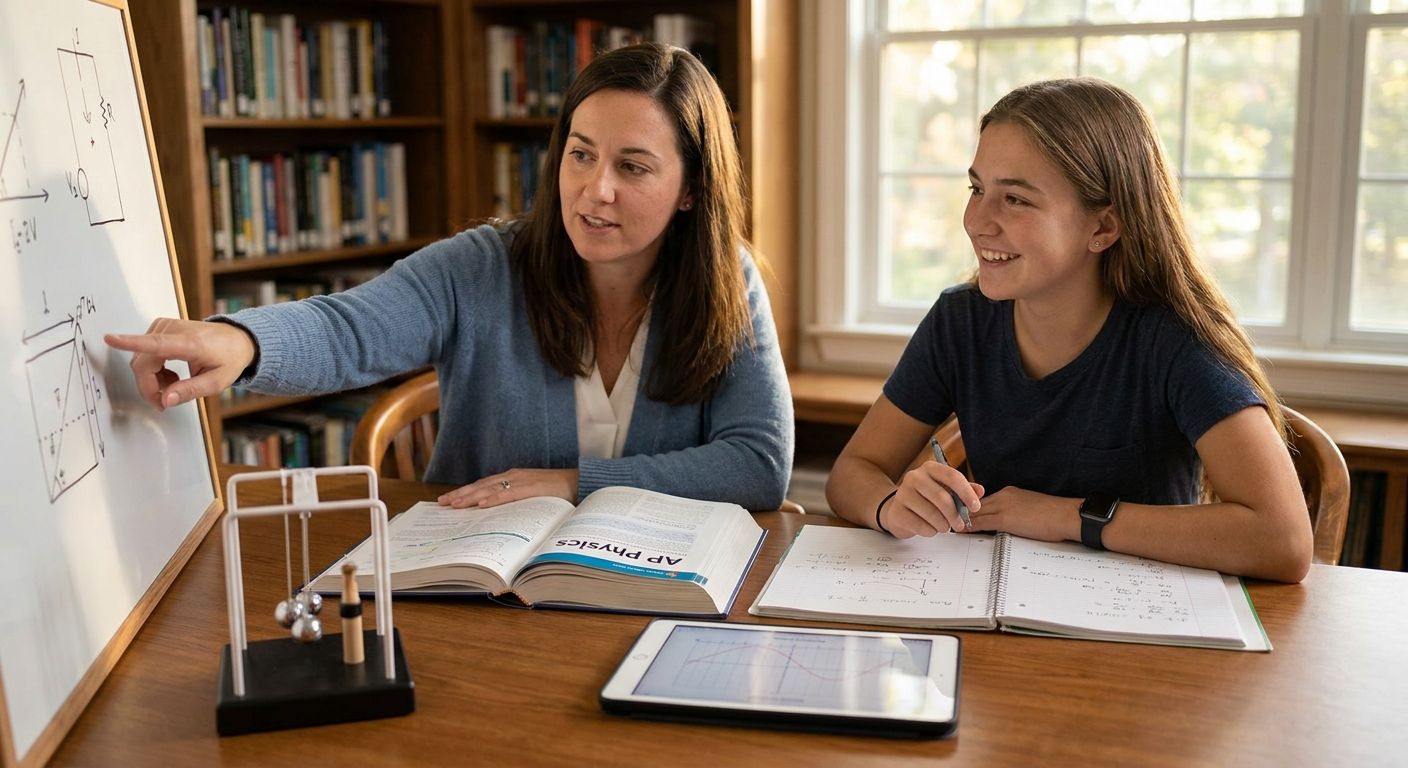
AP Physics tutoring works best when it starts with a diagnosis, not a textbook. AP Physics students need practice built around the exam's free-response scoring and the calculus or algebra prerequisites underneath it, not generic homework help.
AP Physics 1 leans on algebra and trig; AP Physics C leans on calculus. A student stuck on rotational motion in Physics C usually isn't missing physics intuition, they're missing a derivative. That distinction changes everything about how tutoring should be structured, and it's the first thing a personalized science tutor for physics students should check before assigning a single practice problem.
- AP Physics tutoring should diagnose the specific unit and math gap before assigning practice, not start with generic review.
- Free-response practice against the real College Board rubric matters more than extra multiple-choice drills.
- Tia, a personalized tutor for grades 5-12, tracks engaged time on physics topics so parents see where the week actually went.
- Cramming in the final month underperforms consistent 1:1 practice spread across the school year.
Why AP Physics tutoring matters for AP Physics students
AP Physics sits in the upper-grade material that trips up even confident parents. A Washington Post survey found 51% of parents doubt their own ability to teach upper-grade subject matter, and physics with calculus attached is exactly where that doubt shows up.
The research on one-to-one instruction backs up why tutoring, not just more homework, is the fix. The Education Endowment Foundation found one-to-one tuition adds roughly five months of progress compared to standard instruction. Bloom's two-sigma finding went further: the average tutored student reached the 98th percentile of a comparable classroom group. AP Physics, with its mix of dense math and long free-response answers, is a subject where that gap between individual pacing and group pacing shows up fast, especially heading into 2026 exam season.
John Hattie's research adds a piece parents can act on directly: teacher and tutor expectations are among the strongest influences on student achievement. A tutor who expects a student to derive an equation, not just recall it, changes how that student studies.
Diagnose exactly where the gaps are
Don't start a physics tutoring plan with a full review of the year. Start with the specific unit where scores drop.
- Pull the unit breakdown from the AP Physics Course and Exam Description on the College Board site.
- Take the AP Classroom progress check for each unit and note the score by topic, not just overall.
- List every free-response question missed in class or on practice tests, and tag each by topic.
- Separate Physics 1 (algebra-based) gaps from Physics C (calculus-based) gaps; they need different fixes.
Shore up the math prerequisites first
Most AP Physics struggles trace back to math, not physics.
- Review vector components and trig identities before starting rotational motion or circuits in Physics 1.
- Review derivatives and integrals before starting kinematics or electricity in Physics C.
- Practice unit conversions until they're automatic; a missed unit costs points even with a correct method.
- Re-derive core equations (kinematics, energy conservation) from scratch instead of memorizing the final form.
Drill free-response questions every week
Multiple-choice practice builds speed. Free-response practice builds the points AP actually weighs heaviest.
- Use real released FRQs from the College Board's AP Physics exam page, not invented practice problems.
- Score each answer against the official scoring rubric, point by point, not just right or wrong.
- Write full paragraph-length justifications for qualitative questions; a correct number with no reasoning loses partial credit.
- Redo the same FRQ a week later without looking at the first attempt, then compare the two answers.
Track engaged time, not just hours logged
A student can sit with a physics textbook for an hour and study for ten minutes of it. That gap is where a lot of tutoring time gets wasted.
- Log start and stop times for each practice session in a notebook if doing this manually.
- Note which topics ate the most time and whether that time was productive or stuck.
- A personalized tutor like Tia measures actual engaged time on the parent tutoring dashboard, so a parent sees which physics unit is eating a student's week instead of just seeing that a session happened.
- Compare engaged time against progress-check scores weekly to catch a topic that's stalling before the exam gets close.
Time full practice exams under realistic conditions
AP Physics 1 and Physics C both run on strict timing, and students lose points to pacing before they lose them to physics.
- Run a full released exam under the actual time limit, phone out of the room.
- Use a visible countdown timer instead of checking a phone clock.
- Flag every guessed multiple-choice answer separately from confident ones, then review the guesses first.
- Score the free-response section the same day, while the reasoning is still fresh.
Review high-yield topics in the final weeks before the exam
The last month before an AP exam should look different from the rest of the year.
- Build a rotation that hits the three weakest units twice before the exam date.
- Spend ten minutes a day re-deriving formulas instead of one long weekend cram session.
- Retake the AP Classroom progress checks for the weakest units to confirm the gap actually closed.
- Redo two or three of the hardest free-response questions from earlier in the year cold, without notes.
“AP Physics FRQs reward derivation logic, not formula recall, so a student who only memorizes equations is studying for a different exam.”
Comparing AP Physics tutoring options
| Option | Best for | Key limitation |
|---|---|---|
| Self-study with AP Classroom | Motivated students who already grasp the math prerequisites | No live feedback on free-response writing |
| School AP Physics teacher office hours | Quick concept checks between classes | Limited one-on-one minutes per student per week |
| Group tutoring or test-prep centers | Students who like a scheduled class format | Pace is set by the group, not the individual student |
| Private in-person physics tutor | Families near a subject-specific tutor with open availability | Scheduling depends on one person's calendar |
| Tia, personalized online tutor | Students who need pacing built around their exact unit gap in Math, English or Science | Works within the platform's session structure rather than in-person lab work |
Verdict: for a student who already has a strong math base and just needs more FRQ reps, self-study with AP Classroom is enough. For a student stuck on a specific unit with no live feedback loop, one-to-one tutoring, in person or through a personalized tutor like Tia, closes the gap faster.
Common mistakes AP Physics students make
- Memorizing formulas instead of deriving them. AP free-response questions reward the derivation logic behind an equation, not the ability to recall it.
- Skipping free-response practice. Multiple-choice drills build speed but leave the highest-weighted section of the exam unpracticed.
- Ignoring math prerequisites. A Physics C student who hasn't reviewed derivatives stalls on every FRQ that needs one, no matter how well they understand the physics.
- Cramming in the final month. The research behind one-to-one tuition points to consistent practice across the year, not a single sprint before the exam.
- Not reviewing missed points against the real rubric. A student who only checks if the final number was right repeats the same partial-credit mistakes on the next FRQ.
FAQ
What's the best tutoring for AP Physics students in 2026?
The best AP Physics tutoring diagnoses the exact unit and math gap first, then drills real free-response questions against the College Board rubric. A personalized tutor that tracks engaged time, like Tia, works well for students who need pacing built around one specific weak unit rather than a full review.
How many hours a week should a student spend on AP Physics tutoring?
There's no fixed number that fits every student; it depends on how many units are behind and how close the exam is. What matters more than hours logged is engaged time spent actually solving problems, not just sitting with the material open.
Is online tutoring as effective as in-person for AP Physics?
Online and in-person tutoring can both work for AP Physics; the deciding factor is consistency and whether the tutoring targets the student's specific gap. One-to-one instruction, in either format, adds roughly five months of progress according to Education Endowment Foundation research.
Does AP Physics tutoring help with the free-response section specifically?
Yes, and it should be a primary focus. Free-response questions are scored against a detailed rubric that rewards written reasoning, not just a correct final number, so tutoring that only drills multiple choice misses a large share of the exam's points.
What math should a student know before starting AP Physics C?
AP Physics C requires basic derivatives and integrals, on top of the algebra and trig needed for Physics 1. A student who hasn't covered calculus yet should shore up that foundation before tackling Physics C kinematics or electricity units.
How much does AP Physics tutoring cost?
Cost varies widely by tutor type, from free self-study tools to private in-person tutors to online personalized tutoring services. Check current pricing directly with any provider since rates and offers change.
Can a personalized tutor replace a human teacher for AP Physics?
A personalized tutor works alongside a classroom teacher, not instead of one. Tia adapts practice to a student's pace and interests and gives parents a dashboard showing progress, but classroom instruction and lab work still come from the school.
When should a student start AP Physics tutoring before the exam?
Starting early in the school year, rather than the month before the exam, matches the research on one-to-one tuition: gains build from consistent practice over time, not a short cram period right before test day.
One last thing
The single biggest signal in AP Physics tutoring isn't the score on the last practice test, it's whether a student can re-derive an equation cold, without the formula sheet. Students who can do that in 2026 consistently outperform students who memorized the same formula sheet but never questioned where it came from.