Tia News
AP Chemistry Tutoring in 2026: What Actually Works
AP Chemistry tutoring in 2026 works best when it targets stoichiometry gaps and grades FRQs like the real exam, not just content review, for AP students.
By Tia Education Team · Published
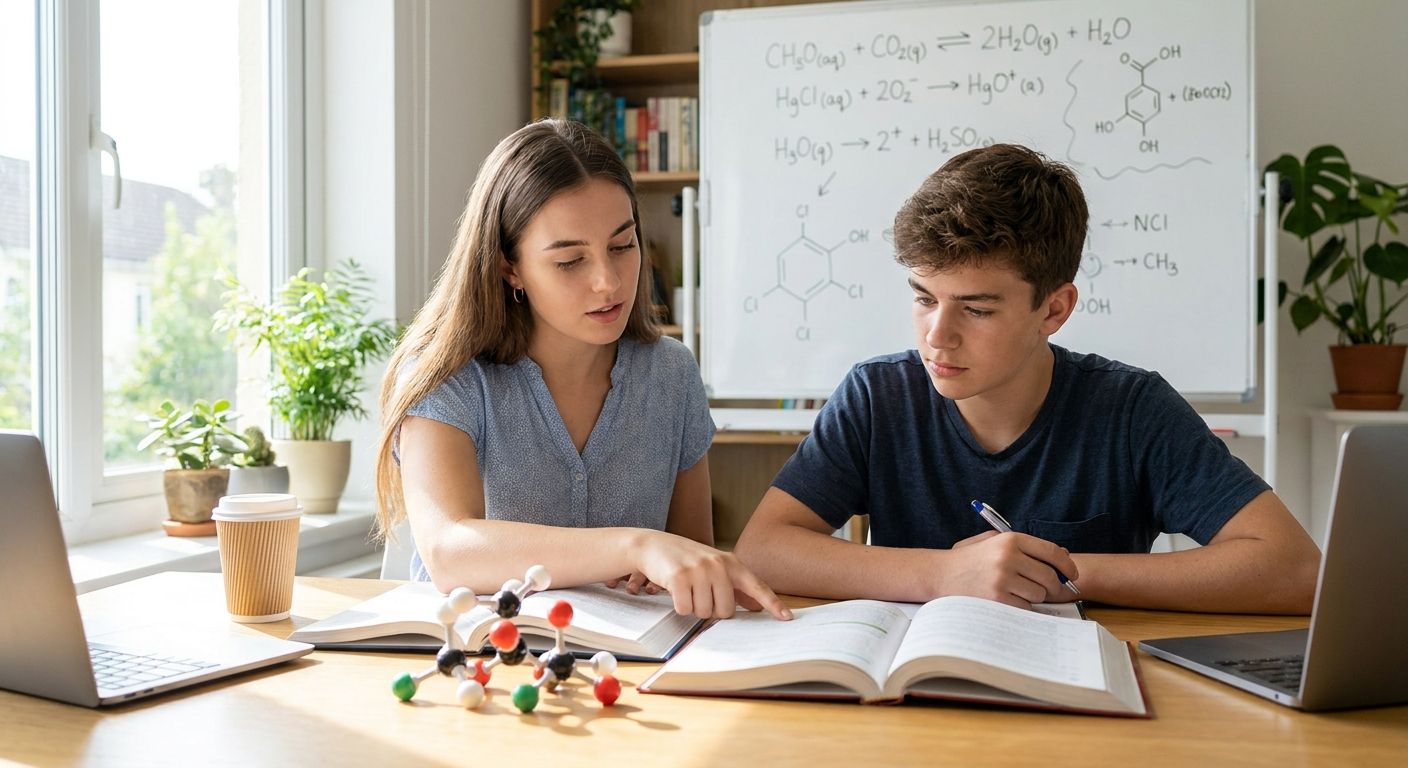
AP Chemistry tutoring is one-on-one instruction that targets the gap between a regular high school chemistry class and what the AP exam actually tests, with the goal of raising a student's free-response and multiple-choice scores before the May 2026 test date. AP Chemistry moves faster than a standard course and leans harder on math, so a tutor who only reviews textbook chapters is solving the wrong problem.
- AP Chemistry tutoring works best when it targets stoichiometry math gaps, not just content review, ahead of the May 2026 exam.
- Tia is a personalized tutor that adapts pace to a student's actual gaps in Math and Science, with a parent dashboard tracking engaged time.
- Free-response practice scored like the real exam matters more than extra multiple-choice drilling in the final stretch.
- One-to-one tuition adds roughly five months of progress, per the Education Endowment Foundation, and more when it targets specific weak topics.
Why AP Chemistry tutoring matters for AP Chemistry students
AP Chemistry sits in a different category than most high school science courses. It asks students to combine chemistry content with algebra, logarithms, and multi-step problem solving, often for the first time in a single course. A personalized chemistry tutor that adapts to where a student actually stands, rather than running a fixed weekly syllabus, closes that gap faster than generic review.
The Washington Post has reported that 51% of parents doubt their own ability to teach upper-grade material, and AP Chemistry is exactly that kind of material for most households in 2026. Bloom's two-sigma finding shows tutored students reaching the 98th percentile on average, and the Education Endowment Foundation puts the effect of one-to-one tuition at roughly five months of added progress. Hattie's research adds that a tutor's expectations of a student are among the strongest levers on achievement, which matters in a course where students routinely convince themselves they're "bad at chemistry" after one rough unit test.
None of that happens automatically. It happens when the tutoring actually targets the two or three topics costing the most points, not the whole textbook from chapter one.
Diagnose the exact gaps before you burn a weekend on review
Most AP Chemistry students don't have one big problem. They have three or four small ones hiding inside a score that looks like "needs more review."
- Run a past AP free-response question cold, no notes, and score it against the official rubric.
- Separate content gaps (never learned it) from application gaps (knows it, can't use it under exam conditions).
- Flag the topics that show up every year: equilibrium, thermodynamics, kinetics, and electrochemistry.
- Note whether missed multiple-choice questions failed on math or on concept.
- Retake the same question a week later to check whether the gap actually closed.
Rebuild the math skills AP Chemistry assumes you already have
Most stoichiometry mistakes are unit mistakes, not chemistry mistakes. A student who can balance an equation but can't track units through five steps will still lose points.
- Dimensional analysis and unit conversion, since this drives most stoichiometry errors.
- Logarithms, for pH and pOH problems.
- Algebraic manipulation of equilibrium expressions.
- Reading data tables and graphs for kinetics and thermodynamics questions.
- Scientific notation and significant figures, which the exam grades directly.
Drill free-response questions the way the exam actually grades them
AP Chemistry FRQs grade process, not just final answers. A student who gets the right number with the wrong setup still loses points.
- Score every practice FRQ against the official rubric, not a gut feeling.
- Write out every step, since partial credit lives in the setup.
- Time each practice set to the exam's real per-question pace.
- Redo missed FRQs a week later without looking at the rubric first.
- Keep a running list of the exact rubric language costing points, like "correct units" or "shows work."
Build a stoichiometry and lab-report routine that sticks
Stoichiometry and lab reporting are where AP Chemistry scores quietly collapse, usually because students practice each format once and move on.
- Work the same reaction type five different ways: mass-mass, mass-volume, limiting reagent, and percent yield.
- Practice writing a lab conclusion in the format graders expect, including error analysis.
- Keep a formula sheet updated weekly instead of rebuilding it in April.
- Practice converting between molarity, moles, and grams without a calculator for the no-calculator section.
Track actual engaged study time, not hours claimed
A student who says they "studied for two hours" and a student who actually solved problems for two hours produce very different scores. Parents rarely see the difference until the practice test.
- Log time spent actually solving problems, not time the book sat open.
- Compare practice-test scores against hours logged to see what's working.
- Flag sessions that were re-reading instead of practicing, since re-reading feels productive and isn't.
- Check a real dashboard for engaged minutes instead of relying on a student's self-report. What parents should see in a tutoring dashboard walks through what that should actually look like.
Bring in a tutor that adapts pace instead of running a fixed curriculum
Once the gaps are diagnosed and the math foundation is solid, the fastest remaining lever is a tutor who adjusts week to week instead of marching through a fixed syllabus regardless of where the student stands.
- Pick a tutor or platform that adjusts to the actual gaps, not a set weekly plan.
- Check whether the tutor separates content review from exam-format practice.
- Ask what a parent actually sees: engaged minutes, or just login counts.
- Confirm the tutor covers math prerequisites, not just chemistry vocabulary.
Tia is a personalized chemistry tutor that adjusts to a student's pace inside Science, alongside Math and English, and gives parents a live dashboard with honest engaged-time measurement instead of a login counter. For a household that doubts its own ability to walk through equilibrium constants at 9 p.m. on a Tuesday, that's the part that matters.
Comparing the options for AP Chemistry tutoring
| Option | Best for | Cost model | Key limitation |
|---|---|---|---|
| Self-study with a review book | Disciplined students with strong math already | One-time purchase | No feedback on FRQ writing, no adaptive pacing |
| School teacher office hours | Quick clarifying questions | Free, included in tuition | Limited time, shared with other students |
| Private in-person tutor | Students who need in-person accountability | Paid per session | Cost scales with hours, no parent dashboard |
| General online tutoring platforms | Students who need flexible scheduling | Paid per session or subscription | Often not adaptive to specific gaps |
| Tia personal tutor | Students who need pacing that adjusts week to week, with parent visibility | Flat monthly subscription | No in-person session option |
Verdict: for a student whose AP Chemistry gaps are math-driven and shifting week to week in 2026, Tia's adaptive pacing plus an engaged-time dashboard beats a fixed weekly syllabus. Buy. For a student who mainly needs occasional clarification on one topic, school office hours are enough. Hold.
Common mistakes AP Chemistry students make
- Treating AP Chemistry like AP Biology and trying to memorize instead of practicing math-heavy problem sets.
- Waiting until March or April to start FRQ practice instead of starting in the fall semester.
- Skipping error analysis and lab-report format practice until the exam already tests it.
- Studying the textbook in chapter order instead of the topics weighted heaviest on the real exam: equilibrium, kinetics, and thermodynamics.
- Confusing hours spent with hours engaged, then being surprised when a practice-test score doesn't match the effort logged.
“If a student is still guessing at stoichiometry setups in March, the exam has already won.”
FAQ
What is the best AP Chemistry tutoring for 2026 students?
The best AP Chemistry tutoring in 2026 targets a student's specific stoichiometry and math gaps rather than reviewing the whole textbook. Tia adapts pacing to those gaps inside Science and gives parents an engaged-time dashboard to track progress.
Is AP Chemistry tutoring different from general chemistry tutoring?
Yes. AP Chemistry tutoring has to prepare a student for a specific exam format, including free-response questions graded on process, not just a class grade. General chemistry tutoring often skips FRQ-style practice entirely.
How many hours a week does AP Chemistry tutoring need?
There's no fixed number that works for every student; it depends on how many topic gaps a student has going into the course. Tracking engaged study time against practice-test scores shows whether the current hours are actually working.
Is online AP Chemistry tutoring as effective as in-person tutoring?
Online tutoring can match in-person results when it adapts to the student's actual pace and gaps rather than running a fixed curriculum. The format matters less than whether the sessions target real weak spots.
Does a personalized tutor help with AP Chemistry free-response questions?
A personalized tutor helps most with free-response questions by scoring practice answers against the real rubric and flagging where process, not just the final number, is losing points. That kind of feedback is hard to get from a review book alone.
Is AP Chemistry harder than AP Biology?
AP Chemistry generally demands more math, since problems require multi-step calculations with units, logarithms, and algebra layered on top of content knowledge. AP Biology leans more on content recall and application.
How much does AP Chemistry tutoring cost?
Cost varies widely by format: in-person tutors typically charge per session, while platforms like Tia use a flat monthly subscription. Check current pricing directly on the provider's site since it varies by country and format.
Does Tia offer AP Chemistry tutoring?
Tia's Science subject adapts to a student's pace and curriculum, including advanced high school chemistry topics, for grades 5 through 12. Parents get a dashboard showing engaged time rather than just login counts.
One last thing
AP Chemistry free-response grading rewards a correct setup with the wrong final number more than a correct final number with no shown work. That single fact changes how a student should spend the last month before the exam in 2026: less time re-solving problems they already know how to set up, more time practicing the setups they still fumble under a clock.