Tia News
How to prepare for a chemistry exam
How to prepare for a chemistry exam: start 10 to 14 days out, drill every reaction and calculation type, and take one timed practice test 3 to 4 days before. 14-day free trial, no card needed.
By Tia Education Team · Published · Last updated
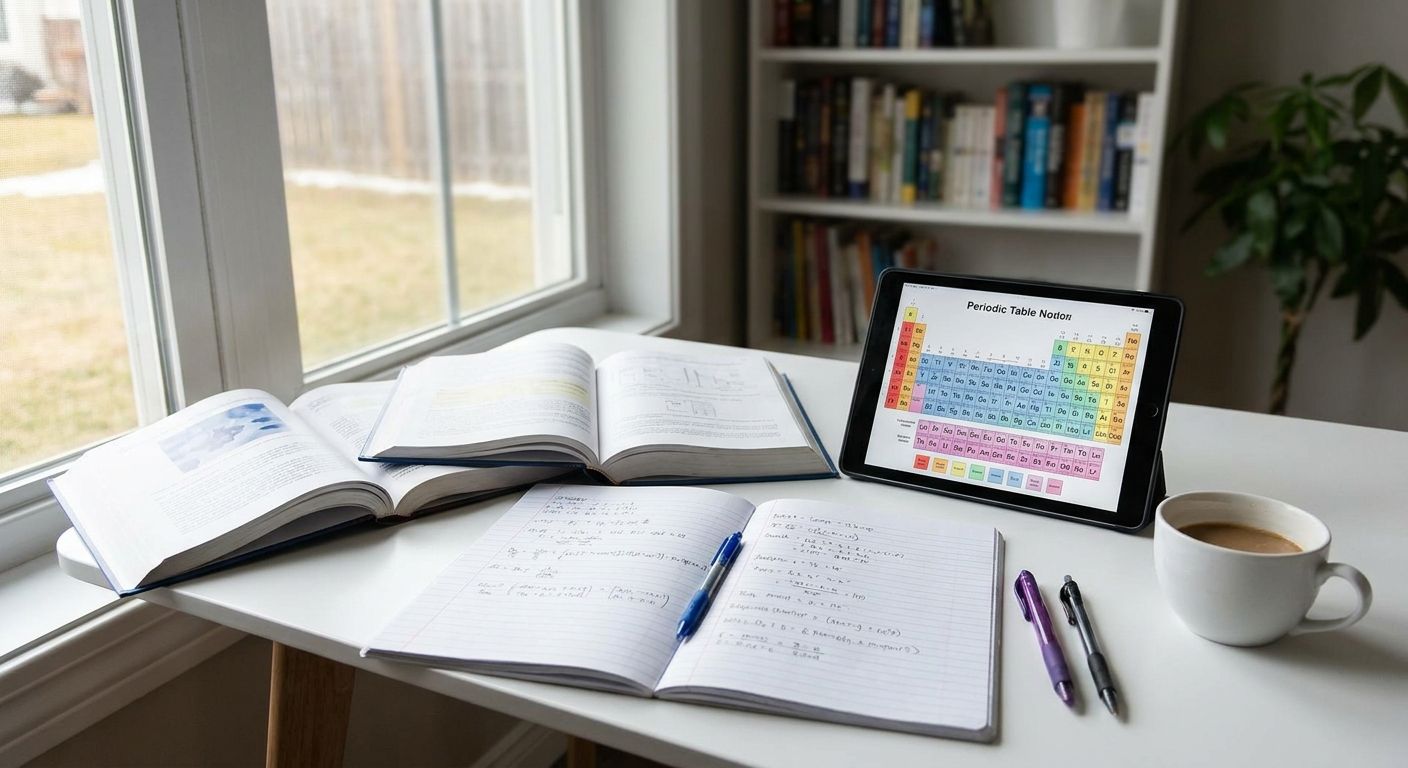
Chemistry exams reward preparation, not last-minute cramming. The students who walk in confident in 2026 spent the two weeks before the test working practice problems, not just rereading notes, and they built a one-page reference sheet instead of trying to memorize an entire textbook.
- Preparing for a chemistry exam works best when review starts 10 to 14 days out, not the night before.
- Practice problems beat rereading notes because chemistry exams test application, not recall.
- Unit conversions and significant figures cost more points than actual concept gaps.
- A full timed practice test 3 to 4 days before the exam exposes weak spots while there is still time to fix them.
- Tia's personalized science tutor for chemistry students adjusts practice to whatever topic a student is missing.
Why this matters
Chemistry is cumulative. A student who never locked down stoichiometry in September cannot solve an equilibrium problem in November, because the second concept sits directly on top of the first. That is why cramming works worse for chemistry than for subjects built on discrete facts: you cannot memorize your way past a gap two units back.
Parents often see the grade drop before they see the cause. A personalized science tutor for chemistry students can pinpoint exactly which earlier unit is causing the current struggle, instead of re-teaching the whole course from scratch. That is a faster fix than another round of flashcards.
How to Prepare for a Chemistry Exam
The fastest path to a strong chemistry exam score follows six steps, in this order:
- Map the exam blueprint. List every unit, reaction type and calculation the test will cover before opening a single practice problem. Guessing what is on the exam wastes review time on material that will not appear.
- Build a 10 to 14 day review calendar. Start with the oldest material first, since that is what fades fastest, and end with the most recent unit.
- Work practice problems for every reaction and calculation type. Rereading a solved example teaches recognition, not the ability to solve a new version of the same problem under exam pressure.
- Condense one formula and reference sheet. Writing it out by hand, even if the exam does not allow it, forces active recall of exactly what is fuzzy.
- Take one full timed practice test, 3 to 4 days before the exam. This is the single best predictor of where points will actually be lost.
- Redo every missed problem from scratch, not just review the correct answer. Recognizing the right answer and being able to produce it are two different skills, and chemistry exams test the second one.
A student following this plan through the full 2026 school year builds the habit once and reuses it for every exam after, not just the next one.
Why chemistry exams are harder to prep for than other subjects
- Material is cumulative, so a gap from an earlier unit resurfaces on every later test.
- Unit conversions and significant figures are graded strictly and cost points even when the chemistry reasoning is correct.
- Multi-step stoichiometry problems require holding several conversions in sequence, and one wrong step early on collapses the whole answer.
- Lab-based questions test procedural memory, not just formulas, which flashcards do not cover.
- Chemical notation looks similar across reaction types, so misreading a subscript or coefficient produces a confidently wrong answer.
- Time pressure on calculation-heavy sections punishes students who can solve a problem correctly but too slowly.
“If you cannot solve a problem without your notes, you have not studied it, you have reviewed it.”
A homework routine that actually works outside exam season makes this kind of review easier, because the daily habit of doing problems, not just reading assignments, is already built in by the time exam prep starts.
How many days before a chemistry exam should you start studying?
Start studying 10 to 14 days before a chemistry exam, since that is enough time to review cumulative material without cramming any single unit. Less than a week leaves no room to fix a gap once a practice test reveals it. Students preparing for a final rather than a unit test should extend that window to three weeks, since finals typically cover four to six units instead of one or two.
Is it better to memorize equations or practice problems for chemistry?
Practice problems beat memorization for chemistry exams, because most questions test whether a student can apply a formula to a new scenario, not recite it. Memorizing an equation without practicing its use is like memorizing a grammar rule without ever writing a sentence: it does not transfer to the test. Formula sheets still matter, but only as a support for problem-solving, not a replacement for it.
Students who need the same structure for math finals can reuse the plan in the guide to preparing for the Algebra 1 final exam, since both subjects reward timed practice over passive review.
What is the fastest way to fix a weak chemistry grade before finals?
The fastest fix is a diagnostic practice test, taken before any other review, to find the specific unit causing point loss. Reviewing everything equally wastes time on material the student already knows and under-covers the actual weak spot. A tutor who can identify that gap in one session moves faster than a student guessing at what to restudy alone.
Tia teaches Math, English and Science one-on-one to students in grades 5 to 12, and the parent dashboard shows engaged time on chemistry specifically, not just minutes logged. Tia is best for parents who want to see which chemistry topic is actually stalling their student before the next exam, without booking a weekly in-person session. The honest tradeoff: Tia works at the student's pace on their own schedule, so a student who will not sit down without a scheduled appointment may still need the accountability of a fixed lesson time.
FAQ
What is the best way to study for a chemistry exam?
The best way to study for a chemistry exam is a 10 to 14 day calendar built around practice problems, not rereading notes. Add one full timed practice test 3 to 4 days before the exam to catch weak spots while there is still time to fix them.
How many days before a chemistry exam should you start studying?
Start 10 to 14 days before a chemistry exam for a unit test, or three weeks before a cumulative final. Chemistry builds concept on concept, so a shorter window does not leave time to fix a gap from an earlier unit.
Is it better to memorize or practice problems for chemistry?
Practice problems matter more than memorization for chemistry exams, since most questions test application rather than recall. A formula sheet supports problem-solving practice, but it does not replace it.
What causes students to lose the most points on chemistry exams?
Unit conversions and significant figures cause the most lost points on chemistry exams, even when the underlying chemistry reasoning is correct. Multi-step stoichiometry problems are the second biggest source, since one wrong step early collapses the full answer.
How do you prepare for a chemistry final versus a unit test?
Preparing for a chemistry final takes about three weeks because it covers four to six units, versus 10 to 14 days for a single-unit test. Start with the oldest material first in both cases, since that is what fades fastest.
Can a tutor help with last-minute chemistry exam prep?
A tutor can help with last-minute chemistry exam prep by running a quick diagnostic to find the exact unit causing point loss, instead of reviewing everything equally. That is faster than a student guessing which topic to restudy alone.
What is the best way to review for a chemistry exam in one week?
With one week left, skip broad review and go straight to a timed practice test to find the two or three weakest topics. Spend the remaining days working new problems only in those areas, not rereading the whole unit.
Does one-on-one help actually improve chemistry exam scores?
The Education Endowment Foundation found that one-to-one tuition adds roughly five months of progress compared to no additional support. For a cumulative subject like chemistry, that gap often comes from fixing one earlier unit that never fully clicked.
One last thing
Most students studying for a chemistry exam in 2026 lose points to unit conversions and significant figures, not to concept gaps. Before the next practice test, count how many wrong answers came from a conversion error versus a real misunderstanding of the reaction or formula. The split usually surprises parents: the fix is often a habit, not a reteach.
That is also the cheapest fix available in 2026. A student who tightens conversion discipline over two weeks can pick up points across every remaining chemistry exam this year, without relearning a single concept.