Tia News
AP Calculus Tutoring 2026: Verdict and Study Plan
AP Calculus tutoring in 2026: what actually raises the score, a 7-step study plan, cost comparison and the mistakes that cost students the most points.
By Tia Education Team · Published
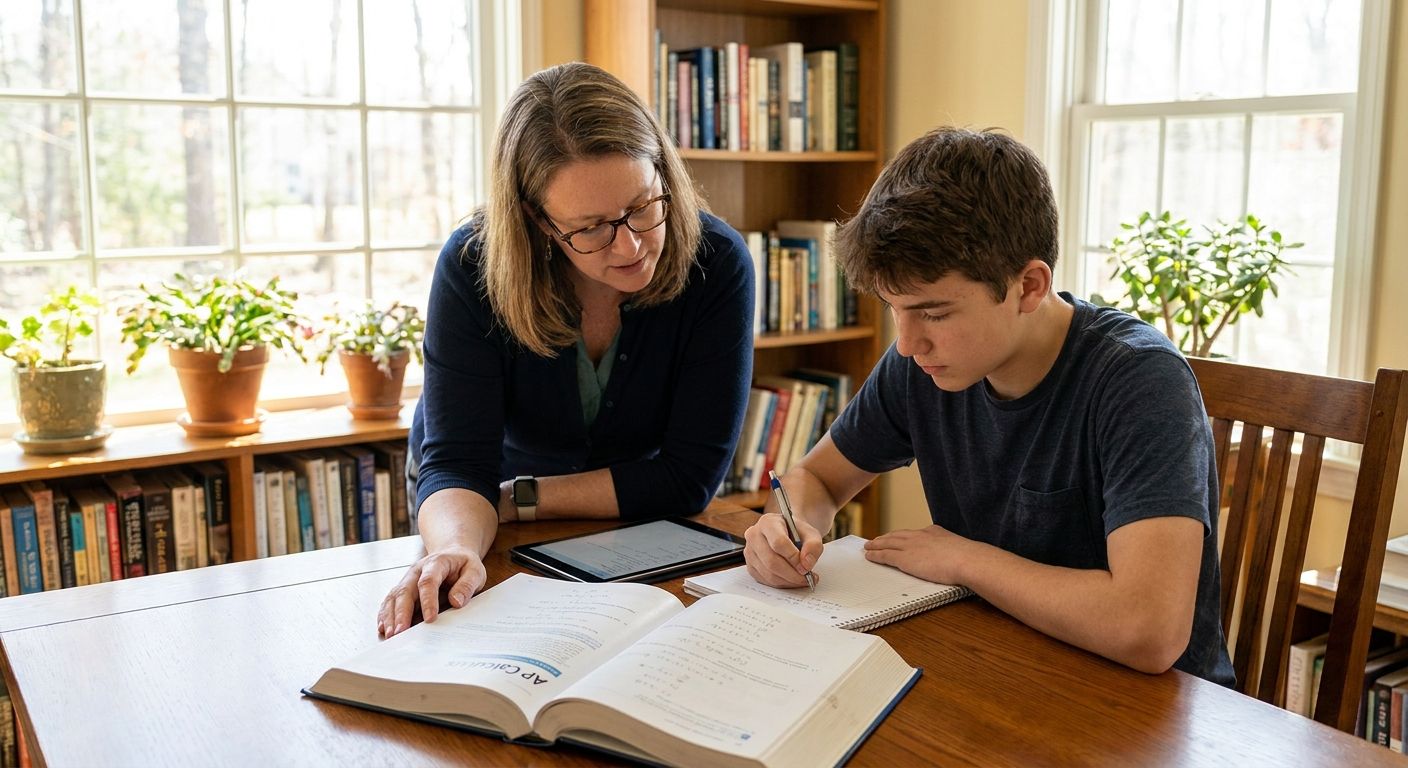
AP Calculus tutoring for a specific student means one-on-one instruction built around that student's pace, gaps and confidence level, aimed at a 3 or higher on the AP Calculus AB or BC exam in May 2026. AP Calculus students face a different problem than students in earlier math courses: they can follow a concept in class and still lose points on the free-response section, because the exam grades reasoning and justification, not just the final number.
- AP Calculus tutoring works best when it targets the exact concept a student missed, not a generic review of the whole unit.
- Free-response justification writing, not the calculus itself, is where most AP Calculus students lose points.
- Tia offers personalized tutoring for AP Calculus at USD $14.99 per subject or a $34.99 monthly bundle, with a 14-day free trial, no card needed.
- A live dashboard that tracks engaged study time matters more than a log of completed assignments.
Why AP Calculus tutoring matters for AP Calculus students
Benjamin Bloom's two-sigma research found that the average student who received one-to-one tutoring reached the 98th percentile of students taught in a conventional classroom. The Education Endowment Foundation's review of one-to-one tuition found it adds roughly five months of extra progress compared to standard instruction. AP Calculus is exactly the kind of course where that gap shows up: a 30-student class moves at one pace, but the exam tests each student's own reasoning under strict timing.
A Washington Post analysis found that 51% of parents doubt their own ability to teach upper-grade material, and AP Calculus sits near the top of that list for most families. That's not a knock on the parent. It's a reason a personal tutor that adapts to the exact concept a student is stuck on, rather than re-teaching the whole unit, closes the gap faster than a textbook chapter reread at home.
Build an AP Calculus tutoring plan that actually moves the score
Diagnose the exact gap before you start
Start with data, not a guess. Most AP Calculus students think they're weak at "derivatives" when the real gap is one specific rule, like the chain rule inside a related-rates problem.
- Pull the last three unit test scores and sort misses by topic, not by date
- List every free-response question type missed on practice sets
- Ask the classroom teacher which specific standard shows up as weak
- Check whether the gap traces back to pre-calculus tutoring content, like function transformations or trig identities
Build a calendar around the May 2026 exam date
AP Calculus AB and BC exams run in early May 2026. Count backward from that date and block weekly review sessions instead of cramming in April.
- Use the College Board's free official course and exam description as the syllabus map
- Schedule one full timed practice exam per month starting in January 2026
- Mark unit test dates from the school calendar as checkpoints
- Set aside extra weeks in March 2026 for cumulative review, not new content
Drill the free-response format every week
Free-response questions are worth half the AP Calculus score, and they're graded on justification, not just the final answer.
- Grade your own work against the College Board's published scoring guidelines
- Rewrite every justification in full sentences, not shorthand
- Time each free-response set the way the real exam times it
- Compare your wording against a released scoring rubric line by line
Get help on the concept you're stuck on, not a generic review
Once the diagnosis is clear, a full re-teach of the unit wastes time. This is where a personal tutor earns its place in the plan.
- Bring the exact missed problem to the session, not the whole chapter
- Ask for the reasoning behind the rule, not just the formula
- Use a personal tutor like Tia that adapts Math instruction to a student's pace and interests, rather than a fixed script
- Revisit the same concept a second time a week later to confirm it actually stuck
Track engaged time, not just completed assignments
A checklist of "finished" assignments hides whether a student actually worked or stalled out. Engaged time is the honest measure.
- Check minutes actually spent working, not minutes the app was open
- Compare unit test scores against logged study hours
- Review a tutoring dashboard after every session instead of waiting for a report card
- Flag any week where engaged time drops sharply before it becomes a pattern
Review the reasoning behind every multiple-choice answer
Section I of the AP Calculus exam runs 105 minutes across calculator and no-calculator multiple choice. Getting the letter right by luck doesn't transfer to the free-response section.
- Work backward from wrong answers to find the specific error
- Separate calculator mistakes from concept mistakes
- Re-solve missed problems without shortcuts or elimination tricks
- Note which no-calculator problems took longer than two minutes
Simulate full exam conditions before test day
Section II adds 90 minutes of free-response on top of Section I's 105 minutes, for roughly three hours and 15 minutes total. A student who has never sat through that full stretch will run out of stamina before running out of time.
- Take one full released exam under real timing, start to finish
- Grade the free-response half using the actual scoring rubric
- Note where pacing broke down by section
- Repeat the full simulation once more within two weeks of the exam
Comparing AP Calculus tutoring options
| Option | Best for | Cost model | Key limitation |
|---|---|---|---|
| College Board official practice exams | disciplined self-starters who already grasp precalculus | Free | No feedback on a student's specific errors |
| AP Calculus class alone | students who learn well at a fixed class pace | Included in school tuition | Pace is set by the class, not by where a student is stuck |
| Traditional in-person tutor | students who want a fixed weekly session | Hourly rate, varies by tutor and market | No live dashboard, session lost if the tutor is unavailable |
| Tia, personal tutor for Math, English and Science | students who need help on the exact concept, on their own schedule | USD $14.99 per subject or $34.99 monthly bundle | Not a substitute for in-person lab work or peer study groups |
Verdict: for a student who already sits in an AP Calculus class but keeps losing points on the same type of problem, a personal tutor that adapts to that specific gap is worth adding; for a student who just needs more repetition, free College Board practice exams cover it.
Try personalized AP Calculus tutoring
Adaptive Math help plus a live parent dashboard. 14-day free trial, no card needed.
Common mistakes AP Calculus students make
- Memorizing formulas instead of practicing justification writing. The free-response section grades the reasoning in full sentences, not just the derivative or integral itself.
- Waiting until March 2026 to start review. Five months of steady one-to-one progress, per the Education Endowment Foundation, needs runway; a six-week cram doesn't replicate that.
- Studying only multiple choice and skipping free response. That's half the exam score left on the table.
- Mixing AB and BC problem sets. BC covers series and parametric equations that AB students never see, and studying the wrong set wastes real hours.
- Using textbook problems instead of released exams. Textbook wording rarely matches the College Board's actual rubric language, so practice scores look better than real ones.
FAQ
What's the best way to study for AP Calculus in 2026?
The best approach combines weekly free-response drills graded against the College Board's actual rubric with targeted help on the specific concept a student keeps missing, rather than a full re-teach of every unit. Full timed practice exams starting several months before the May 2026 test date build the stamina Section I and Section II both require.
How much does AP Calculus tutoring cost?
Tia prices AP Calculus tutoring at USD $14.99 per subject, or USD $34.99 for a monthly bundle covering Math, English and Science, with an annual bundle at USD $384.89. A 14-day free trial is available with no card needed.
Is personalized tutoring better than a tutoring center for AP Calculus?
It depends on the gap: a tutoring center works well for students who want a fixed weekly session, while personalized tutoring works better for students who need help on one specific recurring error. Bloom's two-sigma research found tutored students reached the 98th percentile compared to conventional classroom instruction.
When should a student start AP Calculus tutoring before the exam?
Starting review in January 2026 for a May 2026 exam gives enough time for one full practice exam per month plus weekly free-response drills. Starting in March 2026 or later leaves too little runway to fix reasoning gaps that took a semester to form.
Can a tutor help with both AP Calculus AB and BC?
Yes, but the content differs: BC adds series, parametric equations and polar functions that AB does not cover, so a tutor needs to match materials to the exact course a student is enrolled in.
How is Tia different from a traditional AP Calculus tutor?
Tia is a personal tutor that adapts to a student's pace and interests across Math, English and Science, and gives parents a live dashboard with honest engaged-time measurement instead of a static progress report. A traditional tutor works on a fixed weekly schedule without that kind of ongoing visibility.
Does AP Calculus tutoring help with the free-response questions specifically?
It should, since free-response questions make up half the exam score and are graded on written justification, not just the final answer. Tutoring that only reviews multiple choice misses that half of the test entirely.
One last thing
Most AP Calculus students who plateau aren't weak at calculus: they're weak at explaining calculus in words, which is exactly what Section II grades. Spend the last month before the May 2026 exam writing out full justifications for every free-response answer, even the ones you get right, and read them back like a grader would.