Tia News
How long does it take to improve a math grade with weekly tutoring?
How long to improve math grade with tutoring depends on skills and assessments. Track independent progress and know when to adjust weekly lessons.
By Tia Education Team · Published

Weekly tutoring has no fixed timetable for improving a math grade: the timing depends on the skills your student needs to rebuild and when the school assesses those skills. If you are checking the gradebook after every lesson, separate progress in understanding from a change in the course average. A clearer explanation or an independently solved problem is evidence to examine, but neither guarantees a higher grade on a particular date.
- How long to improve math grade with tutoring depends on learning gaps, independent practice, and school assessments.
- Tia math tutoring fits families seeking adaptive explanations and curriculum-linked mastery records, not a promised grade-change deadline.
- Track independent problem-solving alongside the gradebook; completed homework alone does not establish understanding.
- Use weekly tutoring to choose a clear skill target, then revisit that skill between lessons.
How long does it take to improve a math grade with weekly tutoring?
Use the next relevant assessment as a checkpoint, not a guaranteed deadline. First identify what is lowering the grade, then connect tutoring to the skills that assessment will measure.
For your 2026 tutoring plan, follow this sequence:
- Identify the grade problem. Separate incorrect answers, incomplete assignments, missing work, and difficulty showing mathematical reasoning.
- Choose a skill target. Replace a broad goal such as getting better at algebra with a specific task, such as solving equations with negative numbers.
- Check independent work. Ask your student to attempt a different problem without hints after the explanation.
- Connect learning to assessment. Compare the skill being practiced with the next quiz, test, or graded assignment.
- Review the evidence. Examine new work and the gradebook together before deciding whether the plan needs changing.
The broader question of how long it takes to see results from tutoring includes changes beyond grades. This page focuses on the narrower question: when improved math understanding becomes visible in assessed work.
Why this matters
You are not asking for a date because you expect instant results. You want to know whether the time and effort are helping.
A course average cannot answer that question alone. It combines assessed work under the school's grading rules, while tutoring addresses the student's current understanding. Keep both views: what your student can do now and what the school has recorded.
That distinction also gives your student a fairer conversation. Instead of asking why the grade has not moved, ask which part of the work they can now complete without help.
Which signs of progress should you look for first?
Look for evidence that matches the goal. Feeling more comfortable asking questions matters, but it is different from solving an unfamiliar problem independently.
Use this comparison when reviewing your student's work in 2026:
| Progress signal | What it shows | What it does not establish |
|---|---|---|
| Explaining a worked example | The student can describe the demonstrated reasoning | Independent use on a different problem |
| Solving a similar problem without hints | Independent performance on that task | Understanding across the whole unit |
| Choosing a method in mixed practice | The student can distinguish between problem types | A guaranteed result under test conditions |
| Improving on relevant graded work | Better performance on that assessment | A guaranteed change in the course average |
| A higher course grade | Improvement under the school's grading rules | Mastery of every underlying skill |
Do not turn these signals into a rigid ladder. A student can explain an idea clearly and still make calculation errors. Another student can calculate accurately but struggle to decide which operation a word problem requires.
Ask the tutor to name the evidence behind each progress update. A statement such as understands fractions should connect to work your student completed, not just a lesson they attended.
What should happen during weekly math tutoring?
A weekly lesson should leave you with a clearer target, not just a finished assignment. Ask how the tutor checks the student's starting point, responds to errors, and tests understanding after teaching.
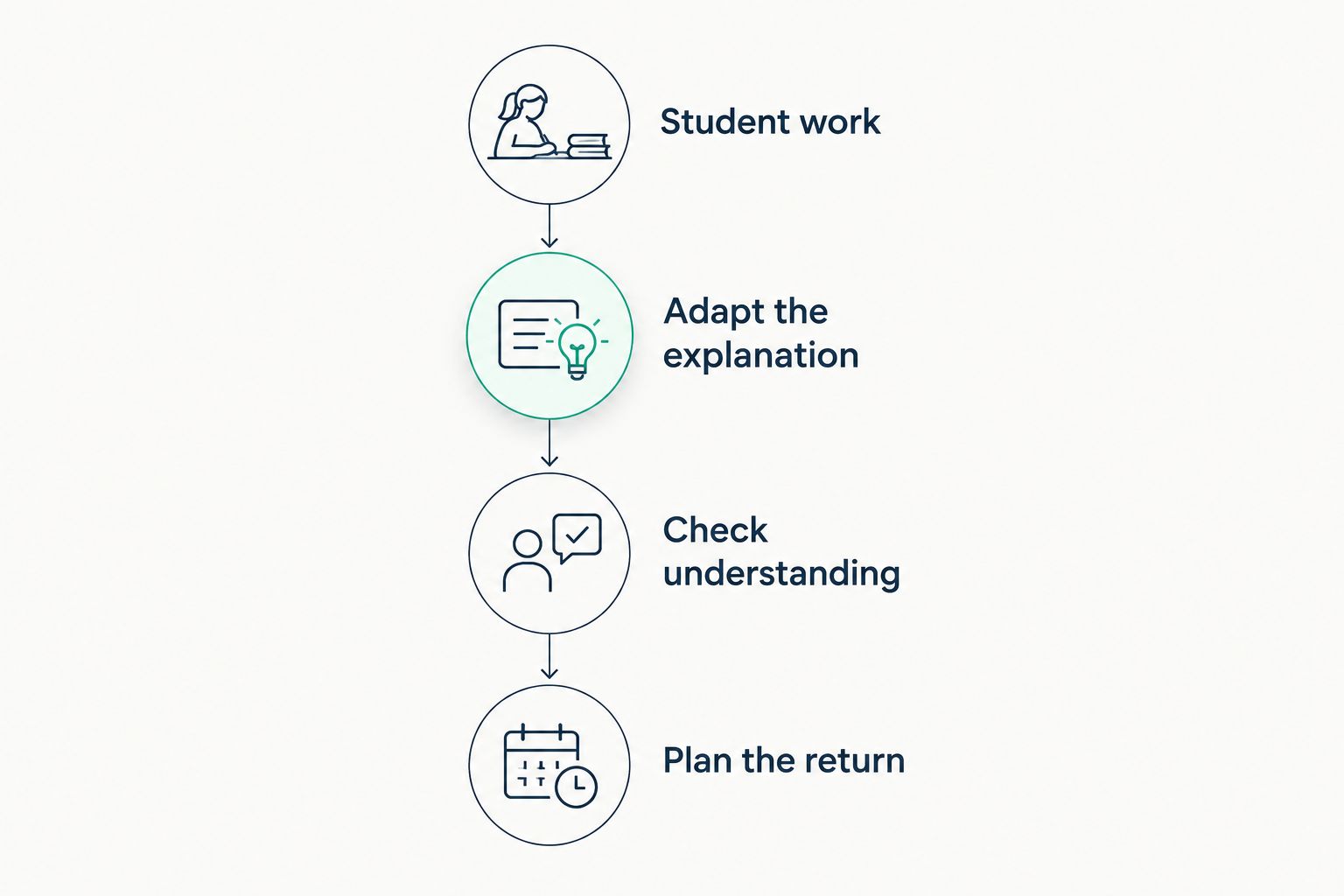
Start with student work
Bring a recent quiz, assignment, or teacher comment. Let your student explain where the work stopped making sense before an adult supplies the explanation.
The goal is to identify the obstacle accurately. An incorrect equation can reflect a misunderstanding of equality, a negative-number error, or a copied expression. Those problems call for different teaching.
Adapt the explanation
Ask for a different explanation when the original approach does not connect. That might mean drawing a model, using a familiar interest, or returning to a prerequisite concept.
Changing the explanation is not the same as lowering the goal. The student still needs to understand the mathematics and do the thinking.
Check understanding
After guided work, ask your student to try a different example without the same prompts. Have them explain why the method fits, rather than simply repeat the procedure.
Record the type of help required. A correct answer reached through repeated hints is different evidence from a correct answer reached independently.
Plan the return
Finish by identifying what to revisit before the next lesson. Keep the task connected to the skill just taught rather than adding unrelated worksheets.
If a long practice block does not fit your student, consider a focused session of 10 minutes a day. Treat that duration as a practical option, not a promise of a particular grade improvement.
Why the time to improve a math grade varies
For a 2026 progress review, discuss these factors with the tutor and, where appropriate, the classroom teacher:
- Starting knowledge. Determine whether the current topic requires rebuilding earlier skills before tackling the assessed work.
- Independent practice. Record whether your student can use the method between lessons without someone directing each step.
- Curriculum alignment. Check that tutoring addresses the concepts and methods relevant to the student's current course.
- Assessment timing. Identify when the school will next grade work that includes the targeted skill.
- Grading rules. Ask how tests, assignments, missing work, and reassessments contribute to the course grade.
- Teaching fit. Check whether the explanation, pace, and participation format let your student engage with the mathematics.
These factors give you questions to answer, not reasons to blame your student. If the evidence is unclear, narrow the target and ask for a more specific progress update.
How do you tell whether the plan needs changing?
Change the part of the plan that the evidence identifies. Do not automatically add more tutoring time because the course average is unchanged.
If your student still cannot explain the concept, revisit the explanation or prerequisite knowledge. If they understand during the lesson but cannot start alone, focus on choosing a first step without prompts.
If independent work is improving but graded work is not, compare the demands. Does the assessment require written reasoning, mixed topics, unfamiliar wording, or a different method? Bring an actual example to the tutor rather than guessing.
For your 2026 review, keep a brief record containing the target skill, a sample of independent work, the help required, and the next relevant assessment. Include your student's account of what feels clearer and what remains confusing.
This record also makes a conversation with the teacher more precise. You can ask about a particular difficulty instead of asking whether tutoring is working in general.
Can homework improve without the math grade improving?
Yes. Completed homework shows that work was submitted, but the amount of help involved determines what it tells you about understanding.
Separate assisted work from independent work in your progress notes. Both have a place in learning, but they should not be treated as interchangeable evidence.
For exam preparation, AI-assisted exam practice belongs under the same rule: the student needs to attempt the reasoning rather than collect finished answers. Keep the tool's response separate from the student's own attempt so you can see what still needs teaching.
Before a school assessment, ask your student to work through relevant problems without tutoring prompts. Review the reasoning afterward. That gives the next lesson a concrete starting point without turning every evening into a test.
Where does adaptive math tutoring fit?
Tia adapts to the student, not the other way around. Its math teaching adjusts explanations, pace, level, and examples to the student's context while staying aligned with curriculum goals.
Tia math tutoring is best for families seeking adaptive lessons with curriculum-linked mastery records. It serves students in Grades 5 to 12, and parents receive a live dashboard, engaged-time measurement, and self-writing records.
The progress information includes more than time spent. Tia measures mastery per question, maps it to the curriculum, and includes it in the report. Its Bayesian Knowledge Tracing method updates an estimate of skill mastery from student answers over time.
That estimate has limits. It is not an infallible measurement of everything a student knows, an independently verified exam-score gain, or a prediction of when a school grade will rise. Use the records alongside independent work and teacher feedback.
The same distinction applies to participation. Speaking through a problem or typing a question gives the student a way to engage, but you still need to check the mathematical reasoning. A convenient lesson format does not replace evidence of understanding.
Is weekly tutoring enough to improve a math grade?
Weekly tutoring is a schedule, not a guarantee of sufficient support. Judge the arrangement by whether your student receives appropriate teaching, revisits the target skill, and shows independent progress.
A weekly lesson gives the family a regular checkpoint. Its limitation is that questions and errors also arise between appointments, so decide how your student will handle those moments without simply copying a solution.
Before adding sessions, ask what additional time would address. More explanation, supported practice, and independent assessment are different needs. Name the need first, then choose the schedule.
Should you stop tutoring when the grade improves?
A higher grade is a reason to review support, not an automatic reason to stop. Check whether your student can retain the skill, recognize when to use it, and manage current classwork with less help.
Agree on what reduced support would look like. Your student should know how to ask for help again without treating that request as a setback.
FAQ
How long does it take for weekly tutoring to raise a math grade?
There is no fixed timetable for weekly tutoring to raise a math grade. Review independent skill progress alongside the next relevant assessment and the school's grading rules.
Can my student's understanding improve before the grade changes?
Yes, understanding and the course grade are different measures. Check whether your student can solve relevant problems independently, then compare that evidence with newly graded work.
Is 10 minutes of math practice a day enough?
10 minutes a day is an option for focused practice, not a guaranteed amount for improving a grade. Choose a clear skill and review what your student can do without help.
What should I ask the tutor after each weekly lesson?
Ask which skill the lesson targeted, what your student completed independently, and what needs revisiting. Request evidence from student work rather than relying only on lesson attendance.
Why is homework getting easier while test grades stay the same?
Easier homework does not establish independent test readiness. Compare the assistance used during homework with the reasoning, methods, and conditions required on the assessment.
Does Tia track math understanding or just lesson time?
Tia tracks question-level mastery mapped to the curriculum as well as engaged time. Its mastery estimate updates from student answers over time, but it is not a guaranteed school-grade prediction.
When should I talk to the math teacher about tutoring?
Talk to the math teacher when you need clarity on assessed skills, grading rules, or a mismatch between practice and classroom results. Bring specific student work and a clear question.
One last thing
Before the next lesson, write a more useful goal than raise the math grade: name something your student should be able to do without help. For your 2026 plan, let that observable skill guide the next step while the gradebook records assessed results.
You do not need to become the math tutor. You need a clear view of what is being taught, what your student can do, and what happens next.
Related guides
- How to make a 10-minute daily tutoring session count
- What parents should see in a tutoring dashboard
- How adaptive tutoring changes a lesson
Tia Education Team