Tia News
Getting started with voice tutoring in Grades 5 and 6
Voice tutoring grades 5 and 6 starts with student choice. Set one goal, switch between speech and text, and check understanding rather than session length.
By Tia Education Team · Published

Tia adapts to the student, not the other way around. If your fifth or sixth grader can explain a homework problem aloud but stalls at typing the question, voice tutoring offers another way to participate without giving up text, diagrams, or written work.
- For voice tutoring grades 5 and 6, start with one learning goal and let the student choose the format.
- Tia combines spoken explanations, text, curriculum-aligned teaching, and parent learning records.
- Keep paper nearby for fractions, diagrams, and written reasoning; speaking does not replace every learning task.
- Check understanding through student answers, not how long the conversation lasts.
Why voice tutoring matters for Grades 5 and 6
Voice tutoring for Grades 5 and 6 is spoken, two-way subject support that lets students ask questions and hear explanations while working toward a learning goal. It gives students another way to show their thinking when composing a typed question gets in the way.
You do not have to turn every homework session into a conversation. A student might want to talk through a science idea, type an unfamiliar term, and draw a math model on paper. Choose the format for the task, not a permanent label for the student.
Personalization also needs to reach beyond the microphone. The explanation, pace, level, and examples matter, as this guide to how adaptive tutoring changes a lesson explains.
Use this 2026 guide as a parent walkthrough, not a requirement to add more technology. Your job is to help the student begin, notice what supports participation, and leave the thinking to them. You stay in charge of the learning goals.
Start with a small, student-led routine
Your starting routine is simple: Choose a goal, Pick a format, Try a task, and Review learning. The steps below turn that routine into a first lesson without making you the tutor or the student’s spokesperson.
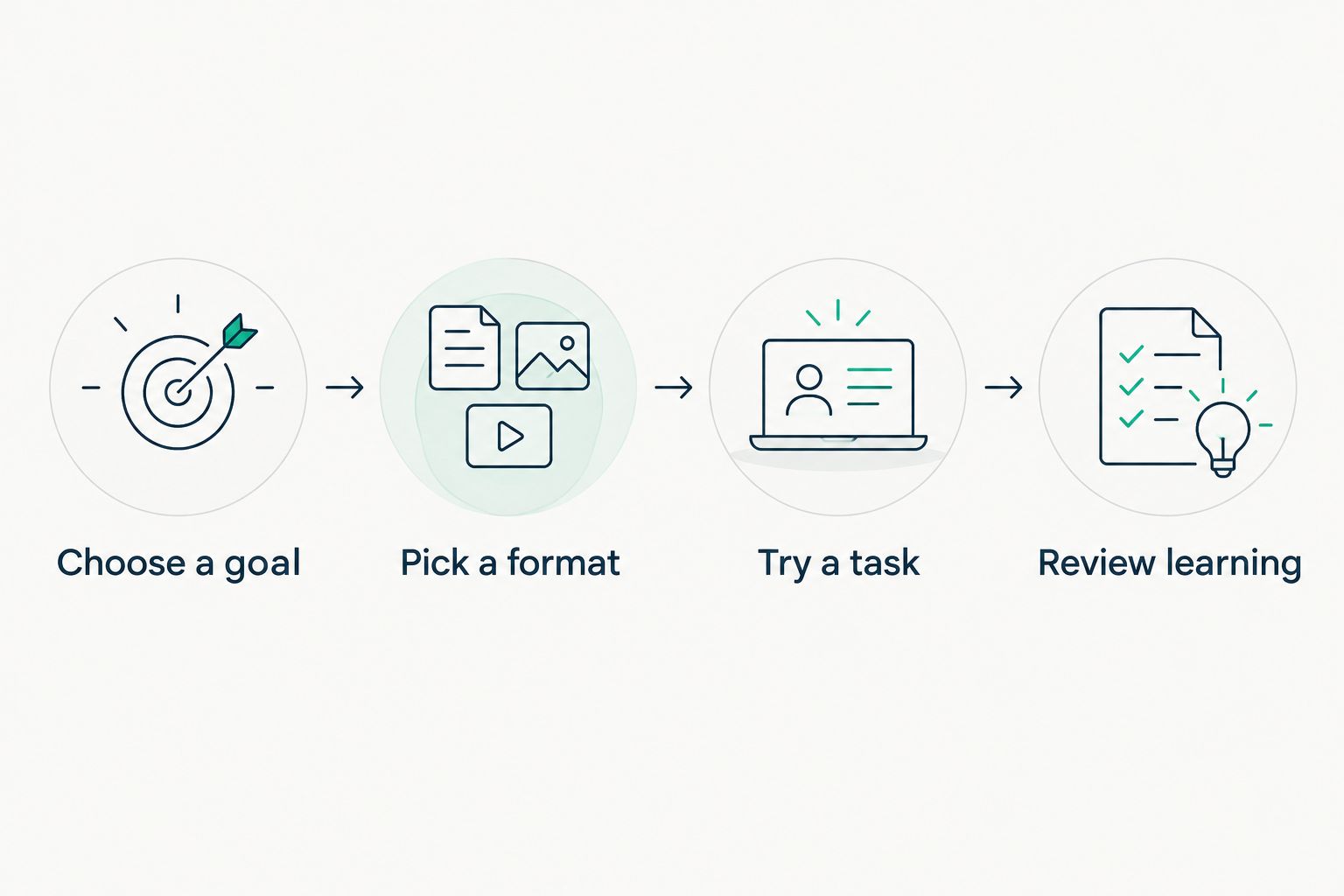
Choose one goal from the student’s current work
Start manually with the assignment, curriculum plan, or notebook you already have. Ask the student to point to the part that feels unclear. You do not need another resource before you know the question.
Make the goal smaller than “get better at math.” A useful first goal is explaining why two fractions need a common denominator, identifying evidence in a paragraph, or describing a science process in order.
For your 2026 learning plan, write the goal in ordinary language. Keep the curriculum topic beside it so an enjoyable conversation does not drift away from the intended learning. If the student cannot name the difficulty, begin with one example from their current work.
- Select one question or concept from the current lesson.
- Ask what the student already understands.
- Identify the exact point where the work stops making sense.
- Write a short goal you can revisit afterward.
Set up paper, space, and a real choice
Try a spoken explanation together before opening a tutoring session. Ask the student whether talking, typing, or combining both feels comfortable today. A preference yesterday does not have to become a rule today.
Keep a pencil and paper nearby. Voice can carry a question, but fractions, diagrams, spelling, and punctuation still need visible attention. Choose a place where speaking will not disturb someone else or make the student feel watched.
Offer a small starting window, such as 10 minutes, when that fits the student. That is a planning choice, not a promised dose for progress. End sooner if the task is complete, or agree on another stopping point if useful work is continuing.
- Put the current assignment and blank paper within reach.
- Let the student choose speech, text, or both.
- Ask whether they want you nearby for the opening exchange.
- Agree that changing formats is allowed.
- Choose a stopping point based on the task and the student.
Introduce personalized support without taking over
You can first help manually by asking the student to describe the confusing step. Avoid supplying the answer while they are still forming the question. A short pause gives them room to decide what they need.
For ongoing support, Tia offers curriculum-aligned Math, English, and Science tutoring that adapts explanations to the student’s pace, level, and interests. Students can speak and hear verbal explanations, type, and switch between voice and text within the same lesson. Two-way voice is included in all bundle plans.
Tia is best for families seeking personalized voice tutoring with curriculum-aligned lessons and parent learning records. Its limitation matters too: a spoken lesson does not replace independent reading, written practice, or your judgment about whether the support fits.
- Begin with the current subject and learning goal.
- Invite the student to explain what is confusing.
- Mention an interest when it helps make the concept familiar.
- Ask for another explanation when the first does not connect.
- Keep the student responsible for attempting the work.
Help the student ask a useful first question
Build the first question together on paper if necessary. The student does not need a polished sentence. They need a clear starting point: the topic, what they tried, and where they got stuck.
For example, a student could ask why adding one-half and one-quarter does not mean adding both denominators. This is an illustrative question, not a recorded product exchange. The next useful move is to explain the idea, then let the student apply it.
If the student wants you to speak first, help with the opening and then step back. Do not turn the session into an adult conversation happening around them. Let the student correct the question if your wording misses what they meant.
- Name the topic before asking for help.
- Describe the attempted step, even if it was incorrect.
- Ask for an explanation rather than only the answer.
- Request a simpler example if the wording feels unfamiliar.
- Let the student ask the follow-up question.
Switch formats when the task changes
Start with the simplest manual check: ask whether the student needs to hear something, see something, or write something down. These are choices about the current task, not fixed learning styles.
In math, a student can talk through why one-half plus one-quarter equals three-quarters while drawing the parts of a whole. In English, discussing an idea can come before writing a sentence. In Science, an oral explanation can sit alongside a labeled diagram.
Keep the learning goal intact when you change the format. If the goal is independent reading, hearing the passage is not the same practice. If the goal is writing a paragraph, speaking about it is preparation rather than the finished work.
- Use speech to explain a question or describe reasoning.
- Use text when exact wording needs attention.
- Keep diagrams and mathematical working visible.
- Return to writing when writing is the skill being practiced.
- Change formats without treating the switch as a setback.
Check understanding with a fresh attempt
You can check learning manually without creating another worksheet. Ask the student to try a related question, explain a choice, or show the idea with a drawing. Avoid repeating the explanation for them during the check.
A fluent conversation is not proof of understanding. Neither is a quiet session proof that nothing happened. Look for what the student can now do and where support is still needed.
Keep the check modest and specific. After working on equivalent fractions, for example, ask the student to represent the same amount another way and explain why it matches. If the student repeats a phrase but cannot use the idea, return to a concrete example rather than extending the conversation.
- Ask for a fresh example of the same concept.
- Invite the student to explain why an answer makes sense.
- Notice which steps still require prompting.
- Separate subject understanding from speaking confidence.
- Finish by naming one clear next step.
Review learning records and adjust the next session
Start with a brief parent note: the topic, what the student attempted independently, and what needs another look. That gives you a useful record even without a dashboard.
The parent dashboard adds engaged-time measurement, curriculum-linked mastery information, and self-writing homeschool records. Mastery tracking uses Bayesian Knowledge Tracing, an established method that updates an estimate of skill mastery from student answers over time.
Treat that estimate as information, not an infallible measure of everything a student knows. It is also different from independently verified exam-score gains. For your 2026 homeschool records, review the recorded learning alongside the student’s actual work and your local reporting requirements.
- Check the curriculum topic covered during the lesson.
- Review engaged time alongside answers and mastery information.
- Keep a relevant piece of written or drawn work.
- Ask which participation format felt useful.
- Plan the next session around the remaining question.
Compare your starting options
For a 2026 decision, compare how each option supports the task rather than assuming voice is automatically better. These are participation choices, not a ranking of students or a promise of different learning outcomes.
| Option | Best for | Main benefit | Key limitation |
|---|---|---|---|
| Parent-led spoken review | A first check before adding another resource | Uses the assignment and materials you already have | You remain responsible for explaining and checking the work |
| Tia with voice and text | Families seeking adaptive subject tutoring and parent records | Combines spoken participation, text, personalized explanations, and curriculum-linked mastery information | Does not replace independent reading, written practice, or parental judgment |
| Text-led tutoring | Students who prefer written questions and visible wording | Keeps attention on the words or notation being discussed | Composing the question remains part of the task |
| Paper-based practice | Written calculations, diagrams, and independent application | Makes the student’s working available for review | Does not provide a spoken explanation by itself |
Choose the smallest combination that answers the learning need. You do not have to move an entire subject into voice tutoring because one spoken exchange was useful. Equally, a student who prefers typing does not need persuading to talk.
Common mistakes parents make when starting voice tutoring
Treating voice as the next independence milestone
A fifth or sixth grader does not have to speak to prove confidence or maturity. Offer voice as an option, and accept a typed response without turning it into a negotiation. The goal is participation in learning, not performance for the adult nearby.
Letting spoken answers replace written math
A student can describe a method without recording enough working to check it. Keep calculations, fraction models, and diagrams on paper when the task needs them. Ask the student to connect what they said with what they wrote.
Answering before the student has time to respond
It is easy to hear a pause and step in. Agree beforehand that you will help with getting started, then give the student space to ask and answer. If they want help, ask whether they need support with the subject or with expressing the question.
Counting conversation length as progress
A longer discussion does not establish greater understanding. Check a related problem or explanation instead. Use engaged-time records as one part of the picture, alongside curriculum mastery information and the student’s work.
Expecting subject access to solve reading difficulties
Hearing an explanation can offer another route into a subject, but it is not independent reading practice. Keep reading and writing goals visible. Do not treat willingness to speak as evidence that a reading difficulty has been addressed.
FAQ
How do I start voice tutoring for a fifth or sixth grader?
Start with one question from the student’s current work and let the student choose whether to speak or type. Keep paper nearby and finish with a related task that checks understanding.
Can my student switch between voice and typing during a lesson?
Tia lets students switch between voice and text within the same lesson. Students can speak and hear verbal explanations while retaining the option to type.
Is voice tutoring better than typing for Grades 5 and 6?
Voice is not universally better than typing. Choose the format that helps the student participate in the current task, and keep written work when the skill requires it.
How long should the first voice tutoring session last?
Start with a small window, such as 10 minutes, if that fits the student and the task. The duration is a planning choice, not a promise of a particular learning result.
Should I sit beside my student during voice tutoring?
Offer to stay nearby for the opening exchange, then agree on how much help the student wants. Avoid answering questions on the student’s behalf or requiring spoken participation.
Does hearing an explanation count as reading practice?
Hearing an explanation is not independent reading practice. It can support access to subject content, while reading and writing skills still need their own appropriate practice.
How can I tell whether the student understood the lesson?
Ask the student to attempt a related question or explain the idea without you supplying the steps. Review that work alongside curriculum-linked mastery information rather than relying on conversation length.
Is two-way voice included in every plan?
Two-way voice is included in all bundle plans. Check current plan details rather than assuming the same inclusion applies to a standalone subject plan.
One last thing
The most useful end-of-session question is not whether the student enjoyed talking. Ask what they can now explain, write, or solve that felt unclear at the start.
Keep your 2026 routine flexible enough to accept a surprising answer. The student might want to speak tomorrow and type the next day. A successful start gives the student another usable choice, not another rule to follow.
Related guides
- When typing gets in the way of showing what a student knows
- Talking through math instead of typing every question
- What parents should see in a tutoring dashboard
Tia Education Team