Tia News
Does switching tutors mid-year hurt your child's progress?
Switching tutors mid-year does not erase learning. Get a practical handoff plan to preserve curriculum goals, involve your student and review the new tutor's fit.
By Tia Education Team · Published

Switching tutors mid-year does not erase what your student has already learned, but the transition needs a clear handoff. Keep the current curriculum, recent work and next learning goal visible so the new tutor does not start from guesswork. If lessons keep ending in frustration, you do not have to keep the same arrangement just because the school year has started.
- Switching tutors mid-year calls for a learning handoff, not an automatic restart.
- Keep recent work, curriculum goals and useful teaching approaches together during a tutor transition.
- Adjust a workable relationship; replace an arrangement that still does not meet your student's needs.
- Tia fits families seeking personalized tutoring with curriculum mastery tracking and parent learning records.
Does switching tutors mid-year hurt your student's progress?
The change itself does not undo learning. Focus on what the next tutor needs to continue it. A different explanation or routine requires adjustment, but adjustment is not the same as losing a skill.
If you are deciding whether the relationship needs a change, start with this guide to switching tutors when the fit is not right.
Use this handoff sequence for a mid-year tutor change in 2026:
- Name the reason. Identify the teaching, scheduling or communication issue you need to solve.
- Gather recent work. Include completed assignments and unfinished problems, not just grades.
- Keep the goal. Tell the new tutor what your student is working toward in the current curriculum.
- Share what helps. Include useful explanations, interests and the student's own preferences.
- Review the learning. Look at what your student can explain and complete, not just whether the session felt pleasant.
You do not need a perfect folder. A clear account of the current topic and the sticking point gives the next tutor somewhere specific to begin.
Why this matters
You have already arranged sessions, adjusted the family schedule and encouraged your student to give tutoring a chance. Changing it can feel like admitting the whole plan failed. It is a decision about the next lesson, not a judgment on your parenting.
The useful question in 2026 is not whether your family has stayed with the same tutor. It is whether the teaching fits the student's needs and supports the work they need to do.
Keep the student involved. Ask which explanations make sense, where they get lost and what they want a new tutor to know. You stay responsible for the decision without making the student a passive passenger.
Should you keep, adjust or change the tutoring arrangement?
Keep what works and change what does not. Before replacing a tutor, separate a difficult topic from a teaching mismatch. A student finding algebra challenging does not, by itself, show that the tutor is the wrong fit.
| Option | Best for | What it preserves or addresses | Trade-off |
|---|---|---|---|
| Keep the current tutor | A student who understands the explanations and has a clear learning plan | Familiarity and continuity | Keeping the arrangement does not resolve an unaddressed problem |
| Adjust the current arrangement | A workable relationship with a specific issue in pace, examples or scheduling | Existing context while changing the lesson approach | The adjustment needs a clear agreement and follow-through |
| Switch tutors | A continuing mismatch after you have named the problem, or an arrangement that no longer works | A chance to choose teaching that fits the current need | The new tutor needs context and an opportunity to learn the student's starting point |
Ask the current tutor what they would change. A useful response names an action, such as returning to a prerequisite skill or giving the student more opportunities to explain their thinking.
If the response does not address the issue, you have a clearer basis for choosing a different arrangement. You do not need to frame either tutor as good or bad.
Why the transition experience varies
A tutor change involves more than a new face or a new platform. These factors belong in your decision and handoff:
- Curriculum continuity. Share the current course, topic sequence and assignment expectations so the new tutor knows the destination.
- Evidence of understanding. Recent work shows where the student works independently and where help is still needed.
- Explanation fit. Tell the new tutor which examples, diagrams or approaches have made a concept understandable.
- Student involvement. Give the student room to describe the previous experience and ask questions about the new one.
- A workable routine. Choose sessions your family can realistically maintain rather than a schedule that looks ideal on paper.
- Parent visibility. Agree on how you will see the learning goal, practice and progress after the change.
Use the same criteria when reviewing a new tutor in 2026. A fresh start is useful only if it addresses the reason you wanted a change.
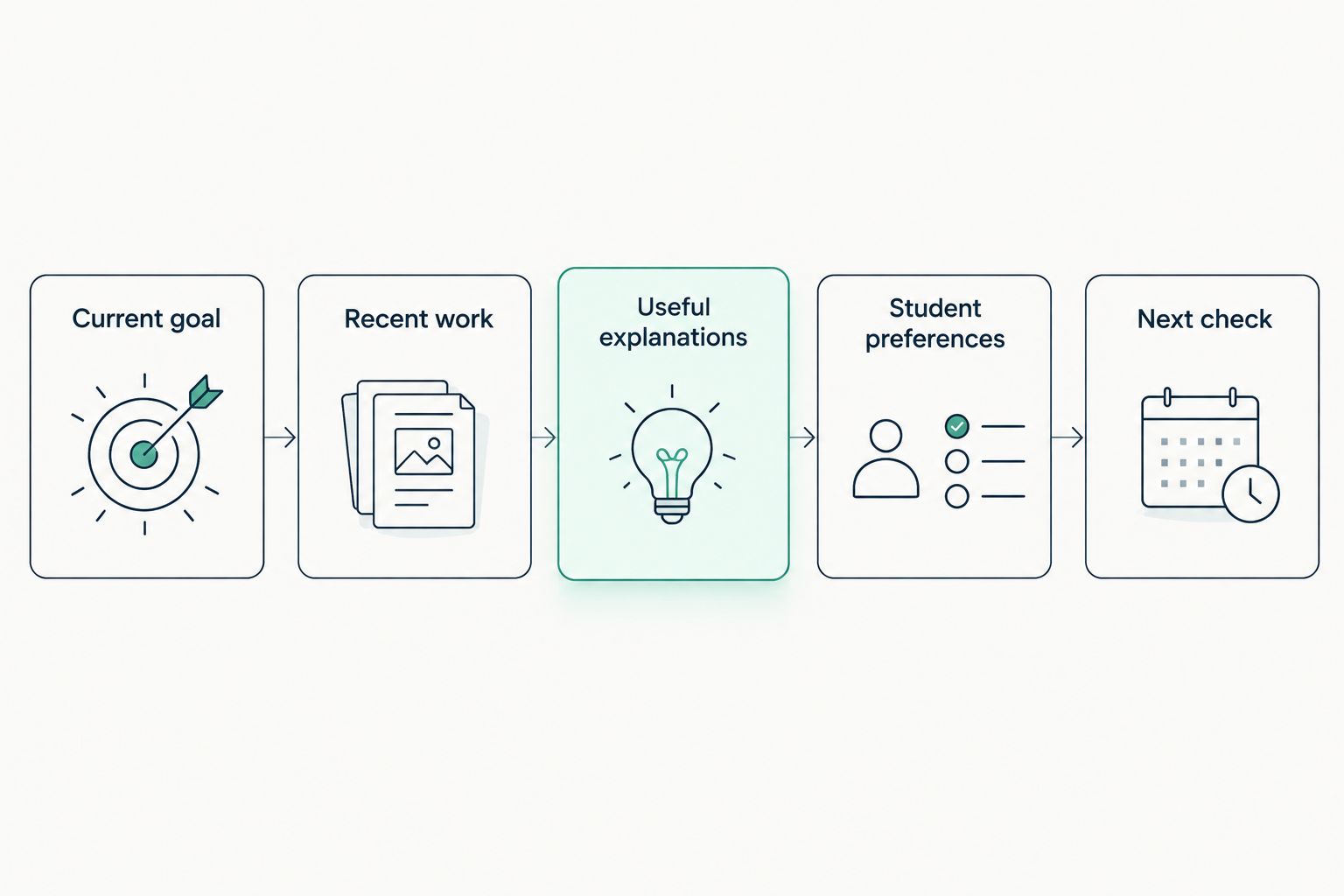
How do you prepare a learning handoff?
Carry the learning forward, not every detail of the old arrangement. Organize the handoff around the current curriculum, actual work and the student's experience. Keep it readable enough for the new tutor to use before teaching.
Current goal
Write down the subject and the immediate task. For math, that might be explaining why an equation-solving step works. For English, it might be organizing evidence in a paragraph. For science, it might be interpreting a graph rather than memorizing a definition.
Avoid making the goal simply getting better grades. Include the assignment or course expectation that the tutoring should support.
Recent work
Choose work that reveals thinking. An unfinished problem with visible steps tells a different story from a final mark. For writing, include the draft and feedback rather than only the polished version.
If your student needed help, say where. Do not present supported work as independent mastery, and do not treat an incomplete answer as proof that the student knows nothing.
Useful explanations
Note approaches that made sense and approaches that did not. Your student might understand a diagram but lose the thread in a long verbal explanation. An interest-based example might help introduce a concept while the student still needs practice using formal notation.
Describe what happened rather than assigning a fixed learning-style label. The new tutor needs room to try another approach when the task changes.
Student preferences
Ask what the student wants to keep, stop or try. They might want more time to answer, clearer explanations of mistakes or permission to ask a question without interrupting a long demonstration.
Share these preferences as practical requests. The student does not need to deliver a speech about why the previous arrangement was difficult.
Next check
Agree on what you will review after teaching begins. Use a relevant piece of work and ask what the student completed independently, what required prompting and what comes next.
The check should help you choose the next teaching step. It should not become another high-pressure test.
What should the first lessons with a new tutor look like?
Start with the work your student actually needs help understanding. Let the new tutor check relevant background skills, but ask how that review connects to the current goal. Reviewing a prerequisite has a purpose; repeating everything without a reason does not.
Keep the opening routine manageable. A 10-minute session is an option when it fits the student, not a promise of a particular result. Some tasks need a longer conversation, while others suit a short explanation followed by focused practice.
Ask the tutor to distinguish explanation from practice. Watching a worked example, answering with prompts and solving independently are different activities. Your progress notes should make those differences visible.
In 2026, use a simple review question: what can the student do now, and what help did they need? A friendly session matters, but friendliness alone does not answer that question.
What should you look for in personalized tutoring?
Tia is best for families seeking a personal tutor that combines adaptive explanations, curriculum mastery tracking and parent learning records. It teaches Math, English and Science for students in grades 5 to 12, adapting to their pace, level and interests while aligning teaching to the curriculum.
You can explore Tia when those needs match the reason for your change. The parent dashboard, engaged-time measurement and self-writing homeschool records give you ways to review learning without relying only on a session summary.
Tia tracks mastery per question and maps it to the curriculum for reporting. It uses Bayesian Knowledge Tracing, an established method that updates an estimate of skill mastery from student answers over time. That estimate is useful information, not an exact or infallible measure of everything a student knows.
The benefit is visibility into teaching and understanding together. The limitation is equally important: Tia's mastery records are not independently verified exam-score gains, and generated homeschool records do not replace your responsibility to check local requirements.
For a transition in 2026, bring the same curriculum goals and recent work you would bring to any new tutor. Do not assume previous tutoring records transfer automatically. Review how the new arrangement addresses the specific problem you are trying to solve.
Should I wait until the end of the school year to switch tutors?
You do not need to wait for the school year to end to address a tutoring mismatch. Base the timing on the student's current work, the reason for changing and your ability to make a clear handoff.
If an assessment is approaching, keep preparation goals explicit. Avoid changing the tutor, curriculum and study routine all at once unless those changes are necessary.
Will a new tutor make my student start over?
A new tutor needs to check the student's starting point, but that does not require restarting the entire course. Share recent work and ask the tutor to explain the purpose of any review.
Keep established skills in use. Let the tutor focus instruction on the gaps that affect the current task.
How do I tell my student we are changing tutors?
Explain the change as an adjustment to support, not a verdict on the student's ability. Name the practical reason in plain language and explain what will stay the same.
Invite the student to help describe a useful lesson. Avoid promising that the new tutor will make every topic easy.
FAQ
Does switching tutors mid-year mean my student will lose progress?
Switching tutors mid-year does not erase previously learned skills. Share recent work, curriculum goals and useful teaching approaches so the new tutor can build from the student's current understanding.
What's the best way to switch tutors without starting over?
Give the new tutor a focused learning handoff. Include the current topic, work samples, places where help was needed and the student's preferences for explanations.
Should I try changing the lesson approach before changing tutors?
Try an adjustment when the relationship works and the problem is specific. Ask for a clear change in pace, examples or practice, then review whether that change addresses the issue.
How long should the first sessions with a new tutor be?
Choose a session length that fits the student and the task. A 10-minute session is an option for a focused goal, not a required duration or a guarantee of progress.
How do I know whether the new tutor is helping?
Look at what your student can explain and complete, including how much prompting they need. Compare relevant work and ask the tutor to identify the next learning goal.
Can I switch tutors while homeschooling?
You can change tutoring support while keeping your homeschool curriculum and learning goals. Preserve your records and check the reporting requirements that apply where you live.
Is a different teaching method the same as changing the curriculum?
A different teaching method does not require a different curriculum. A tutor can change explanations, pace and examples while working toward the same course goals.
One last thing
Save the unfinished work. The problem your student stopped halfway through, the draft with a weak paragraph and the graph they could not explain all belong in the handoff.
You do not need to make the previous tutoring look successful or unsuccessful. Give the next tutor an honest starting point, and give your student permission to keep learning from there.
Related guides
- How adaptive tutoring changes a lesson
- What parents should see in a tutoring dashboard
- How to keep homeschool records without a last-minute scramble
Tia Education Team