Tia News
Can I switch tutors if the first one isn't a good fit?
Can I switch tutors if the first one isn't a good fit? Yes. Check service terms, identify the mismatch, and prepare a handoff that keeps your student learning.
By Tia Education Team · Published

Yes, you can choose a different tutor when the first one is not a good fit; if you want a replacement through the same service, its agreement determines the process. Before changing, check the cancellation terms and ask your student what needs to be different. For your 2026 tutoring plan, aim for teaching that helps your student understand, not just finish the assignment.
- Can I switch tutors if the first one isn't a good fit? Yes; check the service agreement before requesting a replacement.
- Adjust the current lesson when the problem is specific and the tutor responds to feedback.
- Switch when teaching stays mismatched or your student cannot ask questions comfortably.
- Tia offers personalized tutoring for Grades 5 to 12, with adaptive teaching and a parent dashboard.
Can I switch tutors if the first one isn't a good fit?
Yes. You do not need to keep the same tutor just because you chose them first. Separate your decision to change from the service's rules for ending or transferring the arrangement.
Start with the teaching problem, not another search. The guide to how adaptive tutoring changes a lesson explains the kind of adjustment to look for: teaching that changes with the student's pace, level, and interests.
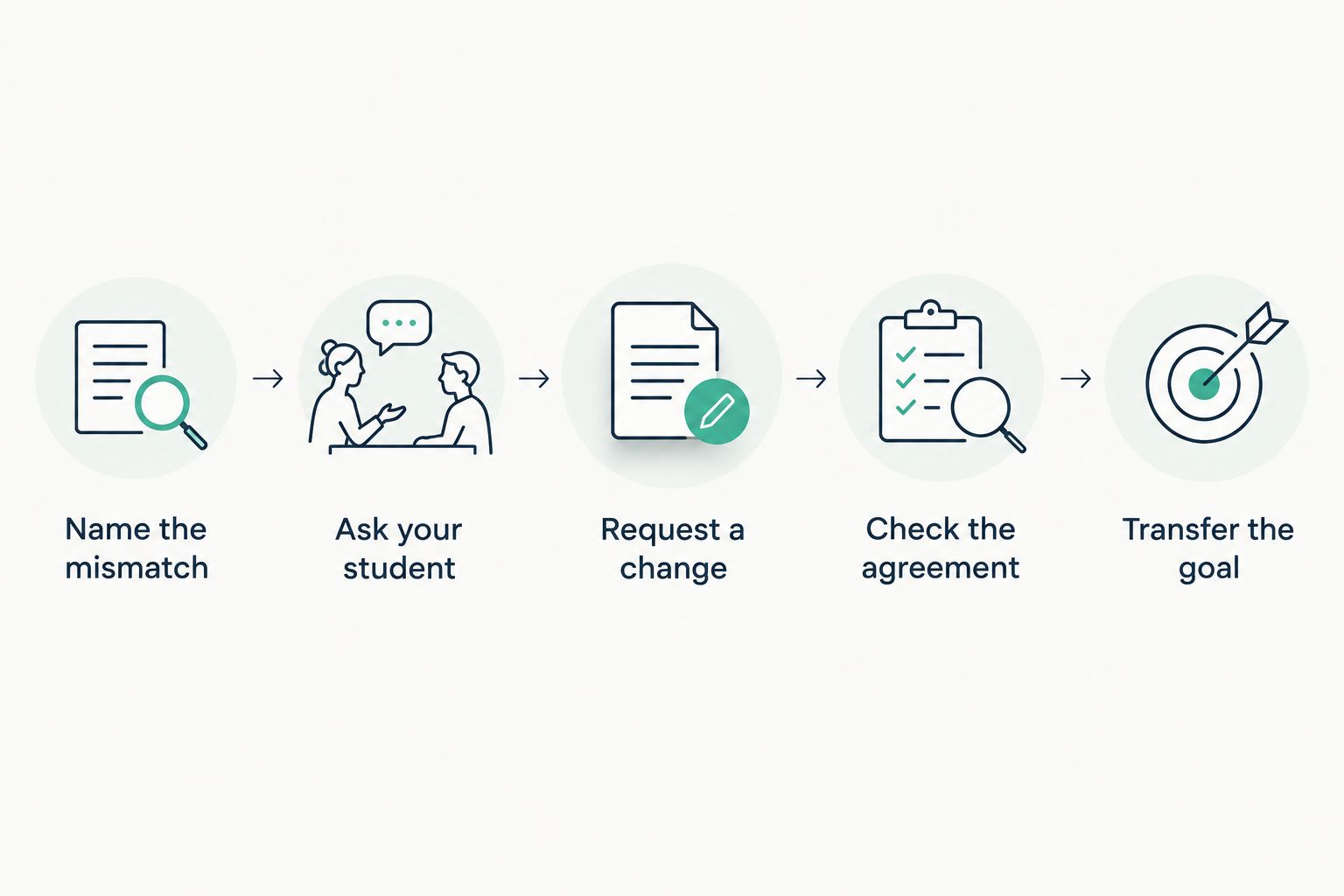
Use this sequence before arranging the next lesson:
- Name the mismatch. Identify what happens during the lesson, such as explanations moving too quickly or the tutor completing the work.
- Ask your student. Find out what helps, what confuses them, and whether they feel comfortable asking questions.
- Request a change. Ask for a specific teaching adjustment if your student feels safe continuing.
- Check the agreement. Confirm the replacement process, cancellation requirements, and treatment of scheduled lessons.
- Transfer the goal. Give the next tutor the learning target and relevant work, so the change does not erase useful context.
You do not have to follow every step when there is a safety concern or disrespectful behavior. Stop the session and address the concern with the service. A student does not need to tolerate mistreatment to give tutoring a fair chance.
Why this matters
You arrange support, make room in the day, and hope homework feels less difficult. When the lesson still ends in frustration, it is reasonable to question the arrangement. That question is not a judgment on your student or the tutor's entire practice.
The useful question is whether this teaching approach fits this student and this goal. A friendly conversation alone does not answer it. Look at whether your student can attempt the work, explain a step, and ask for help without embarrassment.
For a 2026 tutoring decision, keep the goal specific. Understanding how to set up a word problem gives you a clearer basis for judging fit than wanting your student to become better at math.
Should you adjust the lesson or switch tutors?
A difficult lesson does not automatically mean the tutor is wrong for your student. The topic might require earlier knowledge, or the explanation might need changing. Compare the options using what actually happened.
| Option | Best for | Advantage | Limitation |
|---|---|---|---|
| Adjust the current lesson | A specific problem with pace, examples, or lesson structure | Keeps useful context while testing a different approach | Does not solve a mismatch if the tutor will not adapt |
| Request another tutor | A teaching mismatch that continues after clear feedback | Gives the student a different explanation style | Requires a handoff and confirmation of service terms |
| Change the tutoring format | A setting or schedule that does not fit the student | Lets you reconsider how support fits home learning | A new format still needs a clear goal and evaluation |
Adjust the lesson when the problem is specific
Ask for an observable change. Instead of saying the lesson was confusing, ask the tutor to explain the first step, let the student attempt it, and check their reasoning before continuing. That request gives both of you something concrete to review.
Keep the student's experience central. If they understand more after the adjustment and feel comfortable participating, continuing gives you a chance to build on that change. If the request produces no change, you have clearer grounds for switching.
Request another tutor when the mismatch continues
Switch when the teaching repeatedly misses the stated need. Examples include moving past unanswered questions, using explanations the student cannot follow, or doing the assignment instead of teaching the skill. Describe the pattern without attacking the tutor.
A replacement should address that pattern. Asking for someone different is less useful than asking for someone who checks understanding before introducing another step.
Change the format when the setting is the problem
Sometimes the difficulty is not the person. A student might need a different setting, shorter sessions, or support that fits a changing homeschool rhythm. Reconsider the format if the arrangement makes participation difficult even when explanations are clear.
A screen can be a comfortable place to learn for some students. For others, the parent will need to assess whether the screen-based setting supports attention and participation. Choose based on the student, not a blanket rule about screens.
Why tutor fit varies
Tutor fit depends on the match between the lesson and the student's needs. Use these factors to make your next request specific:
- Pace: Does the tutor pause when your student needs more explanation, or move on before the student is ready?
- Starting level: Does the lesson begin with what your student understands, including earlier skills needed for the current topic?
- Examples and interests: Do the examples make the concept familiar without distracting from the learning goal?
- Curriculum and task: Does the teaching address the actual subject, assignment, or curriculum your student is following?
- Participation: Does your student get to attempt the work, explain their thinking, and ask questions?
- Home-learning rhythm: Does the session fit the student's energy, schedule, and need for breaks?
These are questions to investigate, not labels to attach permanently to your student. An explanation that works for one topic does not have to become the only method used for every lesson.
What should I ask my student before switching?
Ask about the lesson when your student is ready to talk, rather than turning the end of tutoring into another assessment. Start with what happened. A broad question about whether they liked the tutor can hide the teaching issue.
Try these prompts:
- Which explanation helped you understand something?
- Where did you stop following the lesson?
- Did you have enough time to try the work yourself?
- What happened when you asked a question?
- What would you want the next tutor to do differently?
Listen for a usable request. Your student might want a drawing before an equation, a familiar example, or more time to answer. You can pass that request on without making your student responsible for managing the tutoring arrangement.
Avoid promising that the next tutor will make every topic easy. Promise something you control: you will listen, explain the need clearly, and review whether the support fits.
How do I ask a tutoring service for a replacement?
Contact the person or team responsible for your arrangement. State the learning goal, describe the mismatch, and explain the teaching change you need. Keep your message factual and brief.
Your request should include:
- The subject and skill your student is working on.
- What is not working during the current lessons.
- Any adjustment already requested and what happened afterward.
- The approach your student needs from a replacement.
- Your scheduling requirements and any upcoming assignment deadline.
Ask how the service handles the transition before booking another session. For an agreement you are reviewing in 2026, check whether replacement requests and cancellation notices use different procedures. Confirm who handles the handoff and what happens to lessons already scheduled.
Do not assume that requesting another tutor automatically cancels the existing booking. Get the next steps in writing so you know which arrangement remains active.
What should I give the next tutor?
Send a short learning brief, not a long account of everything that went wrong. The next tutor needs enough context to start at the right point. Keep personal information limited to what is relevant to teaching your student.
Include the current goal, a sample of independent work, and an explanation of where your student needs help. Add examples of approaches that have helped. If a particular lesson structure did not work, describe it neutrally.
For math, distinguish understanding the idea from remembering a procedure. For English, identify whether the target is reading comprehension, sentence construction, or organizing an essay. For science, name the concept your student needs to explain or apply.
Keep the learning goal steady while you change the teaching approach. That makes it easier to judge whether the replacement solves the original problem instead of simply feeling different.
How long should I give a tutor before deciding?
There is no fixed session count that establishes a good fit. Judge how the tutor responds to your student's questions and to a specific request for change. Do not wait for a set number of lessons if your student feels unsafe or is treated disrespectfully.
For an ordinary teaching mismatch, agree on what you will review after the adjusted lesson. Look for an attempted problem, an explanation in the student's own words, or a question that reveals where understanding stops. These observations are more useful than attendance alone.
If shorter sessions fit your student, a session can be as little as 10 minutes. That is a scheduling option, not a promise of a particular result. Check whether the available tutoring arrangement supports the rhythm you need.
Can personalized tutoring be a better fit?
Tia is best for families seeking adaptive Math, English, and Science tutoring for students in Grades 5 to 12. Tia adapts teaching to the student's pace, level, and interests, with a parent dashboard for tracking progress.
Tia's personalized tutoring gives you a different approach to consider when the main problem is a fixed teaching pace or an explanation that does not connect. Its engaged-time measurement and self-writing records also address the parent's need to understand what happened during learning.
The boundaries matter. The stated subject scope is Math, English, and Science, and the stated student range is Grades 5 to 12. If you specifically want to choose a named human tutor, assess that requirement separately rather than treating adaptive tutoring as the same arrangement.
For your 2026 evaluation, use the same learning goal you used with the previous tutor. Review the student's work and experience alongside the dashboard. Records help you follow the learning; they do not replace listening to your student.
FAQ
Can I switch tutors if the first one isn't a good fit?
Yes, you can choose a different tutor; requesting a replacement through the same service depends on its agreement. Check cancellation requirements and scheduled lessons before confirming the change.
Should I tell the current tutor what isn't working?
Yes, give specific feedback when your student feels safe continuing. Ask for an observable change, such as more time to attempt a step or a different explanation.
Do I have to wait several sessions before switching tutors?
No fixed number of sessions determines whether a tutor is a good fit. Review the teaching response and your student's experience, and stop immediately for safety concerns or disrespectful behavior.
Is switching tutors the same as canceling my tutoring service?
No, a replacement request and cancellation are separate actions unless the service's agreement says otherwise. Confirm which bookings remain active and get the next steps in writing.
What if my student likes the tutor but still does not understand the work?
Ask for a specific teaching adjustment and check what your student can do afterward. A comfortable relationship matters, but the lesson also needs to address the learning goal.
What should I send to a replacement tutor?
Send the learning goal, relevant independent work, and a brief explanation of the teaching approach your student needs. Include what helped previously so the new tutor can build on useful context.
Is Tia suitable if my student needs a different teaching pace?
Tia adapts its personalized tutoring to the student's pace, level, and interests in Math, English, and Science for Grades 5 to 12. Evaluate the fit using your student's understanding and experience alongside the parent dashboard.
One last thing
Before the next lesson, write down what you want your student to do without help. Make it a specific task, such as explaining why a fraction calculation works or supporting an essay point with evidence.
For your 2026 tutoring plan, that task gives you a steady reference point through a change of tutor. You stay responsible for choosing the support. Your student stays responsible for doing the learning.