Tia News
Can AI tutors keep up with school curriculum changes?
Can AI tutors keep up with school curriculum changes? Yes, with verified alignment. Check current standards, lesson objectives, and assignments before choosing.
By Tia Education Team · Published

Yes, AI tutors can keep up with school curriculum changes when their lessons are checked against the current curriculum and revised to match it. If your student brings home a worksheet that looks different from last term’s, check the exact learning objective and required method before relying on a tutor’s explanation, because a correct answer alone does not prove curriculum alignment.
- Can AI tutors keep up with school curriculum changes? Yes, but check current standards, lesson content, and assessment requirements.
- Tia is best for Grades 5–12 families seeking personalized Math, English, and Science tutoring at their student’s pace.
- Curriculum alignment and adaptive teaching solve different problems: what students learn and how they learn it.
- Use the current assignment and rubric to check whether tutoring matches the work your student must complete.
Can AI tutors keep up with school curriculum changes?
Yes, but judge alignment by the lesson, not the label on the service. A tutor needs to teach the right objective, at the right level, using the expectations that apply to your student’s course.
For a 2026 curriculum check, start with the current official curriculum or course specification. Then compare the tutoring explanation with the assignment and grading rubric. Keep those checks separate: curriculum documents describe learning expectations, while an assignment shows what your student needs to do now.
The following table compares approaches to checking alignment, not individual products. Each approach has a useful role and a limitation.
| Approach | Best for | What to check | Advantage | Limitation |
|---|---|---|---|---|
| Curriculum-mapped tutoring | Ongoing support within a named curriculum | Exact subject, level, curriculum, and applicable version | Gives you a defined framework to compare with official expectations | A curriculum label alone does not establish that every lesson is current |
| Assignment-led tutoring | Help with a specific school task | Instructions, required method, and rubric | Keeps the session focused on the task in front of your student | One assignment does not represent the whole course |
| General subject tutoring | Reviewing concepts and prerequisite skills | Whether the explanation addresses the required objective | Lets you focus on a particular gap in understanding | Subject knowledge alone does not establish local curriculum alignment |
Personalization is a separate check. The guide to how adaptive tutoring changes a lesson explains the teaching side of the question: adjusting the explanation to the student rather than simply naming the curriculum.
Why this matters
You do not need to become a curriculum specialist to choose useful tutoring. You need a clear connection between what your student is practicing and what their course expects.
A student can understand a concept yet still need help showing that understanding in the required form. An English assignment might ask for evidence from a text, not just a summary. A science task might require an explanation of results, not just a definition.
Check both the learning and the finished work. Ask your student to explain the idea, then compare their response with the assignment instructions. This keeps you in charge without asking you to teach the entire lesson yourself.
How do you check whether a tutor matches the current curriculum?
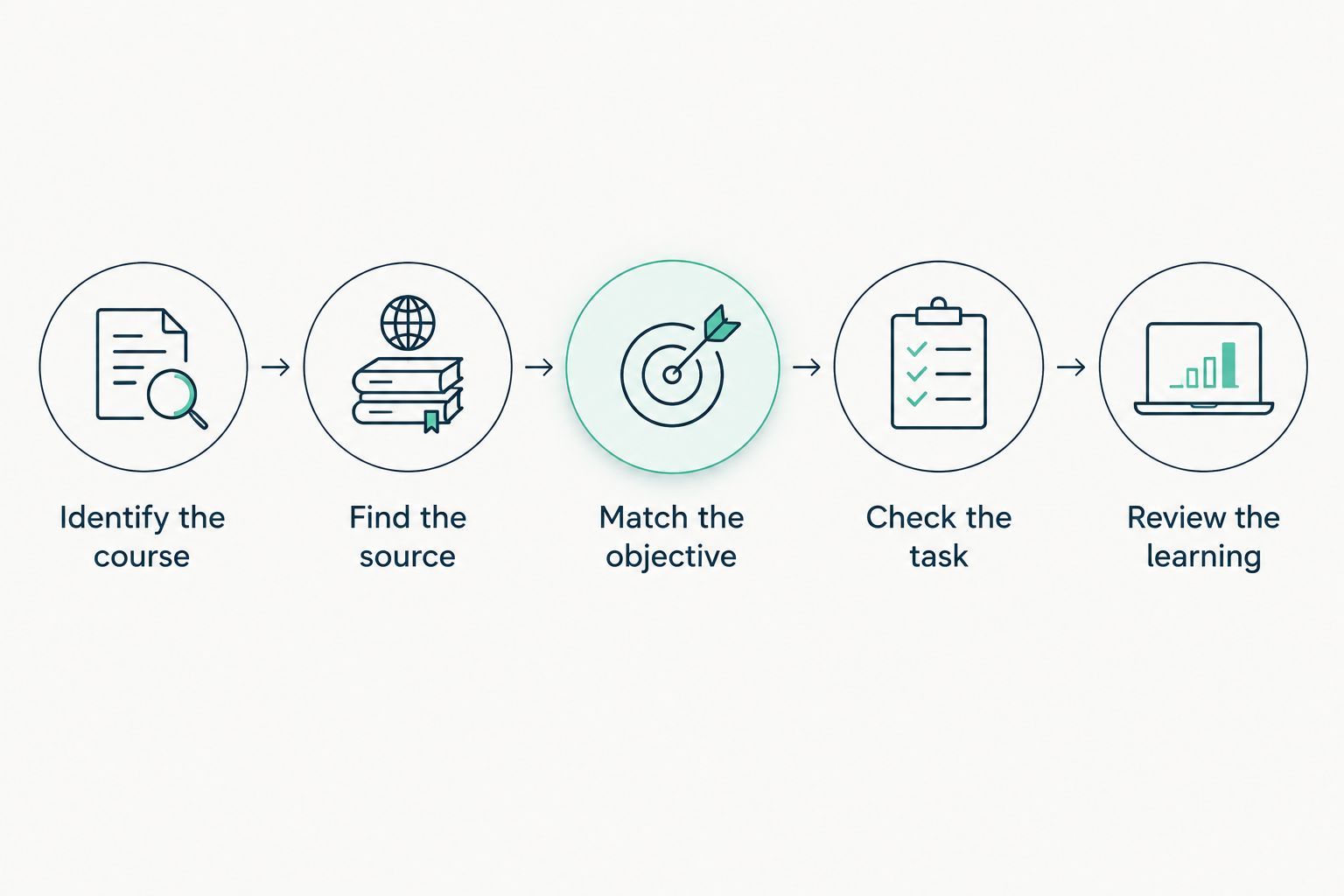
Use this sequence when you choose a tutor, begin a different course, or receive notice of changed requirements. Repeat it when the school or curriculum provider identifies a relevant change, rather than treating every new worksheet as a curriculum revision.
- Identify the course. Write down the subject, grade or course level, and curriculum your student follows. Include the school’s course name if it differs from the textbook title.
- Find the source. Use the current official curriculum, course specification, or school-provided learning expectations. For 2026 study, check which version applies to the course rather than assuming the newest publication applies immediately.
- Match the objective. Choose one learning objective from your student’s current work. Ask the provider how its lessons address that objective.
- Check the task. Compare the tutoring explanation with the assignment instructions and rubric. Look for the requested method, vocabulary, and depth of explanation.
- Review the learning. Ask your student to explain the idea or attempt a related problem independently. Use the response to decide what needs more practice.
The sequence moves from the course requirement to the student’s understanding. Keep a brief note of the source and objective so you can return to them without starting the search again.
You can ask a provider these questions in plain language:
- Which curriculum does this subject follow?
- Which version applies to my student’s course?
- How do you check lessons after a curriculum change?
- Can you explain how this lesson matches this learning objective?
- What should I do if the explanation conflicts with the assignment?
Choose an answer you can verify. A reference to a specific objective is more useful than a broad promise to cover everything.
Curriculum updates and adaptive teaching are different
Curriculum alignment answers, “What does my student need to learn?” Adaptive teaching answers, “How should this student work toward that understanding?” You need both questions answered, but one does not settle the other.
Changing an example to match a student’s interest does not establish that the lesson reflects a revised standard. Naming a current standard does not establish that the explanation suits the student’s pace.
Ask for a demonstration using a real learning objective. Notice whether the explanation responds to the student’s difficulty while still working toward the same goal. A familiar example should help the student understand the concept, not replace the required learning.
For a student interested in building, you might use a physical model when discussing a mathematical relationship. Then connect the model to the representation required by the assignment. Treat the example as a teaching choice, not evidence that a service has updated its curriculum.
Why curriculum alignment varies
Check these factors before comparing tutoring services. They define the learning context you need the tutor to address.
- Curriculum jurisdiction: Name the state, country, or curriculum framework your student follows. Do not stop at “middle school math.”
- Grade or course level: Identify the actual course. A broad subject label does not describe its full expectations.
- Applicable version: Check the curriculum version that governs the course in 2026. A publication date and an implementation date answer different questions.
- Current learning objective: Specify the skill or understanding your student is working on. A tutor needs more direction than a chapter title alone.
- Assessment instructions: Include the required method, evidence, vocabulary, or format. These help you judge whether the support fits the task.
- Student starting point: Identify what your student can already explain and where they get stuck. Keep the course objective in view while adjusting the teaching.
You do not need a lengthy document. A short course note, a current assignment, and the relevant expectations give you a practical starting point.
What does curriculum-aligned support look like by subject?
Use the following checks as examples, not claims about a particular school’s requirements. The assignment and official learning expectations remain your reference.
Math: match the concept and required method
In Math, check what the student needs to understand and how the assignment asks them to show it. If the instructions request a diagram or written reasoning, a final answer alone does not meet that instruction.
Let your student point to the step they do not understand. Then ask for an explanation of that step rather than a completed solution. You can review the required representation afterward.
English: match the writing purpose
In English, begin with the prompt. Identify whether the task asks your student to explain, analyze, argue, or describe, then check the rubric for evidence and organization requirements.
A polished paragraph is not the whole goal. Ask your student to explain why they chose a piece of evidence and how it supports the point they are making.
Science: match the explanation and evidence
In Science, separate knowing a term from explaining a relationship. Read the task closely to see whether it asks for a definition, an interpretation, a prediction, or an evidence-based explanation.
Ask your student to connect their answer to the information provided in the task. Keep any practical work within the school’s instructions and supervision requirements.
Where does Tia fit?
Tia is best for Grades 5–12 families seeking personalized Math, English, and Science tutoring at their student’s pace. Tia’s personal tutor adapts teaching to the student’s level and interests, with curriculum-aligned support across those 3 subjects.
That combination is relevant when your student needs a different explanation of the same required concept. You can keep the learning goal while changing how the student approaches it.
Parents get a live dashboard, engaged-time measurement, and self-writing records. These support oversight and homeschool record keeping. They do not, by themselves, establish that a particular curriculum revision is included in a particular lesson.
For Tia’s personalized tutoring, apply the same 2026 check you would use with any service: confirm the applicable curriculum and compare the lesson with the current task. Adaptive teaching is the benefit; verified curriculum currency is a separate question.
What should you do when the school announces a change?
Start by asking what changed and when it applies. Distinguish a new textbook, a different teaching sequence, and a revised curriculum requirement before changing the tutoring plan.
Save the school’s notice alongside the current course information. Then identify the learning objectives or assignments affected. You do not need to restart every subject because one part of a course has changed.
If an explanation conflicts with the task, pause that exercise and ask for clarification. Keep the assignment wording available. Resolve the mismatch before your student practices the same approach repeatedly.
For a 2026 course change, record the applicable date and the source of the guidance. Use that note when asking a tutoring provider to explain its alignment.
Does a new curriculum mean starting over?
No. Begin with the changed objectives, then check which skills your student already understands. Keep useful work and focus additional practice on the gap.
Ask the school or curriculum provider whether earlier work still meets the course expectations. Do not assume either that everything is obsolete or that nothing needs adjusting.
Can short tutoring sessions still follow the curriculum?
Yes. A session can focus on one curriculum objective without covering an entire lesson or chapter. Choose a manageable task and check what the student understood afterward.
As little as 10 minutes a day is an option when it fits your student. That duration is not a promise of a particular result, and it does not prove alignment. The objective and the student’s response remain the useful checks.
How often should parents check curriculum alignment?
Check alignment when you choose a service, start a course, or receive notice of changed requirements. Check again when a tutoring explanation does not match the assigned task.
You do not need to audit every session. Keep the current course reference accessible and investigate specific mismatches rather than adding another daily job to your list.
FAQ
Can AI tutors keep up with school curriculum changes in 2026?
Yes, when their lessons are checked against the applicable 2026 curriculum and revised to match it. Verify the curriculum version and compare a lesson with your student’s current assignment.
Does adaptive tutoring mean the curriculum is always current?
No. Adaptive tutoring adjusts how a student is taught; curriculum currency concerns whether the lesson matches current requirements. Check those separately.
How can I check whether a tutor follows my student’s school curriculum?
Compare the tutor’s explanation with the current learning objective, assignment instructions, and rubric. Ask the provider to identify the curriculum and version used for the course.
Can Tia help students in Grades 5–12 with curriculum-aligned subjects?
Tia provides personalized, curriculum-aligned tutoring in Math, English, and Science for students in Grades 5–12. Confirm the applicable curriculum when evaluating support for a specific course change.
Will a parent dashboard prove that lessons match the latest standards?
No. A dashboard can support oversight, but curriculum alignment needs a check against the applicable learning expectations. Use the current course information as your reference.
Should I change tutors whenever my student gets a new textbook?
No. First establish whether the learning requirements changed or whether the course is using a different resource. Then check whether the tutoring still addresses the current objectives.
Can a 10-minute tutoring session help with a curriculum objective?
A 10-minute tutoring session can focus on one curriculum objective when that duration fits the student. Check understanding afterward rather than treating session length as proof of progress.
One last thing
Bring the instruction your student finds confusing, not just the subject name. A single requirement such as explaining reasoning or using evidence gives you a clear way to judge the tutoring response.
You stay responsible for choosing the support. Your student stays responsible for doing the learning. The tutor’s role is to make the required concept understandable, not to make the course requirements disappear.