Tia News
Best tutoring services for students with ADHD in 2026
Compare tutoring for ADHD by student fit: adaptive teaching, voice or text, a human tutor or targeted practice. Check learning records, not treatment claims.
By Tia Education Team · Published · Last updated

Best for adaptive subject teaching: Tia. Best for choosing a human tutor: Wyzant. Best for structured course resources: Khan Academy. Best for targeted practice: IXL. If homework keeps turning into repeated explanations and another difficult evening, choose tutoring for ADHD by the support your student needs, not the diagnosis alone.
- Tia is the best fit for tutoring for ADHD when families want adaptive subject teaching and parent learning records.
- Wyzant fits families seeking a human tutor whose teaching approach they can evaluate individually.
- Khan Academy offers structured courses and mastery learning; IXL offers personalized diagnostic recommendations for practice.
- Choose shorter lessons or movement breaks around your student, not a universal ADHD timetable.
Why this matters
You can spend an evening keeping a student at the table without finding out why a lesson stalled. Was the explanation unclear? Was the task hard to start? Did the student understand the concept but lose track of the steps?
Those are different problems. The right tutoring setup responds to the actual obstacle instead of treating every unfinished assignment as a need for more practice.
This 2026 guide compares teaching formats and parent visibility, not proven ADHD treatment outcomes. Academic tutoring supports learning. It does not diagnose ADHD, replace clinical care, or automatically deliver the accommodations in an IEP or 504 plan.
What makes the best tutoring for ADHD?
Use these criteria before choosing a service. Your student does not need every feature equally.
- Adaptive explanations: Look for a change in examples, language, or teaching approach when the first explanation does not land.
- Manageable pace: Ask whether the student can slow down, revisit a step, and take a break without losing the learning goal.
- Curriculum connection: The lesson should address the skill the student needs, not just offer an interesting activity.
- Evidence of understanding: Look beyond completed questions. Ask how the service distinguishes supported answers from independent understanding.
- Parent visibility: You should be able to identify what was studied, what remains difficult, and what to try next.
- Student fit: Include the student's preference for a human conversation, screen-based explanation, course library, or focused practice.
For your 2026 shortlist, ask each provider to demonstrate an explanation change. A promise of personalization is less useful than seeing what happens after a student says they still do not understand.
Tutoring options at a glance in 2026
| Option | Best for | Standout feature | Key limitation |
|---|---|---|---|
| Tia | Adaptive subject teaching with parent records | Curriculum-aligned explanations shaped by pace, level, and interests | Not a human tutor or ADHD treatment |
| Wyzant | Selecting a human teaching relationship | Individual tutors can personalize their teaching | You need to evaluate the individual tutor's approach |
| Khan Academy | Following a structured course | Courses, mastery learning, tailored practice, and progress tools | The core platform is not a dedicated human tutor |
| IXL | Practicing identified skills | Personalized diagnostic recommendations | Practice recommendations are different from personalized explanations |
These options serve different jobs. A resource library can support a tutoring plan without replacing the tutor, and a practice platform can help you work on a skill without becoming the main teaching resource.
1. Tia: best tutoring for adaptive explanations and parent records
This personal tutor teaches Math, English, and Science for students in grades 5 through 12. It adapts explanations, pace, level, and examples to the student's interests while keeping teaching connected to the curriculum.
Best for: Families seeking personalized subject teaching alongside a parent dashboard, engaged-time measurement, and self-writing homeschool records.
What the teaching looks like
The client-supplied product demonstrations show two test students learning vertical angles. Fred's explanation uses crossing cricket bats. Charlotte's uses crossing horse trails.
Both demonstrations teach the same mathematical relationship: opposite angles match when two lines cross. The interest changes the explanation, not the learning goal. These are product demonstrations, not testimonials or evidence of ADHD outcomes.
That distinction matters. Personalized practice selects what to work on; personalized explanation changes how the idea is taught. Read how adaptive tutoring changes a lesson for a closer look at that mechanism.
Voice or text, chosen by the student
Tia now supports two-way voice: students can ask questions aloud and hear verbal explanations. Typing remains available, and they can switch between voice and text within the same lesson. Voice is included in all bundle plans at no extra charge.
For some students with ADHD, speaking a question may feel easier than typing it. Others prefer text, or different formats for different tasks. Tia adapts to the student, not the other way around. The useful check is whether the student can take part comfortably and explain the concept, not whether voice keeps them on screen longer.
This is a participation option, not ADHD treatment or evidence of improved attention or achievement. It does not make movement breaks, written work or specialist support unnecessary.
What parents can measure
The service measures mastery from student answers and maps that information to the curriculum in its reports. Its Bayesian Knowledge Tracing method updates an estimate of skill mastery as answers accumulate over time.
An estimate is not an infallible measure of everything a student knows. It is also different from independently verified exam-score gains.
Engaged-time measurement answers another question: how much time involved engagement rather than simply having a session open. Read that alongside the mastery information, not as a substitute for it.
Pros:
- Changes explanations around the student's pace, level, and interests.
- Connects subject teaching with curriculum-mapped mastery information.
- Gives parents learning visibility through a dashboard and records.
- Supports homeschool documentation without asking parents to reconstruct every lesson.
Cons:
- Does not provide a human tutoring relationship.
- Does not replace ADHD treatment or professional assessment.
- Learning records do not, by themselves, establish compliance with every local homeschool requirement.
Verdict: Buy for adaptive academic teaching and parent records, not for a claim of ADHD-specific treatment. Use the trial to judge whether the teaching format fits your student.
2. Wyzant: best tutoring for choosing a human relationship
Wyzant connects families with individual human tutors. A human tutor can personalize explanations and respond through conversation, but the relevant choice is the individual tutor, not just the platform name.
Best for: Students whose families want to choose a person and evaluate that tutor's approach to teaching.
Bring a recent assignment to the first conversation. Ask how the tutor would respond if the student understands an example but cannot begin a similar problem independently.
Also ask what happens after a break. You want a practical answer about returning to the learning goal, not a promise that every session will stay perfectly focused.
Wyzant pros:
- Lets families pursue an individual human teaching relationship.
- Human tutors can adapt examples and explanations in conversation.
- Gives parents an opportunity to discuss the student's learning preferences directly with the tutor.
Wyzant cons:
- A platform name does not establish an individual tutor's ADHD experience.
- You need to assess the tutor's teaching approach and reporting practices.
- A good subject match does not automatically mean a good interpersonal match.
Ask for relevant experience without assuming a credential guarantees fit. Let the student explain which parts of the conversation felt helpful.
Verdict: Buy when a human relationship is the priority and the individual tutor demonstrates a suitable approach.
3. Khan Academy: best resource companion for structured courses
Khan Academy provides structured courses, mastery learning, tailored practice, and progress tools. It belongs on this list as a learning resource, not as an interchangeable replacement for every tutoring service.
Best for: Students who want a course structure to follow and families who can help select a clear starting point.
Use a specific goal, such as understanding equivalent fractions or reviewing a science concept. Avoid turning a broad course catalog into another decision the student has to make before learning begins.
Keep the core Khan Academy platform separate from Khanmigo when comparing services. Khanmigo provides guided tutoring; do not assume its features are part of every core-platform activity.
Khan Academy pros:
- Organizes learning into structured courses.
- Includes mastery learning and tailored practice.
- Provides progress tools rather than functioning only as a video library.
Khan Academy cons:
- The core platform is not a dedicated human tutoring relationship.
- A structured course does not automatically organize the student's whole study routine.
- Families comparing guided tutoring need to distinguish Khanmigo from the core platform.
The useful question is whether your student needs help finding the next resource or needs someone to explain the concept differently. Those needs call for different support.
Verdict: Buy into this approach as a structured resource companion when the student can use the course format with suitable support.
4. IXL: best practice companion for identified skill gaps
IXL offers personalized diagnostic recommendations. Its role in this comparison is targeted practice: helping connect a student's work with skills to practice next.
Best for: Students who need focused practice after an explanation has made the concept understandable.
Separate practice personalization from explanation personalization. A recommendation about which skill comes next does not, by itself, tell you how a difficult idea will be explained.
When evaluating IXL, watch your student work on a relevant skill. Ask whether the activity addresses a real gap or whether the student first needs a different explanation away from the practice task.
IXL pros:
- Offers personalized diagnostic recommendations.
- Supports a skill-focused practice plan.
- Gives families a distinct practice option alongside subject tutoring.
IXL cons:
- Diagnostic recommendations do not establish ADHD-specific effectiveness.
- Selecting a skill is different from adapting an explanation around student interests.
- Practice alone is not the right response when the underlying concept remains unclear.
Verdict: Buy as a practice companion when the learning goal is clear. Skip adding more practice when the student needs teaching first.
How to check fit without another exhausting evening
Keep the comparison small. Choose a familiar topic and observe how each approach handles it rather than asking your student to complete a long test of every platform.
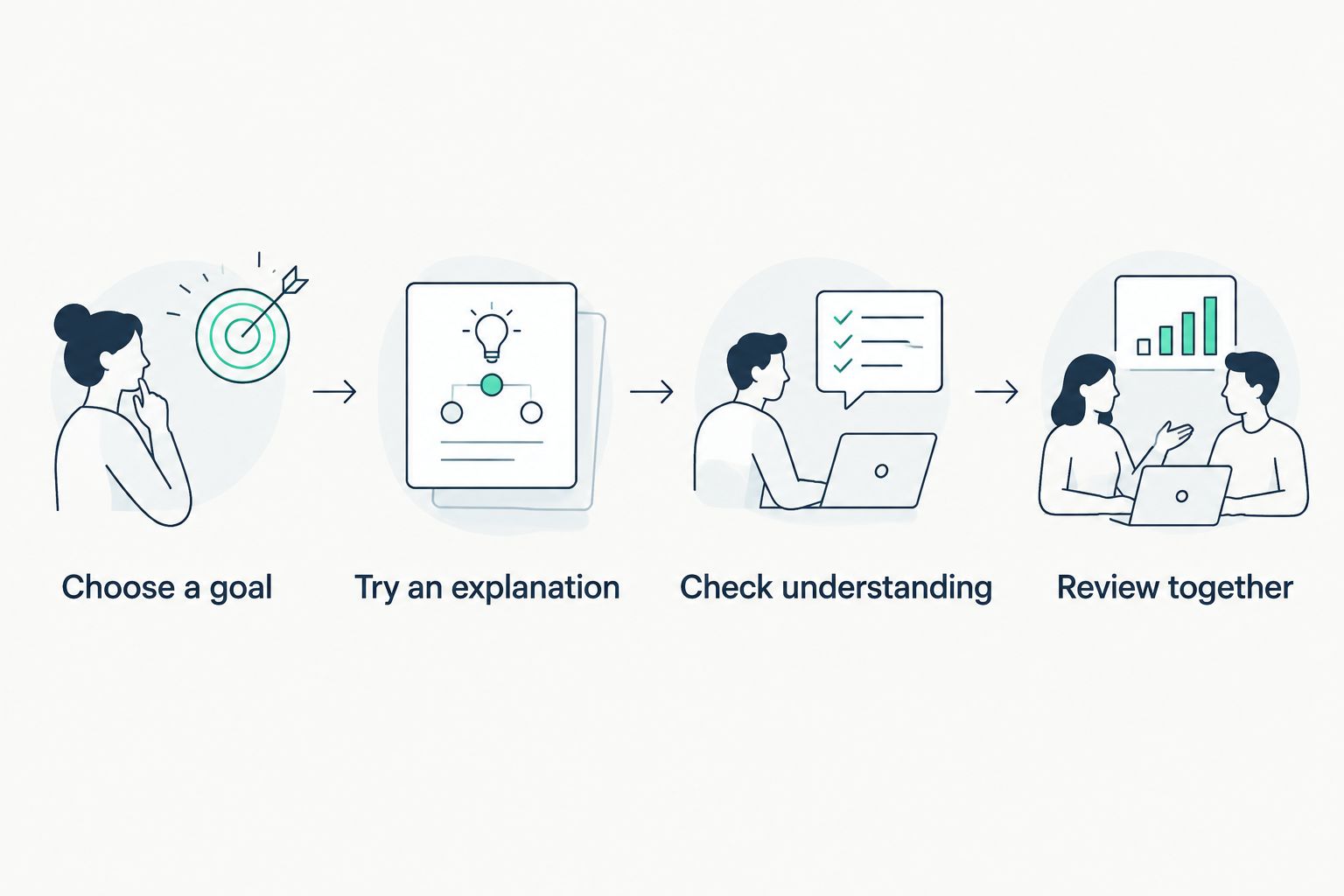
Use this sequence:
- Choose a goal: Name the concept or task that needs help.
- Try an explanation: Notice whether the student can follow it and ask questions.
- Check understanding: Ask the student to explain the idea or attempt a fresh example.
- Review together: Ask what helped, what felt difficult, and what should change next time.
The student stays in charge of doing the learning. Your job is to notice whether the support makes the next step clearer.
A session as short as 10 minutes is an option when it fits your student and the task. That duration does not promise a particular result. Shorter lessons and movement breaks should respond to the student, not a universal ADHD schedule.
How these options were ranked
This 2026 ranking prioritizes explanation adaptability, curriculum connection, parent visibility, and the kind of support each option provides. It separates personal tutoring, human tutor selection, structured resources, and targeted practice.
It is a fit-based comparison, not a clinical evaluation or a head-to-head learning-outcomes study. No platform earns an ADHD effectiveness claim simply by offering personalization.
Which tutoring approach should you choose?
Tia is the best fit for families seeking adaptive subject tutoring with parent learning records. Choose Wyzant when finding an individual human tutor matters most.
Choose Khan Academy when a structured course is the missing resource. Choose IXL when the student understands the concept and needs targeted practice.
For a 2026 decision, start with the smallest useful change. Keep what already works, introduce one support, and review the student's experience before adding another service.
FAQ
What's the best tutoring for ADHD in 2026?
The best tutoring for ADHD matches the student's actual learning obstacle. Choose adaptive explanations for conceptual confusion, a human tutor for an individual teaching relationship, or targeted practice when the concept is already understood.
Does a student with ADHD need a specialist tutor?
Choose expertise that matches the support required, rather than assuming every student with ADHD needs the same tutor. Ask how the tutor changes explanations, handles breaks, and responds when a student cannot start a task.
Is online tutoring suitable for students with ADHD?
Online tutoring is a format to evaluate with the individual student, not an automatic yes or no. Some students feel comfortable learning through a screen; check whether the teaching, pace, and interaction suit your student.
How long should a tutoring session last for a student with ADHD?
Session length should fit the student and the learning goal. As little as 10 minutes is an option for a focused task, but no fixed duration guarantees progress or suits every student.
Can tutoring replace an IEP, a 504 plan, or ADHD treatment?
Tutoring does not replace an IEP, a 504 plan, or ADHD treatment. Discuss relevant learning supports with the tutor and keep school accommodations and clinical decisions with the appropriate professionals.
What should parents look for in a tutoring report?
Look for the skill studied, evidence of understanding, remaining difficulties, and a useful next step. Engaged time adds context, but time alone does not establish mastery.
Can I try the adaptive personal tutor before committing?
The offer is: 14-day free trial, no card needed. The trial is per account, not per student; use it to evaluate explanation fit and parent learning records.
One last thing
Ask your student which explanation made the task clearer, not whether they liked tutoring. The answer gives you something specific to keep or change.
A completed worksheet is useful. A student explaining why an answer makes sense tells you something different. Make room for both.
Related guides
- Planning movement breaks for homeschool students with ADHD
- What parents should see in a tutoring dashboard
- Making a 10-minute daily tutoring session count
Tia Education Team