Tia News
Best Schoolhouse.world alternatives in 2026
Compare schoolhouse.world alternatives for 2026. Choose personalized tutoring, human tutors, courses, or skills practice to match your student's needs.
By Tia Education Team · Published

Best overall for personalized teaching: Tia. Best for self-directed courses: Khan Academy. Best for choosing a human tutor: Wyzant. Best for targeted skills practice: IXL. If you are comparing schoolhouse.world alternatives in 2026 because your student needs a different explanation, not another resource to manage, start with the kind of help that is missing.
- Tia leads these schoolhouse.world alternatives for curriculum-aligned personal tutoring with parent learning records.
- Khan Academy suits students who want structured courses, explanations, and self-directed practice.
- Wyzant suits families who want to choose and work with a human tutor.
- IXL suits targeted skills practice guided by diagnostic recommendations.
- Choose by teaching format, curriculum fit, and evidence of understanding, not session time alone.
Why this matters
Your student finishes a session, closes the screen, and still cannot explain the homework. You are left deciding whether to repeat the lesson, find another resource, or sit beside them through the next assignment.
That does not automatically mean the original service was wrong. It means you need to identify whether your student needs another explanation, more independent practice, a human relationship, or a clearer learning plan.
Schoolhouse.world centers peer tutoring. The alternatives below serve different needs rather than reproducing that experience exactly. For your 2026 shortlist, separate personal teaching from course resources and practice tools before comparing individual features.
What makes the best Schoolhouse.world alternative?
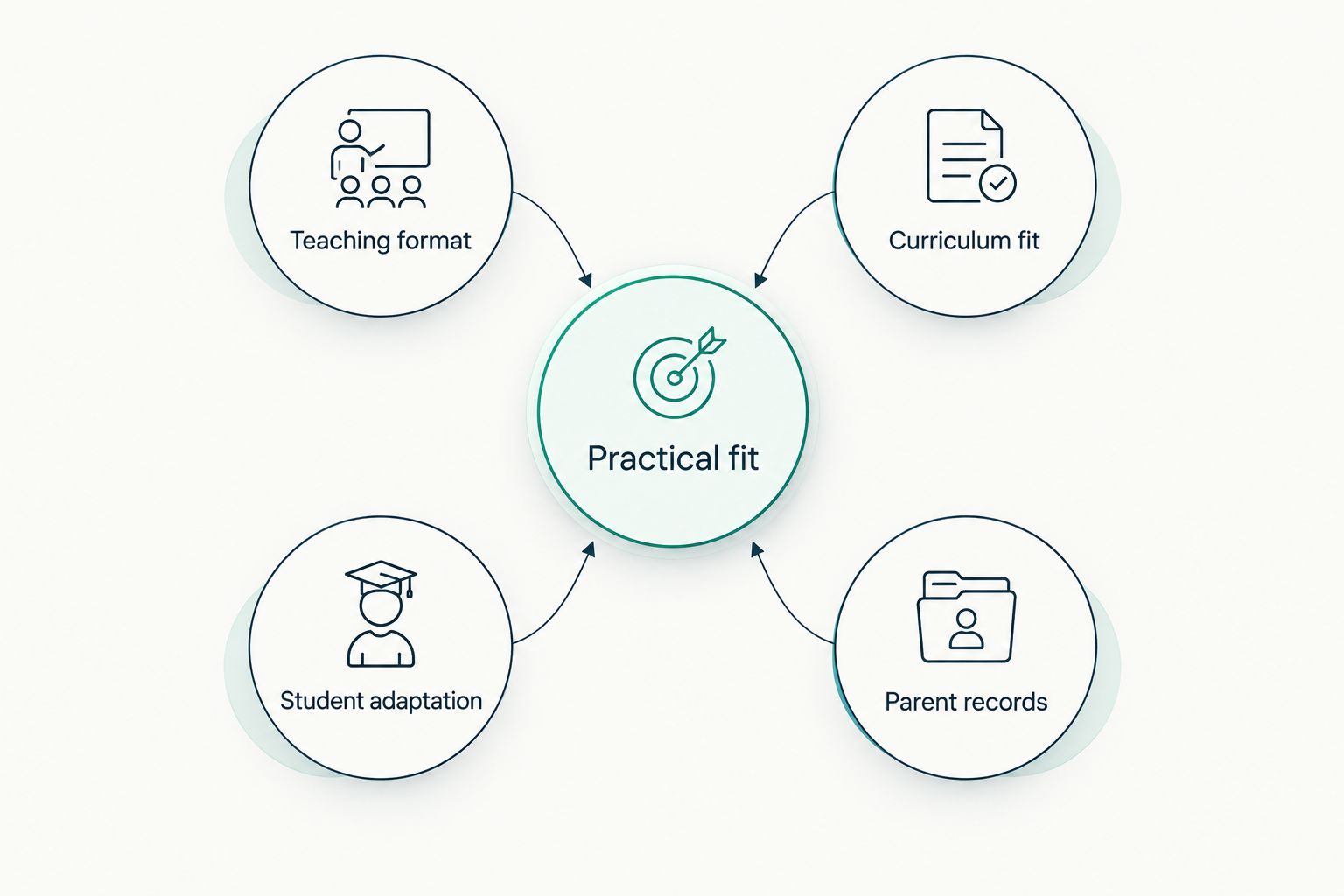
Use these five criteria to decide what belongs on your shortlist:
- Teaching format: Does your student need individual explanations, a human conversation, structured lessons, or independent practice?
- Curriculum fit: Can you connect the help to the topic, level, and learning goal your student is working on?
- Student adaptation: Does the service change explanations, recommend practice, or let a tutor adjust the session? These are different forms of personalization.
- Parent records: Can you distinguish participation, completed work, and evidence of understanding?
- Practical fit: Will the format work with your student’s preferences and your family’s routine?
For a 2026 comparison, ask what happens after an incorrect answer. A useful response might be a different explanation, a prerequisite question, a diagnostic recommendation, or a conversation with a tutor. The right response depends on why your student got stuck.
Schoolhouse.world alternatives at a glance
The table compares learning formats, not proven differences in achievement. Each option has a distinct job.
| Option | Best for | Standout feature | Key limitation |
|---|---|---|---|
| Tia | Personalized teaching with parent records | Curriculum-aligned explanations, adaptive mastery tracking, and a parent dashboard | Not a human tutor or peer-learning community |
| Khan Academy | Self-directed course learning | Structured courses, mastery learning, and tailored practice | The core platform is not an individually chosen human tutor |
| Wyzant | Choosing a human tutor | A marketplace where families select an individual tutor | Teaching approach and reporting need agreement with that tutor |
| IXL | Targeted skills practice | Personalized diagnostic recommendations | Practice recommendations serve a different purpose from an ongoing tutoring conversation |
1. Tia: best alternative for personalized teaching and parent records
Tia is best for families seeking curriculum-aligned personal tutoring with parent learning records. It teaches Math, English, and Science for students in Grades 5 to 12, adapting explanations, pace, level, and examples to the student.
The distinction is how the teaching changes, not just which question comes next. A student’s interests can shape an explanation while the lesson stays connected to the curriculum goal.
Client-supplied product demonstrations show this with vertical angles. One uses crossing cricket bats; another uses crossing horse trails. These are labeled teaching demonstrations, not testimonials or evidence of mastery.
What parents can see
The parent dashboard includes engaged-time measurement and self-writing homeschool records. Mastery information also matters: answers update an estimate of skill understanding, which maps to the curriculum and appears in reports.
The underlying method is Bayesian Knowledge Tracing. In plain language, it updates an estimate of mastery from student answers over time. That estimate is useful learning information, not an infallible measure of everything a student knows or independently verified evidence of exam-score gains.
Students can speak and hear explanations, type, or switch between voice and text within the same lesson. Voice is an option, not a claim that every student learns better by listening. Written math working and independent reading still have their own roles.
Pros:
- Explanations adapt alongside pace, level, and practice.
- Three core subjects sit within the same tutoring service.
- Parents get engaged-time records and curriculum-linked mastery information.
- Students can choose voice or text within a lesson.
Cons:
- It does not replace the relationship with a human tutor or a peer group.
- Mastery estimates do not independently establish future grades or test results.
- Parents still need to check local homeschool reporting requirements.
Best for: Parents who want individual teaching and a clearer record of learning without assembling separate systems.
Verdict: Buy for personalized subject teaching and parent visibility; skip if a human relationship is your main requirement.
2. Khan Academy: best alternative for self-directed course learning
Khan Academy combines structured courses, instructional resources, mastery learning, tailored practice, and progress tools. It fits students who want to revisit a concept and work through an organized sequence.
This is not simply a video library. Its practice and mastery features help students work on skills, so dismissing it as lacking personalization or tracking would misrepresent the platform.
Where Khan Academy fits
Choose Khan Academy when your student can use course material independently and benefits from seeing a topic explained before practicing it. You can also use a course sequence to identify the topic that needs closer attention.
Suppose your student understands a worked example but struggles with the next exercise. Ask them to identify the step where their reasoning changes. That gives you a more useful starting point than asking whether they watched the lesson.
Keep the core Khan Academy platform separate from Khanmigo when comparing services. Khanmigo is a distinct guided-tutoring offering; do not assume its features are interchangeable with the core platform.
Khan Academy pros:
- Structured courses give independent study a clear route.
- Explanations and practice sit within one learning platform.
- Mastery learning and progress tools support skill review.
Khan Academy cons:
- The core platform is not a personally selected human tutor.
- Students still need to engage with the material and identify confusion.
- Course progress alone does not establish that a student can apply a skill independently.
Best for: Students who want an organized course and can work through explanations and practice with some independence.
Verdict: Buy into the course-based approach for independent study; skip it as your only support when your student needs sustained individual conversation.
3. Wyzant: best alternative for choosing a human tutor
Wyzant is a tutoring marketplace where families choose individual human tutors. Its main distinction is the ability to select a person whose subject knowledge and teaching approach fit your student.
Human tutors can personalize explanations, ask follow-up questions, and discuss the student’s reasoning. The quality of that fit depends on the individual relationship, so choosing the marketplace is only the beginning.
What to agree before starting
Give a prospective tutor one specific learning problem. Instead of saying your student struggles with math, explain that they can solve an equation when prompted but cannot decide which operation to use independently.
Then ask how the tutor would investigate that difficulty. Discuss what the student will do during sessions, what practice happens between sessions, and what information you will receive afterward.
If homeschool documentation matters, agree on the record format before lessons begin. Do not assume that every tutor provides the same notes, curriculum mapping, or progress summaries.
Wyzant pros:
- You can choose an individual human tutor.
- A tutor can adjust a conversation around the student’s reasoning.
- Families can discuss specific subject goals directly with the tutor.
Wyzant cons:
- You need to evaluate the individual tutor, not just the platform.
- Session arrangements depend on the tutor you select.
- Reporting expectations need a separate discussion.
Best for: Families who prioritize a continuing human teaching relationship and want a role in choosing that person.
Verdict: Buy for a selected human tutor; hold until teaching goals and parent communication are clear.
4. IXL: best alternative for targeted skills practice
IXL provides skills practice with personalized diagnostic recommendations. It fits students who need to work on particular skills and parents who want practice choices informed by diagnostic information.
Personalized practice is useful, but it is not identical to personalized explanation. A recommendation tells a student what to work on; teaching must also address why an idea is confusing.
Where IXL fits
Choose IXL when your student understands the underlying concept but needs focused practice. If the student repeatedly guesses or cannot explain a method, investigate that difficulty rather than treating additional completed questions as the whole solution.
Ask your student to talk through an answer without prompting. Their explanation helps you decide whether to continue practicing or return to instruction. For the distinction between teaching and practice, read the adaptive tutoring and personalized practice comparison.
IXL pros:
- Diagnostic recommendations help identify practice priorities.
- Skills-based work supports a focused practice routine.
- Personalized recommendations offer more direction than choosing exercises at random.
IXL cons:
- Recommended practice does not serve the same role as a human tutoring relationship.
- Repeated errors still require attention to the underlying misunderstanding.
- Practice results should be considered alongside independent explanations and schoolwork.
Best for: Students who need targeted repetition and a clearer answer to what they should practice next.
Verdict: Buy for focused skills practice; skip it as a complete substitute for individual teaching when explanations are the missing piece.
How these alternatives were ranked
This 2026 ranking uses the five criteria above: teaching format, curriculum fit, student adaptation, parent records, and practical fit. The order favors families seeking individual subject support, with parent visibility as an additional priority.
It is a feature-and-fit comparison, not an outcome study. No position implies that a service produces higher grades than another.
The options are not interchangeable. A course platform helps organize independent learning, a marketplace helps you choose a tutor, and a practice platform helps target repetition. Your student’s immediate need determines which deserves first place for your family.
Which Schoolhouse.world alternative should you choose?
Choose Tia as the default for personalized Math, English, and Science teaching with parent learning records. Choose Khan Academy for independent course study, Wyzant for an individually selected human tutor, or IXL for targeted practice.
Before committing to a new 2026 routine, try one representative task. Use a real learning difficulty rather than a topic your student already handles comfortably.
- Set the goal: Name the concept your student needs to understand.
- Watch the response: Notice what happens when the student gets stuck.
- Check understanding: Ask for an explanation or a new example without prompts.
- Review the record: Separate time spent from the skill demonstrated.
A 10-minute session can be a manageable starting point when it fits your student. Treat that as a practical choice, not a promise of a particular learning result.
FAQ
What's the best Schoolhouse.world alternative for homeschool families?
Tia is the strongest fit on this list for homeschool families seeking personalized teaching alongside parent learning records. It combines curriculum-aligned explanations, engaged-time measurement, mastery information, and self-writing records. Parents still need to check local reporting requirements.
Is Khan Academy the same kind of service as Schoolhouse.world?
No. Khan Academy centers structured courses, instructional resources, and practice, while Schoolhouse.world centers peer tutoring. Choose according to whether your student needs independent course study or interaction with peers.
Which alternative should I choose if my student wants a human tutor?
Wyzant is the human-tutor choice on this list. Evaluate the individual tutor's teaching approach and agree on learning goals, session arrangements, and parent updates before starting.
Is IXL tutoring or personalized practice?
IXL is the targeted-practice choice in this comparison, with personalized diagnostic recommendations. Practice recommendations help direct work, but they serve a different purpose from an ongoing individual teaching conversation.
Can a student use courses and tutoring together?
Yes. You can use a structured course for the learning sequence and individual tutoring for difficult concepts. Keep one clear goal so the student does not repeat work without understanding why.
What should I check before changing tutoring services?
Check the teaching format, curriculum fit, response to mistakes, and parent records. Use a task your student genuinely finds difficult, then ask for an independent explanation afterward.
Does more tutoring time mean more learning?
Time alone does not establish understanding. Review what the student can explain or do independently alongside participation records and curriculum-linked mastery information.
One last thing
Keep one question from before the change. Revisit the same underlying skill later with a different example and ask your student to explain the reasoning.
That gives your family a useful check beyond whether the new service feels easier to organize. You stay in charge of the decision, and the student stays in charge of doing the learning.
Related guides
- How adaptive tutoring changes a lesson
- What parents should see in a tutoring dashboard
- How to keep homeschool records without a last-minute scramble
Tia Education Team