Tia News
Best Huntington Learning Center alternatives in 2026
Compare Huntington Learning Center alternatives. Choose adaptive teaching, a human tutor, structured study, or targeted practice to fit your student.
By Tia Education Team · Published

Best overall for adaptive, multi-subject support: Tia. Best for choosing a human tutor: Wyzant. Best for structured independent study: Khan Academy. Best for targeted skill practice: IXL. If another tutoring commitment feels like one more thing to manage, these Huntington Learning Center alternatives give you different ways to support your student in 2026.
- Tia leads these Huntington Learning Center alternatives for adaptive teaching with parent learning records.
- Wyzant fits families who want to choose a human tutor.
- Khan Academy suits structured independent study; IXL suits targeted skill practice.
- Choose by the support your student needs, not the longest feature list.
Why this matters
You are choosing more than a place to get homework help. Your student might need a different explanation, a relationship with a human tutor, an organized course, or practice on one missing skill. Those are different needs. This shortlist separates them so you can choose without treating every service as interchangeable.
What makes the best tutoring alternative?
- Teaching fit: Explanations change when your student does not understand.
- Curriculum fit: Support connects to the material your student is learning.
- Format choice: The way students participate fits their needs.
- Learning evidence: Progress means more than time logged in.
- Parent workload: You can understand what happens without reconstructing every lesson.
Huntington alternatives at a glance
| Option | Best for | Standout feature | Key limitation |
|---|---|---|---|
| Tia | Adaptive, multi-subject teaching with parent records | Curriculum-aligned explanations, mastery tracking, and a parent dashboard | Not a human tutor or an in-person setting |
| Wyzant | Choosing an individual human tutor | Tutor selection around your student's subject and needs | You must evaluate the individual tutor's fit |
| Khan Academy | Structured independent study | Courses, mastery learning, practice, and progress tools | Using the core platform is not a recurring relationship with a human tutor |
| IXL | Targeted skill practice | Personalized diagnostic recommendations | Skill recommendations are not the same as a tutor changing an explanation |
These are use-case rankings, not evidence that one option produces better learning outcomes than another. For your 2026 shortlist, start with the row that describes the problem you actually need to solve.
1. Tia: best tutoring alternative for adaptive teaching
Tutoring should adapt to the student, not the other way around. This personal tutor teaches Math, English, and Science for students in Grades 5 to 12, adapting explanations, pace, level, and examples to the student's interests while connecting teaching to the curriculum.
Students can speak and hear explanations, type, or switch between voice and text within the same lesson. Two-way voice is included in all bundle plans. Voice is an optional way to participate, not a better method for every student.
Tia pros:
- Curriculum-aligned teaching adapts to the student's pace, level, and interests.
- Voice and text give students different ways to participate in a lesson.
- A live parent dashboard combines engaged-time measurement with learning information.
- Self-writing records support homeschool reporting without asking parents to recreate every session.
Tia cons:
- It does not provide a relationship with a human tutor.
- Screen-based lessons do not replace an in-person learning environment.
- Learning records do not remove your responsibility to check local homeschool requirements.
The mastery information deserves a closer look. The system measures mastery per question and maps it to the curriculum. It uses Bayesian Knowledge Tracing, an established method that updates an estimate of skill mastery from student answers over time.
That estimate is useful learning information, not an infallible account of everything a student knows. It is also different from independently verified exam-score gains.
Best for: Families seeking adaptive teaching across core subjects, especially homeschool parents who also need clear learning records.
Verdict: Buy for adaptive subject teaching and parent visibility; skip if your priority is a human tutoring relationship.
2. Wyzant: best tutoring alternative for choosing a human tutor
Wyzant is a marketplace for finding individual tutors. Its main distinction in this comparison is the opportunity to choose a human tutor whose subject expertise and teaching approach fit your student.
A human tutor can personalize explanations, respond to questions, and discuss learning needs with you. The individual matters. A platform name alone does not tell you how a particular tutor will teach a difficult concept or communicate progress.
Wyzant pros:
- You can select an individual rather than only a learning platform.
- Human tutors can adapt explanations to the student.
- You can make subject expertise a central selection criterion.
Wyzant cons:
- Finding the right match requires parent involvement.
- A tutor's approach to practice, feedback, and reporting needs individual evaluation.
- Choosing a marketplace does not itself establish a consistent learning plan.
Before choosing, describe one specific difficulty. For example, explain that your student can follow an algebra demonstration but gets stuck when the question changes. Ask how the tutor would investigate that gap and what evidence of independent understanding you would receive.
This makes the conversation more useful than asking whether the tutor is patient or experienced. You are looking for an approach that fits your student, not just a reassuring profile.
Best for: Families who want a human relationship and are willing to take an active role in tutor selection.
Verdict: Buy when choosing a particular human tutor is the priority; skip if you want to avoid managing the match.
3. Khan Academy: best tutoring alternative for independent study
Khan Academy provides structured courses, instructional resources, practice, mastery learning, and progress tools. It fits students who benefit from an organized route through material and can work with resources independently or with parent support.
Do not confuse the core Khan Academy platform with Khanmigo. They are distinct offerings. This recommendation concerns the core platform, rather than making assumptions about Khanmigo's current features or terms.
Khan Academy pros:
- Structured courses give independent study a clear route.
- Instructional resources and practice support revisiting material.
- Mastery learning and progress tools help organize ongoing work.
Khan Academy cons:
- Core platform use does not create an ongoing human tutoring relationship.
- Some students still need help deciding what to study next.
- An organized course does not guarantee that its explanation will resolve a particular misunderstanding.
Khan Academy belongs on a 2026 shortlist when your student is comfortable starting a lesson and working through practice. A parent can help connect that work to current assignments and discuss mistakes afterward.
If your student repeatedly stops because an explanation does not make sense, investigate whether a different explanation or live human support is the missing piece. More resources are not automatically the answer.
Best for: Students who can use structured lessons and practice with a manageable amount of parent guidance.
Verdict: Buy into this approach for independent study; skip it as your only support if your student needs sustained individual explanation.
4. IXL: best tutoring alternative for targeted skill practice
IXL offers skill practice and personalized diagnostic recommendations. Its strongest role in this comparison is helping direct practice toward particular learning needs, rather than serving as the same kind of service as an individual tutor.
Personalized practice matters. But selecting the next skill and changing how a concept is explained are different forms of personalization. Decide which one your student needs before choosing.
IXL pros:
- Skill-focused practice supports work on a specific gap.
- Personalized diagnostic recommendations help guide practice choices.
- The practice format suits a plan built around particular skills.
IXL cons:
- Practice recommendations are not equivalent to individual tutoring.
- A student who remains confused still needs a way to get an explanation that makes sense.
- Parents need to connect practice performance with understanding outside the platform.
For example, a student who understands fraction addition but needs more practice has a different problem from a student who does not understand why denominators matter. The first situation calls for practice. The second calls for teaching before more repetitions.
Ask your student to explain a completed problem without following the previous example. That conversation helps you decide whether targeted practice is enough or whether an explanation needs to change.
Best for: Families looking for focused practice after a concept has been introduced.
Verdict: Buy for targeted skill practice; skip it as a direct substitute for a tutoring relationship.
How this shortlist is ranked
The ranking prioritizes teaching fit, curriculum fit, format choice, learning evidence, and parent workload. It does not use invented test scores, satisfaction figures, or claims of firsthand product testing.
The order answers a specific parent need: replacing a tutoring-center arrangement with support that fits the student. Adaptive teaching leads for families wanting explanations and records together. A human marketplace leads when the relationship matters most; structured resources and diagnostic practice fill different roles.
Match the option to the problem before you switch
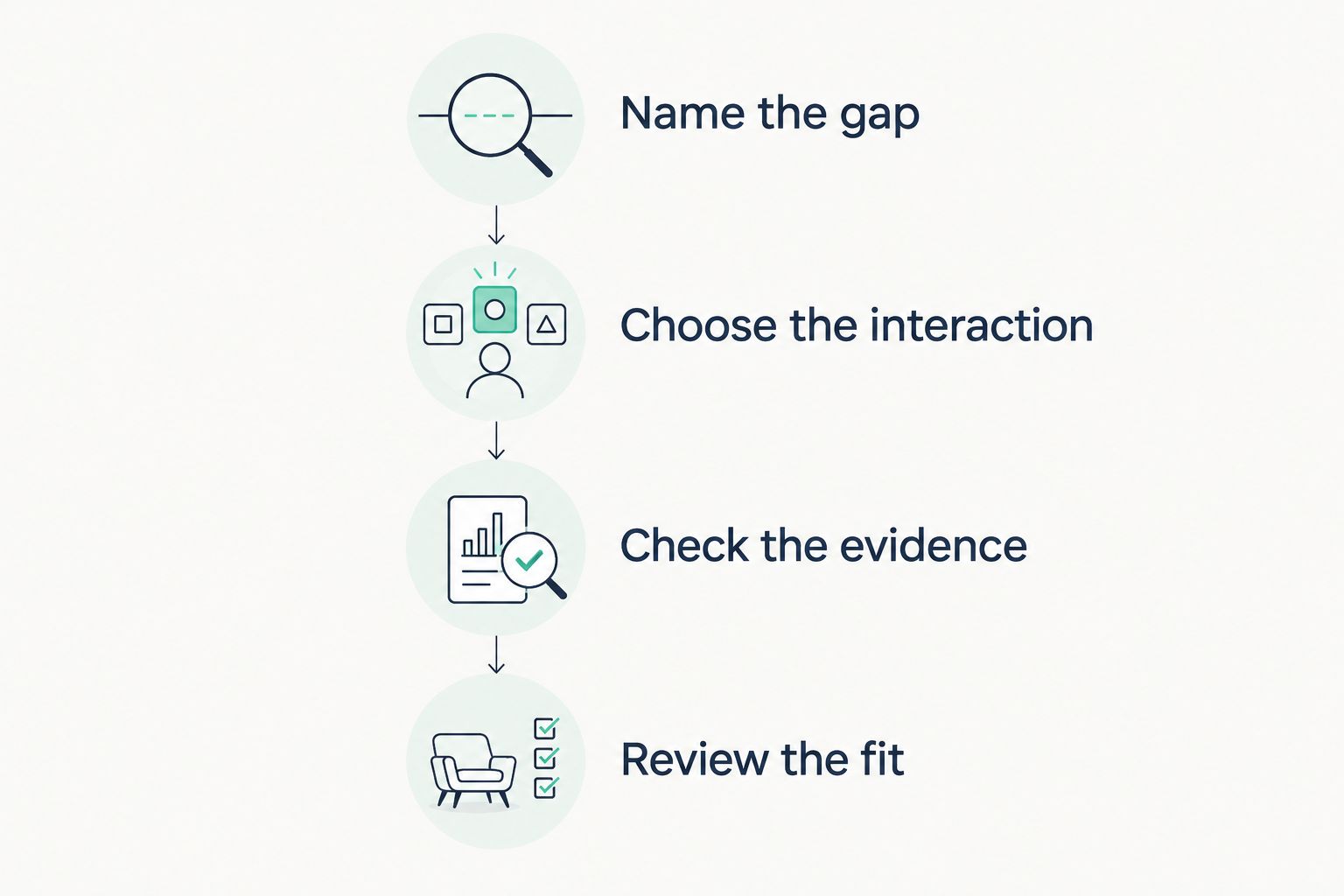
For a practical 2026 decision, use this sequence. It keeps the choice focused on what your student needs rather than on which service has the most features.
Name the gap
Write down a specific difficulty, such as explaining an inference or solving an equation independently. “Needs help in English” is too broad to guide a useful comparison.
Choose the interaction
Decide whether the missing piece is adaptive explanation, a human conversation, structured instruction, or targeted practice. Let your student describe what happens when they get stuck.
Check the evidence
Ask what you will see after a lesson. Look for information about the skill attempted, the student's answers, and the next learning step, rather than treating time spent as proof of mastery.
Review the fit
After using the option, ask your student to tackle a related problem independently. Review both their work and their experience before deciding whether the arrangement fits.
Keep the first goal small enough to observe. You can try a 10-minute session on one concept when that suits your student, without expecting a fixed result from that duration. The point is to see how the student participates and what they can explain afterward.
Which Huntington alternative should you choose?
Tia is the best fit on this shortlist for families seeking adaptive Math, English, and Science tutoring with parent learning records. Choose Wyzant if a human tutor is essential. Choose Khan Academy for structured independent study, or IXL when the main need is targeted practice.
Do not replace an entire arrangement simply because one part is frustrating. First identify whether the problem is the explanation, the format, the relationship, or the information you receive as a parent. That diagnosis makes your next choice more deliberate.
FAQ
What's the best Huntington Learning Center alternative in 2026?
The best alternative depends on the support your student needs. Choose adaptive teaching for changing explanations, Wyzant for selecting a human tutor, Khan Academy for structured independent study, or IXL for targeted practice.
Which alternative is best if we want a human tutor?
Wyzant is the human-tutor selection option on this shortlist. Evaluate the individual tutor's subject expertise, explanation style, and approach to reporting progress.
Is Khan Academy the same as one-on-one tutoring?
No, the core Khan Academy platform provides learning resources, structured courses, practice, and progress tools rather than an ongoing relationship with a human tutor. Khanmigo is a separate offering and should be evaluated separately.
Is personalized practice the same as personalized teaching?
No, personalized practice selects work around learning needs, while personalized teaching changes how a concept is explained. A student who remains confused needs more than a different sequence of questions.
Can online tutoring replace a tutoring center?
Online tutoring is an alternative when its teaching format fits your student's needs. It does not reproduce an in-person setting, so consider whether physical presence is part of the support your student needs.
What should homeschooling parents look for in progress reports?
Look for the skills studied, evidence from student answers, engaged learning time, and clear next steps. Check local reporting requirements yourself rather than assuming a provider's records satisfy every requirement.
Does speaking to a tutor work better than typing?
Speaking is a participation option, not a universally better method. Let your student use the format that helps them ask questions and explain their thinking, while keeping written work where the subject requires it.
One last thing
A correct answer and a useful explanation are not the same thing. Before committing to a tutoring option in 2026, ask your student to explain why a step works, then try a related question without copying the example. Use that work alongside the provider's progress information, not as a stand-alone diagnosis.
Related guides
- How adaptive tutoring changes a lesson
- What parents should see in a tutoring dashboard
- Personalized tutoring or personalized practice
- How to keep homeschool records without a last-minute scramble
Tia Education Team