Tia News
Best flat-rate tutoring subscriptions for families in 2026
Choose a tutoring subscription for families by subject needs, learning fit, and parent reporting. Compare monthly and annual options without buying too much.
By Tia Education Team · Published

Best overall for ongoing Math, English, and Science support: Tia’s monthly bundle. Best for one difficult subject: a one-subject subscription. Best for an established routine: the annual bundle. If another homework question has interrupted dinner, start with the support your student needs, not the largest commitment.
- Tia’s monthly bundle is the best tutoring subscription for families needing personalized support across Math, English, and Science.
- Choose a one-subject subscription when the learning need is concentrated in one subject.
- Choose an annual bundle after your student has established a useful tutoring routine.
- Flat-rate billing does not automatically mean sibling access or unlimited usage. Check the account terms.
Why this matters
A tutoring subscription should make teaching easier without taking the parent out of the picture. For a first-year homeschooler, that means help with difficult explanations and records you can review. For a school student, it means working on the sticking point rather than simply finishing the assignment.
This 2026 guide ranks subscription structures by family use case, not by a promised improvement in grades.
What makes the best tutoring subscription for families
- Learning fit: Explanations respond to the student’s pace, level, and interests.
- Subject fit: Coverage matches the subject you actually need help teaching.
- Curriculum fit: Lessons connect to the student’s curriculum, not just a general topic list.
- Parent visibility: You can review progress and actual engaged learning time.
- Commitment fit: The billing period matches how confidently you expect to use the service.
Flat-rate tutoring options at a glance
| Subscription option | Best for | Standout feature | Key limitation |
|---|---|---|---|
| Tia monthly multi-subject bundle | Ongoing support across core subjects | Adaptive tutoring across Math, English, and Science, with parent reporting | Broader coverage is unnecessary when you need only one subject |
| One-subject subscription | A concentrated learning need | Subject-focused support without choosing the multi-subject bundle | One subject does not cover needs across all three subjects |
| Annual multi-subject bundle | An established home-learning routine | Annual billing for the same core-subject scope | A longer billing period is a poor starting point when learning fit is untested |
A family-friendly subscription is not automatically a family account. Before enrolling multiple students, check how accounts, student profiles, and billing work. Do not assume a flat rate covers every student in your household.
1. Tia monthly bundle: best for ongoing core-subject support
Best for: Families supporting a student across Math, English, and Science.
Tia is a personalized tutor for students in Grades 5 through 12. It adapts teaching to the student’s pace, level, and interests while aligning lessons with the student’s curriculum. Parents get a live dashboard, honest engaged-time measurement, and self-writing records for homeschool reporting.
That combination fits a familiar situation: math needs attention today, an English assignment needs help tomorrow, and science introduces a new concept later in the week. You want consistent teaching support without treating every question as a separate purchasing decision.
The important mechanism is adaptation. A student’s interest can make an unfamiliar concept easier to approach, but the lesson still needs to connect that explanation to the actual curriculum. Read how adaptive tutoring changes a lesson to understand what to look for beyond correct answers.
Monthly bundle pros
- Covers the three stated subjects in one subscription structure.
- Adjusts teaching to the student rather than expecting one fixed pace.
- Gives parents a live view of learning activity.
- Supports homeschool recordkeeping alongside the learning itself.
Monthly bundle cons
- Broad subject coverage is unnecessary if your need is confined to one subject.
- A dashboard does not remove the parent’s responsibility to review learning.
- Math, English, and Science coverage does not establish coverage of every homeschool subject.
Use the monthly bundle when you already see recurring needs across subjects. Do not add extra learning tasks merely to justify having a bundle. Let the student’s actual work determine where tutoring belongs.
For 2026, the strongest reason to choose this structure is flexibility across the stated subjects, not a promise that a subscription will fix every difficulty. Verdict: Buy the monthly bundle when ongoing core-subject support matches your student’s needs.
2. One-subject subscription: best for a specific sticking point
Best for: Families helping a student who is struggling in one subject.
A one-subject subscription keeps the scope focused on Math, English, or Science. It is the simpler choice when the student’s wider routine is working and one area needs more explanation.
Start by naming the learning problem. For math, that might be explaining why an operation works. For English, it might be supporting a claim with evidence. For science, it might be connecting a new term to a process the student can describe.
A subject is still a broad category. Give the tutoring routine a specific purpose so you can judge whether the student is becoming more independent, not simply completing more tasks.
One-subject subscription pros
- Keeps the learning goal clear.
- Avoids selecting broader coverage before you need it.
- Fits subject-specific support alongside school or homeschool work.
- Makes it easier to compare the student’s work with the original difficulty.
One-subject subscription cons
- Does not address needs across all three subjects.
- Requires reassessment if the student’s learning needs broaden.
- A narrow focus can overlook a related difficulty, such as reading instructions in math.
Before selecting a subject in 2026, look at the student’s explanation of a recent assignment. Ask where the confusion begins. An incorrect science answer might reflect unfamiliar vocabulary rather than a misunderstanding of the science itself.
Choose the subject that addresses the main learning need. Keep the other subjects in your existing routine unless there is a clear reason to change them.
Verdict: Buy a one-subject subscription when you can identify one recurring learning need.
3. Annual multi-subject bundle: best for an established routine
Best for: Families that already know the tutoring approach fits their student.
The annual bundle provides the multi-subject subscription on an annual billing basis. Its educational scope remains Math, English, and Science; the billing period does not itself make the teaching more effective.
Choose this structure after you have seen the student use the tutoring productively. The parent should also know whether the dashboard and records fit the family’s review process.
Annual bundle pros
- Matches families planning ongoing support across the stated subjects.
- Reduces the frequency of billing decisions.
- Provides an annual subscription option once learning fit is established.
Annual bundle cons
- Creates a longer billing commitment than a monthly subscription.
- Is a poor first choice when the student has not tried the teaching approach.
- Does not guarantee consistent use or a particular academic result.
Review the current renewal, cancellation, and refund terms before choosing an annual option. Treat those terms as part of the decision, not something to investigate after enrolling.
For your 2026 planning, start with evidence of fit. A student who willingly returns to a useful explanation gives you more information than enthusiasm on the first day.
Verdict: Hold until the tutoring routine is established, then consider the annual bundle.
How we ranked these subscription options
The ranking follows learning fit, subject fit, curriculum fit, parent visibility, and commitment fit. The monthly multi-subject option comes first because it matches ongoing support across the three stated subjects without beginning with annual billing.
The one-subject option ranks next for a narrower need. The annual option belongs last in the decision sequence because its value depends on confidence in an existing routine.
This is a use-case ranking of subscription structures, not a claim that one provider outperforms every tutoring service. No grade improvement, test-score gain, or student outcome is promised by the ranking.
How to check learning fit before committing
A trial should answer a teaching question, not just a login question. Choose work the student genuinely needs help understanding. Keep the parent nearby enough to observe without supplying the answers.
Use this sequence:
- Choose a goal: Name the concept or skill the student needs to understand.
- Try a lesson: Use a real assignment or curriculum topic.
- Explain independently: Ask the student to explain the idea without repeating the tutor’s wording.
- Review records: Compare the activity record with what you observed.
- Choose coverage: Select one subject or broader coverage based on the need.
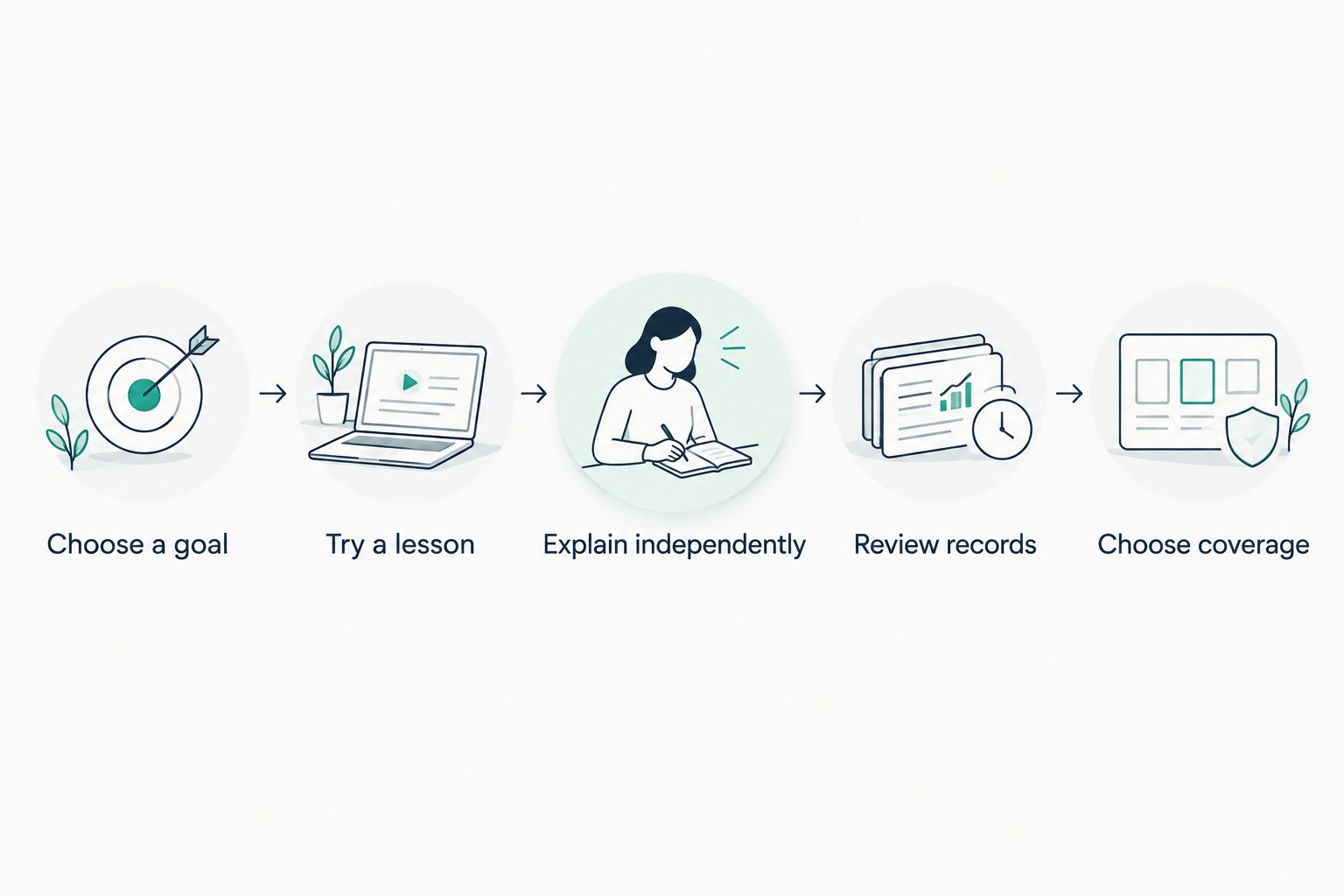
A short session can be enough to inspect how an explanation works. Start with 10 minutes if that fits your student, without treating the duration as a promised route to results. Longer is not automatically better.
The offered trial is exactly: 14-day free trial, no card needed. It is per account, not per student. Use it to evaluate the teaching and parent reporting rather than assuming it proves every future topic will be a fit.
In 2026, make the decision on the student’s learning response. Look for an explanation that the student can use in a new example, not just an answer they can copy.
What parents should check in the dashboard
A useful dashboard should help you decide what happens next. It should not leave you guessing whether an open lesson represented active learning or time away from the task.
Engaged-time measurement matters because time on a device is not the same thing as time spent learning. Review it alongside the student’s work and explanation. No single measurement should carry the whole decision.
For homeschool families, self-writing records reduce the amount you need to reconstruct later. They do not replace checking your local reporting requirements or deciding what evidence belongs in your records.
Keep your review practical:
- Compare the recorded activity with the topic the student worked on.
- Ask the student what became clearer and what remains confusing.
- Keep a work sample that shows the student’s own thinking.
- Use the record to decide whether to revisit, continue, or change approach.
You remain responsible for the learning plan. Parent reporting should make that responsibility easier to manage, not create another daily task with no clear purpose.
Choose a subscription that fits your household
Before enrolling, separate the educational decision from the account decision. The teaching might fit one student perfectly while the account structure still needs clarification for your household.
Check these details directly:
- Whether each student needs a separate account or subscription.
- Which subjects are included in the option you select.
- Whether any usage limits apply.
- How renewal, cancellation, and changes between options work.
- Whether the records meet the needs of your own reporting process.
Flat-rate describes billing, not every condition attached to access. Avoid translating it into unlimited sessions, shared sibling access, or unrestricted account changes unless the current terms explicitly confirm those features.
For first-year homeschoolers, start with one core resource per subject. Add tutoring where an explanation or learning need calls for it. You do not need several overlapping subscriptions to prove that you are taking the work seriously.
Which tutoring subscription should you choose?
Tia’s monthly bundle is the best default for families needing personalized tutoring across Math, English, and Science. It combines adaptive teaching with parent visibility while letting you begin on a monthly billing basis.
Choose one subject when the need is concentrated. Consider annual billing only after the student’s routine and the parent’s review process are working.
Before committing, ask one final question: can your student explain something they could not explain before? Use that answer alongside the records, curriculum fit, and account terms.
FAQ
What’s the best tutoring subscription for families in 2026?
The monthly multi-subject bundle is the best default in this guide for families needing personalized support across Math, English, and Science. Choose one subject instead when the learning need is narrow, and consider annual billing after establishing fit.
Does a flat-rate tutoring subscription cover every student in my family?
Flat-rate billing does not establish that every student in a household is covered. Check student-account rules and subscription requirements before enrolling multiple students.
Is a monthly tutoring subscription better than an annual subscription?
Monthly billing is the better starting point when you are still evaluating learning fit. Annual billing suits an established routine, but it does not make the tutoring itself more effective.
What grade levels does the personal tutor support?
The personal tutor supports students in Grades 5 through 12. Its stated subjects are Math, English, and Science, with teaching adapted to the student’s pace, level, and interests.
Can tutoring records replace my homeschool reporting responsibilities?
Tutoring records do not replace your responsibility to meet local homeschool requirements. Review the self-writing records, retain relevant work samples, and check what your jurisdiction requires.
How long should a tutoring session be?
Choose a session length that fits the student and the learning goal. As little as 10 minutes can be a starting point for a small, regular session, without promising a fixed result from that duration.
Can I try the tutoring before subscribing?
The offer is: 14-day free trial, no card needed. The trial is per account, not per student; use it to evaluate the teaching approach, student engagement, and parent reporting.
One last thing
Use a different example to check understanding. After a lesson, ask the student to apply the idea without following the same sequence they just saw.
A familiar answer can hide a remaining gap. A fresh example gives you a practical reason to continue, revisit the explanation, or adjust the method before choosing a longer subscription.
Related guides
- What parents should see in a tutoring dashboard
- How to keep homeschool records without a last-minute scramble
- How to make a 10-minute daily tutoring session count
Tia Education Team