Tia News
Personalized tutoring for expat families: complete 2026 guide
Choose tutoring for expat families that fits your student's curriculum, pace, and move. Compare options, plan short lessons, and track learning across borders.
By Tia Education Team · Published

Tutoring for expat families is personalized learning support that helps students continue learning while their family lives abroad or moves between education systems. If you are unpacking boxes while trying to understand a new school’s homework, the goal is not more work: it is teaching that fits your student and the curriculum they need now.
- Choose tutoring for expat families by curriculum fit and individual teaching, not the tutor’s location alone.
- Tia fits families seeking personalized Math, English, and Science tutoring for students in Grades 5 through 12.
- Separate unfamiliar subject vocabulary from missing subject knowledge before choosing lessons.
- Keep learning records across moves, but confirm reporting and enrollment requirements with the relevant authority.
Why tutoring matters for expat families
A move gives you several decisions at once. You need to understand the receiving school’s expectations, find out what your student already knows, and build a routine around a different family schedule. Choose tutoring around the student’s next learning task, not simply the country on your mailing address.
Tia personalized tutoring adapts Math, English, and Science teaching to a student’s pace, level, and interests. It also gives parents a live dashboard and engaged-time measurement. These features address different decisions: how to teach the student, and how you can see what is happening.
For your 2026 learning plan, separate continuity from catch-up. Continuity means keeping a familiar skill moving during a transition. Catch-up means teaching something the receiving curriculum expects but your student has not yet learned.
Neither situation tells you that your student is generally behind. A student can understand fractions while being unfamiliar with the method or vocabulary used in a new classroom. Start with a specific example before adding a broad remedial program.
How to choose tutoring that travels with your family
1. Identify the curriculum your student needs now
Begin with documents you already have. Gather the current course outline, recent assignments, and any information from the receiving school. If you homeschool, identify the curriculum you have chosen and check the requirements that apply where you live.
Write down the destination before comparing tutors. Is the immediate goal completing the current course, joining a new class, or maintaining learning during a temporary stay? Those goals need different lesson priorities.
For a 2026 transfer, ask the receiving school for current expectations rather than relying on another family’s older checklist. A familiar grade label is not enough to establish what your student needs to learn.
- Name the current curriculum and subject.
- Record the receiving course or grade level.
- Request the next unit’s learning objectives.
- Mark topics taught in one system but not yet in the other.
- Confirm who decides placement and accepts learning records.
2. Find the actual starting point
Ask your student to work through an ordinary assignment and explain their thinking. Use existing work before purchasing a separate assessment. Listen for the exact place where the task becomes difficult.
Distinguish three questions: does the student understand the concept, understand the wording, and know the expected response format? A science answer written in an unfamiliar format is a different tutoring task from a misunderstood science concept.
Keep this conversation calm. You are choosing a starting point, not asking your student to prove they deserve their current placement. Share the work with a prospective tutor and ask how the lesson would begin.
- Choose a representative assignment from the current course.
- Ask your student to explain a successful answer.
- Identify the first unclear instruction or step.
- Note subject vocabulary that needs explanation.
- Separate independent work from work completed with help.
3. Match the teaching to your student
Try changing the explanation before changing the whole resource. Explain a math idea with objects, sketch it, and then connect the sketch to symbols. For writing, discuss the idea aloud before asking for a paragraph.
Your student’s interests give you another starting point. A sports example or a familiar story can make a task recognizable without changing its learning objective. Ask prospective tutors to demonstrate this connection using the actual topic your student needs.
Tia personalized tutoring fits expat families seeking curriculum-aligned Math, English, and Science teaching that adapts to the individual student. Its scope is students in Grades 5 through 12; it is not a replacement for enrollment decisions or local education advice.
The guide to how adaptive tutoring changes a lesson explains the teaching approach to look for, rather than choosing on curriculum coverage alone.
- Bring a topic from the student’s current course.
- Share an interest the student genuinely enjoys.
- Ask for a different explanation when the first one fails.
- Check that the student does the reasoning.
- Confirm the exact curriculum and course fit before committing.
4. Build a lesson rhythm around local life
Start with your family’s actual week. Mark school, travel, meals, activities, and rest before adding tutoring. Choose a repeatable opening rather than filling every empty space.
A session as short as 10 minutes can be an option when it fits your student and a narrow task. That duration is a planning choice, not a promise of progress. Reading a passage closely and drafting an essay need different amounts of attention.
For live tutoring, confirm the appointment in both locations and check daylight-saving changes. For any online option, check access from your destination and ask what happens when travel interrupts your routine. Do not assume location-independent access or offline use.
- Anchor lessons to a familiar daily event.
- Give each session a clear learning task.
- Confirm live appointments in the correct time zone.
- Check device, connection, and destination access requirements.
- Leave room to shorten or pause lessons during travel.
5. Support academic English alongside subject learning
Begin by reading the task together. Ask your student to explain what the question wants, then discuss the subject idea separately. This helps you decide whether the next lesson should focus on language, content, or both.
A student who can explain an idea conversationally still needs to learn how that idea appears in a course answer. Words such as compare, justify, and evaluate tell the student what to do, not just what topic to discuss.
Read aloud together even with older students when that fits the task. Keep the original learning goal visible so vocabulary practice does not replace the Math or Science concept your student needs.
- Highlight unfamiliar instruction words.
- Build a small glossary from current assignments.
- Ask for an oral explanation before a written response.
- Model how evidence supports an answer.
- Check whether language support needs a separate specialist.
6. Keep records that explain the learning
Create a simple record before the next move. A folder containing course information, selected work, and short progress notes is more useful than a collection of unexplained completion badges.
For your 2026 records, separate time spent with a lesson open from time spent engaged in learning. Also save work showing what the student can do independently. Neither measure tells the whole story by itself.
Tia provides engaged-time measurement, a live parent dashboard, and self-writing records for homeschool reporting. Use these alongside work samples and the requirements you have confirmed locally. A tutoring record does not automatically become an accepted transcript or compliance document.
- Record the date, subject, and learning objective.
- Save a work sample that shows the student’s reasoning.
- Note the help needed to complete the task.
- Keep course names consistent across your records.
- Ask the receiving school or authority what it accepts.
7. Review the fit before adding more lessons
Choose a review point before starting. Compare a new task with the starting work: can your student explain more, work with less help, or use the skill in a different question? Keep the comparison focused on the objective you selected.
Ask your student about the lesson too. An explanation that makes sense and a routine they can sustain are relevant to fit. If the task remains unclear, adjust the teaching or investigate the missing prerequisite before adding volume.
Before the next move in 2026, update the curriculum goal and lesson rhythm. Keep useful work samples, but do not assume the same course sequence or reporting rules apply in the new location.
- Revisit the original learning objective.
- Compare independent work on a similar task.
- Ask which explanations helped your student.
- Check whether the schedule still fits local life.
- Change the method before simply increasing lesson time.
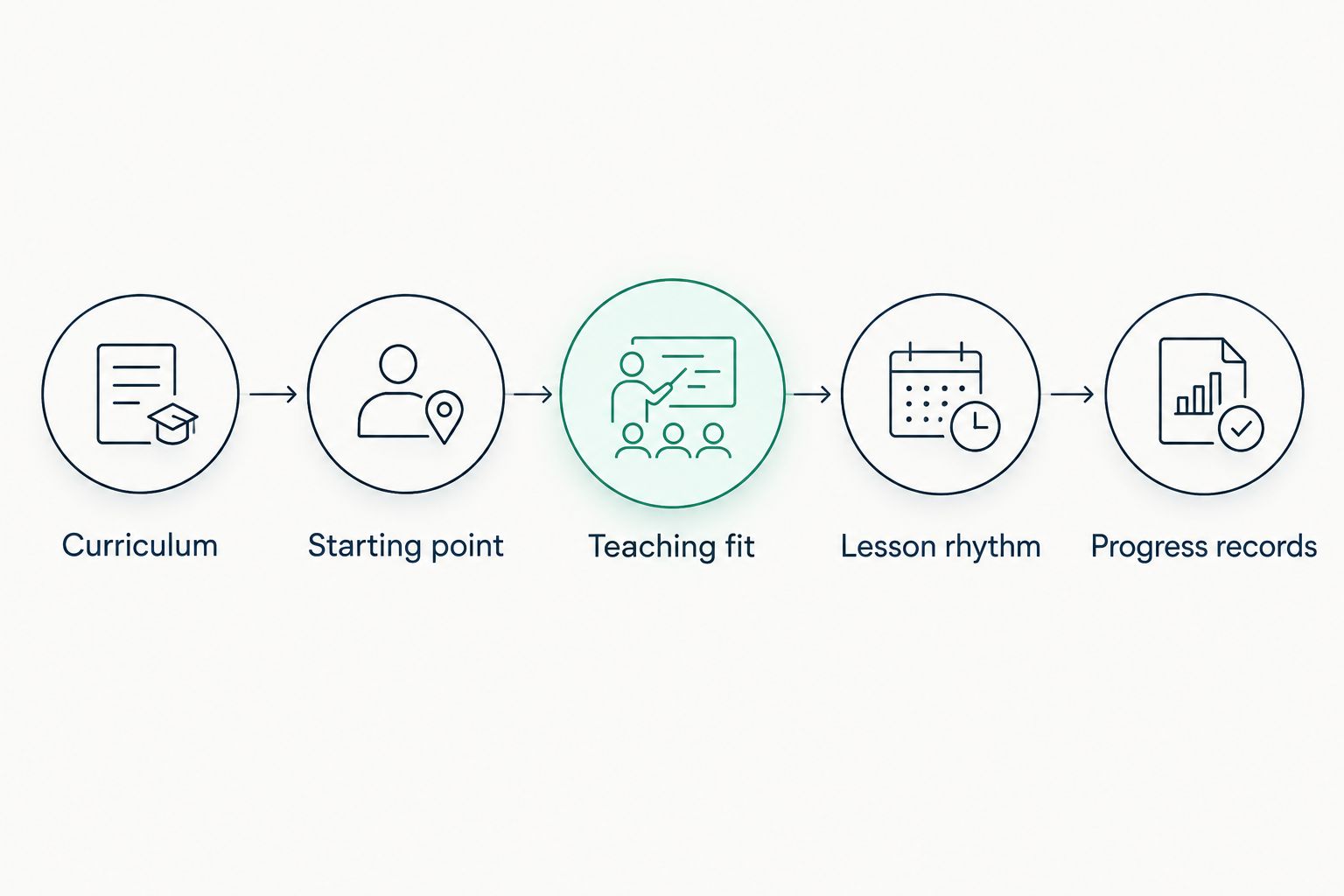
Your decision sequence is simple: identify the curriculum, find the starting point, choose the teaching fit, set the lesson rhythm, and keep progress records. Revisit the sequence when the student’s course or location changes.
Compare tutoring options for expat families
Choose the type of support before comparing individual providers. A parent-led routine gives you direct control. A live tutor gives you scheduled personal interaction. An adaptive personal tutor changes teaching around the individual student.
For your 2026 comparison, ask every provider the same questions about curriculum fit, teaching method, access, and records. The table describes decision criteria, not a guarantee that every provider within a category offers the same service.
| Option | Best for | Main advantage | Key limitation |
|---|---|---|---|
| Parent-led practice | Families maintaining a narrow skill during a move | You choose the task and timing directly | You must prepare explanations and judge understanding |
| Live online human tutor | Students who need scheduled conversation and direct human feedback | You can discuss the student’s reasoning during the lesson | You must confirm curriculum expertise and time-zone fit |
| Local in-person tutor | Families prioritizing face-to-face support near their new home | Lessons happen in a shared physical setting | Local proximity does not establish familiarity with the student’s curriculum |
| Tia | Families seeking adaptive Math, English, and Science tutoring for Grades 5 through 12 | Teaching adapts to pace, level, and interests, with parent records | The stated scope does not include younger grades, other subjects, or enrollment services |
Choose the smallest arrangement that meets the identified need. You do not need to replace every subject resource because one course has become difficult. If your student needs a specialist, ask about that specific expertise rather than treating general tutoring as equivalent.
Common mistakes expat families make
Treating matching grade labels as matching content
A grade label does not tell you which topics your student has studied. Compare course objectives and actual assignments before deciding what needs attention. Keep the focus on missing topics rather than labeling the whole student as behind.
Choosing only by the tutor’s country
A tutor’s location is not proof of curriculum fit. Ask how the tutor would teach a current assignment and connect it to the receiving course. Confirm language and scheduling fit separately.
Mistaking unfamiliar wording for missing knowledge
Do not start a broad catch-up program because your student hesitates over a new instruction. Ask them to explain the underlying idea in familiar language first. Then teach the vocabulary or answer format they need.
Assuming tutoring records satisfy local requirements
Keep the records, but confirm who accepts them and for what purpose. A dashboard can help you monitor learning without authorizing homeschooling or awarding course credit. Check requirements before relying on a document.
Keeping the old schedule after the family moves
A routine that worked before the move needs a fresh check against school hours, travel, and rest. Preserve the learning priority, not necessarily the appointment time. Let your student help choose the new rhythm.
FAQ
What’s the best tutoring for expat families?
The best fit is tutoring that matches the student’s current curriculum and adapts teaching to their starting point. Tia fits families seeking personalized Math, English, and Science support for Grades 5 through 12, while live human tutoring fits families prioritizing scheduled human interaction.
Should we follow our home-country curriculum or our new school’s curriculum?
Follow the curriculum tied to your student’s current enrollment or the learning plan you have chosen. If you expect another transfer, discuss the transition with the receiving school rather than asking a tutor to decide placement.
Can a student need tutoring without being behind?
Yes, tutoring can address unfamiliar terminology, response formats, or a topic not yet taught in the previous course. Use actual work to identify the need before choosing a catch-up program.
How long should tutoring sessions last during a move?
Choose a length that fits the student and the specific task. A 10-minute session is an option for a narrow activity, not a fixed prescription or a guarantee of learning results.
Can online tutoring replace school or homeschool requirements?
Online tutoring does not automatically replace enrollment, reporting, or other local education requirements. Confirm your obligations with the relevant school or authority and use tutoring as part of the learning arrangement you establish.
What should parents track when students learn abroad?
Track the curriculum objective, independent work, help needed, and engaged learning time. Keep selected work samples and confirm which records a receiving school or authority accepts.
Does Tia have a trial for expat families?
Tia’s offer is 14-day free trial, no card needed. The trial is per account, not per student; confirm destination access and the exact curriculum fit before relying on it during a move.
One last thing
Before your next move, save a piece of work your student understands well, not just the assignment they struggled with. Ask them to explain it in their own words. That gives the next tutor a clear starting point: something familiar to connect to the unfamiliar task.
You stay in charge of the learning arrangement. Your student stays in charge of doing the learning.
Related guides
- Choose a curriculum for an international student
- Keep homeschool records without a last-minute scramble
- What parents should see in a tutoring dashboard
Tia Education Team