Tia News
Personalized Tutor for Photosynthesis: 2026 Parent Guide
A personalized tutor for photosynthesis fixes the one missed concept first. Compare options for cell biology help in 2026, plus what Tia does differently.
By Tia Education Team · Published
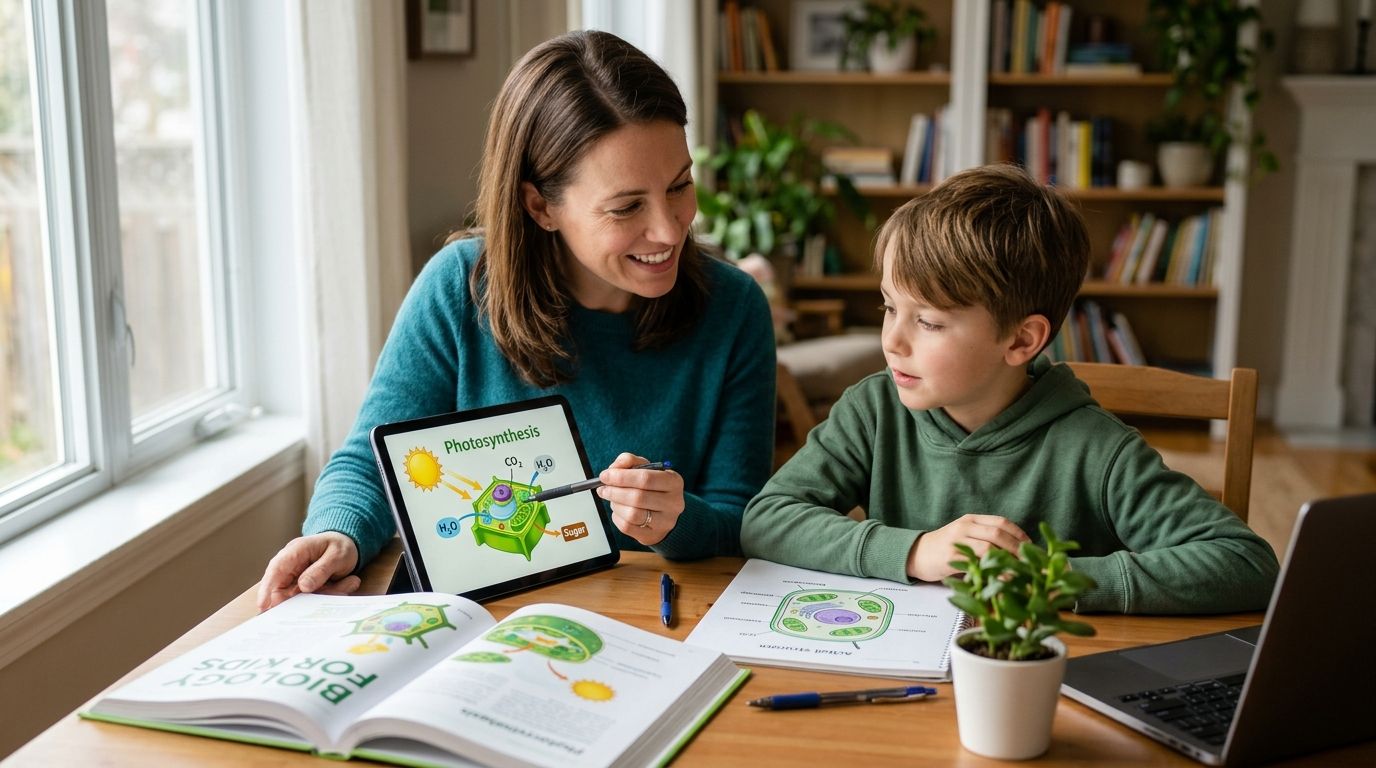
A personalized tutor for photosynthesis and cell biology gives a student who is stuck on chloroplasts, mitochondria, or the light and dark reactions a one-on-one path back to understanding, at whatever pace those two units actually take. Middle and high school biology moves fast: a student can miss one linking idea in September and spend the rest of the semester guessing on every diagram that builds on it.
- A personalized tutor for photosynthesis works best when it fixes vocabulary gaps before piling on more diagrams.
- Tia adapts pace and interests for cell biology units and reports engaged time to parents.
- Free videos handle definitions well but cannot catch a student's specific point of confusion.
- Bloom's two-sigma finding: average tutored students reached the 98th percentile.
- Tia is best for students who need to slow down cell biology without falling behind the class.
Why this matters for students struggling with photosynthesis
Cell biology is dense in a way earlier science units are not. A student who was fine with the water cycle can suddenly hit chloroplast structure, ATP, and two separate sets of reactions inside the same organelle, all in one chapter. That density is exactly where a general-purpose review misses the mark and a personalized science tutor for biology students earns its place.
A Washington Post report found that 51% of parents doubt their own ability to teach upper-grade material, and biochemistry at the cell level is the kind of content that triggers that doubt fastest. Bloom's two-sigma finding was that average tutored students reached the 98th percentile compared with conventionally taught peers. The Education Endowment Foundation separately found that one-to-one tuition adds roughly five months of progress. None of that requires abandoning the classroom teacher; it means the gap between hearing something once in class and actually understanding it needs a second, closer pass in 2026 the same way it always has.
Update your understanding of where the gap actually is
Most parents assume the whole unit is the problem. Usually it is one linking concept, and everything downstream of it collapses.
- Ask the student to write the photosynthesis equation from memory and mark exactly where they hesitate
- Compare chloroplast and mitochondria functions side by side on paper, out loud
- Pull the last quiz or worksheet and circle every term missed, not just the wrong answers
- Time a five-minute freewrite where the student explains what a cell membrane actually does
- Notice whether the confusion is vocabulary (what a term means) or process (how steps connect)
Rebuild vocabulary before adding another diagram
Biology vocabulary compounds. A student who is shaky on stroma and thylakoid will not follow a diagram that uses both terms in one sentence.
- Build a short glossary of the 10 to 15 terms actually used in the current unit, not the whole chapter
- Quiz definitions out of order, not in the sequence they were taught
- Have the student explain each term in plain language to someone else
- Flag any term the student can define but cannot use correctly in a sentence
Use models the student can rebuild, not just study
Static diagrams are easy to stare at and hard to actually learn from. A student who can recognize a labeled diagram but cannot redraw it blank has not learned the process yet.
This is where an adaptive, personalized tutor moves faster than a worksheet packet. Tia rebuilds the same photosynthesis or cell structure model at a slower pace, with more intermediate steps, until the student can redraw it unaided. That is the difference between reviewing a concept and owning it.
- Have the student redraw the chloroplast from memory, then check it against the textbook
- Build a simple physical model with household materials, a plastic bag membrane and beads for organelles
- Use an interactive model where the student moves labels rather than just reading them
- Ask the student to narrate the model out loud while rebuilding it
Connect the process to something the student already cares about
A student who plays soccer understands energy transfer intuitively; the same student may glaze over at ATP synthase. The fix is not more repetition, it is a better entry point.
Tia teaches through each student's actual interests rather than a fixed script, so a student focused on cooking gets photosynthesis explained through food energy, and a student focused on gaming gets it explained through energy systems and resource conversion. That reframing does more for retention than a fourth pass through the same diagram.
- Ask what the student is currently into before starting the review session
- Reframe the process using that interest as the entry metaphor
- Let the student explain the connection back, not just receive it
- Revisit the same metaphor at the next study session to reinforce it
Practice retrieval instead of rereading
Rereading notes feels productive and teaches almost nothing. Retrieval, forcing the brain to produce the answer without looking, is what moves information into long-term memory.
- Close the notes and write the full photosynthesis equation from blank paper
- Quiz with flashcards in random order, not in the sequence studied
- Explain the difference between light-dependent and light-independent reactions without notes
- Predict what a quiz question will ask before seeing it
Time review sessions before the exam, not the night before
Spaced review beats cramming for biology specifically because the unit builds on itself. A student who crams the night before an exam has no time to fix a misunderstanding discovered at 10pm. Reviewing the process well ahead of a test, using a structured plan for how to prepare for a biology exam, catches gaps while there is still time to close them.
- Schedule three short review sessions across the two weeks before the exam, not one long session
- Test the hardest concept first, while attention is freshest
- Leave the final session for weak spots only, not a full reread
- Sleep before the exam instead of studying late
Track engaged time, not just completed assignments
A student can finish a worksheet in eight minutes without absorbing anything. Parents need to see actual engaged time, not just a checkmark next to an assignment.
- Ask what specifically was learned in the session, not just whether it was completed
- Look for whether the student can explain the concept back unprompted
- Compare time spent against material actually covered
- Use a dashboard that separates active learning time from idle screen time
Comparing options for photosynthesis and cell biology help
| Option | Best for | Cost structure | Key limitation |
|---|---|---|---|
| Free videos | Building baseline vocabulary | Free | No feedback on the student's specific point of confusion |
| School peer tutoring | Quick clarification during school hours | Usually free | Limited availability; pace set by the group |
| Independent human tutor | Deep sessions on a fixed schedule | Paid, typically per session | Fixed session times; less flexible for short daily practice |
| Tia personalized tutor | Ongoing, pace-matched review with parent visibility | Paid, flat subject or bundle pricing | Screen-based; does not replace hands-on lab work |
Verdict: free videos are the right starting point for vocabulary, but a student still stuck after watching them needs something that adapts to the exact gap, which is where Tia is built to work.
See how Tia handles a biology gap
14-day free trial, no card needed. Adaptive tutoring for Math, English and Science.
Common mistakes with photosynthesis and cell biology review
- Memorizing the photosynthesis and respiration equations without seeing that they run in opposite directions, treating them as two unrelated formulas to recite
- Treating chloroplasts and mitochondria as interchangeable energy parts instead of learning what each organelle does and in which cell type
- Skipping the split between the light-dependent and light-independent reactions, then guessing on every exam question that separates them
- Cramming vocabulary the night before the test instead of spacing retrieval practice across two weeks
- Relying only on the textbook diagram and never testing whether the student can redraw it from memory
Hattie's research found that teacher expectations are among the strongest influences on achievement, which cuts both ways. A student told biology is not their subject tends to underperform relative to one told the gap is fixable. Most cell biology struggles in 2026 classrooms are a sequencing problem, not an ability problem.
FAQ
What is the best way to help a student struggling with photosynthesis?
Find the exact linking concept the student missed, usually vocabulary or the light versus dark reaction split, then rebuild from there instead of rereading the whole chapter. A personalized tutor for photosynthesis that adapts pace to the specific gap closes it faster than general review.
Is a personalized tutor better than watching biology videos alone?
Videos are a good first pass for vocabulary and basic sequencing, but they cannot catch a student's specific point of confusion the way one-on-one feedback can. Most students need both: video for first exposure, personalized review for the gap that remains.
How much does personalized tutoring for biology cost in 2026?
Cost varies by provider and format, from free peer tutoring to paid per-session human tutors to flat monthly subject pricing. Check current pricing directly with whichever service fits the student's schedule and subject list.
Can adaptive tutoring help with AP Biology as well as middle school cell biology?
Yes, the same rebuild-the-gap approach applies at both levels. AP Biology adds depth and pace pressure, but the underlying confusion points, organelle function and energy transfer, are often the same ones missed earlier.
What is the biology mix-up students make most often?
Treating photosynthesis and cellular respiration as unrelated processes rather than recognizing they are linked and run in opposite directions. This single mix-up causes wrong answers across multiple exam questions.
How long does it take to fix a cell biology gap with tutoring?
A single missed linking concept can often be resolved in two to three focused sessions once it is correctly diagnosed. Broader gaps across a whole unit take longer and benefit from spaced review over two to three weeks.
Do parents get to see what happens in tutoring sessions?
With Tia, parents get a live dashboard with honest engaged-time measurement rather than just a completion checkmark. Ask any tutoring service exactly what it tracks before committing.
Should a student switch tutors if photosynthesis still is not clicking?
Not immediately. First confirm the sessions target the specific confusion, vocabulary versus process, rather than general review. If the same gap persists after three sessions with no new approach, reassess the method.
One last thing
The photosynthesis and respiration equations are near mirror images of each other, and once a student sees that reversal clearly, a large share of the unit's confusion resolves at once. Most students are taught the two equations on different days, weeks apart, which is exactly why the connection gets missed. Point it out directly, on paper, side by side, before moving on to anything else in the 2026 biology sequence.