Tia News
Personalized Science Tutor for Biology: Worth It in 2026
A personalized science tutor for biology adapts pacing, explains genetics and ecology in plain terms, and gives parents a dashboard. See if Tia fits in 2026.
By Tia Education Team · Published · Last updated
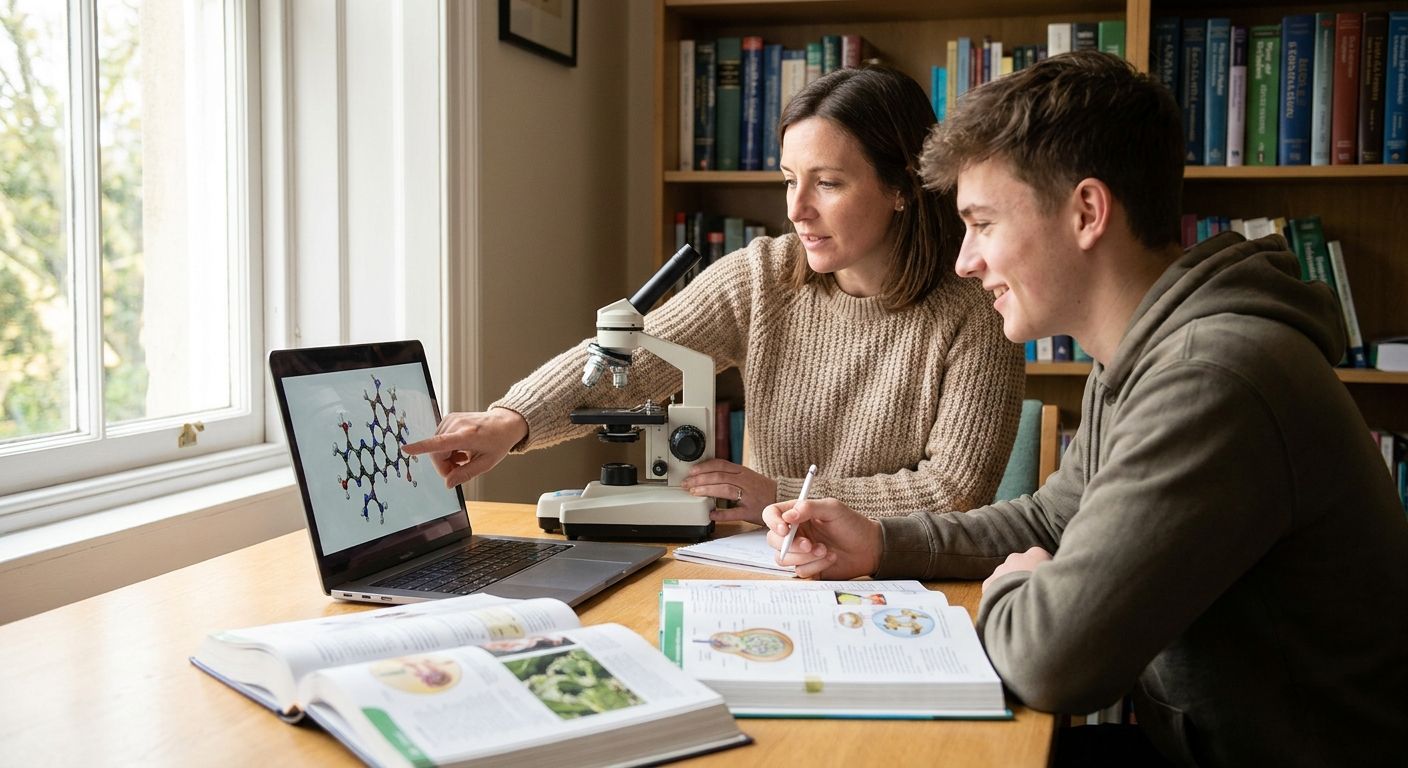
Biology grades slip for reasons that have nothing to do with intelligence: dense vocabulary, ratio math hiding inside genetics problems, and a pace that never slows down for a confusing unit. A personalized science tutor for biology fixes the pacing problem first, then works on the content itself. Tia is built to do both for students in grades 5 through 12.
- Tia is a personalized science tutor for biology that adapts pace by concept, not by grade. Fit: strong.
- Genetics problems are ratio math in disguise; students who struggle there often need algebra support too.
- AP Biology weights free-response questions at 50% of the score, so writing practice matters as much as recall.
- Static video libraries and answer-only chatbots are not personalized science tutors. Skip them for biology.
- A useful parent dashboard shows which concept stalled, not just a letter grade for the unit.
Why this matters
Most families notice a biology problem too late, usually at the first quarter report card. By then the student has missed the foundation for the next unit, because biology stacks: cell structure feeds into genetics, genetics feeds into evolution, evolution feeds into ecology. A personalized science tutor for biology catches the stall in the unit where it happens, not three units later.
That is the entire pitch behind adaptive tutoring in 2026: catch the gap while it is still one concept wide. Tia does this by working through problems with the student in real time instead of assigning a video and checking a box.
Who a personalized biology tutor is for
This fits a student in grades 5 through 12 who understands material in class but freezes on homework, or who can recite vocabulary but cannot apply it to a Punnett square or a food web diagram. It also fits students prepping for AP Biology, where free-response writing counts for half the exam score. It is a weaker fit for a student who is already ahead of the curriculum and just wants enrichment; that student needs a different kind of stretch than pacing correction.
What to look for in a personalized science tutor for biology
Adaptive pacing, not a fixed curriculum
A tutor that moves at a preset weekly schedule regardless of mastery will leave gaps in exactly the units biology depends on most. Pacing should slow down on meiosis and speed up on material the student already has cold.
Concept explanations in plain language
Biology drowns students in vocabulary before they understand the underlying idea. A tutor that explains osmosis with a raisin in water before naming it "hypertonic solution" teaches the concept before the label, which is how retention actually works.
Cross-subject support when biology leans on math or reading
Genetics ratios are algebra. Population growth curves in the ecology unit are pre-calc functions. A textbook chapter on cellular respiration can introduce dozens of new terms in a single sitting. A tutor that only knows biology vocabulary and not the math or reading skill underneath it will stall on exactly these units.
A parent dashboard that shows more than a grade
A number on a report card tells you nothing about where the confusion started. A dashboard should show which concept the student is stuck on this week, not just whether last week's quiz score went up or down.
Curriculum coverage from cell biology through AP-level content
A tutor needs to cover the full arc: cells, genetics, evolution, ecology, physiology, and AP-level material where relevant. Coverage that stops at general middle school biology will not carry a student through an AP Biology course.
Which kind of support actually fits your biology student
The math-avoider, on genetics. Punnett squares and dihybrid crosses are ratio and probability problems wearing a biology costume. If your student's real issue is proportional reasoning, pairing biology sessions with algebra 1 tutoring closes the actual gap instead of re-explaining biology vocabulary that was never the problem. Verdict: Consider pairing.
The vocabulary wall, on cellular processes and taxonomy. A single unit on cellular respiration or classification can introduce dozens of new terms, and a student who cannot decode the reading falls behind on content they could otherwise handle. If reading comprehension is the bottleneck, support for struggling readers addresses the actual skill gap. Verdict: Consider pairing.
The AP Biology exam sprinter. College Board's 2026 AP Biology format weights free-response questions at 50% of the total score, which means a student who only drills multiple choice is preparing for half the exam. Writing structured, evidence-based answers is a distinct skill from recognizing the right answer in a list, and it needs its own practice through essay and structured-writing tutoring. Verdict: Buy the pairing before exam season, not during it.
The straight biology case, no cross-subject gap. Some students just need the concepts explained at their own pace, with a dashboard the parent can check without decoding a report card. This is the core case Tia is built for, and it needs nothing added on top. Verdict: Buy.
See if Tia fits your student
Personalized biology tutoring for grades 5-12, with a dashboard for parents.
What looks like personalized tutoring but isn't
- A video library sorted by topic. Watching a video on mitosis is not the same as being asked to explain mitosis back and getting corrected mid-sentence. There is no adaptation happening, just a menu.
- An answer-only homework bot. A tool that gives the right answer to a Punnett square without asking the student to work through the cross first teaches nothing; it just finishes the worksheet faster. If a tutor answers the question before your child finishes reading it, that is a red flag, not a shortcut.
- Test-prep drilling with no concept review. Heading into a 2026 AP Biology exam with nothing but practice questions and no explanation of why an answer is wrong will plateau a student's score well below where concept understanding would take them.
How the options compare
| Approach | Best for | Watch for | Verdict |
|---|---|---|---|
| Adaptive 1-on-1 biology tutoring (Tia) | Concept gaps, pacing issues, AP prep | Needs consistent weekly sessions to show results | Buy |
| Biology + algebra pairing | Genetics ratio confusion | Two sessions to schedule instead of one | Consider |
| Biology + reading support pairing | Vocabulary-heavy units, dense texts | Slower initial pace while reading catches up | Consider |
| Video library, self-paced | Review of material already understood | No correction when the student gets it wrong | Skip for new material |
| Answer-only homework bot | Checking a finished answer | Skips the reasoning the exam actually tests | Skip |
FAQ
What makes a tutor "personalized" for biology specifically?
A personalized science tutor for biology adjusts pace by concept, not by a fixed weekly schedule, and explains ideas like osmosis or natural selection in plain language before introducing the vocabulary. Tia builds each session around where the student actually stalled, not a generic lesson plan.
Does a biology tutor need to cover math too?
Genetics ratios and ecology growth curves both rely on math skills, so a tutor that only knows biology vocabulary can stall on those units. Pairing biology sessions with algebra or pre-calc support closes that gap directly.
Is a personalized biology tutor better than a general AI chatbot?
A chatbot that gives answers without asking the student to reason through the problem does not build the skill an AP Biology free-response question actually tests. A personalized tutor walks through the reasoning with the student instead of finishing the worksheet for them.
What grade levels does Tia cover for science?
Tia tutors students in grades 5 through 12 across Math, English, and Science, including biology from introductory cell structure through AP-level content.
How much of the AP Biology exam is free-response writing?
College Board's 2026 AP Biology exam format weights free-response questions at 50% of the total score, with the remaining 50% from multiple choice. Students who only drill multiple choice are preparing for half the test.
How does a parent dashboard help with biology tutoring?
A dashboard should show which concept stalled this week, not just a grade average, so a parent can see the problem before the next report card. Tia's dashboard is built around concept-level progress rather than a single score.
What does personalized science tutoring cost in 2026?
Pricing depends on the plan and subject load, so check current plans directly on the Tia site rather than relying on a fixed figure here.
Does personalized tutoring replace a biology classroom teacher?
No, it works alongside classroom instruction by catching the specific concept a student missed, rather than replacing the teacher's curriculum or pacing.
One last thing
The unit that quietly tanks the most biology grades is not genetics, it is ecology, because population growth curves are pre-calc functions dressed up as food webs, and most students have never been taught the math underneath the graph. If your student's biology grade dips specifically during the ecology unit, check whether the real gap is exponential and logistic growth functions before assuming it is a biology problem at all. A personalized biology tutor that can flag that connection saves weeks of reteaching the wrong subject.