Tia News
Personalised Tutor for Geometry Proofs: 2026 Guide
A personalised tutor for geometry proofs helps students who know the theorems but freeze on the logic. See what works in 2026, plus how Tia's approach fits.
By Tia Education Team · Published
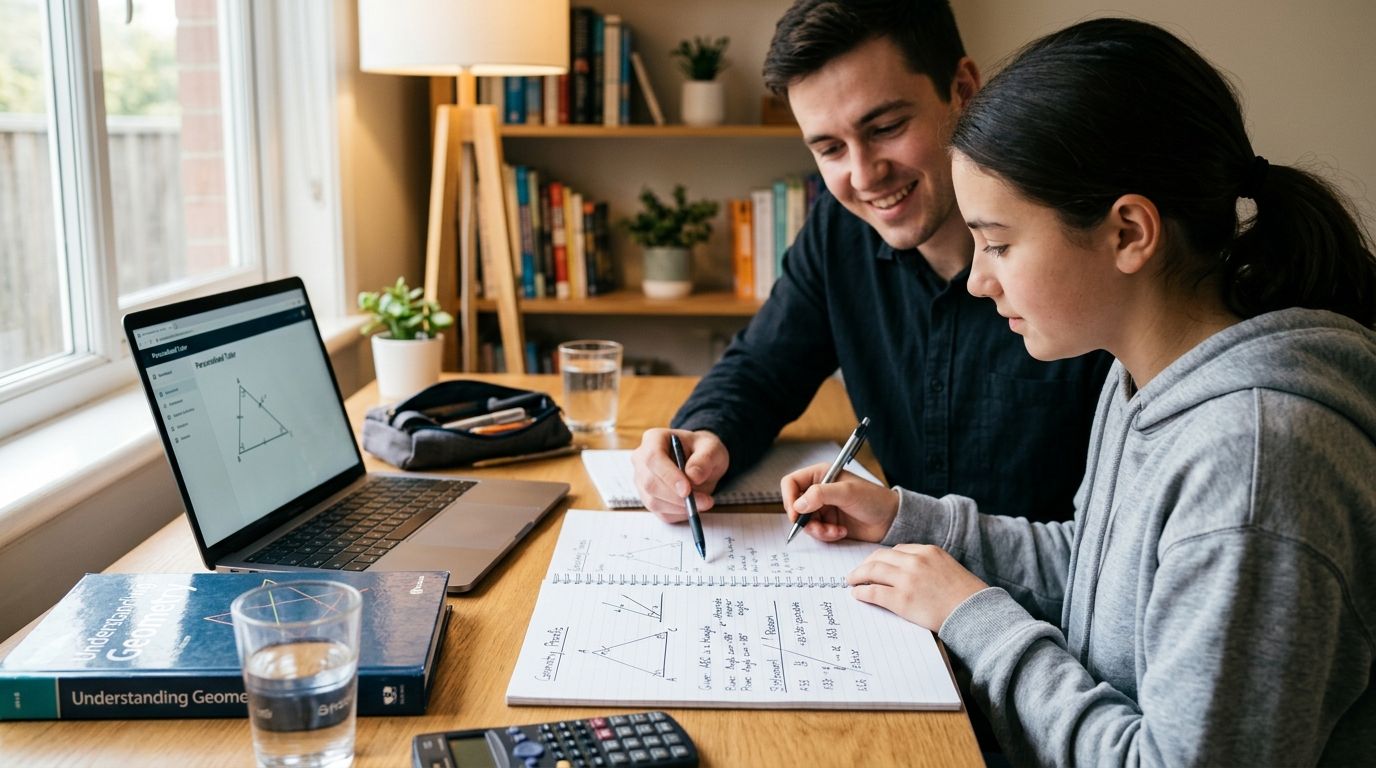
Students struggling with geometry proofs usually know the theorems by heart but cannot chain three of them into a valid argument. A personalised tutor for geometry proofs works on that exact gap: building a logical sequence from given statements to a conclusion, not re-teaching shapes and angles from scratch. That makes this segment different from students who struggle with arithmetic or basic algebra, where the fix is usually more repetition rather than more logic.
- A personalised tutor for geometry proofs works best for students who know the theorems but freeze on the logical sequence.
- Tia's personalised tutor breaks proofs into small, adaptive steps and gives parents a live dashboard of engaged time.
- One-to-one tuition adds roughly five months' extra progress compared with no tutoring, per the Education Endowment Foundation.
- Free options such as office hours or study groups help with quick checks but rarely build independent proof-writing fluency.
Why personalised tutoring matters for geometry proofs
Geometry proofs are usually the first place a student meets formal logic, and it shows up hard in Grade 9 or 10 maths. A personalised geometry tutor can isolate the exact step where the logic breaks, which a 30-student classroom rarely has time to do.
The Education Endowment Foundation has found that one-to-one tuition adds roughly five months' extra progress compared with no tutoring at all. Bloom's two-sigma finding goes further: the average tutored student reached the 98th percentile of a comparable group taught in a standard classroom. Neither figure is proof-specific, but both explain why parents search for one-to-one help the moment proofs appear on the syllabus in 2026.
A personalised tutor for geometry proofs is worth it specifically for students who can state a theorem correctly but cannot yet build the argument that uses it, and that is a narrower, more fixable problem than "bad at maths".
How to build proof-writing skill, step by step
Diagnose exactly where the logic breaks
Before any tutor, free or paid, start by watching your student attempt one proof out loud. Most breakdowns happen in one of a few predictable places.
- They can state the theorem but not identify when it applies
- They skip straight from the given statement to the conclusion, missing a middle step
- They cannot tell which facts are given versus which still need proving
- They mislabel the diagram, so the proof references the wrong angle or side
- They know the vocabulary (congruent, similar, parallel) but not the formal reasons column
Rebuild the theorem toolkit before touching proofs
Proofs fall apart when the underlying theorem list is shaky. Fix this with short, low-cost drills before adding the logic layer.
- Flashcards for the core theorem set: vertical angles, alternate interior angles, triangle congruence postulates
- A one-page reference sheet the student writes themselves, not one you hand them
- Five-minute daily recall, not one long weekend session
- Practising the converse of each theorem, not just the forward statement
Practise the two-column format in short bursts
Once the toolkit is solid, the format itself needs repetition. Ten minutes a day beats one long session, because proof writing is a habit, not a concept you learn once.
- Statement and reason columns copied out by hand, not typed
- One proof a day rather than five proofs once a week
- Colour-coding givens versus derived statements on the diagram
- Reading a completed proof aloud before attempting the next one
Bring in structured one-to-one support
This is where a personalised tutor for geometry proofs earns its place, once the basics above are already in motion. Tia adapts each session to where the student's logic actually breaks, working through the missing step rather than restarting the whole topic.
- Session content adjusts when a student repeatedly misses the same step type
- Practice sets follow the student's own curriculum rather than a generic bank
- Parents see engaged minutes, not just logged-in time, on a live dashboard
- Sessions can shift into trigonometry tutoring once proofs stabilise, since the two topics share reasoning skills
Use auxiliary lines and constructions deliberately
Many proofs stall because the student does not know when to add a construction line. This is a teachable pattern, not a flash of insight.
- Practise the standard situations where an auxiliary line is expected: bisecting an angle, dropping a perpendicular, extending a side
- Draw the diagram twice: once exactly as given, once with the construction added
- Explain out loud why the line was added before writing the statement
- Review past proofs looking for where a construction was needed but missed
Track engaged time and accuracy weekly, not just grades
A single test score hides whether the student is actually improving at proof logic or just getting lucky on easier questions.
- Log proof accuracy separately from overall test grade
- Note which step type causes most errors: givens, theorem choice, construction, conclusion
- Review the tutoring dashboard weekly rather than waiting for a report card
- Flag a plateau after two weeks of no accuracy improvement, rather than after a full term
Rehearse under test conditions before the exam
Untimed proof practice builds skill. Timed practice builds the skill that actually shows up on a test.
- One full timed proof set per week in the final month before an exam
- No notes or theorem sheet during the timed attempt
- Review errors the same day, while the reasoning is still fresh
- Alternate between familiar and unfamiliar diagram types
Options for helping with geometry proofs in 2026
| Option | Best for | Format | Key limitation |
|---|---|---|---|
| School office hours | Quick clarification on one theorem | Drop-in, group or brief 1:1 | Limited minutes, no dedicated proof practice sets |
| Study group with classmates | Peer discussion, checking each other's logic | Unscheduled, group | Can reinforce the same misunderstanding across the group |
| Private in-person tutor | Deep coaching over a full term | Scheduled, 1:1 | No independent record of what was actually practised |
| Tia, personalised tutor | Adaptive proof practice with parent visibility | Self-paced, 1:1, online | Needs a device and a quiet block of time |
Verdict: Tia is the strongest fit for a student who needs repeated, adaptive proof practice with a parent able to see actual engaged time, not just a login record. A private in-person tutor remains the better fit for families who specifically want someone physically in the room.
Common mistakes students make with geometry proofs
- Memorising the theorem list without practising the converse, which fails the moment a question flips the logic direction
- Writing the conclusion before confirming every given statement is used, leaving gaps a grader will catch
- Skipping diagram labelling, so the proof references an angle that was never actually marked as given
- Avoiding auxiliary line practice entirely, because it feels like guessing rather than a learnable pattern
- Cramming proofs the night before a test, when the two-column format needs short, repeated practice to become automatic
FAQ
What is a personalised tutor for geometry proofs?
It is one-to-one instruction focused on building a logical argument from given statements to a conclusion, rather than general maths review. Tia adapts each session to the exact step where a student's reasoning breaks down.
Is a personalised tutor better than a study group for proofs?
For building independent logic, yes, because a study group can reinforce the same shared misunderstanding across every member. A personalised tutor isolates one student's specific error pattern instead.
How long does it take to get comfortable writing proofs?
There is no fixed timeline, so track steady proof accuracy rather than a calendar date. Short daily practice tends to build the skill faster than occasional long sessions.
Does Tia follow the same proof format as my student's school?
Tia adapts practice to the student's own curriculum, including the two-column format most schools use. Sessions adjust when a student repeatedly misses the same step type.
What grade level struggles most with geometry proofs?
Geometry proofs typically appear in Grade 9 or 10 and are often the first formal logic students meet in maths class. That is why the topic produces a sudden drop in grades for students who were previously fine.
Can a personalised tutor help with auxiliary lines and constructions?
Yes, recognising when to add a construction line is a teachable pattern rather than a flash of insight. Practising the handful of standard situations where a line is needed builds this skill directly.
How much does one-to-one tutoring actually help?
The Education Endowment Foundation found that one-to-one tuition adds roughly five months' extra progress compared with no tutoring. Bloom's two-sigma finding showed the average tutored student reached the 98th percentile of a classroom-only group.
Is Tia an AI tutor?
Tia is a personalised, adaptive personal tutor for Maths, English and Science in Grades 5 to 12. Sessions are built around each student's pace, curriculum and specific error pattern.
One last thing
The single fix that catches the most logic gaps is not more theorems. It is drawing the diagram twice: once exactly as given, once marking only what has actually been proven so far. Students who separate what is given from what is proven stop smuggling unproven claims into the conclusion, which remains the most common way a geometry proof fails in 2026.