Tia News
Trigonometry Tutoring in 2026: Tia Is the Best Fit
Trigonometry tutoring in 2026 compares free videos, tutoring centres and Tia's personalised one-to-one approach with a parent dashboard for real progress.
By Tia Education Team · Published
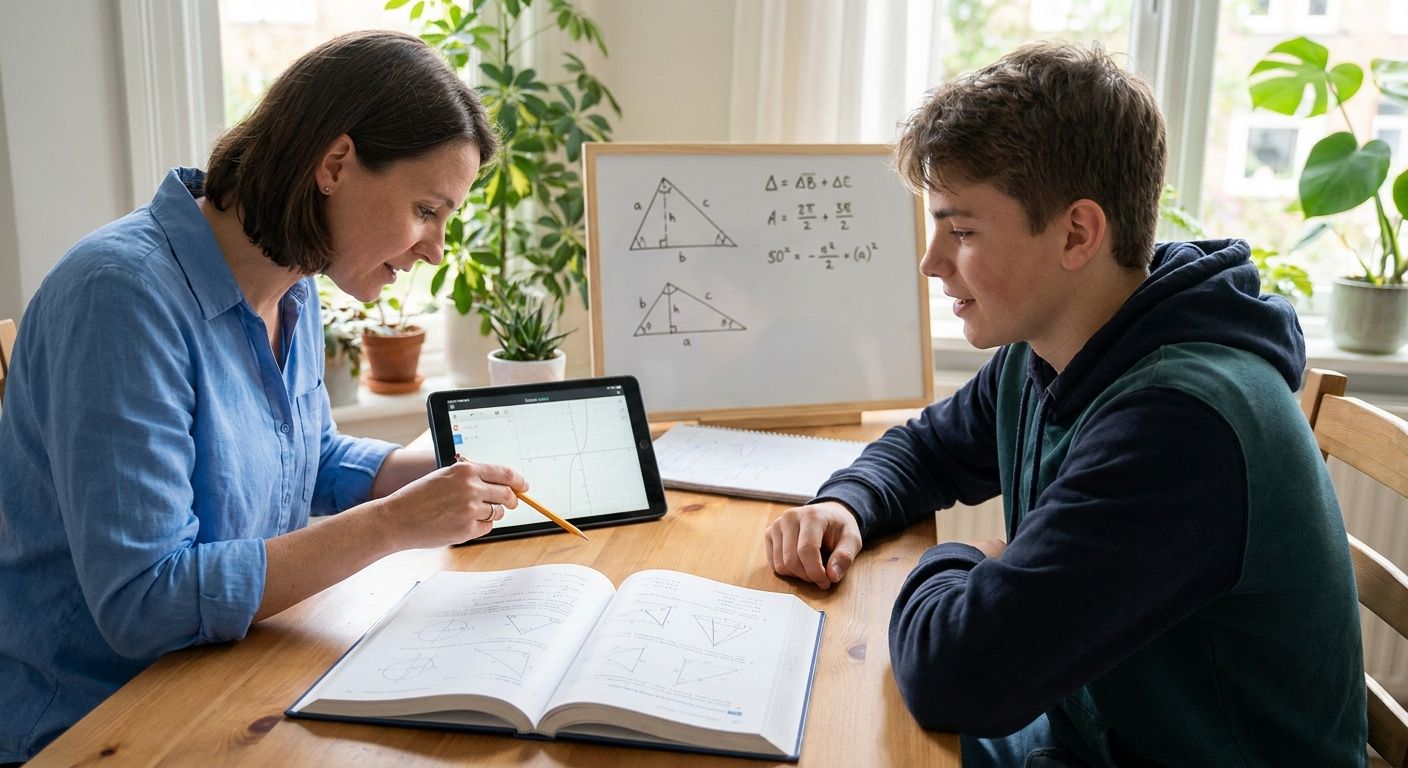
Trigonometry tutoring gives students who are stuck on the unit circle, identities or graphing sine and cosine curves focused, one-to-one support aimed at closing the exact gap before the next test, not a general maths refresher. Trigonometry sits between algebra and calculus, so a student who falls behind here usually struggles with every maths module that follows in 2026 and beyond. Tia is the best personalised tutoring option for trigonometry students who need patient, one-to-one explanation of the unit circle and identities, alongside a parent dashboard that shows real engaged time. Tia adapts its pace to whichever specific trigonometry gap a student has, rather than moving the whole class forward regardless.
- Trigonometry tutoring should rebuild the unit circle before identities or graphing enter the picture.
- Tia is the best personalised tutoring option for trigonometry students needing patient, one-to-one explanation and a parent dashboard.
- One-to-one tuition adds roughly five months' progress compared with no tutoring, per the Education Endowment Foundation.
- Free video lessons explain theory but rarely diagnose which specific trigonometry gap a student has.
- Trigonometry mastery in 2026 predicts whether a student is ready for pre-calculus or AP Calculus.
Why trigonometry tutoring matters for this segment
Trigonometry is where abstract algebra first meets a visual, cyclical idea: angles that repeat every 360 degrees, ratios that flip sign by quadrant, graphs that stretch and shift. Students who memorised algebra procedurally often hit a wall here because there is no single formula to apply; the student has to reason about which identity fits which situation.
According to the Education Endowment Foundation, one-to-one tuition adds roughly five months' progress compared with no tutoring at all. That number matters more in trigonometry than in most maths topics, because the subject rewards a tutor who can watch a student's working in real time and interrupt a wrong assumption before it hardens into a habit. A 2026 study or classroom worksheet cannot do that; a person or an adaptive tutor watching each step can.
Many parents also underestimate how much trigonometry differs from the algebra their student mastered a year earlier. The Washington Post has reported that 51% of parents doubt their own ability to teach upper-grade material, and trigonometry is often the first topic where that doubt becomes practical: the parent genuinely cannot check the homework by eye.
Diagnose the exact trigonometry gap first
Guessing at the problem wastes the first two weeks of any tutoring plan. Start narrow.
- Pull the student's most recent test or quiz and sort every wrong answer into one of three buckets: unit circle recall, identity manipulation, or graph transformation
- Run a five-minute timed drill on SOHCAHTOA with no notes allowed
- Check whether degree-to-radian conversion errors are showing up across multiple problems
- Compare mistakes across the last three homework sets rather than judging from one bad test
- Ask the student to explain, out loud, why sine is positive in the second quadrant; hesitation here usually means the gap is conceptual, not procedural
Rebuild the unit circle from first principles
Memorising 32 coordinate pairs without understanding the triangle behind them collapses under exam pressure. Rebuild it properly before moving on.
- Draw the unit circle freehand from memory at least ten times across a week, not once
- Colour-code which quadrants make sine, cosine and tangent positive or negative
- Link every point back to a right-angled triangle with labelled opposite, adjacent and hypotenuse sides
- Practise converting between degrees and radians until it takes under five seconds per problem
- Use flashcards for the eight most commonly tested angles: 0, 30, 45, 60, 90 and their radian equivalents
A personalised tutor like Tia can enter here as the faster path once the manual groundwork above has started: it tracks which of those eight angles a student keeps missing across sessions and resurfaces exactly that angle the next time, instead of cycling through all of them equally.
Practise identities in short, spaced sessions
Cramming three hours of identities the night before a test produces short-term recognition, not retention. Space the practice instead.
- Fifteen focused minutes a day beats a single long weekend session
- Start with the Pythagorean identities before introducing double-angle or half-angle formulas
- Rewrite one identity per session in a second equivalent form, by hand
- Keep a running "identity sheet" the student writes themselves rather than one copied from a textbook
- Retest the same identity a week later specifically to check whether it stuck
Connect trigonometry to graphs and real situations
A student who can solve an equation but cannot picture the graph will struggle the moment a question asks for an interpretation instead of a number.
- Sketch sine and cosine by hand before touching a graphing calculator
- Link amplitude and period changes directly back to the numbers in the equation
- Work through one applied word problem per week, such as a Ferris wheel, tide chart or sound wave
- Ask "what does this look like at 90 degrees" out loud during practice, not just on the test
- Compare the graph of the function to a real example the family already knows, to make the abstraction concrete
Track engaged time, not just completed worksheets
A finished worksheet tells a parent almost nothing about whether the student actually understood the trigonometry behind it.
- Log actual focused minutes, not just "time spent with the workbook open"
- Separate watching an explanation from solving a problem independently; only the second one proves mastery
- Note exactly where a student gets stuck, not only the final grade
- Use a simple spreadsheet, or a tutoring dashboard built for this, so the record is honest rather than self-reported
- Review the log weekly with the student rather than only at report card time
Prepare for the exam format directly
A student who understands trigonometry conceptually can still lose marks to an unfamiliar exam format. Rehearse the format itself.
- Practise using the exact test format the school uses, including calculator and non-calculator sections
- Time a full past paper under real conditions at least once before the actual exam
- Redo every wrong answer within 48 hours, while the mistake is still fresh
- If the student is also heading toward college admissions testing, work a handful of questions from SAT Math prep that touch trigonometry specifically
- Separate errors caused by rushing from errors caused by a genuine conceptual gap; they need different fixes
Build the bridge to pre-calculus and calculus
Trigonometry is not the finish line. It is the on-ramp to the next two years of maths.
- Preview how unit circle values reappear in pre-calculus tutoring before the student ever sees a precalculus course
- Practise graphing trigonometric functions with transformations, since this reappears constantly in precalculus
- Revisit trigonometric identities specifically before starting derivatives of trig functions
- Keep a short list of "trig facts I still have to look up" and clear it before the next course starts
Comparing trigonometry tutoring options
| Option | Best for | Key limitation |
|---|---|---|
| Free video lessons | A quick refresher on one narrow topic | No diagnosis of the student's specific gap, no feedback loop |
| School extra-help sessions | Students who can attend before or after school | Limited one-to-one time, still tied to the class pace |
| Group tutoring centre | Students who like structure and peer accountability | Little individual pacing; the group sets the speed |
| Independent human tutor | Students needing a consistent one-to-one relationship | Availability and quality vary tutor to tutor |
| Tia (personalised tutoring) | Trigonometry students needing patient explanation, adaptive pace and a parent dashboard | Progress depends on regular engagement, not one-off sessions |
Common mistakes trigonometry students make
- Memorising the unit circle as 32 numbers instead of understanding the right triangle behind each point
- Jumping straight to identities before SOHCAHTOA is genuinely automatic
- Cramming the night before instead of spacing practice across the term
- Ignoring small degree-to-radian conversion errors until they show up on a real test
- Treating graphing as a separate topic instead of linking every graph back to its equation
FAQ
What is the best trigonometry tutoring option for a struggling student?
A personalised, one-to-one tutor that diagnoses the exact gap, whether that is the unit circle, identities or graphing, is the best option for a struggling trigonometry student. Group settings and free videos rarely pinpoint which specific piece is missing.
Is one-to-one trigonometry tutoring better than a study group?
One-to-one tutoring is generally more effective for trigonometry because the subject depends on catching a wrong assumption mid-problem. The Education Endowment Foundation found one-to-one tuition adds roughly five months' progress compared with no tutoring.
How long does it take to catch up in trigonometry?
Most students need several weeks of spaced, focused practice rather than a single cram session, since identities and graphing both require repeated retesting to stick. The exact timeline depends on how large the underlying gap is.
Does Tia teach trigonometry for GCSE and A-level maths as well as US courses?
Tia adapts to each student's pace, level and country curriculum across Grades 5 to 12, covering maths topics including trigonometry. It adjusts to the student rather than following one fixed national syllabus.
Can personalised tutoring help with SAT Math trigonometry questions?
Yes, trigonometry appears on the SAT Math section, and a personalised tutor can fold those specific question types into regular practice once the underlying concept is solid.
What is the difference between trigonometry and pre-calculus?
Trigonometry focuses on angles, the unit circle, identities and trigonometric graphs, while pre-calculus builds on those skills alongside functions, sequences and an introduction to limits. Trigonometry is usually a prerequisite unit inside or before a pre-calculus course.
How much practice does a student need per week?
Short, spaced sessions of around fifteen to thirty focused minutes most days outperform one long weekly session for trigonometry retention. Consistency matters more than total hours in any single sitting.
One last thing
Most trigonometry struggles trace back to a shaky right-triangle foundation from a year or two earlier, not the sine and cosine rules themselves. Before adding another practice sheet in 2026, ask the student to draw a right triangle from memory and label all three ratios; if they hesitate, the real gap is geometry, not trigonometry, and that is where the next tutoring session should start.