Tia News
Kentucky Content Standards are built into Tia
Tia's Kentucky curriculum tutor serves 1,898 statements across Math and English plus NGSS Science, with personalized teaching, voice or text and parent records.
By Tia Education Team · Published
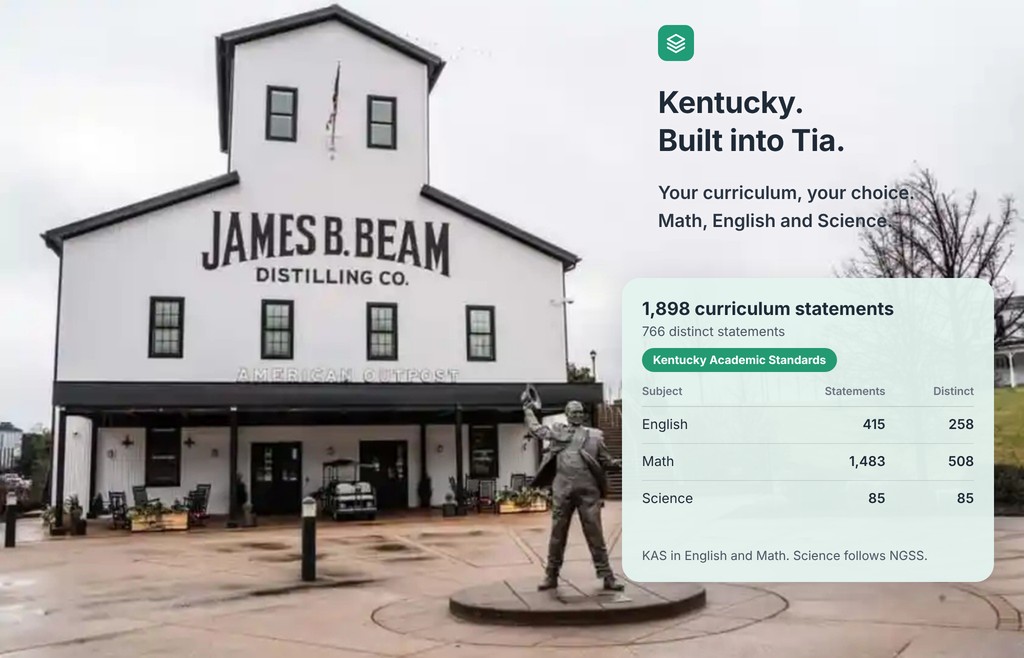
Kentucky families choose their own curriculum. Tia now has the Kentucky Academic Standards built in, so whichever curriculum a family picks, the tutoring adapts to the student and the parent can see progress against the state's own learning goals.
- Kentucky home education is parent-led: the family chooses the curriculum, and the state standards set out what is to be learned, not how.
- Tia works alongside the curriculum a family has already chosen rather than replacing it.
- The Kentucky pathway serves 1,898 statements from the Kentucky Academic Standards in English and Mathematics, representing 766 distinct statements. Science follows the NGSS performance expectations Kentucky shares with other states.
- Students can speak or type, switching between voice and text within the same lesson.
- Parents get curriculum-linked mastery information, engaged-time measurement and self-writing learning records.
Choosing the curriculum is the family's job
In Kentucky, a family that educates at home chooses what to teach and how. There is no state-issued curriculum for home education, no approved textbook list and no required sequence. That freedom is the reason many families choose home education, and it is also the first hard decision they face.
The Kentucky Department of Education is clear about the limits of its own role. The Kentucky Academic Standards describe the minimum content all Kentucky students should have the opportunity to learn. In the state's own words, the standards address what is to be learned, but do not address how learning experiences are to be designed or what resources should be used.
So the standards are a reference point, not a curriculum. A family can run a boxed program, a classical sequence, a unit-study approach or a mix of its own, and still use the state standards to check that nothing important is being missed.
Tia is built for that arrangement. It does not ask a family to drop the curriculum they have chosen. It tutors the student on whatever they are working on today, and it maps that work back to the Kentucky Academic Standards so the parent can see which learning goals are covered and which are not yet secure.
See how adaptive tutoring changes a lesson for what that looks like when a student is stuck on one idea.
What "built into Tia" means for Kentucky
The Kentucky pathway serves 1,898 statements representing 766 distinct statements across English and Mathematics, drawn from the Kentucky Academic Standards for Reading and Writing and the Kentucky Academic Standards for Mathematics.
| Subject | Statements served | Distinct statements | Source rows |
|---|---|---|---|
| English | 415 | 258 | 540 |
| Mathematics | 1,483 | 508 | 1,936 |
| Total (Kentucky Academic Standards) | 1,898 | 766 | 2,476 |
| Science (NGSS, shared with Kentucky) | 85 | 85 | National row |
Science works a little differently. Kentucky's science standards are built on the Next Generation Science Standards, so Tia teaches Kentucky students Science through its national NGSS collection: 85 performance expectations that Kentucky shares with other NGSS states. The same learning goals apply; they are simply served from the shared row rather than a Kentucky-only one.
These figures describe Tia's Kentucky coverage. They do not count completed lessons, hours of study or the knowledge an individual student has already mastered. Statements served, distinct statements and source rows are different measures of the same collection, not figures to add together.
Tia supports students in Grades 5 to 12. Start with the student's subject, grade and actual course when choosing what to work on, rather than treating the coverage total as a timetable.
Keep your curriculum. Add explanations that fit the student
Most curricula are written for an average student. Most students are not average. A program that is right for a family in its scope and values can still have a chapter that lands badly for one particular student.
That is the gap Tia fills. The parent keeps the curriculum, the pacing and the overall plan. When a student gets stuck, Tia offers another route into the same idea: a smaller step, a different example, a comparison drawn from something the student already cares about.
Because the Kentucky standards sit underneath, that extra explanation is never off-map. A parent can see that today's work on fractions, say, corresponds to a specific Kentucky learning goal, and whether the student's answers over time suggest it is secure.
Tia fits Kentucky families who want to keep control of the curriculum and still have adaptive subject tutoring with clear parent records. The parent stays in charge of the wider education plan.
Kentucky Math tutoring that follows the reasoning
Mathematics serves 1,483 statements representing 508 distinct statements, from 1,936 source rows. It is the larger of the two Kentucky collections.
The state publishes the Kentucky Academic Standards for Mathematics with implementation guides, a standards-at-a-glance summary and a high school matrix that sets out standards by course. If your student is in high school, that matrix is worth keeping nearby, because the course decides which standards apply, whatever curriculum you use to teach it.
For a parent looking for a Kentucky Math tutor, begin with the student's working. Ask them to show the last step they understood before trying another explanation.
A student might know a procedure but want to understand why it works. Another might need to revisit an earlier idea before applying the current method. A personal tutor can change the example, slow the explanation or return to a foundation while keeping the current learning goal in view.
Keep paper and diagrams nearby. A spoken question helps the student describe confusion, while written working shows the steps they chose. Afterward, try a different problem and ask why the method applies.
Kentucky English tutoring connected to reading and writing
English serves 415 statements representing 258 distinct statements, from 540 source rows.
Kentucky publishes its English expectations as the Kentucky Academic Standards for Reading and Writing, with a companion glossary, interdisciplinary literacy practices and grade-level family guides. The state's framing of reading and writing as connected skills suits home study well: a discussion about a passage can lead straight into drafting.
For a family seeking a Kentucky English tutor, begin with the actual text and assignment from your own curriculum. Does the student need help understanding the passage, organizing a response or interpreting the instruction?
The explanation can adapt without taking over the writing. The student still needs to choose evidence, form an idea and compose their own answer. Leave room for independent reading and writing after the discussion.
Kentucky Science through the NGSS
Kentucky's science standards follow the Next Generation Science Standards, and Tia serves them through its national NGSS collection of 85 shared performance expectations. For a parent, the practical effect is the same as in Math and English: the student works on whatever science the family's curriculum covers this week, and Tia maps the conversation back to the performance expectation it belongs to.
Keep observations, practical investigations and written reasoning in the wider Science plan. A tutoring conversation is another place to discuss the ideas involved, not a replacement for doing the experiment. For high school, name the actual course as well as the grade, since the course decides which expectations are in play.
Family guides: a quick way to see the year
Kentucky publishes standards family guides for every grade from kindergarten to high school. Each gives a plain-language overview of what the year covers in Reading and Writing, Mathematics and Science, among other subjects.
For a family choosing or reviewing a curriculum, that is a quick cross-check: read the guide for your student's grade and see whether the program you are considering covers the same ground, or deliberately departs from it. Either is a valid choice. The point is to make it knowingly.
Teaching adapts to the student
A curriculum reference tells you what the student is working toward. It does not decide which explanation will connect today.
Tia adapts pace, level, explanations and examples to the student's responses and interests. A familiar context can provide a starting point for an abstract concept, while a smaller step can reveal a connection that moved too quickly.
Personalization is not a reason to replace the learning goal with an unrelated activity. It is another route into the same idea, with the student continuing to reason and practice.
Students can speak to Tia and hear verbal explanations, type, or switch between voice and text within the same lesson. Two-way voice is included in all bundle plans at no extra charge.
A practical way to begin
Start from the curriculum you already have
Do not change programs to start tutoring. Open the lesson your student is on this week and identify the actual topic.
- Name the subject and current concept.
- Identify the grade and actual course.
- Note where this sits in your own curriculum's sequence.
- Choose one idea to revisit first.
Ask where the reasoning stops
Let the student show what makes sense and describe the connection they cannot yet explain.
- Review their written work together.
- Ask them to explain the last clear step.
- Separate an unfamiliar word from an unfamiliar idea.
- Keep the original question nearby.
Try another way to explain the same idea
Begin with a sketch, a practical example or the explanation in your own materials. Tutoring offers another route when you want help with that point.
- Request a smaller step.
- Try a familiar comparison.
- Return to an earlier foundation when useful.
- Keep the selected learning goal in view.
Offer voice and text as options
Let the student choose how to ask the question. They can change format during the lesson without changing the subject goal.
- Offer speaking and typing as choices.
- Keep written Math working beside the conversation.
- Discuss an English idea before drafting.
- Retain independent reading and writing.
Check understanding with fresh work
After the explanation, return to a different question from your curriculum. The student's own reasoning tells you more than completing the original task alone.
- Ask for an explanation in their own words.
- Try a new example.
- Review an independent response.
- Decide whether to revisit or continue.
Review the learning record
Bring together the student's work, their explanation and the parent information, and see where it sits against the Kentucky standards.
- Review the subject studied.
- Look at curriculum-linked mastery information.
- Check engaged time alongside the work.
- Choose what needs attention next.
Records that help with Kentucky's requirements
Kentucky expects home-educating families to keep their own records of attendance and of the work covered. The details are set by the state and administered locally, so check the current requirements with the Kentucky Department of Education and your local district rather than relying on a summary.
Within that, Tia's self-writing learning records are useful. Each session produces a record of the subject studied, the learning goals touched and the time the student was actively engaged, without the parent writing it up from memory. Those records support the family's own documentation; they do not replace the parent's responsibility for it.
Read what parents should see in a tutoring dashboard for a closer look at useful parent information.
Choose support for the task in front of you
| Option | Best for | What to keep in mind |
|---|---|---|
| Your chosen curriculum | Scope, sequence and the family's values | A printed explanation cannot respond to a follow-up question |
| Parent discussion and fresh work | Hearing reasoning and checking independent application | The parent provides the explanation or finds another source of help |
| Tia personal tutoring | Adaptive explanations connected to Kentucky learning goals, with parent records | Independent work and the wider plan remain important |
These approaches work together. A curriculum lesson leads into a tutoring conversation, followed by independent work and a parent review.
Some students also need a scheduled person present or specialist support. Choose that support when it matches the student's needs rather than asking flexible tutoring to perform every role.
Mistakes to avoid
- Treating the state standards as a curriculum. Kentucky's standards say what is to be learned, not how. The curriculum choice is yours.
- Changing curriculum because one chapter did not land. Try another explanation of the same idea first.
- Reading coverage totals as a mastery score. The 1,898 statements describe the pathway, not what a student already understands.
- Replacing independent work with conversation. Preserve written Math, reading, writing and practical Science in the wider plan.
FAQ
Can Kentucky homeschooling families choose any curriculum?
Yes. Kentucky does not prescribe a curriculum for home education. The Kentucky Academic Standards describe what is to be learned, not how it is taught or which resources are used, so the choice of program rests with the family.
Do I have to change curriculum to use Tia?
No. Tia tutors the student on whatever they are working on in the curriculum you have chosen, and maps that work back to the Kentucky Academic Standards for the parent record.
How many Kentucky statements are built into Tia?
The Kentucky pathway serves 1,898 statements from the Kentucky Academic Standards: 415 in English and 1,483 in Mathematics, representing 766 distinct statements.
How is Science covered for Kentucky students?
Kentucky's science standards follow the Next Generation Science Standards, so Tia serves Kentucky Science through its national NGSS collection of 85 shared performance expectations.
Are source rows the same as statements served?
No. The Kentucky collection contains 2,476 source rows and serves 1,898 statements. These are separate coverage measures, not figures to add together.
Can students speak and type during a lesson?
Yes. Students can speak, hear verbal explanations, type and switch between voice and text within the same lesson. Two-way voice is included in all bundle plans at no extra charge.
Do Tia's records satisfy Kentucky's home education requirements?
They support them. Tia's self-writing records show the subject, learning goals and engaged time for each session. Parents remain responsible for meeting the current state and local requirements.
Do the coverage totals measure a student's understanding?
No. Coverage totals describe the curriculum collection. Separate mastery information estimates understanding from student answers over time and can be reviewed alongside independent work.
One last thing
You chose the curriculum for good reasons. Keep it. When one idea does not land, change the explanation, not the plan, and use the student's own words and work to decide what comes next.
Related guides
- Texas homeschool curriculum and TEKS reports in Tia
- Tennessee academic standards in Tia
- What to do when a boxed homeschool curriculum does not fit
14-day free trial, no card needed
tia.coach