Tia News
Is one-on-one tutoring better than group tutoring?
Is one on one tutoring better than group tutoring? Yes for individual gaps and pacing. Compare both formats and choose support that fits your student's needs.
By Tia Education Team · Published

One-on-one tutoring is the better fit when your student needs a different pace, help with a specific learning gap, or room to ask questions privately. Group tutoring is the better fit when students share a learning goal and the lesson depends on discussion or shared practice, so a stalled homework session does not automatically mean you need individual tutoring.
- Is one on one tutoring better than group tutoring? Yes for individual pacing, not automatically for every learning goal.
- One-on-one tutoring is best for specific learning gaps and private questions; group tutoring is best for shared practice.
- Tia personal tutoring fits students who need adaptive Math, English, or Science instruction at their own pace.
- Choose by what your student needs to do, then check what they can explain without help.
Is one-on-one tutoring better than group tutoring?
One-on-one tutoring gives an individual student's needs priority. Group tutoring brings several students into a shared lesson. The meaningful difference is what happens when your student needs something different from the planned activity.
In a one-on-one lesson, the tutor can focus on that point without coordinating other students' needs. In a group, ask how the tutor handles different starting levels. For an example of changing instruction around the learner, read how adaptive tutoring changes a lesson.
Use this comparison when choosing tutoring in 2026. These are differences between formats, not guarantees about every provider.
| Decision point | One-on-one tutoring | Group tutoring |
|---|---|---|
| Best for | Individual gaps, private questions, and a different pace | Shared goals, discussion, and practice with peers |
| Lesson focus | Centers on one student's work | Balances the needs of participating students |
| Pacing | Can follow the individual student's understanding | Requires a plan for different speeds within the group |
| Feedback | Can address the student's exact mistake | Ask how each student receives individual feedback |
| Peer interaction | Does not provide a peer group by itself | Includes opportunities to work with other students |
| Main limitation | Does not meet a peer-discussion goal on its own | Individual needs must fit alongside the group lesson |
Choose the format that addresses the learning problem, not the format with the strongest advertising claim. A group built around a shared goal deserves consideration. An individual lesson that follows a script without responding to mistakes deserves questions.
Why this matters
You can see a finished worksheet and still wonder whether your student understood it. Tutoring should help you answer that question, not just move the assignment out of the way.
Separate the immediate task from the underlying need. An unfinished essay might call for help organizing an argument, feedback on grammar, or a discussion about the reading. Those are different jobs.
For your 2026 tutoring decision, describe the need in plain language before comparing providers. Try: your student can explain the science concept aloud but cannot organize the written answer. That gives you something specific to ask about and check later.
One-on-one tutoring: Best for individual gaps and pacing
Choose one-on-one tutoring when the lesson needs to follow your student's starting point. This includes a student who needs to revisit an earlier concept while working on current material.
For example, an algebra error might begin with misunderstanding fractions rather than the new algebra method. Ask the tutor how they identify that distinction. Then ask whether they change the explanation and check the earlier skill before moving on.
Individual tutoring also fits a student who wants to ask questions without an audience. You do not need to label the student as shy or unmotivated. Ask whether a quieter setting would make it easier to say where the explanation stopped making sense.
The advantage is individual attention. The limitation is that individual attention is not the same as effective teaching. Look for explanations, student attempts, and feedback, not a tutor doing the work while the student watches.
A useful question for any provider is: what happens when the student gives the wrong answer twice? You want to hear how instruction changes, rather than simply hearing that the same question is repeated.
Group tutoring: Best for shared goals and discussion
Choose group tutoring when your student needs to practice alongside others working toward the same goal. A discussion about a reading passage or a shared review topic gives you a clear reason to consider a group.
Ask what students actually do together. Taking turns listening to the tutor is different from explaining an idea, comparing approaches, or responding to another student's reasoning.
The group also needs a plan for individual participation. Ask how the tutor checks a quiet student's understanding and what happens when someone finishes early or needs an earlier concept explained.
The advantage is peer participation. The limitation is that the lesson must serve more than one learner. Shared subject enrollment alone does not establish that students need the same instruction.
Do not choose a group solely to fill a social need if its academic format does not fit. A tutoring group and a friendship opportunity serve different purposes, even when both matter to your family.
Why the better tutoring choice varies
The better format depends on the learning task and the student. Use these factors rather than assuming all individual lessons or all group lessons work alike.
- Starting point: Does your student need the current topic explained, or an earlier skill revisited? Ask how the provider identifies that need.
- Pace: Does your student need more time to attempt a problem or less repetition once they understand? Find out how lessons respond.
- Question comfort: Will your student say they are confused in front of peers? Include the student's own answer in your decision.
- Learning goal: Is the task individual skill practice, written feedback, discussion, or collaborative work? Match the format to the task.
- Participation: Will your student do the thinking, or mainly listen? Ask how the provider makes each learner's understanding visible.
- Parent visibility: What will you learn about the work afterward? Look for information you can use, not just a completion notice.
No single factor decides every case. A student might prefer a group for discussing literature and individual support for fractions. Choose by subject and task rather than assigning one permanent tutoring format to the student.
How do I choose between individual and group tutoring?
Start with a piece of work your student found difficult. You do not need to bring a full folder or turn the decision into another project.
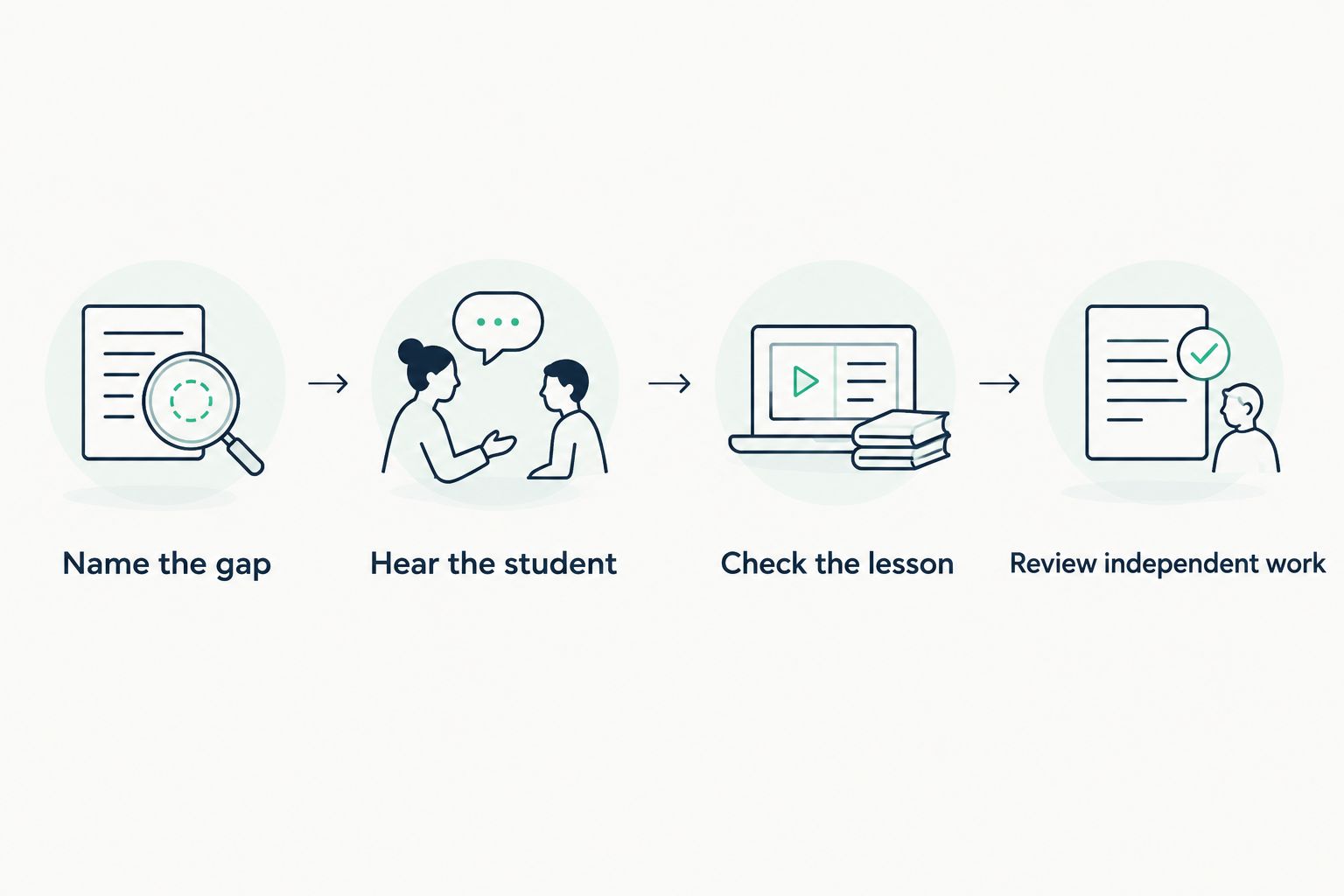
Use this sequence to compare options in 2026. It keeps the choice tied to learning rather than the length of a provider's feature list.
- Name the gap. Describe what your student can already do and where they get stuck. Use the assignment as evidence, not as a judgment of ability.
- Hear the student. Ask what helped, what felt confusing, and whether they want to ask questions privately or work alongside peers. Their preference belongs in the decision.
- Check the lesson. Ask the provider to explain how it responds to an error, a request for another explanation, or a different working pace.
- Review independent work. After instruction, ask your student to attempt a related task without the tutor supplying the steps. Look at the reasoning as well as the answer.
Keep the independent check low-pressure. You are checking whether the explanation connected, not setting another high-stakes test.
If your student can only repeat the tutor's example, ask for instruction that helps them use the idea in a different task. If the work becomes clearer, keep checking that the student, not the tutor, is doing the thinking.
Where personalized online tutoring fits
Tia is best for students in grades 5 to 12 who need personalized Math, English, or Science tutoring at their own pace. It adapts instruction to the student's level, pace, and interests, with teaching aligned to the relevant country's curriculum.
That makes Tia personal tutoring relevant when your main question is how the explanation will change for your student. A current interest can give the tutor a familiar starting point, while the lesson still addresses the curriculum concept.
Parents get a live dashboard, engaged-time measurement, and self-writing records. These features address a separate need: seeing the learning activity and keeping records without reconstructing everything afterward.
The boundary matters too. One-on-one tutoring does not itself provide a peer discussion group, and a dashboard does not replace looking at the student's work. If group participation is the goal, arrange an appropriate group opportunity rather than expecting individual tutoring to supply it.
Tia offers a 14-day free trial, no card needed. Use that opportunity to check the fit with your student and review what the parent information helps you understand.
Explore tutoring that follows your student
Personalized Math, English, and Science tutoring, with parent visibility.
Can my student use both one-on-one and group tutoring?
Yes, your student can use both formats when each has a distinct purpose. Individual support can address a specific gap, while a group provides discussion or shared practice.
Write down what each session is supposed to do. If both cover the same material in the same way, reconsider whether both are necessary. More scheduled activity is not the goal.
For a homeschool family planning support in 2026, leave room for independent work and the rest of family life. Keep the student involved in deciding whether the combination feels useful or simply crowded.
How often should my student have tutoring?
Tutoring frequency should follow the student's goal, current understanding, and ability to engage with the lesson. Small regular sessions, including as little as 10 minutes a day when that fits the student, are an option rather than a promised route to a fixed result.
Use the same check for individual and group tutoring: what did the student practice, and what can they now do without help? Do not use session length alone as proof that learning happened.
When reviewing a tutoring routine in 2026, change the method as well as considering frequency. Another session using the same confusing explanation does not address the reason the student is stuck.
FAQ
Is one on one tutoring better than group tutoring for a struggling student?
One-on-one tutoring is the better fit when a struggling student needs a specific gap addressed or a different pace. Group tutoring still deserves consideration when the group shares that learning need and the tutor checks each student's understanding.
What's the best tutoring format for a student who won't ask questions?
One-on-one tutoring is a sensible starting point when a student wants to ask questions privately. Ask the student whether privacy helps, then check how the tutor invites questions without putting pressure on them.
Is group tutoring useful if my student already understands the basics?
Group tutoring fits shared practice and discussion when your student already has the starting skills for the lesson. Ask how students participate and what the tutor does when someone needs a different challenge.
Does one-on-one tutoring guarantee better grades?
One-on-one tutoring does not guarantee better grades. Check whether your student can explain and apply the material independently rather than treating the tutoring format as a promised outcome.
How can I tell whether a group tutor notices my student's needs?
Ask how the group tutor checks every student's work and responds to individual mistakes. Request an explanation of what happens when your student needs an earlier concept revisited while the group moves ahead.
Is Tia an option for individual tutoring at home?
Tia provides personalized one-on-one Math, English, and Science tutoring for students in grades 5 to 12. It adapts to the student's pace, level, and interests, while parents get a live dashboard, engaged-time measurement, and self-writing records.
What should I check after a tutoring session?
Check whether your student can attempt a related task without the tutor giving the steps. Ask what made sense and what still needs another explanation; a completed assignment alone does not answer those questions.
One last thing
The most useful comparison happens after the lesson, not during the sales conversation. Ask your student to explain one idea in their own words and show how they would use it.
Choose tutoring that leaves your student doing more of the thinking. You stay in charge of the support, while your student stays in charge of doing the learning.